
Your group study is not going to publish before ERAS opens. That is the blunt truth most applicants refuse to accept until it is too late. If the full manuscript is still bouncing between co-authors, stuck in endless statistical revisions, or waiting on a senior author who "will look at it next week," you are already behind. This timeline guide walks you through exactly what to do, month by month, week by week, so the project still strengthens your application instead of becoming a dead weight.
The Reality Check: Assessing Your Group Study Status
At this point you must perform a brutal audit of your group study's progress. Open the shared drive, check the last edit date on the manuscript, and count how many co-authors still owe comments. If that file is not already in the hands of a peer reviewer at a real journal, it will not be published by the time ERAS transmits. Period. I've watched too many students cling to the fantasy of a last-minute acceptance letter that never arrives. Stop.
You should immediately shift your focus from "trying to finish the paper" to "maximizing what you have." A completed abstract or a poster presentation carries more weight in the ERAS system than a lonely "Submitted" line with zero DOI and zero proof. Program directors see "Submitted" every day; most of them assume it means "we never finished it." A clean abstract PDF, on the other hand, proves you did the work, analyzed the data, and can speak to methods and findings.
Stop spending hours on data analysis for a project that has no realistic shot at completion this cycle. That time belongs to Step 2 CK prep and the personal statement drafts that still need three more rounds of ruthless editing. Redirect the energy now. Pull the latest figures, lock the sample size, and freeze the analysis. Anything beyond that is sunk-cost fallacy dressed up as diligence.
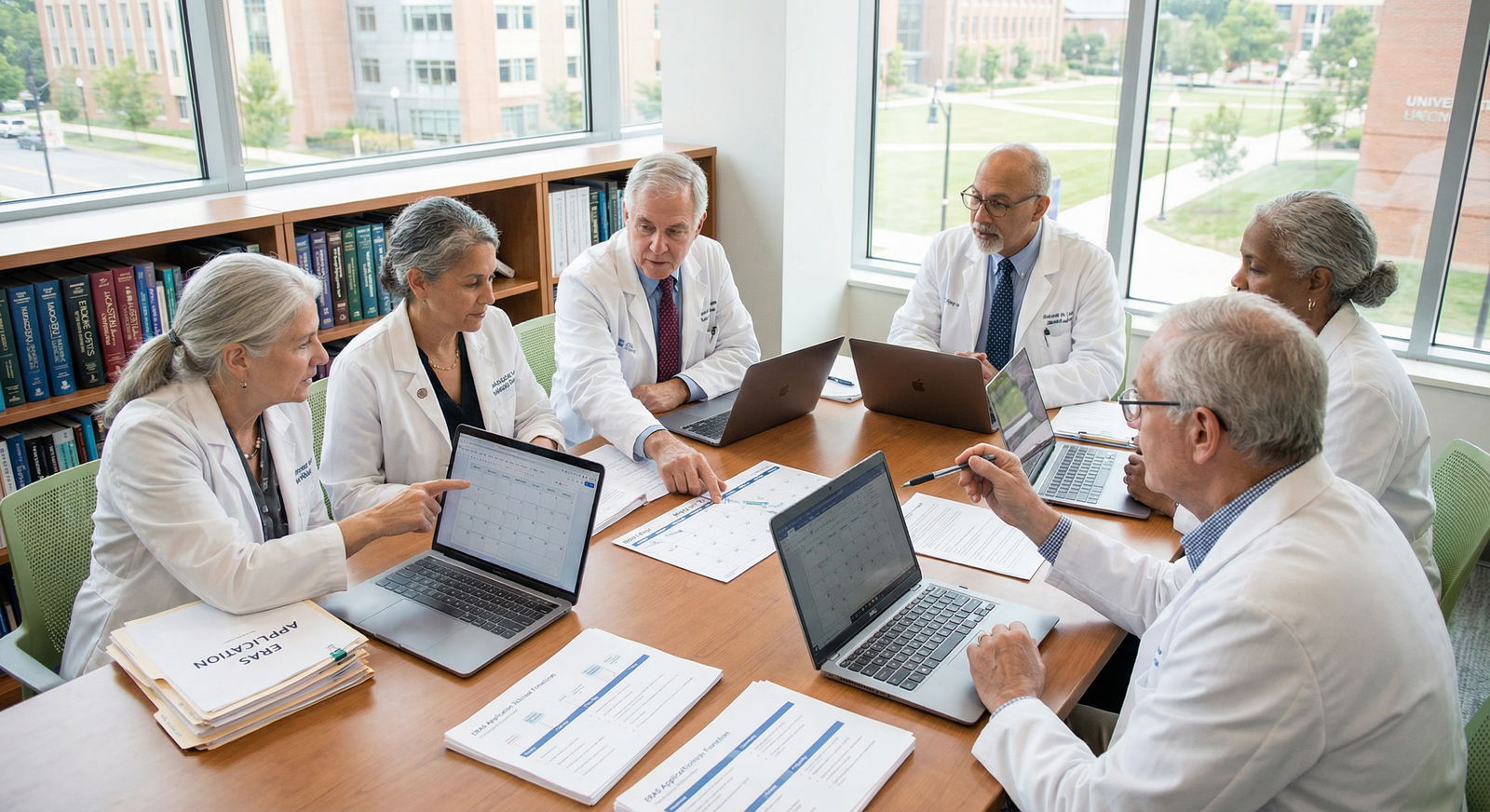
The Plan B Phase: Abstracts and Posters (2 Months Out)
At this point you should have stopped writing the manuscript. Your new goal is simple: get an abstract accepted at a legitimate conference so you have something tangible to list and discuss. Target AAMC, SGIM, specialty society regional meetings, or even well-regarded state chapter events. The prestige ladder matters less than having a confirmed presentation slot before interview season.
You must identify one contact person inside the research group, ideally the junior faculty or the research coordinator who actually answers emails, and hand them the submission logistics. Your job is applications; their job is conference portals. Put the hand-off in writing: "I will send the final abstract draft by Friday; you submit to X and Y by the following Wednesday." No group chats. No vague "we should submit soon."
By this week you should have a draft abstract ready. Keep it tight: background, methods, results (even if preliminary), and one clear conclusion. Submit that same abstract to at least two different conferences. Rejection rates are real; dual submission gives you a backup. Once you receive the acceptance email, screenshot it and save the PDF. That single file becomes your proof of productivity.
Look at the numbers. Published manuscripts sit at the top, no surprise. But a poster presentation still clears the "In Progress" bar by a wide margin. That gap is why Plan B exists.
The ERAS Deadline Phase: Submission Strategy (1 Month Out)
At this point you must enter the research into ERAS exactly as it stands. If there is no acceptance letter and no DOI, you list the project as "In Progress" and give a realistic projected completion date, usually six to nine months out. Do not invent a "Submitted" status unless you can produce the journal's confirmation email with a tracking number. Fake statuses get spotted in interviews and destroy credibility faster than a blank research section.
You should attach your abstract PDF directly in the ERAS research entry. Most applicants forget this is even possible. The upload proves you finished something concrete and lets a curious program director open the file during file review. Pair it with a one-sentence description of your specific role: "Designed data collection instrument, performed primary statistical analysis, drafted abstract."
By this week your research section must be locked. No more tinkering. A clean "In Progress" entry backed by an abstract beats an empty slot every single time. Empty signals you never tried; "In Progress" plus proof signals you are still grinding, an attitude residencies actually like.
Follow the chart. Binary decisions keep you from second-guessing at 1 a.m. the night before the deadline.
The Interview Phase: Leveraging Your Work (Post-ERAS)
At this point you are interviewing. You must be ready to discuss the group study in detail even though it never saw print. Interviewers will ask. They always ask. If you freeze or mumble "it was a group thing," you just wasted the entry.
You should prepare a two-minute elevator pitch that covers three things only: your exact role, the core methodology, and the key finding sitting in that abstract. Practice it out loud until it sounds conversational, not rehearsed. End with one honest sentence about next steps, "We are finalizing the full manuscript for submission this spring", so you control the narrative.
By this week print physical copies of the poster or the abstract handout. Slide one into every interview folder. When the conversation turns to research, place it on the table. The paper copy becomes a prop that keeps the discussion concrete and reminds the interviewer you showed up prepared. I've seen candidates land second-look invitations simply because they had the handout ready while everyone else waved vaguely at "that project we did."
Key Takeaways
- A published paper is ideal, but a completed abstract or poster is a valid, high-value alternative for ERAS.
- Do not list a project as "Submitted" unless you hold a DOI or a confirmed publication date from the journal.
- Always list unfinished work as "In Progress," attach the abstract PDF, and own your specific contribution in one clear sentence.
Action Steps, Do These in Order
- Tonight: open the manuscript file, freeze the data, and extract the abstract draft.
- This week: identify the group's logistics person and lock two conference targets.
- Next 14 days: submit the abstract, save every confirmation email, and upload the PDF into a ready-to-go ERAS entry.
- One month out: finalize the research section as "In Progress" with projected date and walk away.
- Interview season: rehearse the two-minute pitch daily and carry printed handouts to every single interview.
Your group study did not publish on time. That is inconvenient, not fatal. Execute the timeline above and the work still counts.