
It’s 10:47 p.m. You’ve got your interview suit hanging on the closet door, your STAR stories half-memorized, and your ERAS application open on your screen. Your eyes keep locking on that research section.
You’re staring at the title of your project. It looks impressive. It sounds impressive. But if someone actually said, “So can you walk me through your study design and findings?” your brain would absolutely blue-screen.
Your thoughts go something like:
“Okay, we… collected data. On… patients. And there was a p-value. And we used… R? Or was that the biostatistician? Oh my god, I have no idea what a Cox model actually does. They’re going to ask. They’re going to know. I’m cooked.”
Let me say the quiet part out loud: you’re scared your own CV is a trap that’ll expose you as a fraud in front of an attending you might be working under next year.
You’re not alone. At all.
The Fear You Won’t Say Out Loud: “Did I Basically Lie?”
Let me be blunt: this fear is extremely common. I don’t care if people pretend not to talk about it.
You did some summer research. Or you joined a big lab. Or your school pushes research hard for “competitiveness,” so you jumped into a project because saying no felt like career suicide.
Fast forward a year:
- You did a specific slice of the work (chart review, data entry, helping write one subsection).
- The paper has a huge title full of buzzwords and stats you don’t fully grasp.
- Your name is on it. You put it on ERAS. Because of course you did.
And now you’re thinking:
- “What if they quiz me on the methods and I blank?”
- “What if they ask me about some detail I honestly don’t remember anymore?”
- “What if they realize I basically just collected data and nodded along in lab meetings?”
- “What if they think I lied or inflated my role?”
Here’s the reality: what will actually get you in trouble isn’t “I only did part of this and had help understanding the rest.”
What’ll kill you is:
- Acting like you understand things you obviously don’t.
- Pretending you had a bigger role than you did.
- Freezing and panicking instead of calmly owning your piece and your limits.
The bar is not “know everything about the project like a PI.”
The bar is “can talk honestly, coherently, and specifically about what you did and at least broadly about what the project was trying to answer.”
What Interviewers Really Do With Your Research Section
Let me shatter one myth straight away: most interviewers are not sitting there trying to grill you like a PhD defense.
Most common research questions sound like:
- “Tell me about one project that was meaningful to you.”
- “How did you get involved in this work?”
- “What was your role in this study?”
- “What did you learn from doing research?”
- “Would you want to keep doing research in residency?”
Occasionally, if they’re in your field or actually know the topic, you’ll get:
- “Ah, I saw you worked on [topic]. That’s an area I’m interested in. What were your main findings?”
- “How did you define your primary outcome?”
- “How did you handle [X confounder]?”
That last bucket is the one that’s currently making your stomach hurt, right?
Here’s the uncomfortable truth: they can tell within about 15–30 seconds if:
- You actually touched the data or manuscript at all, vs.
- You just “helped” in a vague way and slapped your name on it.
They’re not always judging the amount of contribution as hard as you think. They’re judging:
- Can you clearly explain what you did?
- Are you honest about your level of involvement?
- Can you admit what you don’t know without crumbling?
They’ve seen:
- The person who calls themselves “first author” and can’t explain what a confidence interval is.
- The person who’s 8th author but gives a crystal-clear explanation of the study question and their role in chart abstraction.
Guess which one looks better? Spoiler: it’s not the one flexing with “first author” and vibes.
How Bad Is It If You Don’t Remember Everything?
Let’s quantify this a bit.
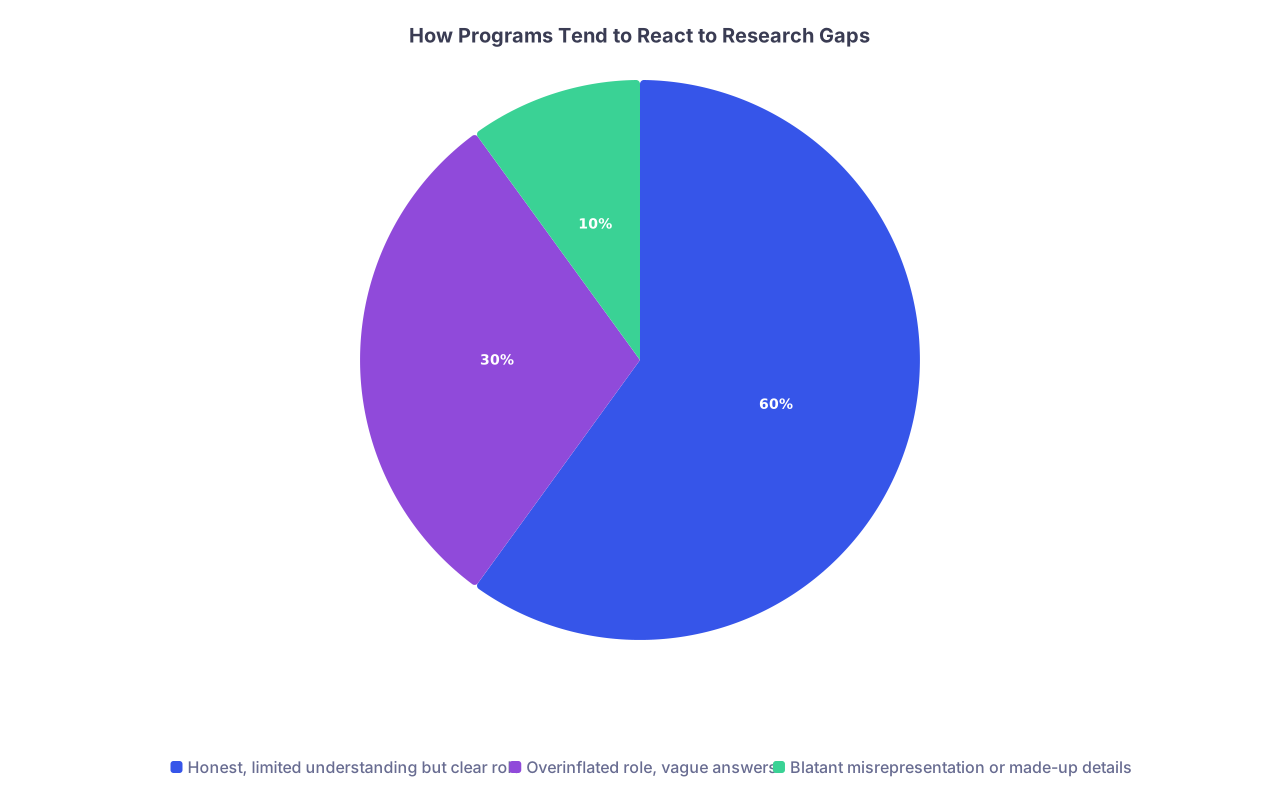
| Category | Value |
|---|---|
| Honest, limited understanding but clear role | 60 |
| Overinflated role, vague answers | 30 |
| Blatant misrepresentation or made-up details | 10 |
From people I’ve talked to and what I’ve watched happen:
- If you’re honest with limited depth but can clearly say what you did and roughly what the project showed → most interviewers shrug and move on. They’ve seen it a thousand times.
- If you inflate your role and then stumble on basic questions → that’s when eyebrows go up.
- If it looks like you basically fabricated involvement or are bullshitting your way through details → that’s when you move into “concern” territory.
You don’t need perfect recall. You need:
- Coherent understanding of the big picture
- Accurate explanation of your role
- A non-panicked way to say “I don’t know” to deep-dive questions
That’s it. Sounds simple. It’s not, when you’re anxious. But it’s doable.
Fixing the Mess: Re-Learning Your Own Project (Efficiently)
Okay, here’s where you actually do something about this. You don’t need to become your PI. You do need to “re-learn” your project like you’re cramming for an oral exam.
Step 1: Pull Every Version You Can Find
Tonight, gather:
- The final manuscript or abstract (published, submitted, or draft)
- Your old emails/slides/poster
- Any protocol or IRB submission you have access to
Print or PDF it. Yes, like you’re that old attending who prints everything.
Step 2: Answer 7 Non-Negotiable Questions About Each Project
For every research item you listed on ERAS, you should be able to answer, out loud, without looking:
- What was the general research question? (One sentence. No jargon.)
- Why did anyone care about this question clinically or scientifically?
- What kind of study was it? (Retrospective cohort, RCT, survey, etc.)
- Roughly how many subjects / data points were included?
- What exactly did you do personally? (Concrete verbs: abstracted 200 charts, ran X analysis, wrote Y section, designed survey, etc.)
- What were the key 1–2 findings?
- How do those findings matter in real life? (Guidelines, practice patterns, understanding disease, whatever.)
If you can’t answer one of those, that’s your homework.
Don’t memorize lines. Just make sure you actually understand the answers.
Step 3: Script a 30–45 Second “Project Pitch”
Pick your most meaningful project. You need a short, conversational explanation ready. Something like:
“I worked on a retrospective cohort study looking at outcomes in patients admitted with decompensated heart failure who had limited English proficiency. The big question was whether language barriers were associated with differences in readmission rates.
My role was primarily data collection and cleaning—I reviewed about 250 charts and worked with the team to define our variables. We ended up finding that after adjusting for comorbidities and insurance status, language itself wasn’t as big a driver as we expected, but follow-up access and discharge instructions were. It was my first real exposure to how messy real-world data is and how much thought goes into defining outcomes.”
That’s the level of detail that makes you look involved and honest without pretending you solo-wrote NEJM.
Write yours down. Say it out loud. Fix the parts that sound robotic.
What If They Ask Something You Truly Don’t Know?
This is the nightmare scenario in your head:
Interviewer: “So why did you use a Cox proportional hazards model instead of a logistic regression?”
You: internal screaming, external word salad
Here’s how you handle this without tanking yourself.
You need a “template” response that:
- Acknowledges the question
- Owns your role honestly
- Shows curiosity instead of panic
For example:
“That’s a great question. I didn’t actually lead the statistical analysis for this project—that was our biostatistician and PI. My understanding is that we chose a Cox model because we were specifically interested in time-to-event data and wanted to account for differing follow-up times. But I’d be overstepping if I pretended I picked or ran that model myself.”
Or if you remember nothing about that specific detail:
“I’m actually blanking on the reasoning for that specific choice—we worked closely with our biostatistician on the analysis plan. My role was mainly on the data collection and initial cleaning side, plus helping interpret the results for the manuscript.”
You’re not going to get blacklisted for that answer. If anything, you come across way better than the person who tries to fake an explanation and spirals.
The line you never want to cross: confidently saying things that are wrong and obviously outside your described role.
“But I Literally Just Did Data Entry. Is That Even Defensible?”
Yeah, it can be. If you’re honest about it and you frame it right.
You don’t need to turn “I did chart review” into “I designed and led a multicenter trial.” That’s how people look ridiculous.
You do need to show that:
- You understand why the data you collected mattered.
- You learned something from the process.
- You didn’t just mindlessly type numbers into RedCap for 6 weeks.
Something like:
“For this project I was primarily responsible for chart review and data abstraction. I went through about 180 patient records looking for pre-specified variables like XYZ. It taught me a lot about how inconsistent documentation can be and how hard it is to translate real clinical notes into clean variables. It also forced me to think more carefully about how we define outcomes—in a way I honestly hadn’t appreciated as a student just reading finished papers.”
That’s a solid, defensible answer. Nobody’s going to attack you for not being the PI. You were a student. You were a cog. That’s normal.
When You Should Actually Be Worried
This is where I’m not going to sugarcoat it.
You need to be more careful if:
You listed yourself as “first author” but:
- You can’t explain the core question.
- You barely remember the design.
- You weren’t actually driving the writing or analysis.
You described your role with verbs like “designed,” “analyzed,” “led,” but:
- In reality, you mostly followed directions and did background stuff.
You padded multiple projects where you:
- Helped for a week or two,
- Went to 2 meetings,
- Did one small task,
- Then ghosted, but still claimed substantial contribution.
Those are the situations where careful questions can expose inconsistencies fast.
If this is you, you don’t need to panic—but you do need to course-correct now.
What You Can Do About That (Yes, This Late)
Recalibrate your own story in your head.
If you wrote “led” but you didn’t, don’t double down in the interview. Don’t lie again to defend a previous exaggeration. Focus on accurately describing your role out loud: “I helped with…” “I contributed to…”Know which projects you’ll actually talk about.
Lean hard on the one or two where your involvement was most genuine. Steer answers toward those when they say “Tell me about a research experience.”Prepare a sane explanation for apparent inconsistencies.
If someone really pushes—rare, but possible—you can say:“Looking back, I probably overstated my role with that one. I was excited to be part of the team, but my contribution was mainly X and Y, not the whole project.”
Owning that calmly is far better than trying to keep the exaggeration afloat under pressure.
How Much Research Depth Do Programs Actually Expect?
You’re imagining they want:
- Deep mechanistic insight
- Near-PI level understanding
- Ability to defend every choice like dissertation committee
They actually want:
- Evidence you can commit to something long enough to produce a product
- A sign you can think about problems systematically
- Proof you’re not just chasing lines on a CV; you got something out of it
They know:
- Med students are not statisticians
- Projects are often student-on-rails under a PI
- A lot of “authorship” is politically distributed
The red flag isn’t “limited understanding.”
The red flag is “dishonest or delusional about what you did and what you learned.”
A Quick Self-Check Before Interviews
Here’s a fast sanity table you can use tonight. Be brutally honest.
| Item | Yes/No |
|---|---|
| Can I explain the main question for each project in 1 sentence? | |
| Can I describe my *exact* role with concrete verbs? | |
| Do I know at least the study type for each project? | |
| Can I explain at least 1–2 key findings for my main project? | |
| Do I have a 30–45 second “go-to” project pitch? |
If you’ve got mostly “No” right now, that’s not a character flaw. That’s just a to-do list.
And yes, you can fix it this close to interviews.
The One Thing You Can’t Do: Hope It Won’t Come Up
You can’t control:
- Which interviewer you get
- Whether they care about research
- Whether they ask follow-up questions
You can control:
- Whether you go in having re-learned your own CV
- Whether you’ve practiced saying “I don’t know” without crumbling
- Whether your story about each project is honest and specific
Here’s the harsh truth: research will probably come up somewhere. Even in community programs. Even in prelim spots. Someone will glance at your ERAS and say, “Oh, you did research. Tell me about that.”
Avoidance is just borrowing more anxiety from the future.
Face it now when you can still prepare.
Do this today: open your ERAS, pick one research entry, and write a 5–6 sentence spoken explanation of it—what the project asked, what kind of study it was, what you personally did, and what you found. Then actually say it out loud once. Not in your head. Out loud.
If you stumble, good. Now you know exactly where to shore things up before you’re sitting in front of a PD.