
What if the PD opens my ERAS, sees my “research,” realizes nothing is actually published, and instantly decides I’m padding my CV and can’t be trusted?
Yeah. That one.
Let’s talk about the exact thing most of us are low‑key terrified of: you have research, but it’s messy. Unpublished projects. Posters that never turned into papers. A “manuscript in progress” that has been “in progress” since M2. And now ERAS is asking about scholarly activity like you’re supposed to be a mini‑NIH‑funded scientist.
And you’re sitting there wondering:
“If my study was never published, should I even list it? Or is that going to make me look like a liar, a failure, or both?”
Let me be direct: yes, you can and usually should list legitimate unpublished research on ERAS.
But—and this is the part that makes my stomach knot—it depends completely on how you list it and how honest you are about its status.
Let’s go through the fears one by one and untangle this.
First: Are Programs Going To Think I’m Lying If Nothing Is Published?
Here’s the nightmare version in my head:
Program Director at Big Name IM Program opens ERAS.
Sees my “Research Experience” section.
Notices I have “manuscript in preparation,” “data collection ongoing,” “submitted for publication.”
Goes: “Wow, this applicant is trying to inflate their application. Trash.”
Reality? Less dramatic. And honestly, more boring.
Here’s what I’ve actually seen and heard:
- Tons of applicants list unpublished work. Seriously, most of your classmates are doing it.
- PDs know that most med student projects don’t end up published. They’ve supervised these projects. They know exactly how many die in IRB purgatory or under a pile of new rotations.
- The red flag isn’t “unpublished.”
The red flag is dishonesty or exaggeration.
If you call something “Published” and it’s not? Bad.
If you call something “Accepted” and it’s actually just “we’re hoping to submit soon”? Very bad.
If you clearly label it as “Unpublished work” / “Manuscript in preparation” / “Data collection ongoing”? Totally fine.
So the key question isn’t “Published or not?”
It’s “Is this real, and am I describing it honestly?”
What Counts As “Real” Enough To List?
This is the anxiety trap: “Do I actually have enough to justify mentioning this? Or am I being cringe and desperate?”
Quick gut‑check: if you actually did work that someone could reasonably verify (PI, lab, department, IRB, abstract, poster, etc.), it usually belongs on ERAS in some form.
Here’s a rough breakdown.
| Type of Work | Usually List It? | How to Frame It |
|---|---|---|
| Completed project, no submission | Yes | Research experience |
| Data collected, analysis ongoing | Yes | Research experience |
| IRB-approved, then stalled early | Usually yes | Research experience (small) |
| Just “idea discussions,” no work | No | Don’t list |
| Ghostwritten or barely involved | Risky | Only if your role was real |
If the only thing that happened was:
You had 2 Zoom calls where the attending said “That would be a cool project” and then nothing ever started? Don’t list that. That’s not research. That’s a conversation.
If you:
- Helped design the protocol
- Wrote parts of the IRB
- Did chart reviews
- Helped collect data
- Helped clean data or run stats
- Drafted a section of a manuscript
- Presented it as a poster somewhere
Then it’s research experience, whether or not the final paper exists.
ERAS Structure: Where Do I Put Unpublished Stuff?
ERAS separates two things:
- Experiences (where you can list “Research” as a role)
- Publications/Presentations (where you list specific outputs)
This is where a lot of the anxiety comes from. You’re thinking:
“If I list a research experience and don’t have a nice clean PubMed citation, will I look weak?”
No. Not if you’re honest and specific.
1. In the Experiences Section
Here’s where you can absolutely list:
- Research assistant / student researcher roles
- Longitudinal projects
- Clinical research electives
In the description, write clearly:
- Project title or topic
- Your role (what you actually did)
- Status of the project
Example of honest wording (and yes, this is the tone you want):
Retrospective chart review of patients with heart failure with preserved ejection fraction (HFpEF) at [Institution]. Contributed to data extraction from EMR, variable definition, and initial data cleaning. Assisted with drafting Methods section for planned manuscript. Data analysis is ongoing; no manuscript submitted yet.
That “no manuscript submitted yet” feels like a punch to the gut, but it’s the right move. Clear. Boring. Honest.
2. In the Publications/Presentations Section
This is where you do not lie. Ever.
If you have:
- Posters only → list as Poster
- Oral presentations → list as Presentation
- Nothing presented yet → DO NOT list it as “in press,” “submitted,” or “accepted” when it’s not
You can list:
- “Manuscript in preparation” if there’s an actual draft in progress
- “Manuscript submitted” only if it’s truly submitted to a real journal
- “Accepted” only when you literally have acceptance
If your study never got that far, it just lives under Experiences as research. That’s fine. That’s normal.
“But Won’t I Look Weak Next To People With Ten Publications?”
Let’s just say it: comparing your CV to the MD/PhD with 12 first‑author papers is psychological self‑harm.
Here’s how program directors actually view this stuff (yes, across specialties it varies, but some patterns are pretty stable):
- Community programs: happy if you have any legitimate exposure to research. Even more so if it’s at their hospital.
- Mid‑tier academic programs: like to see you’ve engaged with research, don’t expect you to be a machine. One or two decent projects = plenty.
- Top heavy‑research programs (think MGH, Hopkins, UCSF): yeah, they care more. But even then, quality and honesty beat fake volume.
And most applicants are not what you think they are. A lot of people with “10 items” on ERAS:
- 7 are posters
- 1 is a case report
- 1 is a middle‑author paper
- 1 is an actual solid first‑author article
It feels like everyone else is a research god. They’re not.
You know what programs really care about?
- Did you stick with a project long enough to actually learn something from it?
- Can you explain your role and the project intelligently if they ask?
- Are you honest, reliable, and not inflating things?
I’ve seen applicants with zero publications but 1–2 real, well‑explained research experiences do absolutely fine. Even in competitive specialties. Because their story made sense and they weren’t pretending.
Worst-Case Scenarios (And What Actually Happens)
Let’s go straight at the fears.
Fear #1: “They’ll ask about the project and realize nothing ever happened.”
What actually happens:
Interviewer: “I see you worked on a HFpEF chart review. What came of that?”
You: “We ran into some challenges with missing data and PI bandwidth. We got through cleaning the dataset and started preliminary analysis, but it didn’t reach manuscript submission by the time I applied. I still learned a lot about study design, EMR data, and the limitations of retrospective work.”
Is that ideal? No.
Is that honest, mature, and acceptable? Yes.
Fear #2: “They’ll think I’m incompetent because it never got published.”
They might think your mentor was slow, or the project was overambitious, or that this is just how med student research goes. Because it is.
What they will actually judge you on is:
- Whether you take ownership without throwing everyone else under the bus
- Whether you can clearly describe what you did and what went wrong
- Whether you sound like someone who learned and won’t disappear on future projects
Fear #3: “What if they try to look up my ‘submitted manuscript’ and don’t find it?”
If you lie like that and they catch you, you’re done.
Not just “we’re not ranking this person.” More like “this is a professionalism issue.”
That’s why the answer is always: list it, but label it accurately. If it’s not submitted, don’t say it is.
How To Phrase Unpublished Work Without Sounding Like You’re Making Excuses
This is where wording matters. You want straightforward, restrained language. No fluff.
Some templates you can steal:
- “Data collection completed; manuscript in early drafting stage. Not yet submitted for publication.”
- “Project paused after initial data extraction due to PI leaving institution; no publications resulted.”
- “Abstract submitted to [Conference], not accepted; project not advanced further but provided experience with study design and IRB process.”
- “Retrospective review designed and IRB approved; data collection ongoing as of application submission.”
Do these sound a little painful? Yes.
Do they sound honest and adult? Also yes.
That’s exactly the tone you’re aiming for.
When Should You Not List an Unpublished Study?
Here’s where I’d personally draw a line:
Don’t list it if:
- Your involvement lasted like 1–2 hours total and you barely remember the project
- You can’t explain the study aim, methods, or your role
- There’s no record of your involvement (no email, no PI who’d remember you, nothing)
- The “project” was essentially just someone casually saying, “You could help with research sometime,” and it never happened
If you’d panic being asked even a simple question like:
“What was the main outcome you were measuring?”
Then don’t list it.
Unpublished is fine.
Imaginary is not.
Quick Reality Check: You’re Not The Only One With Dead Projects
Look, almost everyone has a graveyard of abandoned research:
- The QI project that died when the attending changed hospitals
- The “awesome RCT idea” that never got past IRB
- The retrospective study that collapsed under inconsistent documentation
- The “multi‑center collaboration” that turned into 10 centers ghosting each other
Programs know this. Many attendings evaluating you have three half‑finished manuscripts of their own sitting in a folder titled “To Do” since 2019.
So no, you’re not uniquely flawed because your study isn’t on PubMed.
You’re just normal.
A Simple Framework: Should I List This or Not?
If you’re still spiraling, use this quick framework.
Ask yourself:
- Did I actually do meaningful, traceable work on this project?
- Could my PI reasonably confirm I was involved?
- Can I explain the project and my role clearly if asked in an interview?
- Am I prepared to label the status honestly—even if the answer is “no publication”?
If you can answer “yes” to 1–3 and are willing to be brutally honest on #4, you should list it.
If not, leave it off. Silence is better than suspicion.
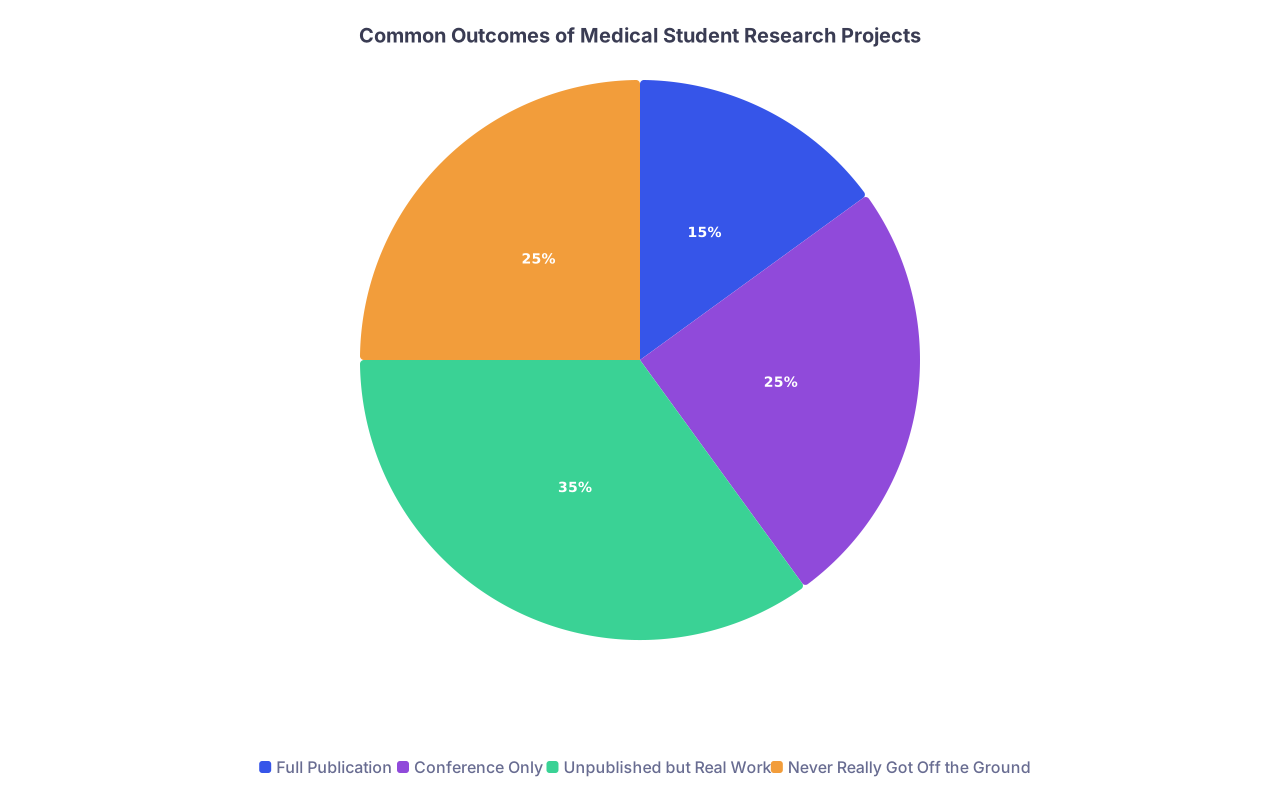
| Category | Value |
|---|---|
| Full Publication | 15 |
| Conference Only | 25 |
| Unpublished but Real Work | 35 |
| Never Really Got Off the Ground | 25 |
See that? The “unpublished but real work” chunk is massive. That’s you. That’s most of us.
Ok, So What Should You Actually Do Today?
Here’s a concrete way to take control instead of just marinating in anxiety:
- Make a list of every project you’ve touched, even vaguely.
- For each one, write:
- Title/topic
- PI/mentor
- Your actual tasks
- True current status (dead, ongoing, submitted, etc.)
- Cross out anything where your involvement was too weak to defend.
- For the remaining ones, decide:
- Is this an ERAS “Experience”?
- Is there any actual abstract/poster/presentation that belongs in “Publications/Presentations”?
Then rewrite each one with brutally honest, boring status language. No fluff.
You’ll feel exposed. And strangely relieved. Because now you’re not faking anything. You’re just telling the truth clearly.

| Step | Description |
|---|---|
| Step 1 | Research Project |
| Step 2 | Do not list |
| Step 3 | List as Experience + Presentation |
| Step 4 | List as Research Experience only |
| Step 5 | Clearly state status: no publication |
| Step 6 | Did you do real work? |
| Step 7 | Any output? Poster/abstract? |
FAQ (Exactly 4 Questions)
1. Should I list a project that completely died and never reached data collection?
Maybe. If you genuinely worked on study design, literature review, or IRB, you can list it as a smaller research experience and clearly say: “Project did not proceed to data collection due to [reason].” If your involvement was super minimal or you can’t explain it well, leave it off.
2. Can I say “manuscript in preparation” even if there’s no full draft yet?
Only if there’s a real, active plan and at least some sections drafted or outlined. If all you have is “we might write this someday,” don’t call it “in preparation.” Just say: “Data analysis completed; manuscript not yet drafted as of application.”
3. Will having research experiences without any publications hurt my chances?
Not by itself. Tons of applicants are in that boat. Programs mainly care that your activities are real, your role is clear, and you’re honest. One solid, well‑explained research experience is better than a bloated list of sketchy “in preparation” projects.
4. What if my PI is slow and I’m scared the project will never be finished—should I still list it?
Yes, if you did real work. You can’t control your PI’s timeline. Just describe what you contributed and state the current reality: “Data collection completed; manuscript timeline uncertain due to mentor availability.” Programs get this. They’ve seen much worse.
Open your ERAS right now, go to one unpublished project, and rewrite its description so the status is 100% honest and boringly clear. If you’d feel comfortable defending that exact wording in an interview tomorrow, you’re doing it right.