
You’re in the library, again. It’s 10:47 p.m., your co-authors stopped answering the group chat three hours ago, and you’re still editing the “limitations” section on a project you secretly kind of hate. And the whole time this one thought keeps circling in your brain:
“Do programs know I only did this research because I had to? Is it obvious I’m just padding my residency application?”
Let me answer that directly: no, they can’t read your soul. But yes, they can smell fake—or at least, they can smell when something doesn’t quite fit.
The trick is understanding what actually makes research look like padding, and what just looks like a normal med student trying to survive this ridiculous, competitive process.
What PDs Actually See When They Look at Your Research
Program directors aren’t sitting there thinking, “Did this person do research out of pure scientific curiosity and the love of knowledge?” They already know the game. They know you need lines on your CV. They know almost nobody wakes up and says, “I live and breathe retrospective chart reviews.”
They’re asking a different set of questions:
- Does this applicant’s story make sense?
- Does the research match their stated interests at least a little?
- Does the level of involvement match their training stage?
- Does the timeline look plausible, not manufactured?
They’re not judging your motives. They’re judging coherence.
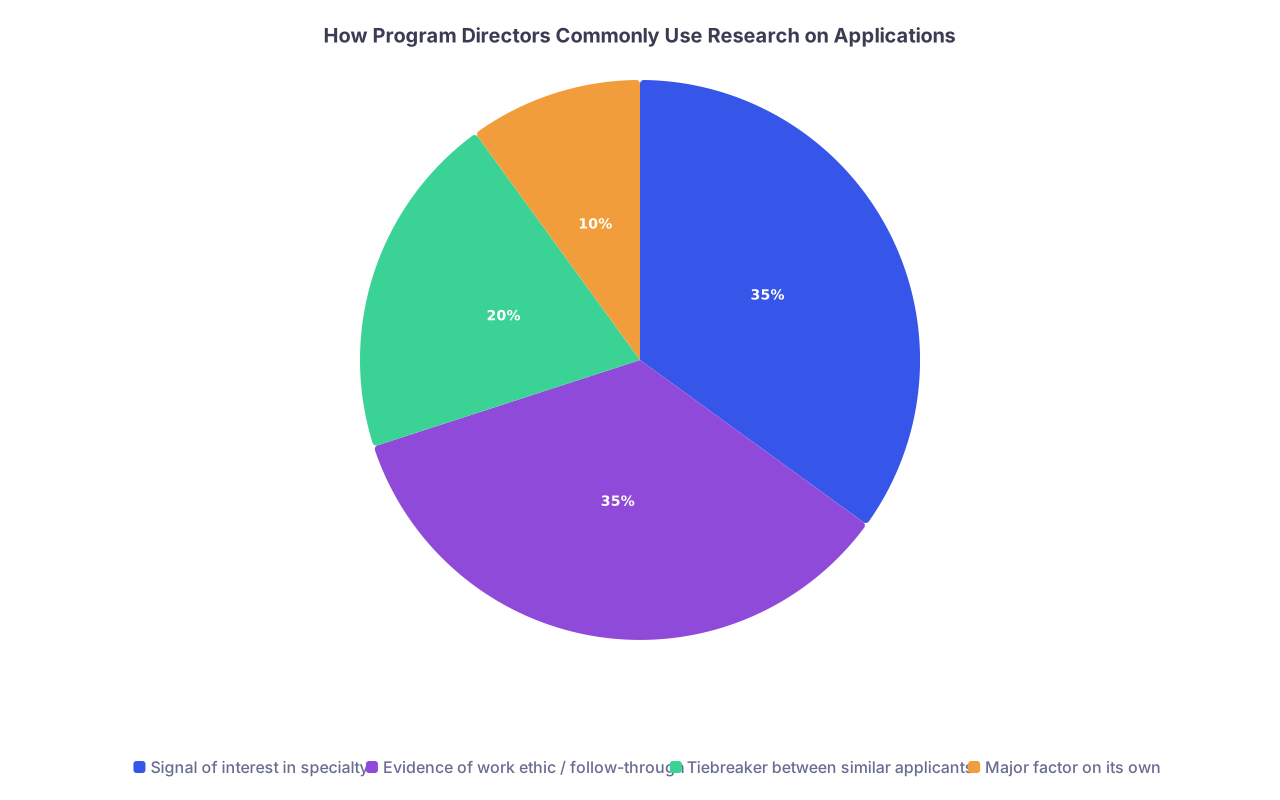
| Category | Value |
|---|---|
| Signal of interest in specialty | 35 |
| Evidence of work ethic / follow-through | 35 |
| Tiebreaker between similar applicants | 20 |
| Major factor on its own | 10 |
That last slice is tiny for a reason. Research, by itself, very rarely makes or breaks you. It’s supporting evidence, not the main event.
But I know what you’re really scared of: that they’ll see your two poster presentations in a random field and think, “Wow, this person is clearly just checking boxes.”
So let’s talk about what actually sets off that “padding” alarm.
Signs Your Research Might Look Like Pure Padding (and How to Fix It)
Here’s where the anxiety kicks in. You’re staring at your ERAS “Scholarly Activity” section thinking:
- “Everything is in a completely different field than the specialty I’m applying to.”
- “I started suddenly doing five projects the year before applying.”
- “I’m middle author on everything and honestly don’t remember half the details.”
I’m not going to sugarcoat it. Some of those things can look a little… manufactured. But they’re also extremely common. The difference between “normal med student” and “obvious padding” is how the story gets told.
1. Research That Has Nothing To Do With Your Chosen Specialty
You did a nephrology poster, a derm case report, a radiology abstract, and now you’re applying to EM or psych or OB. You’re convinced programs will think: “This person has no direction. They just chased anything that would publish.”
Honestly? They won’t care nearly as much as you think, as long as your application has some consistency somewhere else—like rotations, electives, personal statement, or letters.
Where it starts to feel like padding is when:
- Your personal statement screams “lifelong passion for X speciality”
- But your entire CV screams “I said yes to literally anything that might be presentable at a conference.”
Even then, that’s fixable. You frame it.
You say something like:
“I initially explored multiple fields—nephrology, radiology, dermatology—through research. Working on those projects helped me see what I didn’t want long term and pushed me toward [your chosen specialty], where I found the mix of [insert real reason] that fit me best.”
That sounds intentional, not desperate. Same facts. Different story.
2. The Last-Minute “Oh Crap, I Need Research” Surge
You did basically no research MS1–early MS3. Then suddenly, in one year, you’re “involved” in six projects, three posters, two manuscripts “in progress.” You’re terrified this screams: “Started research only when it was time to apply.”
Does it look like you woke up late? Maybe. But that doesn’t equal automatic rejection. A ton of people realize late they want a competitive specialty and start scrambling. PDs know that.
What makes it really look like padding is when there’s:
- Zero depth in any of those projects
- No first-author roles
- No ability to talk clearly about what you did
So if that’s you, your job now isn’t to magically invent passion. It’s to choose one or two of those projects and actually know them cold. Be able to explain:
- What question you were asking
- What you contributed personally
- What you learned
- How it changed your thinking about patient care or your specialty
If you can do that authentically for even one project, you’re already ahead of the people who list 10 things and can’t explain a single methods section.
Does It Matter If I Only Did It For My Application?
You’re probably not going to like this answer: your internal motivation matters less than you think, unless it leaks out in how you talk about it.
No PD can look at your ERAS and say, “Yep, this one did research for love, that one did it for clout.” They’re not clairvoyant. They judge based on:
- Consistency
- Credibility
- How you talk about your work
If, in an interview, you say with dead eyes, “I did research because I know it’s important for residency,” yeah, that’s not going to land great. It sounds transactional and shallow.
But if you say something like:
“I’ll be honest—I initially got involved in research because I knew it was expected for [specialty]. But once I got into the project, I realized I actually liked learning how to ask structured questions and see patterns in patient outcomes. It hasn’t turned me into a pure researcher, but it has made me more thoughtful about how I approach clinical questions.”
That’s real. That’s mature. You’re allowed to be pragmatic. You just can’t sound like you hated every second and learned nothing.
The worst way to talk about research is:
- OverLY dramatic: “My life’s passion is retrospective chart reviews on COPD readmissions.” Nobody believes that.
- Totally dismissive: “Yeah, I just slapped my name on some projects to be competitive.” Also bad.
The middle ground—“I did it partly for applications, but here’s what I honestly got out of it”—actually plays very well.
How Obvious Is “Padding” From Their Side? Less Than You Think.
Let me tell you what PDs and faculty actually have when they’re skimming your file:
- Your ERAS entries (short descriptions)
- Maybe a couple of letters that briefly mention research
- Sometimes a publication list, which they only scan
- 8–12 minutes before your interview (if that)
They don’t have a mind map of your career choices. They don’t have a full forensic history of every “why” behind every project.
What they do notice are a few patterns that can feel a bit off:
- Projects you clearly didn’t understand when you talk about them
- Inflated language in ERAS (“I led X” when you were clearly 4th author who did data entry)
- Big claims like “ongoing RCT” that never show up again and you can’t explain
- Sloppy or copy-paste descriptions that look generic
None of that screams “this person did research just to pad.” It screams “this person exaggerates or doesn’t take ownership.” That’s different—and worse, honestly—than just being honest that you participated modestly.
| Profile Type | How It Usually Reads to PDs |
|---|---|
| 1–2 small, consistent projects, can explain well | Solid, believable, not flashy but trustworthy |
| 8+ activities, all minor author, vague role | Busy, maybe padding, depends on how you talk about it |
| One strong first-author project in non-matching field | Serious effort, shows follow-through and skill |
| Tons of “submitted/in progress” with no specifics | Questionable, might be overinflated or unfinished |
You don’t need to be the first profile. You just don’t want to be the fourth and be clueless about your own work.
What If I Actually Did Just Check the Box?
Let’s say you really did this in the most “I need something on ERAS” way possible.
You agreed to help a resident with a project you didn’t care about. You did some chart reviews. Your name’s buried in the middle. You don’t remember half the details. You’re not proud of it. You just don’t want a blank research section.
Okay. That’s honestly… extremely normal. Especially for people who weren’t at powerhouse research med schools or who decided on a competitive specialty late.
Here’s how to rehab that situation so it doesn’t scream “fake”:
Pick the projects where you actually did something you can describe.
I don’t care if it’s minor. “I helped design the data collection form and reviewed 50 charts, then helped create the initial table for baseline characteristics” is better than vague fluff.Cut down the list.
More lines ≠ better. Listing six tiny roles on six tiny projects doesn’t magically beat listing two you can talk about like an adult.Own the level of your involvement.
Don’t make yourself “project lead” if you weren’t. Write things like:“Contributed to data collection and preliminary analysis. Assisted with preparing abstract for regional conference.”
That’s enough. Nobody expects you to be PI as a med student.
Extract a genuine takeaway.
Even from the most box-checky project, there’s something you can say you learned. About teamwork. About how annoyingly slow IRB is. About how much bias you find in charts. Whatever. Just don’t act like it was meaningless.

But What About People Who Genuinely Love Research? Won’t I Look Bad Compared to Them?
Here’s the part where your brain compares your two posters from a community hospital with someone who has 12 PubMed-indexed papers, 5 first-author manuscripts, and worked in a big-name lab before med school.
You assume PDs automatically prefer them. Sometimes they do. Often, they don’t automatically.
Because heavy research can also raise questions:
- “Is this person more interested in research than clinical work?”
- “Is this person going to be unhappy here if we’re not a research-heavy program?”
- “Did this person actually do all this work, or are they just a name on a million big-lab projects?”
Programs look for fit, not just who has the longest PubMed list. Community and mid-tier programs especially are happy with “did a normal amount of research and can explain it” applicants.
If you’re applying to super academic places? Yeah, research matters more. But even at those programs, honest, coherent, modest research looks way better than someone obviously stretching their role or bullshitting their way through methods.
Your goal isn’t to out-research the hardcore people. Your goal is to show you can exist in that environment without faking it.
How To Talk About “Padding” Research Without Exposing Yourself
You’re scared they’ll ask, “So why did you get involved in this project?” and your real internal answer is, “Because I panicked about my chances.”
You don’t have to lie, but you also don’t have to confess the raw, unfiltered anxiety.
You can say things like:
- “I wanted to understand this problem better after seeing it on my rotation.”
- “I was looking for a way to get involved in scholarship, and this was an accessible project where I could contribute concretely.”
- “I knew [specialty] values familiarity with research, so I looked for opportunities to get that experience.”
All of those are true without being self-sabotaging. They show you knew the landscape, took initiative, and used the opportunity.
Then you pivot into something specific you did and something you learned. Always.

| Step | Description |
|---|---|
| Step 1 | Asked about why you did research |
| Step 2 | Admit pragmatic part briefly |
| Step 3 | Add a concrete academic/clinical reason |
| Step 4 | Describe your actual role specifically |
| Step 5 | Share 1-2 things you learned or how it changed your thinking |
You’re not auditioning to be a pure scientist. You’re auditioning to be a resident who understands what research is, can participate if needed, and won’t embarrass the program with made-up CV lines.
When Padding Actually Does Hurt You
There are only a few scenarios where “padding” crosses from mildly cringe to actively harmful:
- You exaggerate or misrepresent your role, and someone calls you on it.
- You list things as “submitted” or “in press” that never existed.
- You can’t describe even basic details of projects you supposedly worked on for months.
- Your letters mention “difficulty following through” on research you claim you completed.
That’s when programs start to wonder about integrity and reliability, not just motivation. That’s the danger zone—not “I did this partly to look better on paper.”
So your job is simple, in a painful way: be accurate. Be able to talk about what’s on your CV. Don’t pretend to be something you’re not.

What You’re Really Being Judged On (Spoiler: It’s Not Whether You Loved Your Research)
Under all your spiraling thoughts, here’s what PDs actually care about when they see your research:
- Can you commit to something over time?
- Can you work in a team and not disappear halfway through?
- Can you think about patient problems in a structured, analytical way?
- Are you honest about what you did and didn’t do?
You can answer “yes” to all of those even if you started research late, did it partly to pad your app, and never once felt “called” to a life of academia.
You’re allowed to be practical. You’re allowed to be late to the game. You’re allowed to feel neutral about the project itself and still extract something real from it.
Just don’t sell yourself short by assuming PDs are looking for some pure, noble motivation that almost nobody actually has.
Bottom line — the quick version
- It’s not “obvious” you only did research to pad your application unless you exaggerate, can’t explain your work, or your story is wildly inconsistent.
- You can admit you were partly pragmatic, as long as you can clearly explain what you did and what you learned.
- Depth, honesty, and coherence beat long, noisy, obviously-stuffed research sections every single time.