
The fear that one “blank” year in your research timeline will tank your residency chances is wildly exaggerated.
I know that’s not what your brain is telling you at 1 a.m. when you’re staring at your CV and seeing a giant black hole labeled “MS3: NOTHING.” Your brain is probably going: “Great, now they’ll think I’m lazy, unserious, inconsistent, not academic enough, not competitive. Everyone else somehow did sub-is, clerkships, step studying, AND published three papers. I took one breath and now I’m doomed.”
Let me be blunt: programs do not sit around with a magnifying glass trying to catch a 9–12 month dip in your research productivity during your clinical year. That’s not how this works.
They do notice patterns. They do care about your story. And yes, they might ask about a research gap. But it’s not the automatic red flag you’re afraid it is—unless you handle it badly.
Let’s walk through the stuff you’re actually scared of, not the sanitized version people post on Reddit.
What Programs Actually Look At (Not the Fantasy You’re Imagining)
There’s this fantasy that PDs open ERAS, zoom straight to the “Scholarly Activities” section, and start counting:
“Hmm. Two posters MS1, one abstract MS2, and then… nothing MS3? Reject. Clearly lacks commitment.”
That’s not real.
Programs look at a combination of things, weighted differently depending on the specialty:
| Thing | Programs Actually Prioritize | What We Obsess Over |
|---|---|---|
| Clinical Grades | High | Medium |
| Step 2 CK | High | High |
| Letters of Rec | Very High | Medium |
| Research Volume | Medium–High (varies by specialty) | Off-the-charts High |
| Research *Continuity* | Low–Medium | Panic-inducing |
The “gap” you’re freaking out about is a continuity issue, not a volume issue. Most PDs care far more about:
- Do you have any real engagement with research, especially in their field?
- Can you speak intelligently about what you did?
- Does your application show growth and a coherent narrative?
They’re not timing your productivity down to the quarter.
MS3 is also when your life explodes: 6 a.m. prerounds, notes, pimp questions, shelf exams, call, trying not to forget how to be a human being. A year of fewer or no new research outputs is actually… normal.
I’ve literally heard attendings say in ranking meetings: “Of course they didn’t publish much MS3—it’s a grind. They picked it up again later, that’s what matters.”
Is a Gap in MS3 Research a Red Flag?
Short answer: by itself, no.
It can become a yellow flag only if it’s part of a bigger pattern that looks like:
- Minimal or no research at all, in any year
- Claims of “strong research interest” but zero follow-through
- A confusing, choppy story with no explanation
But a pretty typical path like this?
- MS1: small project, maybe a poster
- MS2: one more project, maybe ongoing
- MS3: clinical focus, nothing new submitted
- Early MS4: one abstract gets accepted, maybe a manuscript under review
That is not a red flag. That’s “you’re a normal human trying to survive third year.”
Where it can get tricky is:
- Ultra-academic specialties: derm, rad onc, neurosurgery, some ortho, some ENT
- Top-tier research-powerhouse programs: think big-name university hospitals where faculty bios are just wall-to-wall PubMed IDs
Those places care more about research volume and trajectory. But even there, the focus tends to be on total output and alignment with the specialty, not whether there’s a nice even distribution across MS1–MS4.
If you’re applying to, say, dermatology at UCSF with:
- One small unrelated research experience MS1
- Nothing after that
- No derm-specific project
…then yeah, your lack of derm-oriented research is a real problem.
But that’s not the same as: “I had 6–9 months where I didn’t push any projects forward during MS3.”
The Real Issue: How You Explain the Gap
Programs aren’t dumb. They know you weren’t sitting on a beach MS3. They know you were in the hospital, burning out, eating trail mix at 2 p.m. and calling it lunch.
They usually only care about a gap if:
- Your file is otherwise borderline and they’re looking for reasons to rank you lower
- You claim to be “deeply passionate about research” but your timeline doesn’t match that
- You bring it up awkwardly and make it sound worse than it is
The danger isn’t the gap itself. It’s you sounding defensive, ashamed, or like you checked out.
If they ask, you want something like:
“I was involved in research MS1 and MS2 and got [poster/abstract/etc.] out of it. During MS3, I really focused on building my clinical foundation and honestly didn’t have the bandwidth to push projects forward without compromising patient care and shelf performance. I re-engaged with research MS4 with [project X], which I’m excited about because it ties more directly into [specialty/interest].”
That sounds mature. Bounded. Intentional.
What you don’t want:
“Yeah, I kind of stopped doing research MS3… I know I probably should’ve done more… everyone else was getting stuff published and I just didn’t… I guess I dropped the ball.”
Same facts. Completely different signal.
But Won’t They Think I’m Not Serious About an Academic Career?
Here’s the thing: a shocking number of applicants say some version of “I see myself in academic medicine” in their personal statement or interviews.
Programs have learned to mostly ignore that line on its own.
What convinces them you’re “serious” about academics is not uninterrupted yearly research. It’s:
- Having at least one or two substantive projects where you can explain the question, methods, limitations, and impact
- Some alignment with the specialty (e.g., cardiology-related for IM, neuro stuff for neurology, etc.)
- Active intellectual curiosity: asking good questions, having ideas, reading more than what’s assigned
One MS3 research gap doesn’t cancel any of that.
Where you might get skepticism is if you’re applying to:
- “Physician-scientist track” or research-heavy pathways
- MSTP-like research residencies
- Programs that emphatically market their basic science / big NIH portfolio
In those environments, you want to show:
- Research before MS3
- Re-engagement after MS3 (even if nothing is fully published yet)
- Some continuity or depth—sticking with an area or mentor over time
Even there, they know MS3 is not your sabbatical year for writing grants. They just want to see you didn’t stop forever.
What You Can Do Now If You Had an MS3 Research Gap
Here’s where the anxiety gets loud: “Okay, fine, maybe they won’t judge it if I handle it right. But I already had the gap. I can’t go back in time.”
No, you can’t. But you have more control over the story and the present than you think.
1. Reactivate Something Before You Apply
You don’t have to suddenly churn out ten papers. That’s fantasy land.
But you can:
- Reconnect with a prior PI: “Hey, I have a bit more bandwidth now, can I help push that manuscript/abstract forward?”
- Join a small, clearly scoped project you can actually complete: chart review, QI, short retrospective
- Get involved with a project in your target specialty, even modestly
You want one thing you can point to and say: “I’m currently working on X.”
Even “manuscript in preparation” or “abstract submitted” looks better than radio silence.
2. Clean Up Your ERAS Research Section
You’re probably overthinking the timeline. Programs don’t see your exact day-to-day activity, just:
- When the project started
- When it ended
- What came out of it (poster, abstract, manuscript, nothing yet)
Projects that started MS1/MS2 but led to a publication MS4? Totally fine. That doesn’t scream “gap.” It screams “research takes forever,” which is accurate.
You don’t need to label something “MS3 gap” anywhere. Don’t create a problem they aren’t looking for.
3. Align Your Narrative
If you emphasize your love for research in every paragraph of your personal statement, then show almost no activity except MS1, it creates dissonance.
But if your story is:
- I discovered I like research MS1/MS2
- I focused hard on clinical growth MS3
- I’m now working on research that ties to the patients I want to care for in residency
That arc makes sense.
You’re allowed to evolve. You’re allowed to say, “I thought I wanted to do bench research, then realized I’m more interested in clinical questions, and that’s where my current project sits.”
Reality Check: You Also Need to Eat and Sleep
Another thing no one says out loud: some students survive MS3 by sacrificing literally everything that isn’t required. Sleep, social life, research, hobbies, you name it.
Is that healthy? No. Is it common? Absolutely.
Residency programs are not confused about what MS3 is like. Half the faculty still tell war stories of pre-80-hour weeks. They remember what it means to be exhausted and just trying not to screw up real patients.
I’ve seen PDs look more favorably on:
- A student with strong clinical performance, solid letters, decent research… and a gap in MS3
than - A student with constant, forced, superficial “research” activity but mediocre clinical comments and lukewarm letters
Residency is not a PhD. They are training clinicians first. If you had to choose between being good with patients or squeezing in one more retrospective chart review during surgery call, you did not make the wrong choice.
Who Actually Needs to Worry (And Who Really Doesn’t)
You should seriously worry about an MS3 research gap if:
- You’re going into a hyper-competitive, research-obsessed specialty
- You’re aiming ONLY at top 5 programs with massive NIH funding
- You have almost no research at all before or after the gap
- You’re also weak on other metrics (Step 2, grades, letters)
You should stop spiraling about it if:
- You have any reasonable research history MS1/MS2 or early MS4
- You can talk clearly about at least one meaningful project
- You’re not exclusively targeting 0.1% hyper-academic spots
- Your letters and clinical performance are strong
Research is one axis. Not the whole picture.
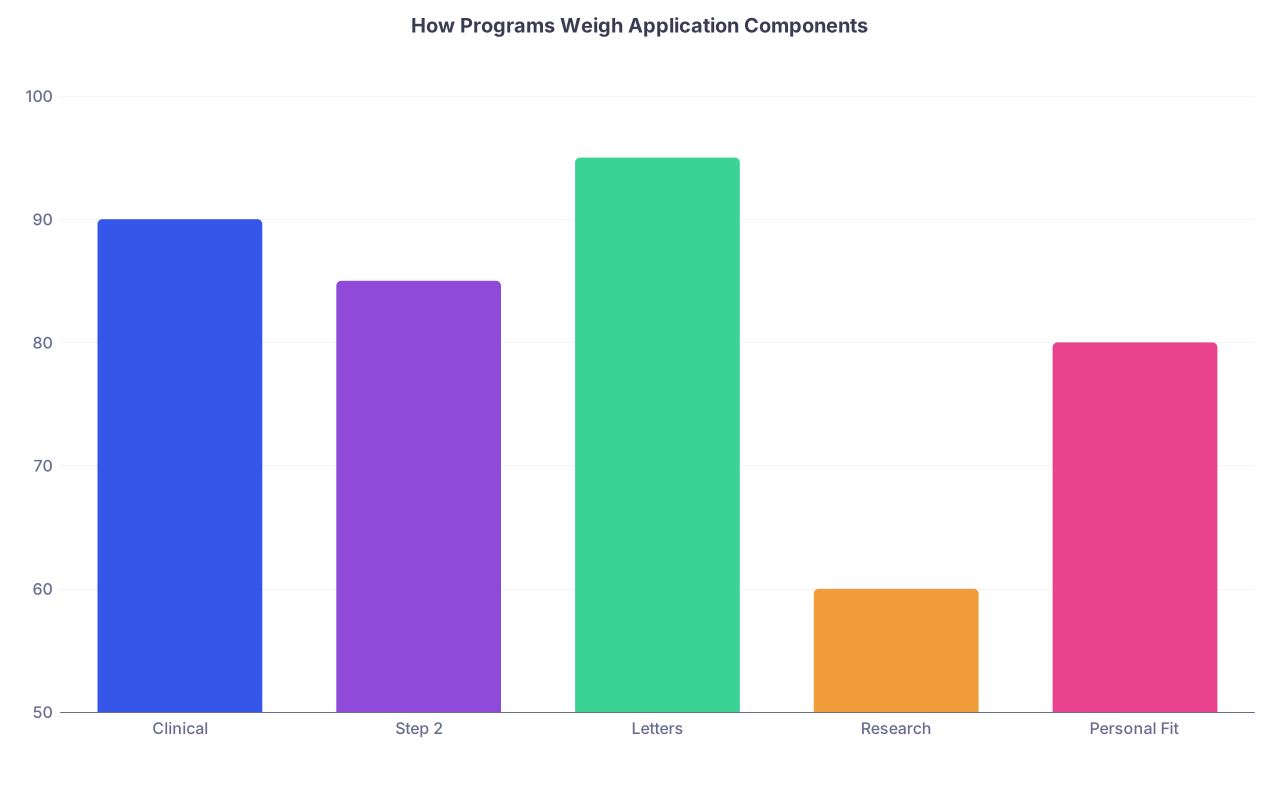
| Category | Value |
|---|---|
| Clinical | 90 |
| Step 2 | 85 |
| Letters | 95 |
| Research | 60 |
| Personal Fit | 80 |
How to Talk About Your MS3 Research Gap Without Sounding Guilty
If it comes up in an interview, here’s a basic structure you can steal and adapt:
Acknowledge it calmly
“You’re right, you’ll see less research productivity during my MS3 year.”Give the real context without whining
“That year I was really focused on my clinical growth—long hours on the wards, learning to be an effective team member, and preparing for shelves and Step 2.”Connect to growth or insight
“That experience actually clarified which kinds of clinical questions I care about most, which is what led me to my current project on [X].”Point to what you’re doing now
“Since then, I’ve been working on [current project], and we’re [submitting an abstract / drafting a manuscript / analyzing data] now.”
Short. Steady. No apologizing for being a third-year medical student who was busy being a third-year medical student.
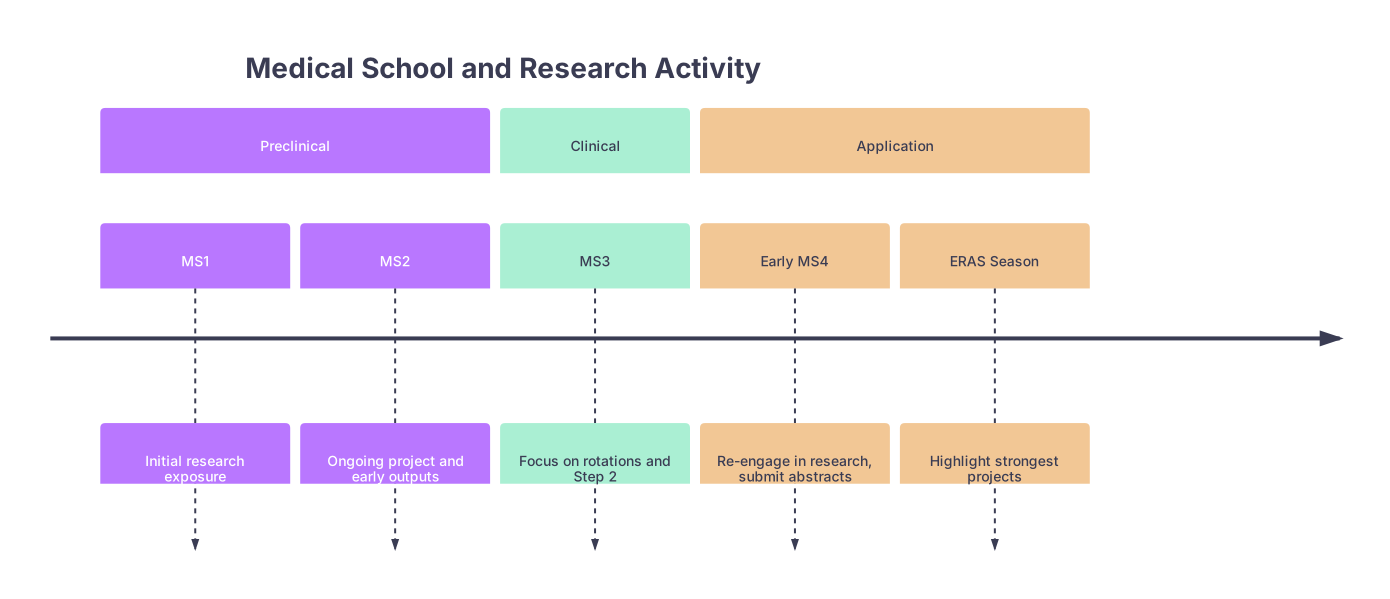
| Period | Event |
|---|---|
| Preclinical - MS1 | Initial research exposure |
| Preclinical - MS2 | Ongoing project and early outputs |
| Clinical - MS3 | Focus on rotations and Step 2 |
| Application - Early MS4 | Re-engage in research, submit abstracts |
| Application - ERAS Season | Highlight strongest projects |
FAQ (The Late-Night Panic Edition)
1. I had zero research activity MS3 and only started something again late MS4. Is that fatal?
No. Fatal is a strong word and doesn’t apply here. It might limit your options at the most research-heavy programs or for ultra-competitive specialties, but for the vast majority of residencies, the bigger questions are: do you have at least some research? Can you talk about it intelligently? Are your clinical metrics and letters strong? A late MS4 project is still better than nothing and shows renewed engagement.
2. Should I rush into a tiny, meaningless project now just to “fill the gap”?
Only if you can do it well enough to not sound fake. A flimsy “I collected five charts for a week” project that you barely understand is worse than nothing when someone starts asking, “So what was your role?” It’s better to have one solid, honest project than three padded, superficial ones.
3. Do I need to literally explain ‘I didn’t do research MS3’ in my personal statement?
Usually, no. Don’t spotlight a problem they might not even perceive as a problem. Use your personal statement to tell a coherent story about who you are, what matters to you clinically, and how any research you did fits into that. Save the “why less productivity here?” explanation for interviews if someone actually asks.
4. Will programs compare the exact timing of my projects with my classmates from my school?
Not in that level of detail. They’re not running side-by-side timelines of you vs. your classmates. They see your file, maybe have a general sense of how research-y your med school is, and then they move on. They’re much more interested in the quality of your letters, your clinical performance, and your current trajectory than whether you squeezed in a poster during surgery call.
Bottom line?
One research gap during MS3 does not equal “not committed.” Programs care more about total pattern than perfect continuity. You can offset that gap by re-engaging, telling a clear story, and focusing on strong clinical performance and letters.