
The idea that only bench research counts as “real” research is flat-out wrong.
But I know that’s not what your brain is telling you at 2 a.m. when you’re scrolling through other people’s ERAS screenshots on Reddit and seeing “first-author basic science paper,” “NIH grant,” “3 PubMed-indexed original research articles,” while you’ve got… three QI projects, two posters, and a draft abstract that may or may not ever see a conference.
And the question just sits there: If my CV is mostly QI, are programs going to think I’m less academic? Less serious? Less competitive?
Let’s be brutally honest and then actually useful.
The uncomfortable truth about how programs see QI
Here’s the part nobody says out loud: some programs still secretly rank “types” of scholarly work. They may not put it on their website, but in committee rooms it often sounds like this:
“PubMed paper > conference abstract > poster > QI project > ‘ongoing project’.”
Is that fair? No.
Is it real in some places? Yes.
But that’s not the full story, and if you stop there you’ll completely misread how QI plays into your application.
Here’s what I’ve actually seen:
- Community and mid-tier academic programs: very happy with solid, outcome-focused QI. Sometimes they honestly prefer it to random basic science that obviously came from pipetting for a summer and never thinking about it again.
- Big-name, research-heavy programs (think UCSF IM, MGH Anesth, Hopkins Neuro): they still want a signal that you can do “traditional” scholarly work if you’re aiming for academic careers, fellowships, or physician-scientist tracks. But they do not dismiss QI. In fact, they need people who understand systems and outcomes.
So no, you’re not “less academic” just because your CV skews QI.
You can look less academic if your QI is:
- poorly described
- buried in your application
- obviously thrown together for a requirement
- not tied to measurable outcomes or learning
The type of project matters less than how you present it.
QI vs “research”: what programs are actually looking for
Let me translate the vague “research” requirement into what selection committees are secretly scanning for when they look at your QI-heavy CV:
They’re asking:
- Can you identify a problem worth solving?
- Can you use data instead of vibes?
- Can you follow through on a project over months, not days?
- Can you work in a team without imploding?
- Can you present complex information in a coherent way?
QI, when done properly, screams “yes” to all of those.
The trap is when applicants list QI like:
- “QI project – hand hygiene compliance”
- “Member, sepsis QI initiative”
That tells them nothing. That does read like checkbox, filler stuff.
Compare that to something like:
- “Led multidisciplinary QI project to reduce time-to-antibiotics for sepsis patients in ED; analyzed baseline data (n=120), implemented triage protocol change, decreased median door-to-antibiotic time from 120 to 65 minutes over 6 months; presented results at regional EM conference.”
One line. Completely different energy. Same “type” of project.
Programs don’t sit there thinking, “This is QI, therefore not academic.”
They think, “Does this show me someone who can produce and communicate meaningful work?”
You can absolutely “lose” against a strong traditional research applicant at a research-heavy program. But you won’t lose because it’s QI. You lose if your projects are vague, small-scope, or look like they didn’t go anywhere.
How different specialties treat QI vs research
This is where the anxiety really spikes—because it’s not the same for every field.
Here’s a blunt snapshot:
| Specialty | QI Value | Traditional Research Pressure |
|---|---|---|
| Internal Med (non-phys sci tracks) | High | Moderate |
| Surgery (categorical) | Moderate | High |
| EM | Very High | Low–Moderate |
| Psych | High | Low–Moderate |
| Neuro / Rad Onc / Derm | Moderate | Very High |
If you’re going into:
Internal Medicine (generalist, hospitalist-bound, or community-focused)
Strong QI = huge plus. Hospital medicine lives on QI. They want people who understand readmissions, LOS, sepsis bundles, etc.Emergency Medicine
QI can be your main research and no one will blink. ED flow, sepsis, stroke door-to-CT times, etc.—this is gold if you describe it well.Psychiatry, Family Medicine, Pediatrics
QI is extremely relevant. Think med reconciliation, follow-up adherence, reducing restraints, vaccination rates. Totally acceptable as primary “research-like” experience.
Where it gets trickier:
- Highly competitive, research-heavy specialties like Derm, Rad Onc, Neurosurgery, some elite Surgery programs
QI alone often isn’t enough if you’re aiming for academic heavy-hitters. They want to see hypothesis-driven, IRB-approved, publishable work. QI can complement that, but rarely replaces it.
So ask the hard question: what tier of program and what kind of career are you really targeting? Because that changes how “dangerous” it is to be QI-heavy.
When mainly QI does hurt you
Let me not sugarcoat this. Your brain is trying to game out worst-case and some of those scenarios are real.
Mainly QI can absolutely hurt you if:
You’re applying to research-obsessed programs and want academic careers
Think: “I want GI at Mass General” while having only small local QI and no pubs. They’re not going to blacklist you, but other applicants will look more obviously “academic.”Your QI is all low-effort and fragmented
Three one-month “projects” with no data, no results, no presentations, no follow-through. That reads like requirement-chasing, not scholarship.You don’t understand your own projects deeply
Committee member: “Can you walk me through your QI project design?”
Applicant: “Uh… we, um, collected some data? I’m not sure which metrics…”
That’s the nightmare scenario. And they remember it.There’s nothing written, presented, or shared from any of them
If nothing became a poster / abstract / talk / manuscript / local presentation, it’s hard to argue this was serious academic work, even if you felt busy.
So yes, there are situations where mainly QI is a liability. But all of those are fixable with how you shape, deepen, and present what you’ve done from now until ERAS submission.
How to make your QI projects look legitimately academic
This is where you can actually do something instead of just spiraling.
You want your QI to read like this in the committee member’s brain:
“Real project. Real data. Real outcomes. This person could do research too.”
Here’s how you do that.
1. Frame QI with the same bones as research
Whenever you describe a QI project (ERAS entries, CV, personal statement), hit these elements:
- Problem: what was broken?
- Baseline: what were the initial numbers?
- Intervention: what exactly did you change?
- Outcome: what moved, quantitatively or qualitatively?
- Your role: what did you do vs the group?
For example:
Instead of:
“Participated in QI project to improve discharge summaries.”
Say:
“Co-led QI initiative targeting incomplete discharge summaries on medicine floors. Reviewed 200 baseline discharges (45% missing follow-up info), co-developed standardized template, implemented with housestaff training, audited 3 months post-implementation (missing follow-up info reduced to 12%). Presented findings at institutional QI day.”
That screams: data, method, outcome, leadership.
2. Get something—anything—presented or accepted
You’re worried about seeming less academic? Abstracts and posters are the bridge.
Push your QI mentor to:
- Submit an abstract to a regional or national meeting
- Present at hospital QI / safety day
- Turn it into a short paper or case series focused on process change
Don’t sit there waiting for them to magically do this. Send the awkward email:
“Hi Dr. X, I was wondering if we could discuss turning our QI project into an abstract or poster for [Conference Y] or our local QI day. I’m happy to take the lead on drafting.”
You sound annoyingly eager. That’s fine. That’s what gets your name on things.
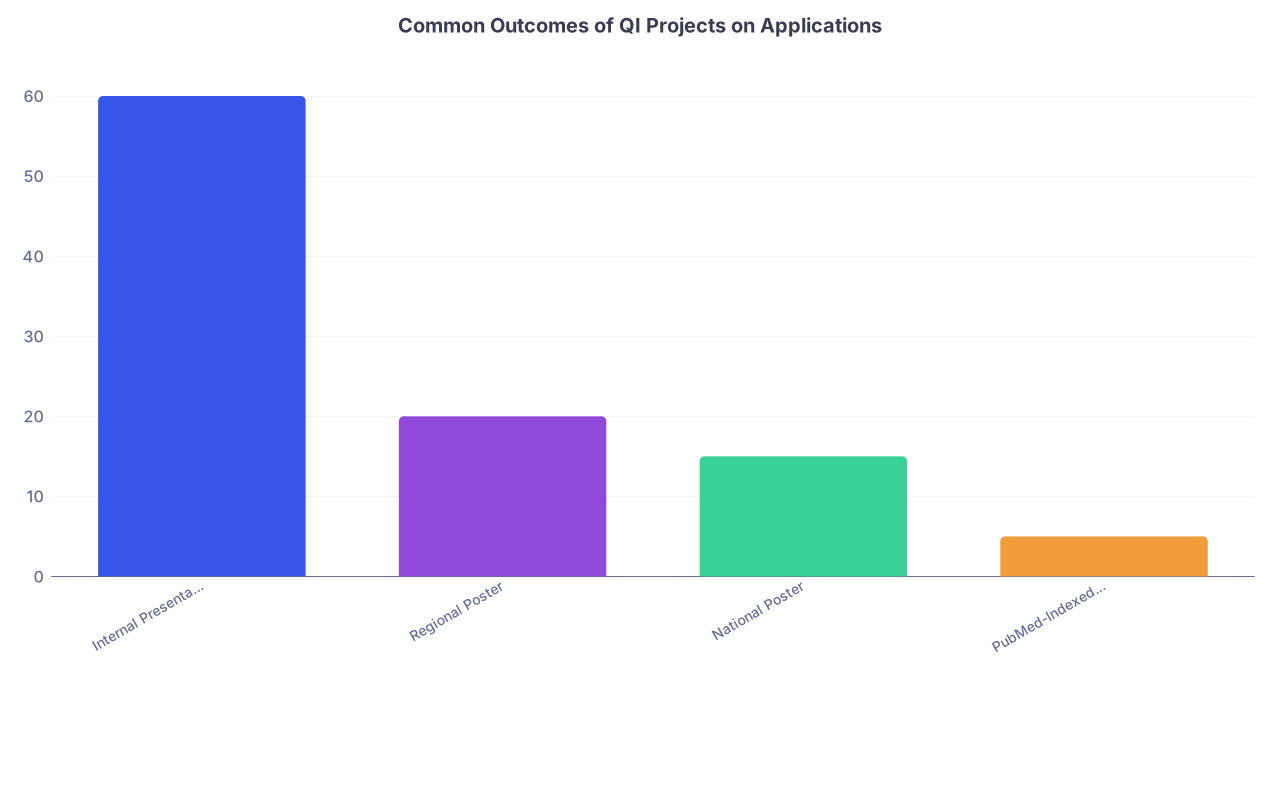
| Category | Value |
|---|---|
| Internal Presentation Only | 60 |
| Regional Poster | 20 |
| National Poster | 15 |
| PubMed-Indexed Manuscript | 5 |
Most people stop at “internal presentation.” You don’t have to.
3. Clarify your role so it doesn’t look like fluff
Every committee has seen the CV line: “Member, XYZ QI project.”
Translation: I attended 3 meetings, nodded, and left.
Where you can honestly claim more, do it. Use active, specific verbs:
- Designed data collection tool
- Performed chart review on 150 patients
- Conducted pre/post-intervention analysis
- Presented outcomes to departmental leadership
You’re not lying by being specific. You’re clarifying that you weren’t a background extra.
4. Tie QI to your future career in your personal statement
If you’re QI-heavy and nervous about being seen as “less academic,” you absolutely should connect the dots in your personal statement or secondary essays.
For example:
“I’m particularly drawn to hospital medicine because of the opportunity to pair direct patient care with system-level quality improvement. Through my project reducing time-to-antibiotics in ED sepsis patients, I saw how small process changes can shift outcomes for hundreds of patients. I hope to continue this work in residency and contribute to larger institutional QI initiatives.”
You’re not justifying your lack of “real research.” You’re positioning yourself as someone with a coherent academic interest.
How to patch the “I only have QI” panic, realistically
You might be thinking, “It’s too late, I’m in M4 / late M3 and all I have is QI.”
It’s not great, but it’s not hopeless.
Here’s a practical, not-perfect pathway from now to ERAS:

| Step | Description |
|---|---|
| Step 1 | Today |
| Step 2 | List all QI projects |
| Step 3 | Identify 1-2 with real data/results |
| Step 4 | Email mentor about abstract/poster |
| Step 5 | Draft abstract & CV descriptions |
| Step 6 | Prepare 2-3 minute project pitch for interviews |
| Step 7 | Submit ERAS with strengthened QI entries |
You’re not going to magically create three PubMed papers in six months. That’s fantasy. But you can:
- Turn 1–2 QI projects into abstracts/posters
- Make every description sound like serious, thoughtful work
- Be able to discuss methodology and outcomes in-depth on interviews
That moves you from “checkbox QI” to “this person does real work, even if it’s mainly QI.”
Quick reality check: what programs actually remember
After sitting in too many selection meetings, here’s what sticks:
They don’t remember:
“Was it QI vs RCT vs retrospective chart review?”
They remember:
- “That’s the applicant who led the sepsis time-to-antibiotic project.”
- “She actually knew her data and could explain PDSA cycles.”
- “He clearly likes systems and outcomes stuff; would be a great chief someday.”
- Or, bad version: “He listed five projects but couldn’t explain even one.”
So your nightmare that they’ll dismiss you with, “Ugh, only QI” is… not how it plays out. They care what your work says about you, not just how ERAS categorizes it.
FAQs (The things you’re probably still spiraling about)
1. Do programs secretly rank applicants lower if they only have QI and no publications?
Some will favor applicants with traditional, published research—especially top academic or fellowship-pipeline programs. But “only QI” doesn’t automatically drop you into a lower rank bucket. what actually hurts is “only vague, unimpressive QI with no outcomes and no evidence of follow-through.” If your QI is substantial, measurable, and well-presented, you’re competitive at a huge number of programs.
2. Should I hide weaker QI projects so I don’t look like I padded my CV?
If a project was truly superficial—no data, no meaningful role, lasted two weeks—yes, you can leave it off. More lines doesn’t always look better. But if you did real work, even if the project wasn’t massive, keep it and describe your role concretely. Better to have 2–3 strong, clearly-explained projects than 7 vague ones that scream filler.
3. Will interviewers grill me on detailed statistics if I talk about QI?
Usually not. They’re not trying to fail you. But they will expect you to understand your own project at a basic to moderate level—what problem you addressed, how you measured it, what changed, any limitations. If you threw your name on something and can’t explain it, that’s where it backfires. Review your projects before interview season like you’re prepping for an oral exam on just those.
4. Is it “cheating” to call QI “research” on ERAS?
Call it what it actually is. Use the QI/QA category if appropriate and be honest in your description. You don’t need to pretend it was a randomized trial for it to be respected. Adcoms are used to seeing QI as legitimate scholarship. What does look bad is inflating or mislabeling what you did. You can still emphasize data collection, analysis, and outcomes—those are research skills, even in a QI context.
5. If I’m late in the game, should I start a tiny traditional research project just to have “real” research on my CV?
Starting a rushed, tiny project that never gets finished often looks worse than having strong QI only. If you have access to a mentor with an ongoing chart review or secondary analysis you can join and realistically bring to abstract/paper stage before or during residency, go for it. But don’t abandon improving your existing QI work in favor of a half-baked “research” line that leads nowhere.
6. What’s one concrete way to make my QI sound more academic right now?
Take one project and rewrite its ERAS/CV description using: problem, baseline, intervention, outcome, and your role. Include at least one number (percentage change, n of patients, months of data). Then send that description to your mentor and ask, “Does this accurately capture the project? Anything I should adjust?” You’ve just upgraded both the content and signaled professionalism to someone who might vouch for you.
Open your CV or ERAS draft today and pick your strongest QI project. Rewrite that one entry so it reads like a real, data-driven study—problem, baseline, intervention, outcome, your role. If you can’t do that yet, that’s your signal to go back to your mentor tomorrow and get the information you need.