
Last week, I sat in my car outside the hospital for almost an hour, staring at my ERAS experiences section. One “dedicated research year” entry… and almost nothing concrete to show for it. No first-author paper. No flashy NEJM anything. Just a couple of abstracts, a “manuscript in preparation,” and a lot of empty space where I thought achievements would be.
And the thought that wouldn’t shut up was: “Program directors are going to see this and think I completely wasted a year. That I’m lazy. That I failed.”
Let me say the scary part out loud: you’re afraid your low-output research year didn’t just “not help” — you’re afraid it actively damaged your application and your reputation.
Let’s unpack this in a way that’s honest, not sugar-coated, and actually useful.
What PDs Actually See When They Look at Your “Low-Output” Research Year
They’re not scrolling ERAS thinking: “Where’s their NEJM paper? Automatic reject.”
PDs are busy and brutally practical. When they glance at your research year, they’re subconsciously scanning for three things:
- Did you do real work, or does this look like a vacation year?
- Does your story make sense for your specialty and trajectory?
- Are there red flags: huge gaps, obvious excuses, or contradictions?
They are not running a mental tally of:
- PubMed ID count
- Impact factor sum
- Whether you beat the “average matched applicant” number in that one NRMP chart you’ve been staring at at 2 a.m.
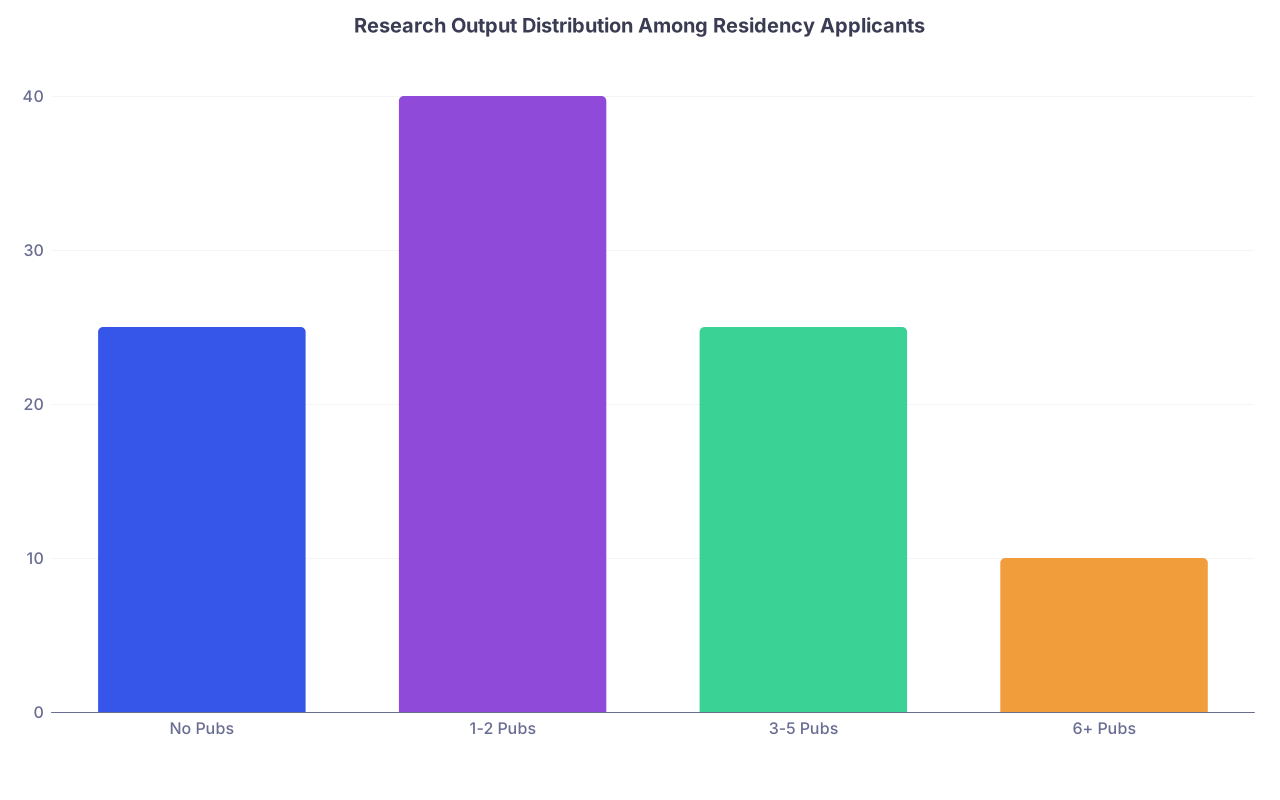
For context, research output looks more like this across applicants than the horror story you’re telling yourself:
| Category | Value |
|---|---|
| No Pubs | 25 |
| 1-2 Pubs | 40 |
| 3-5 Pubs | 25 |
| 6+ Pubs | 10 |
Translation: plenty of people have little or no actual publications. Especially people who didn’t do a research year. Your situation feels uniquely awful to you, but to PDs, “research year, low output” is… not that rare.
What they really care about in a “research year”:
- Did you stick with projects?
- Can your mentor vouch that you showed up, took initiative, didn’t disappear?
- Can you talk about what you learned at a deeper level than “I collected data”?
If your ERAS and letters can answer those, you’re not dead in the water.
But It Feels Like Failure: Why This Hurts So Much
You didn’t take a research year because you were bored. You did it because:
- You thought it would make you competitive for a more competitive specialty
- You wanted to “fix” a weaker part of your application
- Everyone around you was saying “You need research for this field”
And now you’re sitting there with:
- 0–1 manuscripts actually accepted
- Maybe a couple of posters from some minor meetings
- One or two “submitted” or “in revision” that might not be accepted until after rank lists are in… if ever
And your brain goes:
- “If others turned a year into 5 first-author papers and I didn’t, I must be the problem.”
- “PDs will assume I wasted time or I’m incompetent.”
- “This proves I can’t follow through.”
Here’s the ugly truth I’ve seen play out again and again: research timelines are completely divorced from the med school/residency timeline. Projects stall. IRB takes months. Your PI goes on leave. A senior resident who promised to help ghosts you. Data turns out to be garbage.
You don’t see that chaos on people’s CVs.
You just see the final PubMed list. You don’t see:
- The 3 dead projects that never got published
- The “manuscript in preparation” that has been “in preparation” since M2
So yeah, it feels like failure because you set a very clear, outcome-based goal (X number of publications), and the system you’re in is not built to reliably give you that in 12 months.
That doesn’t mean PDs automatically label you a failure.
How to Frame a Low-Output Research Year So It Doesn’t Sink You
This is the part that matters. Not what actually happened, but how it appears and how you explain it.
1. Get your mentor’s letter aligned with your story
If you had a research PI this year, their letter is absolutely critical. If that letter says:
- You were reliable
- You owned parts of projects
- You contributed intellectually (not just scut work)
- Progress was made, even if papers are pending
…then PDs are far more forgiving about the lack of final publications.
If you’re panicking right now because your mentor:
- Writes terrible letters
- Barely knows you
- Or is not big on specifics
You need to do damage control:
- Send them a concise one-page summary of your work: projects, your role, skills, status
- Gently highlight obstacles that delayed publications (IRB changes, dataset issues) without blaming them
You want their letter to say: “This person worked. The system was slow. They are not lazy.”
2. Rewrite your ERAS entries like you actually did something (because you probably did)
A weak ERAS entry: “Research fellow, cardiology. Helped with data entry. Working on manuscript.”
A stronger one: “Research fellow in interventional cardiology studying outcomes after TAVR procedures. Led data extraction and cleaning for 250+ patients, performed preliminary statistical analyses using R, and developed first draft of a retrospective outcomes manuscript currently in preparation.”
Same output. Completely different impression.
Focus on:
- Specific tasks you did
- Skills you gained (databases, stats, writing, study design)
- What the project is and why it matters
And yes, you can list:
- “Manuscript in preparation”
- “Manuscript submitted”
- “Abstract accepted for [Conference]”
Just don’t fabricate. Ever. That is a PD-killer.
3. Use your personal statement and interviews to control the narrative
If you did a formal research year, they’re going to ask about it. Pretending it didn’t happen is worse than facing it.
What you don’t want to say:
- “Yeah, unfortunately nothing got published…”
- “It was kind of a waste honestly…”
- “We ran out of time…”
That sounds like you either:
- Didn’t understand how research works
- Or didn’t fully engage
Instead, something like: “I took a dedicated research year to deepen my understanding of [field]. I worked on [brief description of 1–2 main projects]. We faced [specific challenge], which delayed publication more than I anticipated, but I’m proud of [concrete piece: analysis, protocol, abstract]. The biggest thing I took away was [skill, insight, or change in how you think].”
You’re not hiding the lack of output. You’re putting it in context and redirecting to growth and actual work.
When a Low-Output Research Year Actually Becomes a Red Flag
Let me be honest: there are situations where PDs will look twice and not in a good way.
Red flags:
- You did a research year AND your mentor’s letter is generic or lukewarm
- You can’t clearly explain what you did when asked
- You have almost nothing in ERAS to show for it: no abstracts, no posters, no roles described
- Your timeline is confusing (e.g., says “full-time research” but also lists other full-time activities that don’t add up)

If one or more of these apply, the issue isn’t the number of publications. It’s that your year looks like a black box.
PDs don’t like black boxes. They worry:
- “Did this person lack follow-through?”
- “Is there something they’re not telling me?”
- “Will this be how they handle projects as a resident?”
Your job is to fill in that black box with:
- Clear descriptions
- Coherent timeline
- Concrete contributions
Strategy Check: How Bad Is This Actually For Your Specialty?
Different specialties care differently. A low-output research year in derm is not assessed the same way as in family med.
Here’s a rough comparison (real-world-ish, not perfect):
| Specialty Level | Example Fields | How Harshly a Low-Output Research Year Is Judged |
|---|---|---|
| Ultra-competitive | Derm, Plastics, Ortho, ENT | High |
| Competitive | Rad Onc, Anesth, EM, Gen Surg | Moderate |
| Mid-range / broad | IM, Peds, OB/GYN | Low–Moderate |
| Less research-focused | FM, Psych, Path (varies by program) | Generally low |
If you’re going for derm or plastics and your research year yielded basically:
- No papers
- No meaningful abstracts
- No strong mentor advocating for you
Then yes, it probably hurts relative to others who used that year to stack 5–10 outputs. It doesn’t mean you’re done, but the bar is higher and the competition is brutal.
But if you’re going into:
- IM (even academic IM)
- Peds
- OB/GYN
- Psych
- FM
A lower-output year, if well-explained and well-lettered, is usually not a fatal flaw. You’re overestimating how intensely every program is scrutinizing your PubMed list.
What You Can Still Do Right Now Before and During Application Season
This is the part your anxiety doesn’t like: taking action instead of just catastrophizing.
1. Push every project one notch further before ERAS locks
- Turn “we’re analyzing data” into “abstract submitted to [Conference]”
- Turn “we’re drafting” into “manuscript in preparation with target journal [X]”
- Ask your mentor: “Is there a smaller offshoot we can realistically turn into an abstract before October?”
Even one accepted conference poster makes your year look less empty.
2. Tighten your timeline and story
Write it down somewhere private:
- Why you chose the research year
- What you actually did (projects, skills)
- What got in the way (in realistic, not self-pitying terms)
- What you got out of it anyway
This is your script for:
- Personal statement
- Interviews
- Emails to mentors asking for letters
3. Shore up the rest of your application
Because here’s the truth PDs will never put in a brochure: they care more about some things than your research.
Things that usually weigh more than your year’s publication count:
- Step 2 score / COMLEX Level 2
- Clerkship grades, especially in core rotations
- Letters from clinicians who say “I’d take this person on my team”
- Evidence you can function on a real service without falling apart
If your research year feels underwhelming, then everything else matters even more. Max those out.
What to Say When They Ask the Question You’re Dreading
You know it’s coming: “So tell me about your research year.”
Here’s a simple framework that doesn’t sound like a disaster:
Why you did it
“I took a year for research because I wanted stronger exposure to [field] and to understand the evidence base behind [area].”What you worked on (2–3 projects max)
“My main project looked at [X]. I was responsible for [A, B, C]. We [current status]. I also contributed to [brief second project].”What delayed or limited the tangible output (brief, factual)
“The project ended up being larger and required several IRB amendments, which slowed us down more than I expected, so most of the work is still in the abstract/manuscript stage rather than published.”What you actually gained
“But that process forced me to learn [skills: data cleaning, working with statisticians, revising protocols], and it changed how I read and apply literature on the wards.”
That answer:
- Admits the lower output
- Avoids self-flagellation
- Shows you weren’t just passively drifting through the year
The Part You Probably Need to Hear Most
Program directors are not sitting together mocking people with “only” one or two small abstracts after a research year. They’re trying to figure out who will show up at 5:30 a.m., not crumble on call, and keep patients safe.
Your fear is that your research year screams “failure.”
In reality, unless it’s paired with:
- Weak letters
- Poor clinical performance
- Or obvious inconsistency
…it’ll more likely register as:
- “Okay, they did some research, sounds like things took longer than planned, their pubs will probably trickle in during residency. How are their clinical grades/letters?”
You are not the first person whose research year didn’t become the golden ticket they imagined. You won’t be the last. Plenty of those people still matched. Even into competitive fields. I’ve watched it happen.
Your job isn’t to rewrite the past year. It’s to:
- Tell a coherent, honest story
- Show you actually worked
- Make the rest of your application scream: “I will be a solid resident”
The anxiety voice in your head is grading you on a perfection scale PDs are not actually using.

| Step | Description |
|---|---|
| Step 1 | Low Research Output |
| Step 2 | Frame Year as Learning Experience |
| Step 3 | Clarify Contributions in ERAS |
| Step 4 | Highlight Skills & Projects |
| Step 5 | Emphasize Clinical Strengths |
| Step 6 | Prioritize Step 2 & Rotations |
| Step 7 | Viable Application |
| Step 8 | Strong Mentor Letter? |
| Step 9 | Clinical Metrics Strong? |
FAQ (Exactly 5 Questions)
1. Should I even list a “research year” if I have barely any publications?
Yes. Hiding it looks worse. List the position, describe your role clearly, and be honest about project status (in preparation, submitted, etc.). Omitting it creates confusion in your timeline and raises more red flags than a low-output year.
2. Will programs think I’m lying if I write “manuscript in preparation” or “submitted”?
They’ll assume some of those won’t ever become real publications, because that’s how research works. That’s fine. Just don’t exaggerate your role or claim “accepted” when it’s not. If they ask, you should be able to describe exactly what stage the manuscript is at and what you personally did.
3. Is it better to apply this cycle with low output or wait another year to get more papers?
Usually, it’s better to apply rather than burning another full year only chasing papers. An extra year doesn’t guarantee output, and you risk looking like you’re stuck. The exception is for ultra-competitive specialties where research is basically currency; in those cases, it’s a serious conversation to have with an honest mentor.
4. How many publications do I “need” for my research year to not look embarrassing?
There is no magic number. For many fields, 1–2 meaningful abstracts/posters and a couple of manuscripts in progress, combined with a strong letter and clear description of your work, is perfectly acceptable. Stop comparing yourself to the one person with 18 PubMed entries; they’re not the norm.
5. What if my PI is slow, unresponsive, and nothing is moving—will PDs blame me?
If your ERAS entries are detailed, your story is consistent, and you can explain your role and the project’s obstacles clearly, most PDs won’t assume it’s all your fault. Academia is slow and messy; they know that. Where you get into trouble is if your year looks completely empty and your mentor’s letter is vague or negative. That’s why it’s worth one more uncomfortable conversation with your PI now to clarify your contributions and push something—anything—forward.
Key points: your “low-output” research year feels like a catastrophe, but PDs mostly care that you worked, learned, and have solid clinical performance. Don’t hide the year; frame it clearly, get the best letter you can, and make the rest of your application as strong and coherent as possible.