
What if the only “research” on your CV is a single case report… and you’re terrified programs are going to laugh, toss your app, and move on?
Same. This is exactly the kind of thing that keeps people up at 2 a.m. in the call room refreshing FREIDA.
Let’s talk about what that case report actually means, how programs really see it, and where it hurts you (and where it absolutely doesn’t).
The Ugly Fear: “Everyone Else Has 12 PubMed Papers and I Have… This”
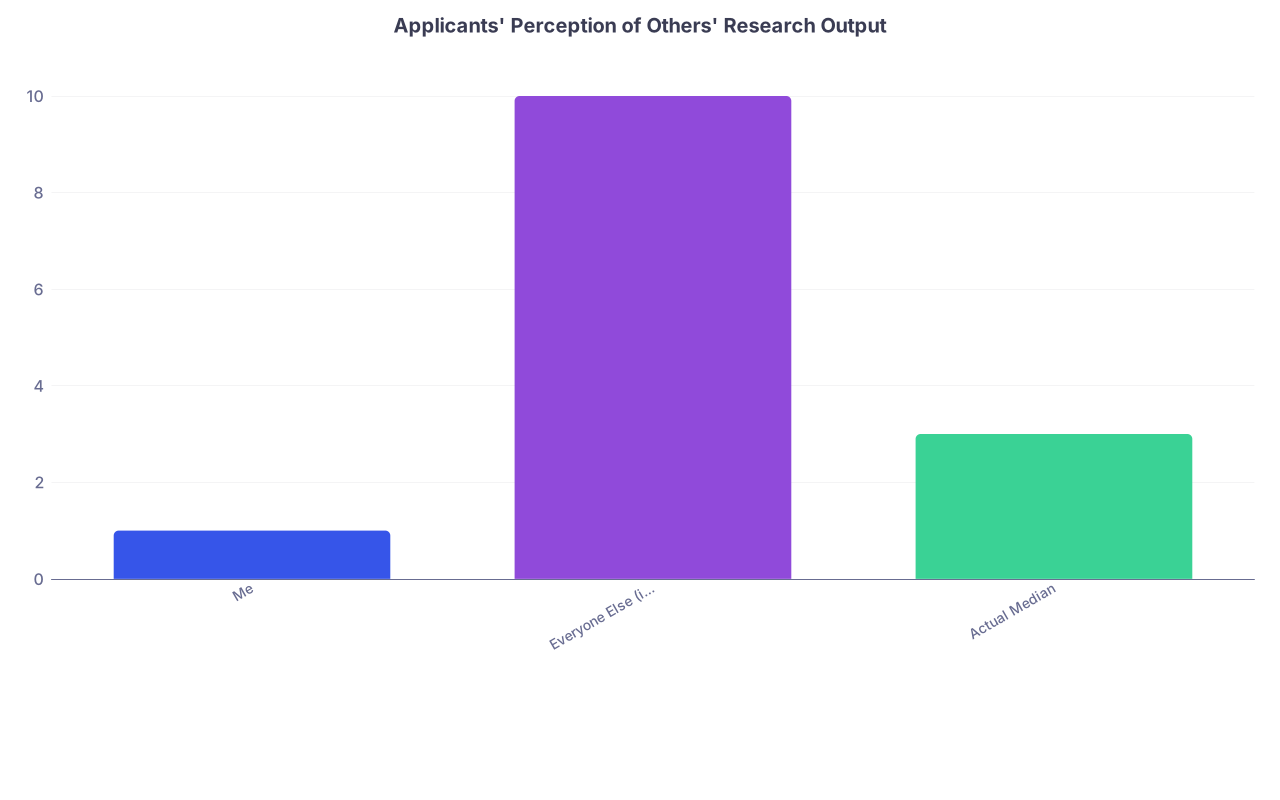
| Category | Value |
|---|---|
| Me | 1 |
| Everyone Else (in my head) | 10 |
| Actual Median | 3 |
Here’s the script running in your head:
- “Program directors are going to see just one case report and think I’m lazy.”
- “People applying to [insert competitive specialty] have 15+ publications, R01s, and a Nobel.”
- “My single case report is basically a participation trophy.”
Let me be blunt: your brain is catastrophizing.
Is one case report the same as three years of basic science or 10+ first-author clinical studies? No. Of course not.
But is a single case report “nothing”? Also no.
Programs don’t look at that line as “lol, cute.” They see:
- You got something from clinical reality → to idea → to IRB/approval (hopefully) → to writing → to submission/presentation/publication.
- You finished a scholarly project. That matters a lot more than you think.
- You had at least one faculty member who trusted you enough to attach their name to your work.
Is this enough on its own to impress, especially for hyper-competitive specialties? Probably not.
Is it a zero? Definitely not.
How Programs Actually Look at Case Reports

Let me walk you through how I’ve literally heard people on selection committees talk.
Picture a pile of applications. They’re going down the list:
- “USMLE scores, fine.”
- “Clerkship grades, solid.”
- “Research… one case report, okay.”
- “LORs, strong.”
What they don’t say is: “Only a case report? Disgusting. Reject.”
The mental buckets for research often go more like this:
| Category | What They Think |
|---|---|
| None at all | Missed opportunity / neutral to mild negative |
| Minimal (e.g., 1 case) | Baseline effort / at least did something |
| Moderate (2–5 projects) | Good engagement, depending on quality |
| Heavy (6+ pubs, abstracts) | Strong research interest / potential academic path |
Your single case report puts you clearly in “minimal but not zero.”
Is that amazing? No.
Is that categorically bad? Also no.
Where it matters more is:
- For research-heavy or academic programs.
- For highly competitive specialties.
- When comparing you to someone almost identical on everything except research.
But it’s not the automatic deal-breaker your brain is making it out to be.
Specialty Reality Check: When a Single Case Report Hurts vs. When It’s Fine
This is the part you’re really afraid of: “Am I doomed for my specialty because I only have one case report?”
Let’s be honest by specialty type.
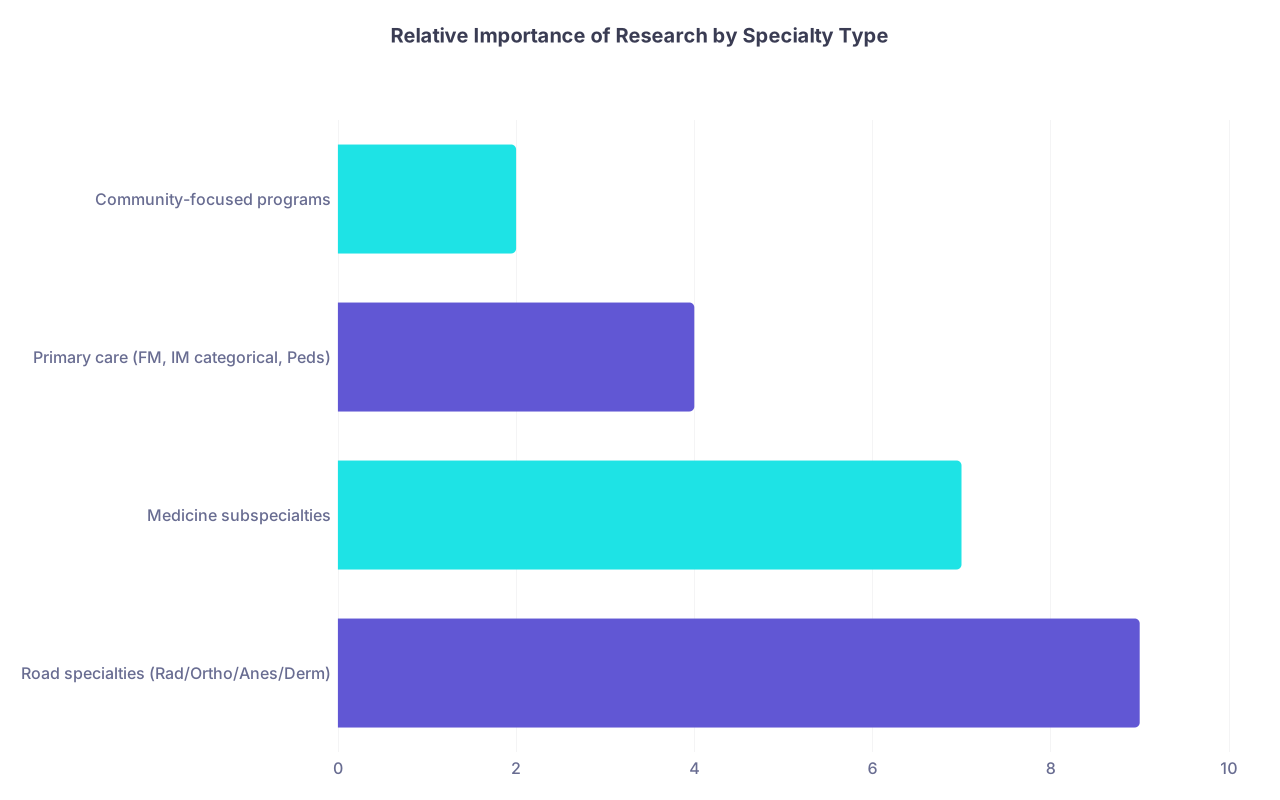
| Category | Value |
|---|---|
| Road specialties (Rad/Ortho/Anes/Derm) | 9 |
| Medicine subspecialties | 7 |
| Primary care (FM, IM categorical, Peds) | 4 |
| Community-focused programs | 2 |
High research expectations
Think: dermatology, radiation oncology, plastics, some ortho, some ENT, top academic IM or neurology programs.
Reality:
- Many applicants to these programs have multiple publications, often real clinical/translational work.
- Faculty do pay attention to PubMed presence and ongoing projects.
- A lone case report will not carry you at those places.
Does that mean you’re automatically dead? Not necessarily, but:
- You’d better have something else exceptional (Step scores, AOA, insane letters, home program connections).
- You should be strategic: balance your list with mid/low-tier and community programs, not just elite research institutions.
- You absolutely should try to squeeze in additional scholarly work if you can (even QI, posters, retrospective chart reviews).
Middle-ground specialties / programs
Think: internal medicine, neurology, OB/GYN, EM, psych, many mid-level university programs.
Here, a single case report usually lands as:
- “OK, they’ve at least done something.”
- Extra points if: it’s in the specialty you’re applying to, and you can talk about it intelligently.
You might not stand out for research, but you’re not in the “no research, no idea how to talk about a project” camp either.
Lower research emphasis
Think: family medicine, many community IM and peds programs, smaller hospitals without massive academic infrastructure.
In these settings:
- They’re not judging you for not having bench research.
- Many residents have one or two things: a case report, a QI poster, a small retrospective study.
- Your single case report is usually perfectly adequate to show “I’m able to complete a scholarly project.”
If you’re applying mainly to these types of programs, your anxiety is probably louder than reality.
What Makes a Single Case Report Actually Valuable?
Here’s the annoying truth: not all case reports are equal.
Programs care more about how you use it than the raw fact that it exists.
Your one case report becomes a lot more powerful if:
It’s in your target specialty
Applying to neurology with a neurology case report? Much better than an unrelated one in dermatology.You can clearly explain your role
They want to hear: “I did the chart review, wrote the first draft, created the figures, and revised it per reviewer comments.”
Not: “I just added my name because my attending was nice.”You can talk about what you learned
Especially:- How it changed your thinking.
- How it affected your clinical decision-making later.
- How it sparked actual curiosity.
It’s not just a box you ticked
If, in an interview, you sound like you barely remember the case or just did this to “have something,” that’s obvious. They can tell.
The Conversation in Your Interview: How This Can Go Very Wrong (or Very Right)

| Step | Description |
|---|---|
| Step 1 | Interviewer sees case report |
| Step 2 | You explain role clearly |
| Step 3 | Moves on, neutral |
| Step 4 | Research becomes a plus |
| Step 5 | Looks like checkbox / weak point |
| Step 6 | Asks about it? |
| Step 7 | You sound engaged & reflective? |
Worst-case scenario you’re imagining:
- “So tell me about your research.”
- You: “Uh… it was a case of… something… it was rare, um, I helped write it, I guess.”
- Interviewer mentally: “Cool, so you don’t really care about this.”
Better scenario:
- “Tell me about your research.”
- You: “Most of my formal work has been in a single published case report in [field]. It started when we saw a patient with X who presented in this really atypical way. I led the chart review and wrote the first draft. What interested me was how it changed how I think about [specific diagnostic/management issue]. It also taught me a lot about seeing patterns in outliers and actually following through on a project instead of just talking about it.”
Now that single case report sounds like:
- Evidence of curiosity.
- Ability to finish work.
- Foundation for future projects during residency.
Same line on the CV. Totally different impression.
If You’re Still Early: How to “Upgrade” from Single Case Report to “Decent Story”
If you’re reading this with even a little time before ERAS locks, there are ways to beef things up without magically conjuring an RCT.
Some realistic options:
Join an ongoing retrospective project
Ask attendings or residents: “Do you have any chart review or retrospective work where you need help with data collection or basic analysis?”
People almost always need help with the boring parts.Turn your case report into more than one output
Same case, multiple formats:- Poster at a local/regional conference.
- Grand rounds or resident conference presentation.
- Short write-up for a departmental newsletter.
Suddenly that one patient becomes 2–3 lines on your CV.
Help with QI and call it what it is
QI is still scholarly activity.
“Reduced door-to-antibiotic time by X minutes via Y intervention” is more interesting to some programs than a random zebras-only case.
Don’t get paralyzed trying to create “perfect research.” A small, completed thing is better than an imaginary massive thing you never finish.
If It’s Too Late to Add More: How to Stop Spiraling and Use What You Have
Let’s say it’s go time. ERAS is in. You can’t add a new project. You’re just staring at your single case report and panicking.
Here’s what you can still control:
How you frame it on your CV
Under “role,” don’t write: “Helped with research.”
Write specifics: “Performed literature review, collected clinical data, wrote first draft, and revised manuscript based on peer review feedback.”How you connect it to your specialty interest
Tie it to your “why [specialty]?”
“This case was my first time really seeing how [specialty] sits at the intersection of [X/Y], and that’s what drew me in.”How you talk about future plans
Programs don’t just care what you’ve done. They care if you’ll participate during residency.
“I know my formal research is limited to a single case report, but I’m very interested in getting more involved in [clinical/education/QI] work during residency, especially around [area].”The rest of your application
Research is one piece. If your:- Letters are strong.
- Clinical grades are good.
- Personal statement isn’t generic.
You’re still in the game. Seriously.
Quick Reality Check: You’re Not the Only “Single Case Report” Applicant
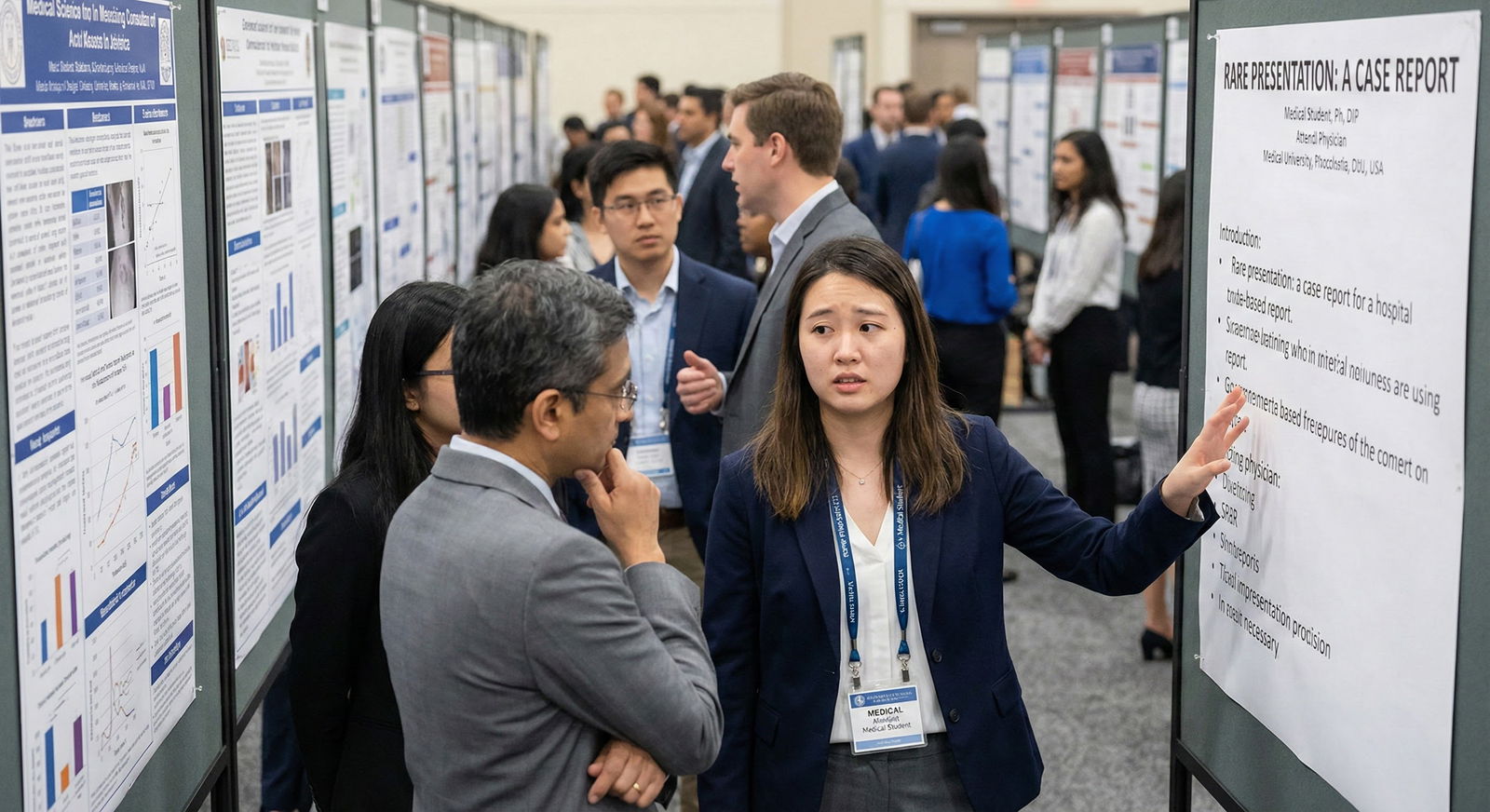
You know what’s funny? A ton of people have:
- A single case report
- Or: a poster that never got published
- Or: their name buried in the middle of an abstract they barely remember
But no one posts, “Matched into IM with only one lame case report!” on Reddit. They disappear into residency and move on with their lives.
You’re comparing your behind-the-scenes to everyone else’s highlight reel, and your brain is filling in the gaps with worst-case scenarios.
Mini Comparison: Where You Stand with One Case Report
| Situation | How Programs Tend to See It |
|---|---|
| Competitive specialty, top academic | Weak on research, need other strengths |
| Competitive but mid-tier/community | Acceptable if rest of app strong |
| Middle-competitiveness specialty | Fine; not a plus, not a huge minus |
| Community programs in most specialties | Totally adequate as 'some research' |
| Primary care-focused programs | Often more than many applicants have |
So no, you’re not “done.” You’re just… not a research rockstar. And that’s okay for most paths.
The Part You Don’t Want to Hear but Need To
If you are absolutely set on:
- Dermatology at a top-10 academic center
- Neurosurgery at ultra research-heavy places
- Oncology with a guaranteed research track
…then yeah, you probably needed more than a single case report. Those lanes are built for people who’ve been gunning for this for years.
But for most other applicants, especially going into IM, peds, psych, EM, FM, OB/GYN, neuro at non-top-5 places?
One case report isn’t the death sentence your 3 a.m. brain is whispering about.
FAQ: Single Case Report Panic Edition
1. Is a single case report better than having no research at all?
Yes. Definitely. Programs see at least:
- You can finish a project.
- You worked with faculty.
- You engaged with scholarly activity in some form.
Zero research gives them nothing to ask you about. One case report at least shows up as: “They tried.”
2. Will programs judge me because it’s just a case report and not a “real” study?
Some hyper-academic faculty secretly look down on case reports, yes. But most don’t care at that microscopic level.
They’re not ranking:
- RCT > cohort > case-control > case series > case report
for med students.
They’re mostly asking: “Did this person show initiative, follow-through, and curiosity?” You can absolutely demonstrate that with a case report.
3. Should I list my case report if it’s only accepted as a poster and not published?
Yes. Posters and abstracts belong on your CV.
Just be honest about status:
- “Poster presentation, [Conference], [Year].”
- If “submitted” only, label it as such and don’t oversell.
Even as a poster, it counts toward your scholarly story.
4. What if my case report isn’t in the specialty I’m applying to?
Not ideal, but not fatal.
You can still use it to show:
- You can do scholarly work.
- You can think critically about a patient.
- You understand the process from idea to product.
Then, in your personal statement or interviews, clarify your interest in the specialty you’re actually applying for and how your clinical experiences drew you there.
5. I didn’t do the majority of the writing—can I still talk about it?
Yes, but don’t lie.
You can say:
- “I contributed to literature review and data collection, and helped revise the discussion section.”
Then emphasize what you learned from participating. If you pretend you wrote the whole thing and get probed on details, it’ll be obvious you’re faking it. That’s way worse than having a smaller role that you’re honest about.
6. If I only have one case report, should I still bring up research in my personal statement?
If you make your entire personal statement about research and you only have one small project, it looks off.
But mentioning it briefly as part of your journey is fine, especially if:
- It ties into why you like the specialty.
- It shows how you think clinically.
- You’re honest about the scale of your experience.
Just don’t posture as “deeply committed to a physician-scientist career” with a single case report. Programs can spot that mismatch instantly.
Open your CV right now and look at how you’ve described that case report. Add 1–2 clear, specific lines about what you actually did and what you learned from it. Don’t change the past—just make sure you’re getting full credit for what you have done.