
Program directors trust institutions, not individuals. Remember that sentence, because it explains nearly every confusing interaction you will ever have about the research section of your application.
Here is the scenario I have watched play out for years. Applicant A spends fourteen months building a retrospective cohort with a community cardiologist, 400 charts, real statistics, a genuine publication in an indexed journal. Applicant B is author nine of eleven on a university meta-analysis, and their contribution was screening titles for three weeks. In interview after interview, Applicant B fields warm questions about "their work." Applicant A gets silence. Or worse, the squint, that half-second look a PD gives when they cannot decide whether your entry is research or decoration.
The difference is not merit. It is heuristics. And heuristics can be hacked, once you understand exactly what they are made of.
The Prestige Gap: Why Community-Based Research Triggers PD Skepticism
Let me break down what is actually happening in a PD's head when they reach your research entries.
If you are unsure how your specific research output will be perceived by committee members, refer to our guide on how PDs quietly rank applicants with zero, some, and heavy research to understand where you stand.
The institutional heuristic. Most program directors spent their formative years inside academic medical centers. Their mental model of "research" was built in that environment: an IRB down the hall, a biostatistics core on the third floor, a mentor whose promotion depends on producing legitimate scholarship. When a PD sees a university affiliation next to your mentor's name, they assume that entire infrastructure was present. When they see "Advanced Cardiology Associates of Greater Phoenix," they assume nothing. The burden of proof does not disappear, it transfers entirely to you.
Is this heuristic lazy? Yes. It is also rational. A PD at a mid-sized internal medicine program may screen 2,000 applications in six weeks. Affiliation is a free, instant proxy for oversight. Nobody gets fired for trusting a Stanford letterhead.
The "CV filler" stigma. Here is the part applicants do not want to hear: PDs are suspicious because they have been burned. Repeatedly. Every seasoned PD has interviewed a candidate who listed "Research Assistant" under a private physician and then could not name their own outcome variable when asked a single follow-up question. The entry was shadowing with a PubMed search stapled on top. After enough of those interviews, PDs develop a reflex: unaffiliated research reads as inflated until proven otherwise. Academic entries get the benefit of the doubt. Community entries start in a deficit.
The perception gap, defined precisely. An academic center is not a place with smarter doctors. It is an accountability stack, IRB review, grants administration, departmental research committees, promotion pressure, a library that warns faculty away from fraudulent journals. A community site may have excellent clinicians and rich data, but none of that accountability is visible on your CV. The PD is not judging your mentor's intelligence. They are judging the absence of verifiable oversight. That distinction matters, because absences can be filled.
The Verification Process: How PDs Validate Your Off-Site Mentor
When a PD is genuinely interested in you, especially in competitive specialties, they do not take your research section at face value. Here is the actual audit sequence.
Even with perfect methods, some applicants still struggle with the narrative of their projects. For those with limited publications, learn more about why PDs discount "In Progress" research on ERAS (and what to do) to avoid common application pitfalls.
Step one: the letterhead check. A letter of recommendation on university letterhead signals that the writer answers to a promotions committee and has institutional reputation at stake. A letter on private practice letterhead is not worthless, but it is unverifiable at a glance. So the PD triangulates: does this writer have a publication record? A faculty appointment anywhere? A name that appears in the citations on your own CV?
Step two: the citation search. Someone, the PD, an associate PD, a chief resident assigned to "look into this one", searches your publication. The hierarchy they apply, whether consciously or not:
- MEDLINE-indexed journal: full credibility, immediately.
- PubMed Central deposit: partial credibility. Here is a detail most applicants miss, a paper deposited in PMC displays a PMID even if the journal itself is not MEDLINE-indexed. Applicants exploit this ambiguity constantly, and PDs who know the difference check the journal's status in the NLM Catalog.
- Scopus or Web of Science indexing: acceptable, recognized.
- An ISSN and a website: nothing. An ISSN is a serial number, not a quality mark. Every predatory journal on earth has one.
Step three: the predatory screen. PDs specifically fear predatory publishing in community settings, because predatory journals prey on exactly that population, applicants with no institutional library, no grants office, and an urgent need for a CV line. The red flags are well known: solicitation emails addressed to "esteemed researcher," acceptance in seven days, a $1,600 article processing charge, a scope covering "all of medicine and allied sciences," and fake metrics like the "Global Impact Factor." If your citation sits in one of these venues, the entry does not read as neutral. It reads as a character problem, either you were deceived, or you knew.
Before you submit anywhere, run the journal through the Directory of Open Access Journals, the NLM Catalog, and the Think. Check. Submit. checklist. Ninety seconds of due diligence protects months of work.
How to Bridge the Credibility Divide: Strategic Positioning
Now the fixes. None of these require you to abandon your community mentor. They require you to manufacture the accountability signals that a university would have provided automatically.
1. Standardize every artifact of the project.
Rigor leaves a paper trail, and paper trails are what skeptical reviewers trust. Concretely:
- Register the protocol. Time-stamp it on the Open Science Framework before data extraction begins. For systematic reviews, register on PROSPERO. A registration ID costs nothing and instantly separates your project from retrofitted chart-fishing.
- Follow the reporting guidelines. STROBE for observational cohorts, CONSORT for trials, PRISMA for reviews. Stating "this study adheres to STROBE" in your ERAS description signals methodological fluency that most academic applicants never demonstrate.
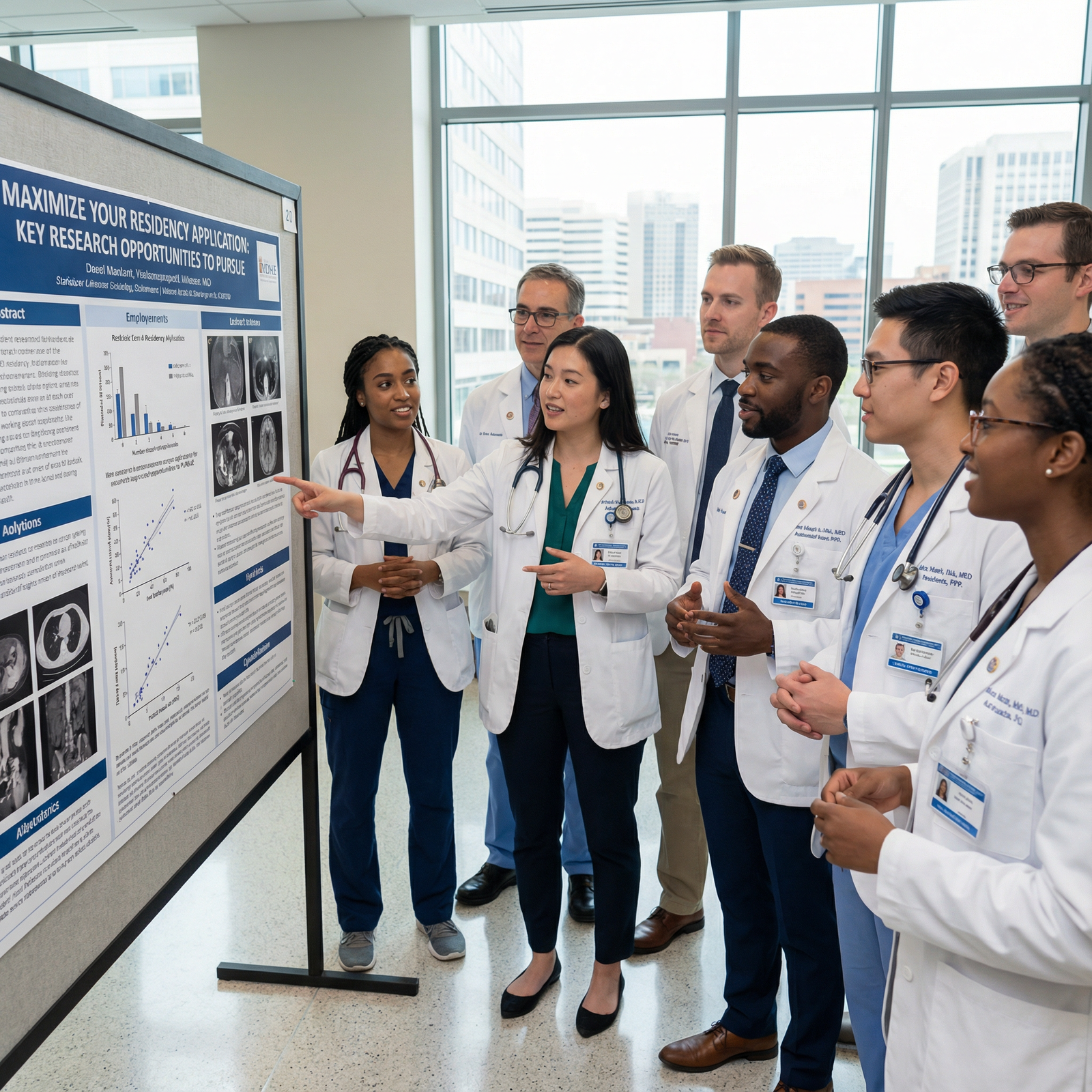
- Present formally. A poster at a named specialty society meeting, ACP, ACC, AAO-HNS, whatever fits, is a third-party validation event. Use the conference's official template. Sloppy, homemade posters reinforce the amateur-hour stereotype; a clean, guideline-structured poster dismantles it.
- Target indexed journals only. One publication in a modest MEDLINE-indexed journal outweighs three in predatory venues. Not equal. Outweighs.
2. Contextualize the mentor, compactly.
You have roughly two sentences in a personal statement or experience description to establish your mentor's credibility. Use them on verifiable facts: fellowship training institution, board certification, prior indexed publications, leadership roles (chief of staff, society committee member, site PI on industry trials). "Dr. Rao, an interventional cardiologist trained at Cleveland Clinic and site principal investigator for three device trials, supervised the project", that sentence does more work than two paragraphs about how inspiring she was.
And lean into what community sites actually offer. Volume and generalizability. A busy community cardiology group may see more NSTEMI in a quarter than a tertiary referral service, and that population, unselected, un-referred, is the one guidelines actually get applied to. Frame your setting as access to real-world data, because that is precisely what it is. Hiding the setting makes PDs suspicious. Owning it makes you interesting.
3. Run the dual-mentorship play.
This is the single highest-yield strategy for off-site research, and it is underused. The structure: your community clinician owns the clinical question and the data access; an academic co-mentor owns analytic oversight and manuscript framing. The community site contributes what universities struggle to get, dense, generalizable patient data. The academic contributes what community sites lack, statistical supervision and an institutional name on the author line.
The result is a hybrid project, and the perceived-value jump is dramatic.
Two cautions. First, the academic co-author must make a real contribution, ICMJE authorship criteria exist, and PDs can smell an ornamental author line. Second, do not assume no faculty member will respond. A cold email to a university biostatistician or a clinically aligned faculty member, offering a clean, IRB-approved dataset and genuine collaboration, gets answered more often than applicants expect. Faculty need publications too. That asymmetry is your opening.
Optimizing Your Research Narrative for ERAS
Even legitimate community research dies in the description field. Here is how to write it so it survives.
Describe methods and impact, never activities. ERAS experience descriptions cap at roughly 600 characters. Most applicants waste them on process narration, "assisted with," "helped with," "participated in." Those phrases are credibility killers because they describe presence, not contribution. Use ownership verbs: designed, extracted, analyzed, authored, presented. Then load the structural facts a verifier wants:
"Designed a retrospective cohort of 412 adults with resistant hypertension at a 14-provider community cardiology practice. Performed chart abstraction and multivariable logistic regression in R under biostatistics faculty supervision. IRB exemption granted by WCG IRB (#2024-1187). First author on manuscript under review at a MEDLINE-indexed journal; interim analysis presented as a poster at ACP Internal Medicine Meeting 2024."
Sample size. Statistical method. IRB identifier. Venue. Your discrete role. Every element is checkable, and checkability is the entire game.
The shadowing line you must not cross. If you did not touch data, draft a manuscript section, or present an abstract, the project is not research. List it as a clinical experience. PDs probe this relentlessly in interviews: "Walk me through your inclusion criteria." "Why logistic regression instead of a chi-square test?" "What was your primary limitation?" I have watched applicants fold in under ten seconds on the first question, and the collapse contaminates everything else on their CV, including the legitimate entries. One fabricated entry poisons the whole document.
Make your IRB transparent. Community research rarely runs through a university IRB, and PDs know this, which is exactly why you must name yours. Central and commercial IRBs, WCG, Advarra, Sterling, are the standard mechanism for community-based studies, and exemption determinations from them are legitimate. Write the IRB name and determination number directly into your ERAS description. That single line converts your project from "unsupervised" to "legible." An unmentioned IRB lets the PD assume the worst: that no oversight existed at all.
Prepare your mentor for the follow-up call. It is rare outside the most competitive specialties, but it happens, a PD or faculty reviewer emails or phones your mentor directly. Brief your mentor before interview season with a one-page summary: the study's aim, your specific role, the timeline, the IRB status, and the manuscript's current stage. Your mentor should be able to speak about your contribution for two minutes without notes. Nothing ends your research credibility faster than a mentor who answers, "Remind me which project this was?"
Key Takeaways
The whole problem, and the whole fix, compress into three rules:
- PDs equate "research" with "replicability." If your mentor sits outside an academic center, you must prove the methodology was as rigorous as a university-led study, registered protocols, reporting guidelines, named IRB oversight, and indexed output. Rigor you can point to beats prestige you cannot.
- Never list a project as research if it was shadowing. PDs will expose it in a single interview question, and one collapsed entry takes your entire application down with it. Clinical experience is honorable. Mislabeled clinical experience is fatal.
- Indexed publication is the universal validator. PubMed/MEDLINE and Scopus indexing are recognized by every PD regardless of where the work originated. A hybrid project, community data plus academic analytic oversight, delivers the best of both worlds and closes the credibility gap almost entirely.
Community-based research is not weaker research. It is unvouched research, and those are very different problems. The first you cannot fix. The second you now know exactly how to.