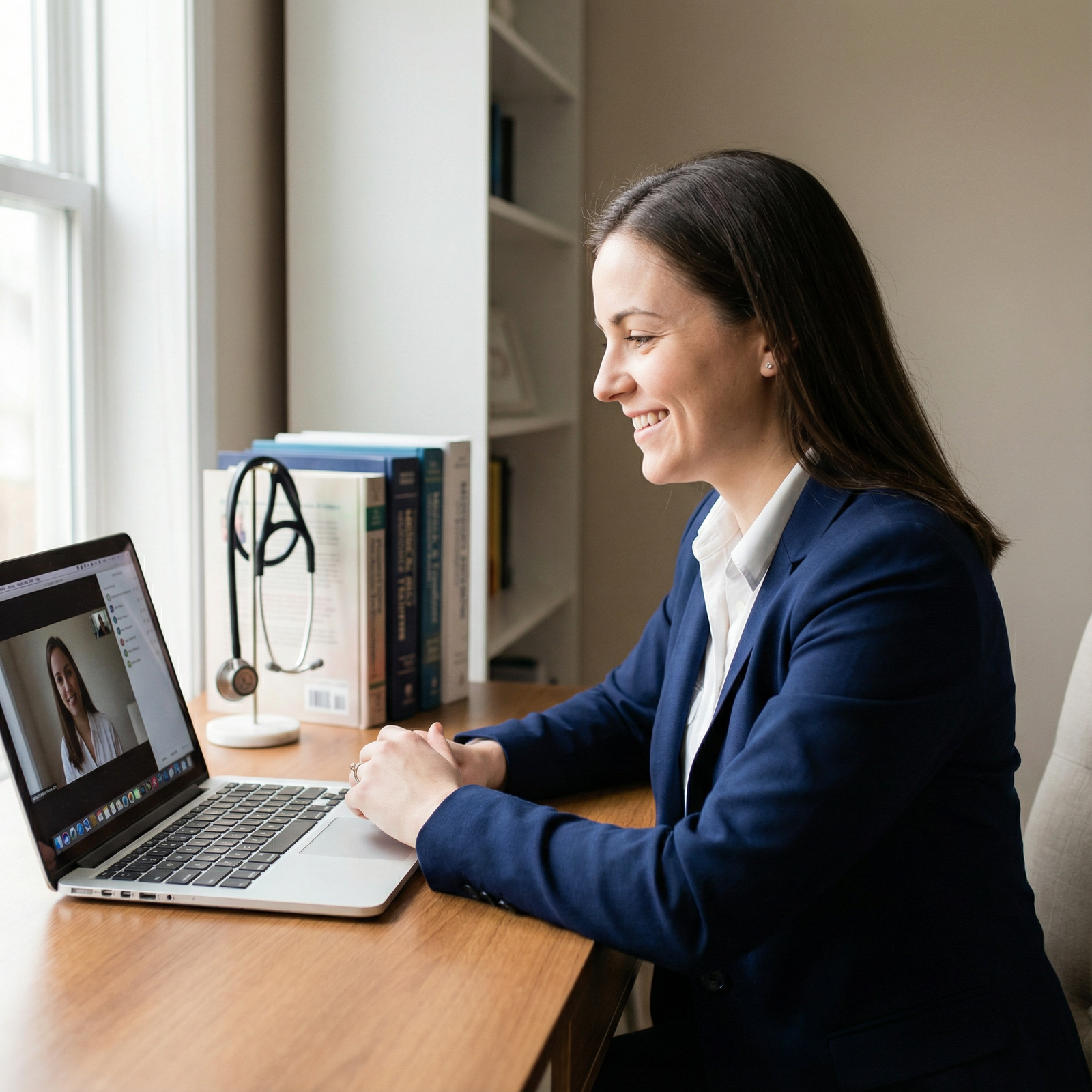
In the current landscape of medical education and residency applications, Virtual Interviews are no longer a temporary solution—they are a core part of how programs select residents. For applicants, this shift brings enormous opportunity and unique challenges. You’re now expected to demonstrate clinical maturity, professionalism, and program fit through a screen.
This guide walks you through how to ace your virtual residency interviews with practical, high-yield strategies grounded in real applicant experiences and program expectations. Whether you’re applying this year or planning ahead, these Interview Preparation and Career Tips will help you present your best self and make a strong impression on every program.
Understanding the Role of Virtual Interviews in Residency Applications
Virtual residency interviews are now central to the residency selection process. Most specialties and programs have integrated virtual formats—either fully or paired with optional in-person visits—because they:
- Reduce travel costs and time burdens for applicants
- Allow programs to meet more candidates efficiently
- Expand access to geographically distant programs
- Offer flexibility for international medical graduates (IMGs) and non-traditional applicants
From the program’s perspective, a virtual interview is still a professional interaction, not a casual video chat. Faculty, residents, and program leadership will evaluate you on:
- Professionalism and communication skills
- Clinical maturity and insight
- Fit with the program’s mission and culture
- Alignment of your goals with their training environment
- Ability to handle stress, ambiguity, and ethical challenges
Unique Challenges of Virtual Interviews
While interviewing from home may feel more comfortable, it introduces specific challenges that can impact your performance if not addressed:
Technical Problems
- Unstable internet, audio lag, or frozen video
- Difficulty accessing the platform (Zoom, Thalamus, Webex, etc.)
- Poor sound or lighting that makes you hard to see or hear
Reduced Non-Verbal Communication
- Harder to establish eye contact through a camera
- Body language more limited to upper body and face
- Subtle cues—like how you greet or enter the room—are different or missing
Environmental Distractions
- Noise from roommates, family, pets, or neighbors
- Visual distractions in the background
- Interruptions from deliveries, notifications, or other devices
Despite these challenges, virtual interviews can be a major advantage when approached strategically. Many successful residents describe virtual formats as an environment where they could control more variables—lighting, noise, setup—and therefore perform at their best.
Strategic Preparation: Laying the Foundation for a Strong Interview
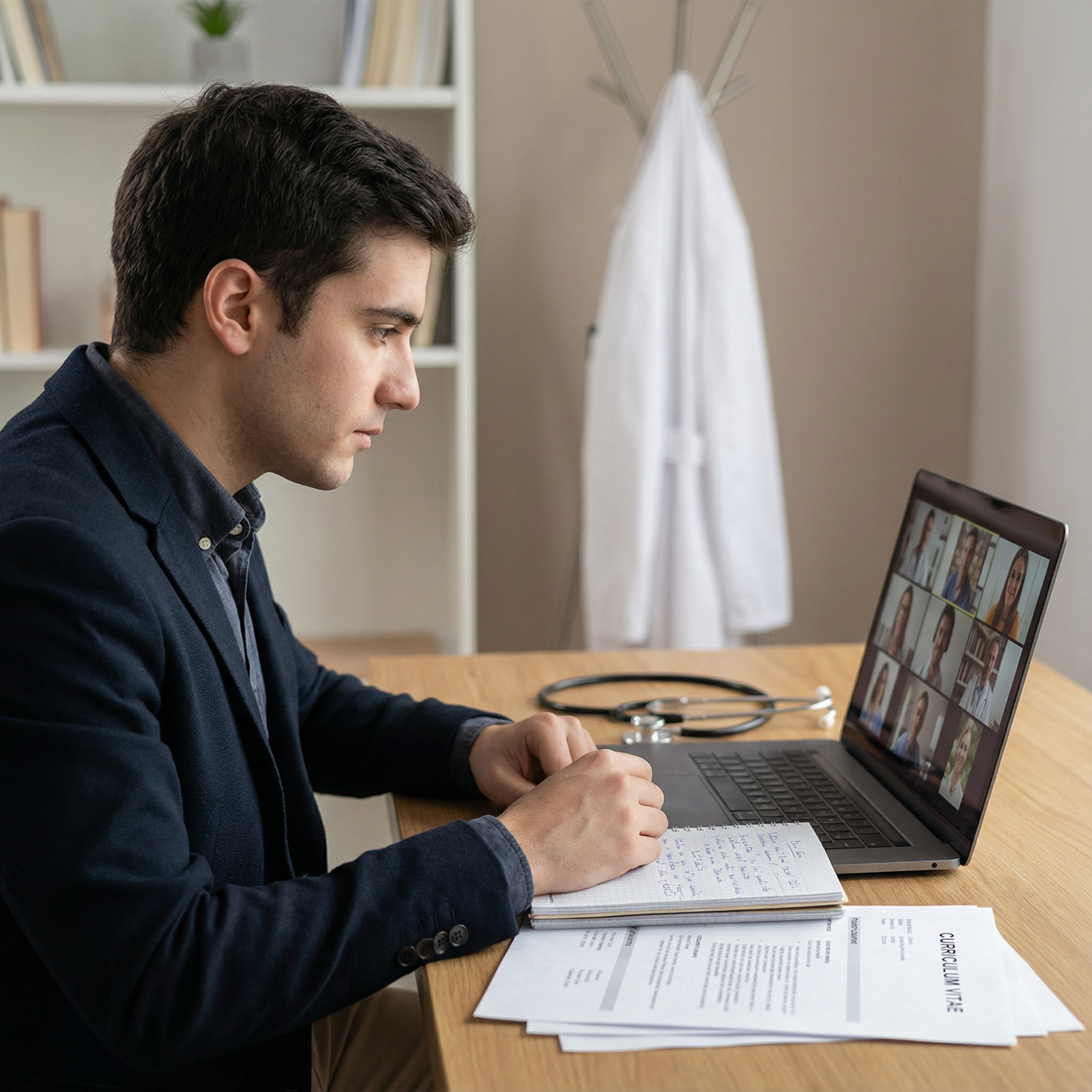
Thorough preparation is still the most powerful way to stand out—especially when you cannot rely on in-person rapport or physical presence. Treat your virtual interview like a high-stakes clinical encounter: you would never walk into a new patient encounter unprepared; don’t walk into an interview that way either.
1. Deep-Dive Research on Each Program
Generic answers are the fastest way to blend in. Programs want to know why their training environment fits your goals.
Actionable steps:
Study the program’s website
- Mission statement and core values
- Curriculum structure (rotations, tracks, longitudinal experiences)
- Research opportunities and scholarly activity
- Resident wellness initiatives, diversity and inclusion efforts
Look up faculty and leadership
- Program Director and Associate PDs
- Key faculty in your areas of interest (e.g., ultrasound, global health, critical care)
- Recent publications or initiatives you can reference in conversation
Explore program presence beyond the website
- Social media (X/Twitter, Instagram, LinkedIn)
- Resident-run blogs, podcasts, or webinars
- Virtual open houses or information sessions
Use your research to:
- Tailor your answer to “Why this program?”
- Ask specific, meaningful questions (e.g., about a curriculum innovation you read about)
- Show that you are genuinely invested in learning about them—not just accumulating interviews
2. Know Your Application Better Than Anyone Else
Your ERAS application, CV, personal statement, and letters are the foundation of your interview. Interviewers will frequently reference them, and you should be prepared to talk comfortably about every element.
Review and reflect on:
- Key clinical experiences and sub-internships
- Research projects—your exact role, findings, and what you learned
- Leadership, teaching, advocacy, or community work
- Red flags or non-linear paths (leaves of absence, exam failures, career changes)
For every major experience listed, prepare to answer:
- What exactly did you do?
- What skills did you build or demonstrate?
- What did you learn, and how has it shaped your approach to residency or your specialty?
3. Anticipate and Practice Common Interview Questions
You will likely encounter variations of many classic residency interview questions, as well as program-specific ones. Prepare concise, structured responses that incorporate brief, concrete examples.
Some high-yield prompts to prepare:
- “Why this specialty?”
- “Why our program specifically?”
- “Tell me about yourself.”
- “Describe a challenging clinical situation and how you handled it.”
- “Tell me about a time you received critical feedback.”
- “What are your strengths and weaknesses?”
- “How do you handle stress or burnout?”
- “Describe a time you worked on a team and faced conflict.”
- “Where do you see yourself in 5–10 years?”
Use simple, structured frameworks like:
- STAR: Situation – Task – Action – Result
- SPIES (for conflict/ethics): Situation – Problem – Ideas – Evaluation – Solution
Practicing out loud is crucial. Written answers don’t automatically translate to spoken clarity.
4. Designing a Professional, Interview-Ready Space
Your interview environment is part of your first impression. It signals professionalism, organization, and respect for the process.
Aim for:
Quiet, private location
- Inform roommates/family of your schedule
- Put a note on the door to prevent interruptions
- Silence phones, smart speakers, and notifications
Clean, neutral background
- Plain wall, tidy bookshelf, or simple office space
- Avoid clutter, busy patterns, or distracting posters
- If necessary, use a simple, non-distracting virtual background—but real background is usually preferred if professional
Good lighting
- Natural light in front of you (not behind) is ideal
- If needed, use a desk lamp or ring light at eye level
- Make sure your face is evenly lit and clearly visible
Ergonomic, stable setup
- Laptop or camera at eye level (use books or a stand)
- Sit an arm’s length from the camera
- Avoid holding your device; shaky video is distracting
Technical Readiness: Eliminating Preventable Problems
Technical problems are sometimes unavoidable, but most can be minimized with deliberate Interview Preparation.
1. Get Comfortable with the Interview Platform
Well before interview day, confirm:
- Which platform each program uses (Zoom, Thalamus, Teams, Webex, etc.)
- Whether you need to download apps or update software
- Your login credentials and any waiting room or passcode details
Do at least one full test run:
- Conduct a mock call with a friend, advisor, or fellow applicant
- Check audio, video, screen name, and background
- Practice muting/unmuting, turning video on/off, and using chat if needed
Use your real interview equipment (same computer, headphones, internet) during practice.
2. Optimize Your Equipment and Connection
High-quality equipment doesn’t need to be expensive, but it does need to function reliably.
Checklist:
- Computer: Up to date, plugged in or fully charged
- Camera: Built-in or external webcam with clear image
- Audio: Headset or earbuds with built-in microphone often provide the best sound and reduce echo
- Internet:
- Prefer wired Ethernet if possible
- If Wi-Fi only, interview close to the router
- Ask others not to stream high-bandwidth content during your interview
Pro tip: Run an internet speed test; aim for at least ~5–10 Mbps upload and download for smooth video.
3. Always Have a Backup Plan
Even with preparation, problems can occur. Programs understand this—but they will also notice how you handle them.
Prepare:
- A backup device (tablet or phone) with the app installed
- Program coordinator’s email and phone number easily accessible
- Your phone fully charged and nearby
If something goes wrong:
- Stay calm, acknowledge the issue briefly
- Use the chat to let them know you’re reconnecting, if possible
- If you lose connection entirely, email or call the coordinator immediately
- Rejoin as soon as you can, apologize once, then move on without dwelling on it
How you recover from a glitch can actually demonstrate poise, adaptability, and professionalism.
Rehearsal and Performance: Practicing Until It Feels Natural
You cannot control every question you’ll be asked, but you can control how prepared and composed you are. Practice builds confidence and reduces anxiety.
1. Conduct Mock Virtual Interviews
An effective mock interview replicates the real conditions:
- Use the same platform and setup you’ll use on interview day
- Sit in your actual interview space, in full professional attire
- Ask a mentor, resident, or faculty member to conduct the mock
- Request honest feedback on:
- Clarity and structure of answers
- Non-verbal communication (eye contact, posture, facial expressions)
- Professionalism and energy level
If faculty are unavailable, do mock sessions with classmates or through your school’s career or advising office.
2. Record and Review Your Practice Sessions
Seeing yourself on video can feel uncomfortable, but it is an exceptionally powerful tool for improvement.
As you review, ask:
- Do I look engaged and attentive, or flat and monotone?
- Am I speaking too fast, too slow, or using filler words excessively?
- Am I looking at the camera enough to simulate eye contact?
- Are my facial expressions consistent with what I’m saying?
Make specific adjustments (e.g., slower pace, more pauses, more direct gaze at the camera) and repeat.
3. Fine-Tune Your Professional Presence
Non-verbal communication remains critical in virtual interviews.
Body language and demeanor:
- Sit upright but relaxed, with both feet on the floor
- Keep your shoulders open; avoid crossing your arms
- Nod occasionally to show you are listening
- Let your natural expressions come through—interviewers want to see your personality
Eye contact through the camera:
- Place the video window near your camera so your gaze doesn’t wander
- When you speak, look primarily at the camera, not at your own image
- When listening, it’s fine to look at the interviewer’s video box
Professional attire:
- Dress as you would for an in-person interview (e.g., suit, blazer, or equivalent)
- Solid, neutral colors tend to look best on camera
- Avoid busy patterns or excessive accessories
- Dress fully—not just the top half—in case you need to stand up unexpectedly
Dressing professionally also helps you feel more like you’re in a serious, high-stakes setting, which can improve mindset and focus.
Performing on Interview Day: How to Stand Out on Screen
By interview day, your goal is to execute calmly and confidently, not to cram new content. Treat the day like a major exam: you’ve already done the studying; now you just need to perform.
1. Start Strong: First Impressions Still Matter
- Log in 10–15 minutes early to troubleshoot any last-minute issues
- Double-check your lighting, audio, and background
- When you first meet your interviewer:
- Smile warmly
- Greet them by name if provided (“Good morning, Dr. Smith. Thank you for taking the time to meet with me today.”)
- Show appreciation for the opportunity
Those first few seconds set the tone for the rest of the conversation.
2. Communicate Clearly and Thoughtfully
In the virtual format, clarity is essential:
- Speak slightly slower than you think you need to
- Use short pauses between ideas to avoid talking over the interviewer
- If the audio lags, wait a second before responding to avoid interruptions
- If you don’t understand a question, it’s fine to ask for clarification
When answering, prioritize depth over length: better to give a focused, meaningful example than a long, unfocused response.
3. Show Authenticity, Insight, and Self-Awareness
Programs are not looking for perfection; they are looking for evidence that you are:
- Reflective about your experiences
- Honest about your strengths and growth areas
- Genuinely passionate about the specialty and patient care
Examples of authenticity:
- Owning a mistake and explaining what changed in your practice
- Acknowledging a challenge (e.g., burnout, failure, imposter syndrome) and how you addressed it
- Being specific about what excites you in the specialty (certain patient populations, procedures, continuity)
Generic enthusiasm (“I love working with people”) is less memorable than specific, grounded examples.
4. Engage Actively as a Listener and Participant
Strong interview performance is not just about answering questions; it’s about how you interact.
- Listen fully before responding—avoid jumping in too early
- Use verbal cues (“Absolutely”, “That’s a helpful question”) sparingly to show engagement
- Mirror the interviewer’s energy level while staying true to your style
- In group or panel settings, avoid dominating the conversation but don’t disappear either
5. Ask High-Quality, Personalized Questions
Asking thoughtful questions accomplishes two things:
- It shows genuine interest and preparation
- It helps you discern whether the program is a good fit
Consider asking about:
- Resident education structure and feedback culture
- Support for research, advocacy, or global health interests
- How the program has adjusted to virtual learning or telemedicine
- Wellness resources, mentorship, and career development support
- How residents are involved in quality improvement or leadership
Avoid questions easily answered on the website (e.g., “How many residents are in the program?”) unless you are clarifying.
Have a short list of 4–6 questions ready, then choose dynamically based on what is already discussed that day.
After the Interview: Follow-Up, Reflection, and Continuous Improvement
What you do after each interview can significantly influence both your future performance and how programs remember you.
1. Thoughtful Thank-You Notes
While practices vary, many programs appreciate concise, specific thank-you messages.
Good thank-you notes are:
- Sent within 24–72 hours of the interview
- Personalized to each interviewer when possible
- Specific (mentioning a topic you discussed or something you learned)
- Professional in tone—brief, clear, and free of exaggeration
Example structure:
- Express gratitude for their time
- Reference a specific part of your conversation or something you appreciated about the program
- Reiterate your interest in the program and/or how it aligns with your goals
Avoid implying ranking commitments or exaggerating (“You are definitely my #1 choice”) unless you genuinely mean it and it is appropriate at that stage.
2. Systematic Self-Reflection
Immediately after each interview day:
- Take 10–15 minutes to jot down:
- Questions you were asked (especially tough or unexpected ones)
- What went well
- What you wish you had answered differently
- Key impressions about the program, residents, and culture
Over time, this creates a personal question bank and helps you identify patterns you can improve on before the next interview.
3. Learning from Real Applicant Success Stories
Many applicants who matched highly in the virtual interview era share similar habits:
Case Example 1: Peer Practice and Performance
A candidate scheduled weekly mock virtual interviews with a classmate. They rotated roles—one as interviewer, one as applicant—using a shared document of common questions. Feedback sessions focused on clarity and body language. By the time real interviews began, the candidate described feeling “surprisingly comfortable,” and multiple programs later commented on their poise and confidence.Case Example 2: Environment and Professional Presence
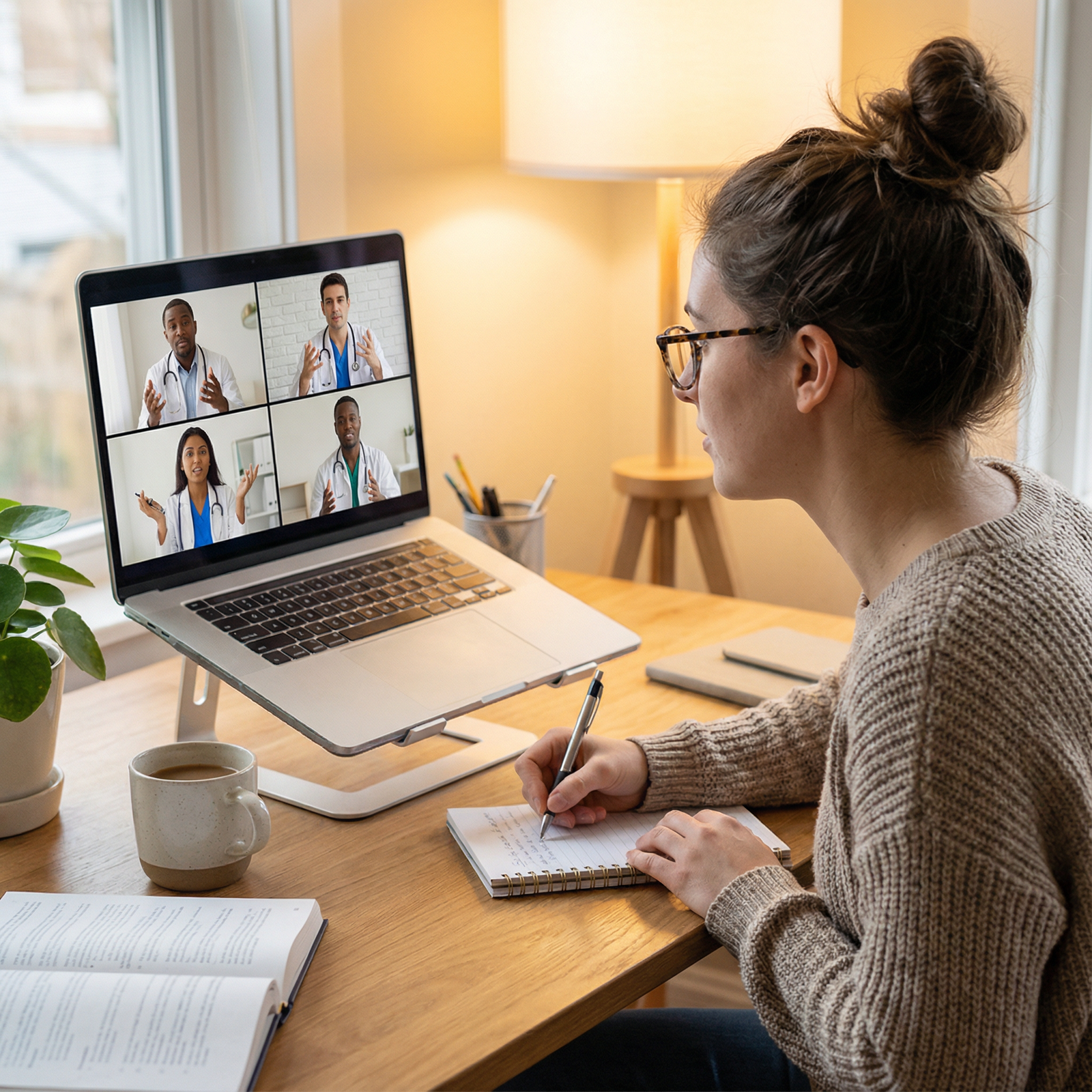
Another applicant invested time in optimizing their space: neutral background, consistent lighting, and a laptop stand to align the camera at eye level. They noticed a dramatic difference when comparing early recordings with later ones. Faculty interviewers explicitly praised how “engaged” and “present” they seemed—even through the screen—helping them stand out among similarly qualified peers.
These stories reinforce a central principle: you cannot control your metrics by interview season, but you can significantly influence how you’re perceived in your interactions.
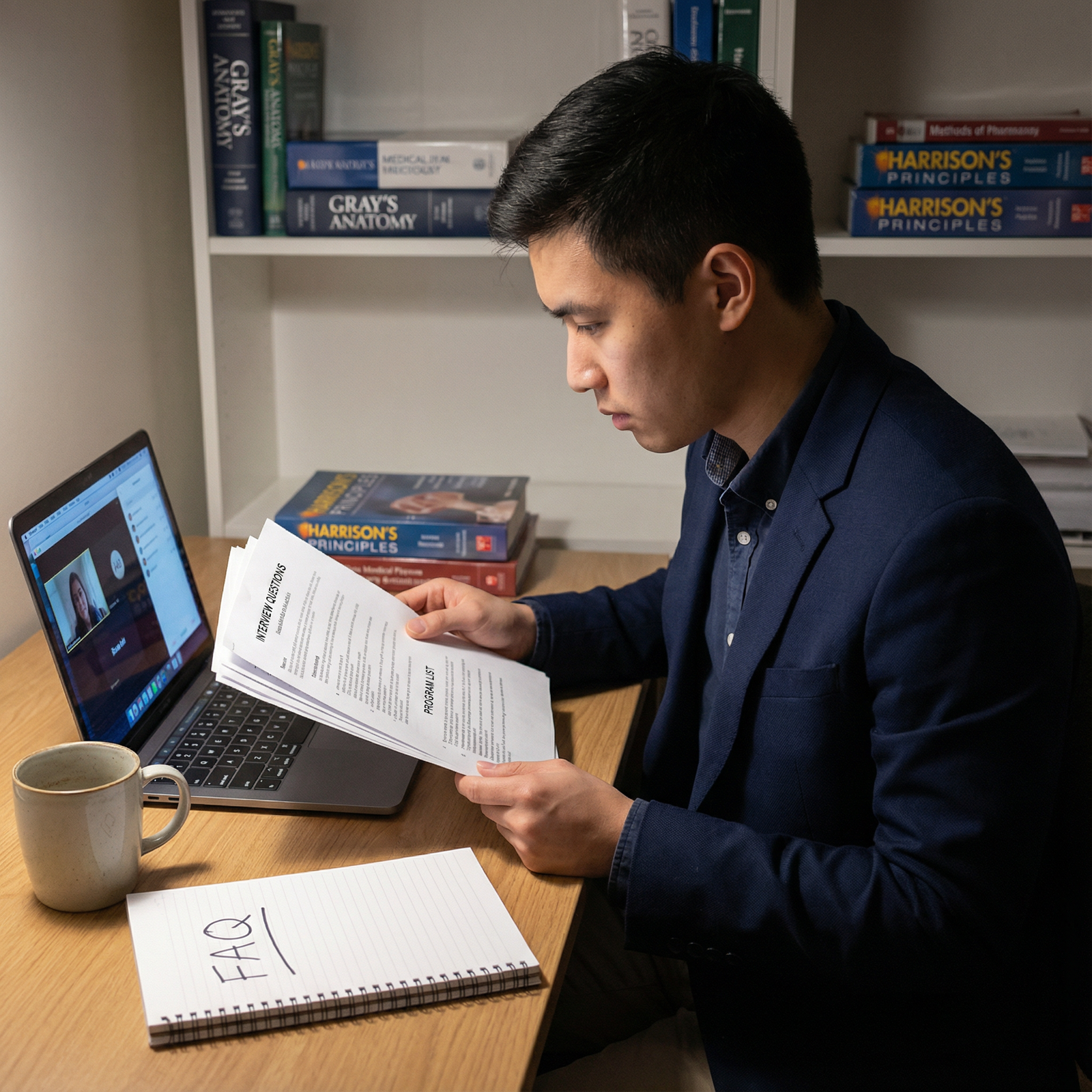
Frequently Asked Questions (FAQ) About Virtual Residency Interviews
1. How far in advance should I start preparing for my virtual residency interviews?
Ideally, begin 4–6 weeks before your earliest interview:
- Weeks 1–2: Program research, refining your personal narrative, updating your CV talking points
- Weeks 2–3: Draft and practice answers to common questions; schedule mock interviews
- Weeks 3–4: Finalize your interview setup (space, lighting, technology), do recorded practice runs
- Week of interview: Light review, rest, and logistics (confirm times, time zones, links)
If you have less time, prioritize: tech setup, practice with common questions, and one or two mock interviews.
2. What should I do if I encounter technical issues during a virtual interview?
Stay calm and handle it professionally:
- Briefly acknowledge the issue (“I’m sorry, it looks like my audio cut out for a moment.”)
- Try to quickly correct it (reconnect audio, move closer to router, restart the app if needed)
- Use the chat feature to communicate if audio is failing
- If disconnected, rejoin immediately; if unable, contact the coordinator by phone or email
Programs understand that technical issues occur. They are more interested in how you respond—calmly, respectfully, and with problem-solving skills.
3. Is it acceptable to use notes during virtual residency interviews?
It’s generally best not to rely on visible notes:
- Glancing repeatedly off-screen can make you appear disengaged or scripted
- Over-prepared answers can sound unnatural or rehearsed
A small discreet set of bullet points (key program details, questions you want to ask) placed near your camera is reasonable. Use them as a backup, not a script. Focus on conversation, not reading.
4. How should I handle unexpected or difficult questions?
You are not expected to have perfect, polished answers to every curveball. When faced with a tough question:
- Take a brief pause: “That’s a thoughtful question; let me think for a moment.”
- Clarify if needed: “Just to make sure I understand, are you asking about…?”
- Use a simple structure to organize your response (e.g., past example, what you learned, how you’d apply it now)
- Stay honest—if you don’t know something, say so and explain how you would find the answer or approach the problem
Thoughtful, reflective answers usually matter more than being quick or “correct.”
5. How important are thank-you emails and post-interview communication?
While policies vary by specialty and program, sending a professional thank-you email is generally recommended:
- It demonstrates courtesy and professionalism
- Reinforces your interest in the program
- Gives you a chance to highlight a memorable part of your interaction
Keep them brief, sincere, and specific. Avoid over-communicating (e.g., multiple follow-up emails) unless the program requests additional information.
Virtual residency interviews are a critical part of your residency applications journey. With deliberate preparation, technical readiness, and authentic engagement, you can turn the virtual format into an advantage. Use this period not only to impress programs, but also to assess where you will thrive as a learner and future physician.
Every interview is a learning opportunity. Approach each one with curiosity, professionalism, and intentionality—you are not just proving your readiness for residency; you are also choosing the environment in which you will grow into the physician you aspire to be.