
Understanding the Landscape of General Surgery Board Exam Prep
Preparing for general surgery boards—whether the ABS Qualifying (written) Exam, Certifying (oral) Exam, or in‑training exams (ABSITE)—requires a deliberate strategy and the right mix of resources. Unlike the medical school boards, this phase demands integration of operative judgment, clinical decision‑making, and broad textbook knowledge.
Before selecting resources, clarify three things:
Your target exams
- ABSITE (PGY‑1 to PGY‑5): annual in‑training exam; strong predictor of Qualifying Exam performance.
- ABS Qualifying Exam (QE): written exam taken after residency graduation.
- ABS Certifying Exam (CE): oral exam taken after passing the QE.
Your baseline
- Past ABSITE percentiles.
- USMLE/COMLEX performance (Step 1, Step 2 CK).
- Comfort level with core subspecialties: trauma/critical care, colorectal, vascular, breast, endocrine, surgical oncology, HPB, minimally invasive surgery.
Your realistic time budget
- Q4 vs Q6 call, research year vs full‑time clinical, senior vs junior resident responsibilities.
The goal is not to use every resource, but to build a balanced, efficient toolkit combining:
- A core text for conceptual understanding.
- High‑yield reviews for rapid revision.
- Question banks for active learning and exam simulation.
- Flashcards (e.g., Anki USMLE‑style) for spaced repetition.
- Case‑based/operative resources for clinical and oral exam readiness.
Core Readings: Building a Strong Knowledge Foundation
Textbooks are slow but essential. They provide the conceptual scaffolding that makes question banks and flashcards truly stick.
1. Flagship Surgical Textbooks
These are not meant to be read cover‑to‑cover during a busy clinical year, but you should know where to look when you encounter weak areas.
Sabiston Textbook of Surgery
- Strengths:
- Excellent for physiology, pathophysiology, and evidence‑based management.
- Strong coverage of general surgery “bread and butter.”
- How to use:
- Target chapters missed on ABSITE (e.g., endocrine, transplant).
- Read 1–2 key chapters per week in PGY‑1 to PGY‑3.
- Use as reference when preparing for M&M or grand rounds.
Schwartz’s Principles of Surgery
- Strengths:
- Clear, clinically focused discussions.
- Good for trauma, critical care, and perioperative management.
- How to use:
- Alternate or complement with Sabiston.
- Ideal for deep dives on new consults or upcoming rotations (e.g., GI, vascular).
Greenfield’s Surgery
- Strengths:
- Detailed, particularly on surgical techniques and perioperative care.
- How to use:
- Selective review if your program uses it as a “house text.”
- Helpful for complex topics like transplant or surgical oncology.
Actionable advice:
Pick one primary text (often dictated by your program) and commit to it. Create a reading plan that aligns with your rotations (e.g., during a colorectal rotation, read the colorectal chapters in your chosen text and supplement with questions).
2. Focused Review Books for ABSITE and QE
These are more realistic as your day‑to‑day “study spine” during residency.
Surgical Recall
- Best for:
- Junior residents (PGY‑1–2), medical students on surgery rotations.
- Rapid‑fire OR and call prep.
- Limitations:
- Not deep enough as a standalone general surgery residency board resource.
- Strategy:
- Use during intern year to build vocabulary and basic frameworks.
ABSITE Slayer
- Best for:
- High‑yield ABSITE and QE preparation.
- Quick hits and question‑style learning.
- Features:
- Organized by topic with concise explanations.
- Emphasizes patterns frequently tested across years.
- Strategy:
- Read a few sections daily in the 3–4 months before ABSITE.
- Mark weak sections and revisit them just before the exam.
The ABSITE Review / Rush Review / Other House Favorites
- Best for:
- Programs that “officially” recommend or structure didactics around one text.
- Strategy:
- Sync your independent studying with your program’s curriculum.
- Use as the foundation, then plug gaps with question banks.
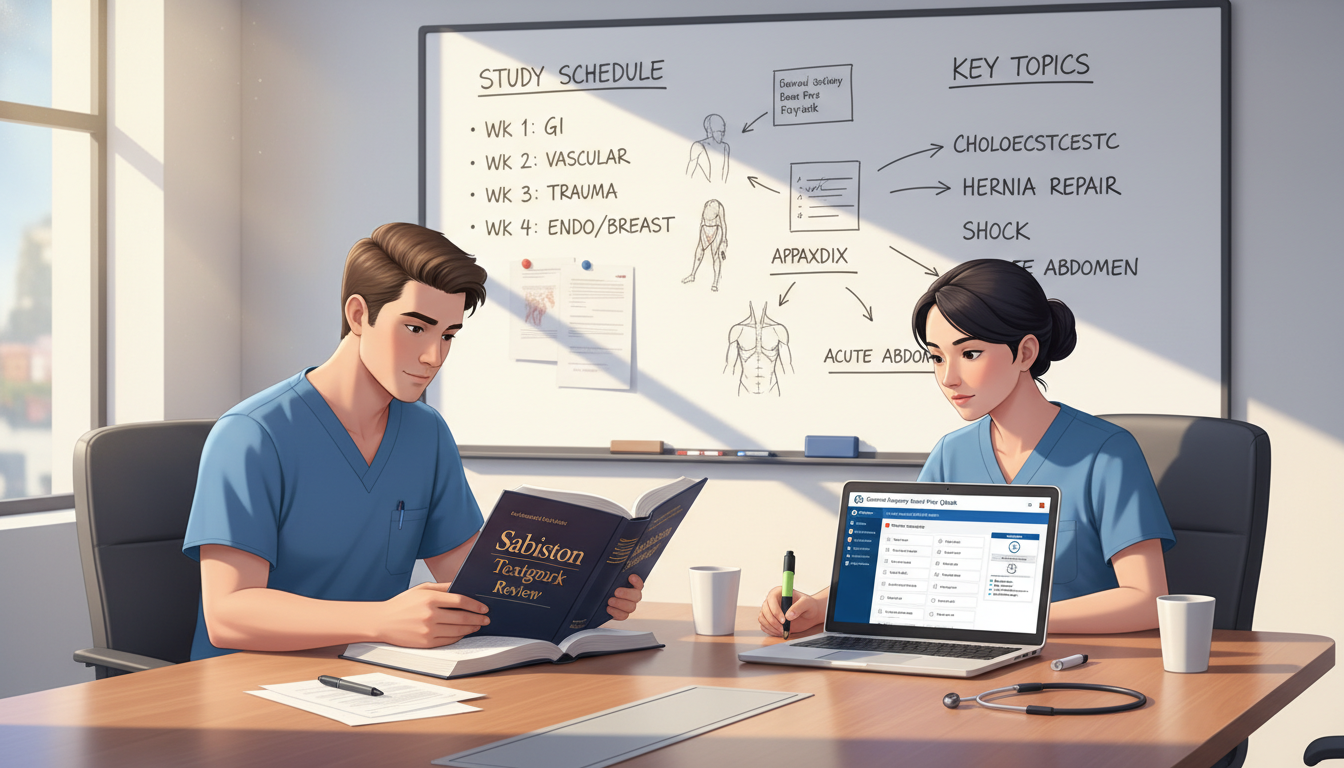
Question Banks and Practice Questions: The Engine of Your Study Plan
Active practice is the single most powerful way to prepare for the general surgery boards and ABSITE. Question banks allow you to learn the exam language, identify gaps, and reinforce knowledge via retrieval.
1. Core ABSITE and Board Question Banks
Unlike medical school, there is no single dominant Q‑bank like UWorld for surgery boards, but several strong options exist.
TrueLearn ABSITE
- Features:
- Large, exam‑style question bank tailored specifically to the ABSITE.
- Detailed explanations and performance analytics.
- Timed modes and customizable quizzes by subject.
- Pros:
- Strongly aligned with ABSITE blueprint.
- Good for both junior and senior residents.
- How to use:
- Aim for at least one full pass in the 3–4 months before ABSITE.
- Repeat incorrect questions; use the analytics to guide focused reading.
- Use “Timed Exam” mode for simulation in the final 4–6 weeks.
Score‑Specific/Program‑Curated Banks
- Many residency programs subscribe to institutional question banks or compile old ABSITE questions.
- Strategy:
- Treat program‑provided Q‑banks as your baseline; complete all of them.
- Combine with an external commercial bank if your scores are average or below.
Text‑based Question Resources
- Books like Surgery: A Case Based Clinical Review, NMS Surgery, or The Washington Manual of Surgery often include end‑of‑chapter questions.
- Strategy:
- Use for topic‑specific review when you notice repeated misses (e.g., endocrine or trauma).
- These are ideal for shorter sessions, like post‑call or on lighter days.
2. UWorld Tips: Leveraging Step‑Style Banks as a Resident
While UWorld is designed for USMLE/COMLEX, it still offers value for surgery residents—especially early in training.
Where UWorld fits in:
- Step 2 CK surgery and IM sections:
- Reinforce general clinical reasoning and perioperative medicine.
- Step 3 content:
- Helpful for ICU, sepsis, shock, and medical management around surgery.
Practical UWorld tips for surgical residents:
- Focus on:
- Perioperative risk assessment (cardiac, pulmonary).
- Antibiotic choice and stewardship.
- Management of common surgical complications (PE, MI, AKI, delirium).
- Use as:
- A supplement during PGY‑1–2 to shore up medical knowledge.
- A bridge if your ABSITE performance is dragged down by non‑operative topics.
Don’t:
- Spend massive time on pediatrics OB/GYN, or psychiatry blocks unless explicitly weak or relevant to exams you’re taking.
3. Building an Effective Q‑Bank Strategy
To maximize question banks for the surgery residency match and later board success, structure your approach:
A. Daily question targets
- PGY‑1–2:
- Start with 10–20 questions/day on non‑call days.
- Focus on understanding explanations, not just score.
- PGY‑3–5:
- Ramp up to 20–40 questions/day in the 3 months pre‑ABSITE or QE.
B. Mix of modes
- Early prep:
- Untimed, tutor mode, topic‑based (e.g., only trauma or GI).
- Late prep:
- Timed, mixed blocks to simulate real test conditions and cognitive switching.
C. Missed‑question workflow
- Do the block.
- Flag all incorrect and “guessed” questions.
- For each miss, write a one‑line takeaway (e.g., “Barrett with high‑grade dysplasia → esophagectomy vs ablation, depending on comorbidities and center expertise.”)
- Convert the one‑liners to flashcards (Anki or similar).
D. Exam simulation
- Schedule 1–2 full‑length mock exams (using mixed blocks) about 2–3 weeks before ABSITE/QE.
- Use these as stress‑tests: track stamina, break strategies, and pacing.
Digital Tools and Flashcards: Making It Stick Long‑Term
Information volume in general surgery is enormous. Without spaced repetition, almost everyone forgets critical material between annual ABSITEs or before the Qualifying Exam.
1. Anki and Spaced Repetition for Surgery
Anki, widely known from medical school and Step 1/2 prep (“Anki USMLE”), is equally powerful for general surgery board prep—if used correctly.
Options for Anki in surgery:
- Pre‑made decks:
- Some residents share ABSITE‑focused decks with topics like trauma, endocrine, vascular, etc.
- Quality varies; always cross‑check with trusted resources.
- Personal decks:
- More work up front, but far more tailored to your weaknesses and your program’s style.
Best practices using Anki as a general surgery residency board tool:
- Keep cards short and focused:
- Bad card: “Everything about pancreatic cancer.”
- Good cards:
- “Most common location of pancreatic adenocarcinoma?”
- “Initial imaging modality for painless jaundice? Why?”
- “Key poor prognostic factors in pancreatic cancer.”
- Convert missed questions and new attendings’ pearls into cards.
- Daily discipline:
- Do your Anki reviews every single day, including lighter call days, even if only 10–15 minutes.
- Avoid creating so many new cards that your reviews become unmanageable during heavy rotations.
What to prioritize in surgical Anki cards:
- Facts with high test yield:
- Tumor markers, staging cut‑offs, classic triads.
- Antibiotic regimens and prophylaxis timing.
- Trauma algorithms (ATLS, massive transfusion protocols).
- Numbers:
- Risk thresholds (size, margins, nodal involvement).
- Lab cutoffs (e.g., severe pancreatitis criteria, sepsis definitions).
- Algorithms & “if X, then Y”:
- Management pathways for appendicitis, cholecystitis, SBO, diverticulitis.
- “Next best step” in acute settings.
2. Apps and Online Platforms Beyond Anki
Spaced repetition & micro‑learning apps
- Some commercial platforms specifically target ABSITE/ABS content with built‑in spaced repetition.
- Use these if you prefer a more guided interface than DIY Anki.
Board exam resources apps
- Many review books (e.g., ABSITE Slayer) have companion apps or online question banks.
- Strategy:
- Use the app for on‑the‑go quizzing during brief downtime (e.g., waiting for sign‑out or in the cafeteria line).
Podcasts and audio resources
- Surgery‑focused podcasts can reinforce knowledge passively:
- Topics: clinical decision‑making, evidence updates, board‑style reviews.
- Use during commutes or workouts; not a replacement for active studying but helpful for repetition.

Specialty‑Specific and Oral Board Resources
Success in general surgery isn’t just about multiple‑choice exams. Developing operative judgment and communication for the oral boards is equally crucial.
1. Topic‑Based Board Review Resources
Trauma and Critical Care
- ATLS manual and course materials:
- Foundational for trauma questions and algorithms.
- Many ABSITE and QE trauma questions echo ATLS principles.
- Surgical Critical Care texts:
- Use for topics like ventilator management, sepsis, shock, ARDS.
Oncology, Breast, Endocrine, Colorectal, Vascular, HPB
- Society guidelines (e.g., NCCN, SSO, ASCRS, SVS):
- High‑yield for staging, treatment algorithms, and surveillance.
- Review articles or guideline summaries:
- Build Anki cards around recommended workups and management strategies.
Minimally Invasive Surgery
- SAGES guidelines:
- Great for indications, contraindications, and complication management.
- Video libraries:
- Use video learning to pair anatomy and technique knowledge with written prep.
2. Oral Board (Certifying Exam) Resources
The oral exam tests how you think and speak as a surgeon, not how many obscure facts you’ve memorized.
Case‑based oral board books
- Several well‑known titles organize common cases with “expected answers”:
- Appendicitis, perforated ulcer, colon cancer, breast mass, thyroid nodule, etc.
- Strategy:
- Practice verbally—even if alone.
- Time yourself and structure answers: initial stabilization → workup → diagnosis → operative plan → complications.
Mock orals with faculty and co‑residents
- Ask faculty who recently took or frequently examine for the CE.
- Simulate exam conditions:
- Wear professional attire.
- Sit in a quiet room with a faculty member as examiner.
- Don’t use notes. Answer in complete sentences.
Key skills to practice:
- Saying “I don’t know” the right way:
- “I’m not certain of the exact statistic, but my approach would be…”
- Prioritizing safety:
- When uncertain, emphasize resuscitation, consultation, and safe alternatives rather than reckless choices.
- Managing complications:
- Always be prepared to answer “What would you do if the patient decompensates post‑op?”
Building a Step‑By‑Step Study Plan Across Residency
The best board exam resources won’t help if they’re used haphazardly. Your strategy needs to evolve as you progress through training.
PGY‑1 to PGY‑2: Foundation and Habits
Goals:
- Establish daily study habits.
- Build broad familiarity with core topics.
- Learn to use Anki USMLE‑style spaced repetition for surgical content.
Suggested approach:
- 10–20 questions/day from ABSITE‑type banks (or high‑yield review books).
- Consistent use of a review book (e.g., ABSITE Slayer) aligned with your rotations.
- Anki:
- Start small: 10–15 new cards/day.
- Use it to capture attendings’ pearls, common orders, and guidelines.
PGY‑3 to PGY‑4: Depth and Performance
Goals:
- Push ABSITE scores into stronger percentiles.
- Address persistent weak areas.
- Start thinking in “board style” for both written and oral expectations.
Suggested approach:
- Intensify Q‑bank usage (TrueLearn or equivalent).
- Target: Complete the full bank over the course of the year.
- Topic‑based review:
- After each ABSITE, dissect your score report.
- Identify the bottom three domains and build a 6–12 week remediation plan for each.
- Increase integration:
- When you encounter cases (e.g., obstructing colon cancer), deliberately connect:
- Clinical management → guideline recommendations → how these might appear in Q‑bank questions.
- When you encounter cases (e.g., obstructing colon cancer), deliberately connect:
PGY‑5 and Post‑Graduate (QE and CE Focus)
Goals:
- Cement knowledge for the Qualifying Exam.
- Transition to oral exam skills for the Certifying Exam.
Qualifying Exam prep:
- 3–6 months before exam:
- Daily timed mixed Q‑bank blocks.
- Systematic pass through your primary review book.
- Short Anki sessions to maintain key facts.
- 4–6 weeks before exam:
- Full‑length exam simulations.
- Focused reading and question review on your weakest domains.
Certifying Exam prep:
- Start 3–6 months ahead:
- Weekly (then bi‑weekly) mock orals with co‑residents and faculty.
- Practice common cases, complications, and “nightmare scenarios.”
- Use targeted resources:
- Oral boards texts.
- Case‑based teaching and morbidity/mortality conferences.
Putting It All Together: Choosing the Right Mix of Resources
Given the time constraints of general surgery residency, prioritize resources that give the highest yield per minute spent.
Essential components:
- One primary review book
- Example: ABSITE Slayer or a program‑specific ABSITE review text.
- One primary Q‑bank
- Example: TrueLearn ABSITE or your program’s chosen bank.
- Spaced repetition system
- Example: Anki customized for surgery content.
- Supplemental resources
- Major textbook (Sabiston/Schwartz) as reference.
- Topic‑specific guidelines (NCCN, SAGES, ASCRS, etc.).
- Oral boards case books and mock exams in senior years.
Adjust for your situation:
- If you’re a weaker test‑taker:
- Prioritize more Q‑bank volume, test‑taking strategies, and structured Anki use.
- If your knowledge is strong but scores lag:
- Work on pacing, anxiety management, and exam simulation.
- If you’re returning after a research year:
- Front‑load reading and targeted Q‑banks; rebuild habits with a strict daily schedule.
The overall goal is to consistently align your daily learning (on rounds, in the OR, during call) with your exam prep tools so that everything you see clinically reinforces and is reinforced by your board exam resources.
FAQs: Board Exam Study Resources in General Surgery
1. How early should I start using board exam resources in general surgery residency?
Start from PGY‑1. Early on, focus more on habits than volume: a handful of questions per day, a few short Anki cards, and selective reading tailored to your current rotation. This foundation makes ABSITE prep much less painful later, and it steadily builds toward the surgery residency match of your long‑term goals (fellowship and job competitiveness).
2. Is there a “UWorld for surgery boards” that everyone uses?
No single Q‑bank dominates surgery like UWorld does for USMLE. However, TrueLearn ABSITE and other ABSITE‑focused banks are widely used and highly regarded. Many residents combine one commercial Q‑bank with their program’s internal materials, oral board resources, and a core review book.
3. How do I balance clinical duties, the OR, and studying for ABSITE/boards?
You cannot out‑study an impossible schedule, so aim for consistency over intensity:
- Commit to a realistic daily minimum (e.g., 10–20 questions, 15 minutes of Anki).
- Use small pockets of time (between cases, before sign‑out).
- Increase volume during lighter months, research years, or dedicated study periods. Even modest but consistent studying compounds over years.
4. Are flashcards like Anki really worth the time in residency?
Yes—if used judiciously. Building every card from scratch can be time‑consuming, but converting missed questions and key clinical pearls into brief, focused cards pays off. The spaced repetition approach that made “Anki USMLE” popular works just as well for high‑yield surgical facts, guidelines, and algorithms, especially across the multiple years leading to your Qualifying and Certifying Exams.