



Addiction medicine is an intensely practical, rapidly evolving field—yet success on the board exam still depends on structured, high-yield study. The challenge is choosing and using the right resources without drowning in content or wasting precious time.
This guide walks you through the major board exam study resources in addiction medicine, how to combine them effectively, and how to build a realistic study plan around them. It’s written for fellows in an addiction medicine fellowship, residents, and early-career attendings preparing for certification or recertification.
Understanding the Addiction Medicine Board Exam
Before picking resources, it’s critical to understand what you’re studying for.
Exam structure and scope (ABPM & ABPN)
Most physicians in the US pursue addiction medicine certification via:
- American Board of Preventive Medicine (ABPM) – Addiction Medicine
- American Board of Psychiatry and Neurology (ABPN) – Addiction Psychiatry (closely related but different focus)
This article focuses on addiction medicine as tested by ABPM, but most resources are excellent for addiction psychiatry fellows as well.
Expect content across:
- Substances & Disorders
- Alcohol, opioids, stimulants, sedatives/hypnotics/anxiolytics
- Cannabis, hallucinogens, inhalants
- Tobacco and nicotine products
- Behavioral addictions (gambling; limited for others)
- Diagnostics & Assessment
- DSM-5-TR SUD criteria
- Screening tools (AUDIT, ASSIST, CAGE, DAST, ASI, CIWA-Ar, COWS, etc.)
- Risk assessment, including suicidality and overdose
- Pharmacologic Treatment
- Methadone, buprenorphine, naltrexone
- Disulfiram, acamprosate, topiramate, gabapentin (off-label)
- Tobacco pharmacotherapy (NRT, varenicline, bupropion)
- Management of withdrawal and intoxication
- Psychosocial & Behavioral Interventions
- Motivational interviewing, CBT, contingency management
- 12-step facilitation, group therapy, family interventions
- Systems, Legal, and Public Health
- Levels of care (ASAM criteria)
- Harm reduction, overdose prevention, syringe services
- Regulatory issues: prescribing regulations, confidentiality (42 CFR Part 2, HIPAA)
- Epidemiology, health disparities, stigma
Understanding this blueprint helps you evaluate resources: any serious board prep tool should address these domains clearly and systematically.
Core Textbooks and Guidelines: Your Knowledge Foundation
Textbooks and guidelines are your content backbone. Question banks test application; texts give you the conceptual scaffolding you need.
1. Essential Addiction Medicine Textbooks
You don’t need to read every textbook cover-to-cover. Focus on one primary text and use others as references.
(a) ASAM Principles of Addiction Medicine (6th edition)
This is the “gold standard” for many addiction medicine fellowship programs.
- Strengths:
- Comprehensive, evidence-based
- Aligns closely with how ASAM and ABPM conceptualize the field
- Deep coverage of pharmacology, psychosocial interventions, systems of care
- How to use:
- Start with high-yield sections:
- Neurobiology of addiction
- Opioid, alcohol, stimulant, sedative, and tobacco chapters
- Withdrawal management and intoxication
- Treatment settings and ASAM levels of care
- Harm reduction and public health chapters
- Read in targeted chunks, then reinforce with questions (Q-banks, flashcards).
- Flag key figures/tables (e.g., diagnostic criteria, treatment algorithms).
- Start with high-yield sections:
(b) Textbook of Addiction Treatment (Springer)
More global and multidisciplinary.
- Best as a supplement when you want added depth on psychosocial or systems topics.
- Good for fellows with specific research or public health interests.
(c) Specialized resources by substance
For more targeted content:
- Alcohol:
- “Treating Alcohol Use Disorder” guideline documents (APA, VA/DoD)
- Opioids:
- TIP 63 (Treatment Improvement Protocol) – Medications for Opioid Use Disorder
- Tobacco:
- U.S. Clinical Practice Guideline for Treating Tobacco Use and Dependence
Use these when you’re building detailed understanding in key exam- and practice-relevant areas.
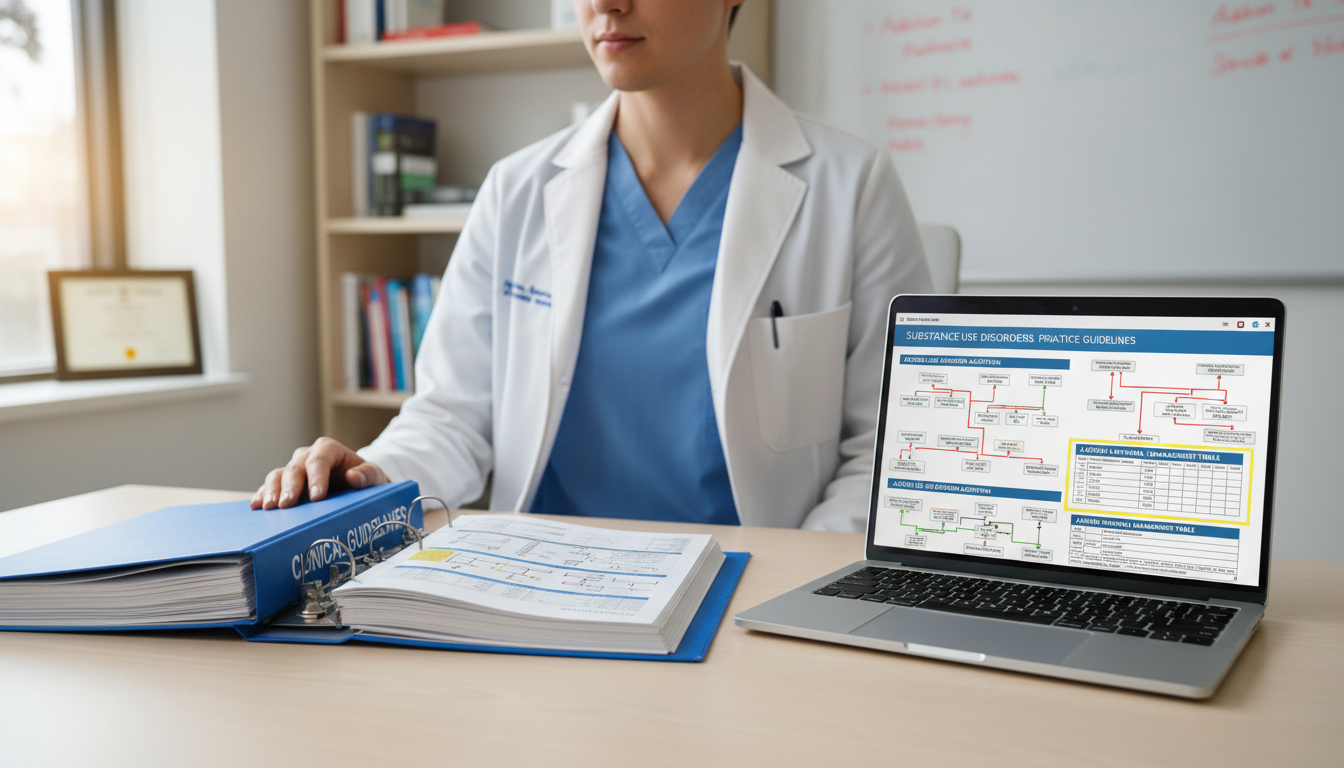
2. Guidelines and Consensus Statements
Guidelines are high-yield for both exams and clinical practice; they often inform board questions directly.
Prioritize:
- ASAM Practice Guidelines, such as:
- National Practice Guideline for the Treatment of Opioid Use Disorder
- Alcohol Withdrawal Management
- Management of Stimulant Use Disorder (emerging areas may appear in updated exams)
- APA Practice Guidelines
- Substance Use Disorders (especially for comorbid psychiatric conditions)
- VA/DoD Clinical Practice Guidelines
- For SUDs and tobacco use—they’re concise with clear algorithms.
Actionable tip:
Create a 1–2 page summary for each major guideline:
- Diagnostic criteria
- First-line treatments
- Key contraindications, safety issues
- Recommended levels of care and follow-up
These summaries can become exam-day “mental one-pagers.”
Question Banks and Practice Exams: Learning by Doing
Question-based learning is the highest-yield exam strategy, especially if your time is limited. Unlike USMLE, there’s no single dominant addiction medicine question bank (like UWorld) yet, but you can still use USMLE-style strategies and UWorld tips to get more value from what’s available.
1. Dedicated Addiction Medicine Question Banks
(a) Board-style Q-banks (various vendors)
Several organizations and commercial groups offer:
- Online question banks with single-best-answer, multiple-choice questions modeled after the ABPM format
- Timed or tutor modes, performance analytics, and explanations
When choosing:
- Look for at least 400–600 questions dedicated to addiction medicine.
- Ensure the questions are case-based, not trivial recall.
- Confirm recent updates to reflect current practice (e.g., buprenorphine prescribing, harm reduction).
How to use effectively (adapted from classic UWorld tips):
- Treat questions as learning tools, not just assessment.
- Use tutor mode early in your study period:
- Read explanations carefully (both correct and incorrect options).
- Take concise notes on what you missed or guessed.
- In the last 4–6 weeks, shift to timed blocks:
- Simulate real exam conditions.
- Aim to do 40–60 questions in a sitting with minimal interruptions.
- Review every completed block:
- Categorize each question you missed:
- Knowledge gap (content you never learned)
- Application error (misapplied knowledge)
- Test-taking error (rushing, misreading)
- Adjust your study plan accordingly.
- Categorize each question you missed:
2. Practice exams and self-assessment tools
Some boards or professional societies offer:
- Self-assessment modules with CME/MOC credit
- Practice exams with score reports and domain breakdowns
Use these:
- Early in your study plan to diagnose strengths and weaknesses
- 4–6 weeks before the exam to simulate test conditions
Repeat similar forms only after a substantial interval (6–8 weeks), and only if you’ve studied your weak areas in between.
3. Leveraging generalized question banks
There is no dedicated “UWorld for addiction medicine,” but:
- Internal medicine, psychiatry, and family medicine Q-banks (including UWorld) have substance use disorder questions that are still valuable.
- Focus on:
- Alcohol withdrawal, Wernicke-Korsakoff
- Opioid overdose, naloxone use
- Non-medical prescription drug use
- Tobacco cessation
- Psych comorbidity with SUD (depression, anxiety, bipolar, psychosis)
Use these as adjuncts, not primary resources, and practice your test-taking approach:
- Carefully read stems and differentiate:
- Intoxication vs. withdrawal vs. baseline use
- Acute management vs. long-term treatment planning
The skills honed here—the same UWorld tips you used for USMLE (annotating errors, reviewing explanations, learning from distractors)—apply directly to addiction medicine boards.
Flashcards, Anki, and Active Recall for Addiction Medicine
Passive reading is never enough. The most efficient way to retain details—diagnostic criteria, drug interactions, dosing ranges—is through active recall and spaced repetition.
1. Building an Anki deck for addiction medicine
Using Anki USMLE-style methods for addiction medicine is powerful.
Step-by-step approach:
Define your content scope
- DSM-5-TR SUD criteria
- Withdrawal and intoxication features
- Pharmacology:
- Mechanism, indications, contraindications
- Side effects, interactions, dosing
- Screening tools and cutoffs
- Guideline pearls (first-line vs second-line treatments)
Create high-quality cards
- Prefer short, focused cards over dense ones.
- Use cloze deletions for criteria and lists, e.g.:
- “DSM-5 criteria for severe opioid use disorder require ≥ {{c1::6}} of 11 symptoms in a 12-month period.”
- For mechanisms:
- “Buprenorphine is a {{c1::partial agonist}} at the μ-opioid receptor and a {{c2::antagonist}} at the κ-opioid receptor.”
Source material from your primary resources
- ASAM text, guidelines, and question bank explanations.
- Every time you miss a Q-bank question, write 1–2 targeted cards.
Review schedule
- Daily Anki reviews (even 20–30 minutes) dramatically improve retention.
- Front-load card creation during the first half of your study period, then mostly review and refine.
2. Other flashcard systems
If you don’t want to build a custom deck:
- Look for addiction medicine Anki decks in online communities (r/medicalschoolanki, specialty forums).
- Evaluate decks for:
- Recency (post-DSM-5-TR)
- Inclusion of pharmacology and guidelines
- Reasonable card length and quality
Customize by:
- Suspending overly detailed or low-yield cards.
- Adding your own cards for high-yield facts you personally struggle with.
Digital Platforms, Courses, and Integrated Study Plans
Beyond texts and Q-banks, structured courses and multimedia content can help consolidate complex topics and break monotony.
1. Live and on-demand board review courses
Professional societies and academic centers often offer:
- 2–5 day intensive board review courses
- Online modules with lectures, case discussions, and practice questions
Advantages:
- Curated, exam-focused content
- Quick exposure to expert reasoning and clinical pearls
- Often provide slide decks you can later convert into notes or flashcards
How to integrate:
- Schedule a course midway through your study period:
- You’ll understand enough to benefit, but still have time to close knowledge gaps.
- Take structured notes during sessions:
- Mark anything labeled “board favorite,” “high-yield,” or “commonly tested.”
- Immediately after the course, convert key points to Anki or a summary document.
2. Video lectures and podcasts
These are great for:
- Commuting
- Gym time
- Low-energy study days
Look for:
- Addiction-focused content:
- Neurobiology of addiction
- Pharmacology of MAT
- Harm reduction and public health perspectives
- Case-based teaching:
- Realistic scenarios about complex co-occurring disorders
- Practical management of benzodiazepine tapering, polysubstance use, pregnancy, and SUD
Use a “watch with purpose” approach:
- Pause to jot down 1–2 bullet points per lecture you want to remember.
- Add only the highest-yield points into your main notes or Anki deck.
3. Integrating resources into a coherent plan
A powerful plan weaves textbooks, Q-banks, and flashcards into a weekly structure.
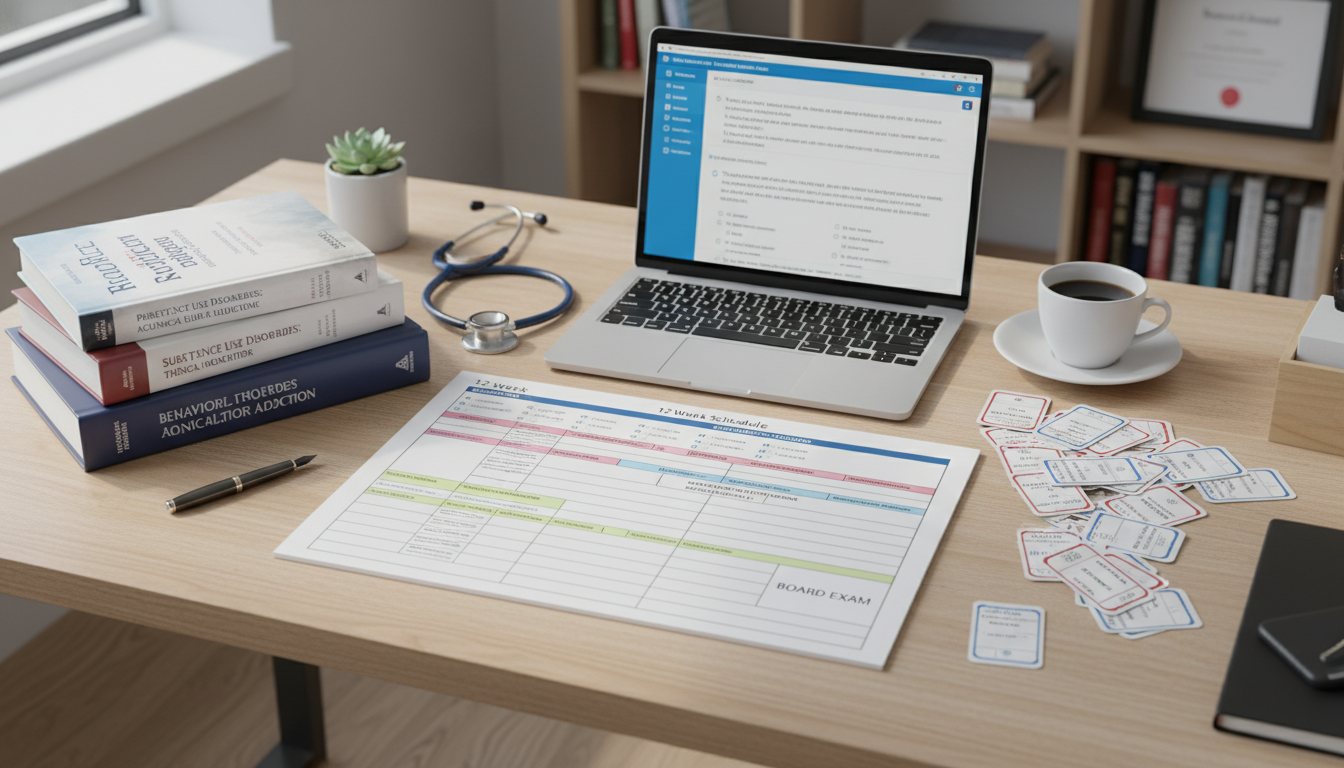
Example 12-week framework (adaptable to your schedule):
Weeks 1–4: Foundation building
- Read focused chapters (alcohol, opioids, stimulants, sedatives, tobacco).
- Do 10–20 Q-bank questions/day in tutor mode.
- Build Anki cards from every miss or new concept.
- Spend 20–30 minutes daily on Anki reviews.
Weeks 5–8: Integration and expansion
- Add systems topics: harm reduction, epidemiology, legal/ethical issues, ASAM levels of care.
- Increase to 20–40 Q-bank questions/day.
- Consider attending a review course during this phase.
- Start one full-length practice exam around week 7 or 8.
Weeks 9–12: Refinement and simulation
- Focus heavily on questions: 40–60/day in timed blocks.
- Target weak domains identified by practice exams.
- Continue Anki but taper new card creation—prioritize review.
- At least one more full-length practice exam 2–3 weeks before test day.
Time Management, Common Pitfalls, and Exam-Day Strategy
Even with great resources, poor strategy can undercut performance. Smart time management and exam tactics can add significant points to your score.
1. Common study pitfalls
Pitfall 1: Passive reading without active recall
- Reading ASAM Principles cover-to-cover feels productive but rarely sticks.
- Fix:
- Convert critical facts into flashcards or outlines.
- Teach concepts briefly to a colleague or yourself out loud.
Pitfall 2: Ignoring weaker domains
- Many clinicians are comfortable with opioids and alcohol but underprepared for:
- Stimulants
- Sedatives and complex tapers
- Tobacco
- Systems/public health/legal topics
- Fix:
- Use Q-bank performance reports to identify content gaps.
- Assign entire evenings or weekends to those domains.
Pitfall 3: Starting Q-banks too late
- Leaving questions for the last few weeks limits learning from mistakes.
- Fix:
- Begin Q-banks by week 1–2, even if you haven’t read widely.
- Let questions guide what you read next.
2. Calibrating difficulty and expectations
Unlike USMLE Step 1, addiction medicine boards are:
- Less about esoteric basic science
- More about clinical judgment, guidelines, and common scenarios
Examples of typical question styles:
- Choosing between methadone vs buprenorphine vs naltrexone for a specific patient scenario.
- Determining level of care based on ASAM criteria.
- Safely managing co-prescribed benzodiazepines in a patient on opioids.
- Addressing comorbid depression or anxiety in the context of SUD.
Expect that common, bread-and-butter cases will dominate, but you’ll need to handle complex co-occurring conditions and legal/ethical nuance.
3. Exam-day tactics
Apply the same structured approach you learned from USMLE and UWorld tips:
- First pass:
- Answer all questions you know quickly.
- Flag ambiguous or time-consuming ones.
- Second pass:
- Revisit flagged items with more deliberation.
- Carefully read the last sentence of the stem to understand precisely what’s being asked (diagnosis, next best step, risk factor, etc.).
- Use pattern recognition plus guidelines:
- Many questions reflect “classic” presentations of withdrawal syndromes or intoxications.
- When in doubt, align your answer with standard national guidelines over local practices.
- Time management:
- Know how many questions and how many hours.
- Aim for a steady pace—roughly 1–1.5 minutes per question with buffer time.
Frequently Asked Questions (FAQ)
1. What are the single most important resources for addiction medicine boards if my time is limited?
If you’re truly time-constrained, prioritize:
- One primary text or guideline set, such as:
- Key chapters from ASAM Principles of Addiction Medicine
- Core ASAM and APA guidelines for opioids, alcohol, stimulants, and tobacco.
- A solid board-style question bank with at least a few hundred questions.
- A targeted Anki or flashcard deck built from:
- Your Q-bank mistakes
- DSM-5-TR criteria
- Pharmacology details
These three combined—content, questions, and active recall—are far more effective than passively reading multiple books.
2. How far in advance should I start studying during fellowship?
For most fellows:
- 3–4 months of structured, consistent studying is adequate, assuming:
- 1–2 hours/day on weekdays
- A longer block (3–4 hours) on one weekend day
- If you’re working full-time in a demanding setting with call, lean closer to 4–6 months, but with realistic expectations (some weeks will be lighter).
The key is consistency, especially with Anki reviews and question practice.
3. Can I use my old USMLE resources like UWorld or Anki decks for addiction medicine?
Yes, but only in a targeted, supplemental way:
- UWorld tips and habits—thorough explanation review, annotating mistakes, timed practice—are directly useful.
- Actual USMLE content:
- Helpful for basic tox presentations (e.g., opioid overdose, alcohol withdrawal).
- Limited for nuanced addiction medicine concepts (harm reduction, 42 CFR Part 2, long-term treatment planning).
- Old Anki USMLE decks:
- May help with pharmacology basics and toxidromes.
- Won’t cover exam-specific topics (ASAM levels of care, MAT selection nuances, updated prescribing regulations).
Use them if they’re easily accessible, but don’t let them displace dedicated addiction medicine resources.
4. How do I balance fellowship responsibilities with board studying without burning out?
Practical strategies:
- Integrate study with clinical work:
- After difficult or interesting cases, spend 10–15 minutes reading or making 2–3 Anki cards about that topic.
- Use micro-study blocks:
- 10–15 Anki cards between clinic sessions.
- One Q-bank vignette while eating lunch.
- Protect one “anchor” session per week:
- A 3–4 hour block (weekend morning or evening) for deeper reading and completing a full question block.
- Set realistic daily minimums:
- For example: 20 minutes of Anki + 10 questions/day, even during busy weeks.
- Plan recovery:
- Build in 1–2 evenings/week with no studying to maintain sustainability.
By choosing a focused set of high-yield resources—core textbooks and guidelines, a solid question bank, and a disciplined active-recall system like Anki—and embedding them in a realistic, structured plan, you can prepare efficiently and confidently for the addiction medicine board exam while continuing to grow as a clinician.




















