



Preparing for board exams in plastic surgery is a long, strategic process that begins early in residency and evolves through fellowship and early practice. This guide walks you through the major board exam study resources in plastic surgery, how to use them at different stages of training, and practical strategies to build a sustainable, high-yield study plan.
Understanding the Plastic Surgery Board Exam Landscape
Before selecting resources, you need a clear picture of which exams you’re targeting and what each one emphasizes.
Key Examinations in Plastic Surgery
Most US trainees in plastic surgery will encounter some or all of the following:
USMLE/COMLEX (Pre-residency / Early Residency)
- USMLE Step 1 (often pass/fail), Step 2 CK, and sometimes Step 3.
- Still relevant for residents in integrated plastic surgery residency programs, especially early in training.
- Drives initial fund of knowledge, test-taking skills, and habits (e.g., use of Anki USMLE, UWorld tips, etc.).
In-Service Exams (In-Training Exams)
- ACAPS In-Service Exam (for integrated plastic surgery residents).
- Annual multiple-choice exam mirroring the format and content focus of the future boards.
- Critical for benchmarking your progress against peers and demonstrating growth to your program.
American Board of Plastic Surgery (ABPS) Examinations
- Written (Qualifying) Exam: Multiple-choice exam testing broad core knowledge across reconstructive, aesthetic, hand, craniofacial, and basic science.
- Oral (Certifying) Exam: Case-based, emphasizing judgment, safety, ethics, indications, and complication management.
- Passing both is required for American Board of Plastic Surgery certification.
Subspecialty or Related Exams (Selective)
- Certificate of Added Qualifications (CAQ) in Hand Surgery (joint boards).
- Specialty society exams and mock orals by ASPS, ASMS, and other organizations.
Each stage requires slightly different resources and strategies, but there is heavy overlap. The earlier you align your daily learning with eventual board content, the less “cramming” you’ll need later.
Core Resources: Books, Question Banks, and Digital Tools
This section focuses on foundational board exam resources every plastic surgery resident should know, including textbooks, Q-banks, and digital tools tailored to plastics.
1. Core Plastic Surgery Textbooks
Textbooks are not for last-minute studying; they’re scaffolding for your entire residency foundation.
a. Grabb and Smith’s Plastic Surgery
- Concise, algorithmic, and clinically focused.
- Strong for:
- Principles of wound healing, flaps, grafts.
- Breast, hand, craniofacial, microsurgery, and aesthetic basics.
- How to use:
- Read key chapters aligned with your rotations (e.g., hand section during hand rotation).
- Use it as a reference after doing related questions from a Q-bank.
- Make summary tables or Anki cards for recurring high-yield facts (e.g., flap classification, innervation patterns).
b. Neligan’s Plastic Surgery (Multiple Volumes)
- More detailed, subspecialty-focused text.
- Particularly valuable for:
- Complex reconstructive planning.
- Microsurgery, craniofacial anatomy, and advanced aesthetic concepts.
- How to use:
- Reserve for targeted deep dives when you consistently miss questions in a given area.
- Use selected chapters as a reference for board-style “why” explanations behind clinical algorithms.
c. Essentials of Plastic Surgery (Janis)
- High-yield, outline-style text; bridges the gap between Grabb and Smith and full multi-volume sets.
- Board-friendly structure with bullet points, tables, and illustrations.
- How to use:
- Excellent for pre-in-service and pre-Qualifying Exam “sweeps.”
- Build checklists from chapters: “Must know points in cleft lip/palate,” “Key nerve injuries,” etc.
d. Subspecialty Texts (As Needed)
- Green’s Hand Surgery, Cronin and Hobar for craniofacial, aesthetic surgery atlases, etc.
- Most useful if you’re fellowship-bound or weak in a specific domain.
Practical Tip:
Don’t try to “read Neligan cover-to-cover” during residency. Instead, anchor your reading to your active questions and your rotation schedule.
2. Question Banks (Q-Banks): Your Primary Testing Engine
For modern board prep in any specialty, question banks function as your main active learning tool.
a. Plastic Surgery–Specific Question Banks
ACAPS In-Service Exam Questions (Past and Practice)
- Many programs maintain internal libraries of past questions or practice sets.
- High-yield because they mirror exam style and commonly tested themes.
- Strategy:
- Do these during the 2–3 months before the in-service.
- Turn missed questions into notes or flashcards focusing on concepts, not just facts.
Commercial Plastic Surgery Q-Banks
- Examples (names may evolve over time): BoardVitals, Decker/AccessPlasticSurgery modules, specialty society–produced Q-banks.
- Pros:
- Frequently updated.
- Often include explanations with references to core texts.
- How to use:
- Aim for complete pass-through each year (or every other year, depending on size).
- Use “tutor” mode early in the year to learn; switch to “test” mode closer to exam time for timed practice.
Society Review Courses with Question Components
- ASPS, ASMS, and regional societies may run review courses with practice questions and mock tests.
- Sometimes recorded and accessible online.
- Use them for:
- Structured review near exam season.
- Identifying blind spots you haven’t encountered in other Q-banks.
b. General Surgery / General Q-Banks (Early Training)
While you’re still close to your medical school years or during PGY1–2:
- General surgery Q-banks (e.g., ABSITE-focused) can reinforce core topics: trauma, critical care, oncologic principles, perioperative care.
- These topics often appear in plastic surgery in-service and boards in the context of complex reconstructions, burn management, and surgical comorbidities.
UWorld Tips (and Similar Platforms):
- If you still have access to UWorld or similar during early residency:
- Focus on surgery, cardiology, pulmonology, and infectious disease systems that influence perioperative decision-making.
- Treat every missed question as a chance to refine reasoning: “What guideline or principle did I miss?”
3. Flashcards and Spaced Repetition: Anki in Plastic Surgery
Anki is not just an “Anki USMLE” tool; it can be an exceptionally powerful system throughout plastic surgery training if used intentionally.
Why Anki Works for Boards:
- Boards test repetitive, granular details:
- Nerve injury levels.
- Tendon zone classification.
- Flap blood supplies.
- Syndromic associations.
- Spaced repetition ensures you review information just before you’re likely to forget it.
How to Use Anki in Plastic Surgery:
Build Your Own Decks
- From:
- Missed Q-bank questions.
- Conference and journal club notes.
- Key tables/figures in Grabb and Smith or Janis.
- Focus on one concept per card (e.g., “What artery supplies the latissimus dorsi flap?”).
- From:
Don’t Over-copy USMLE-Style Decks
- Some Step 1/2 decks are still useful for:
- Fundamental anatomy, embryology, and physiology.
- But for board exam preparation in plastic surgery, custom decks reflecting in-service and ABPS-style questions are higher yield.
- Some Step 1/2 decks are still useful for:
Daily Routine
- Target: 20–40 new cards a day and 100–200 reviews (adjust based on workload).
- Integrate into “micro-moments”: 10–15 minutes during commute (if not driving), between cases, or while waiting on consults.
Board-Level Anki Content Examples
- “What is the most common cause of late hemorrhage after rhytidectomy?”
- “Name the boundaries of the submental triangle.”
- “Which nerve is at risk in a sagittal split osteotomy?”
You don’t have to be a “flashcard person,” but if you struggle with recall or have less time for textbook reading, Anki can dramatically compress your review cycles.
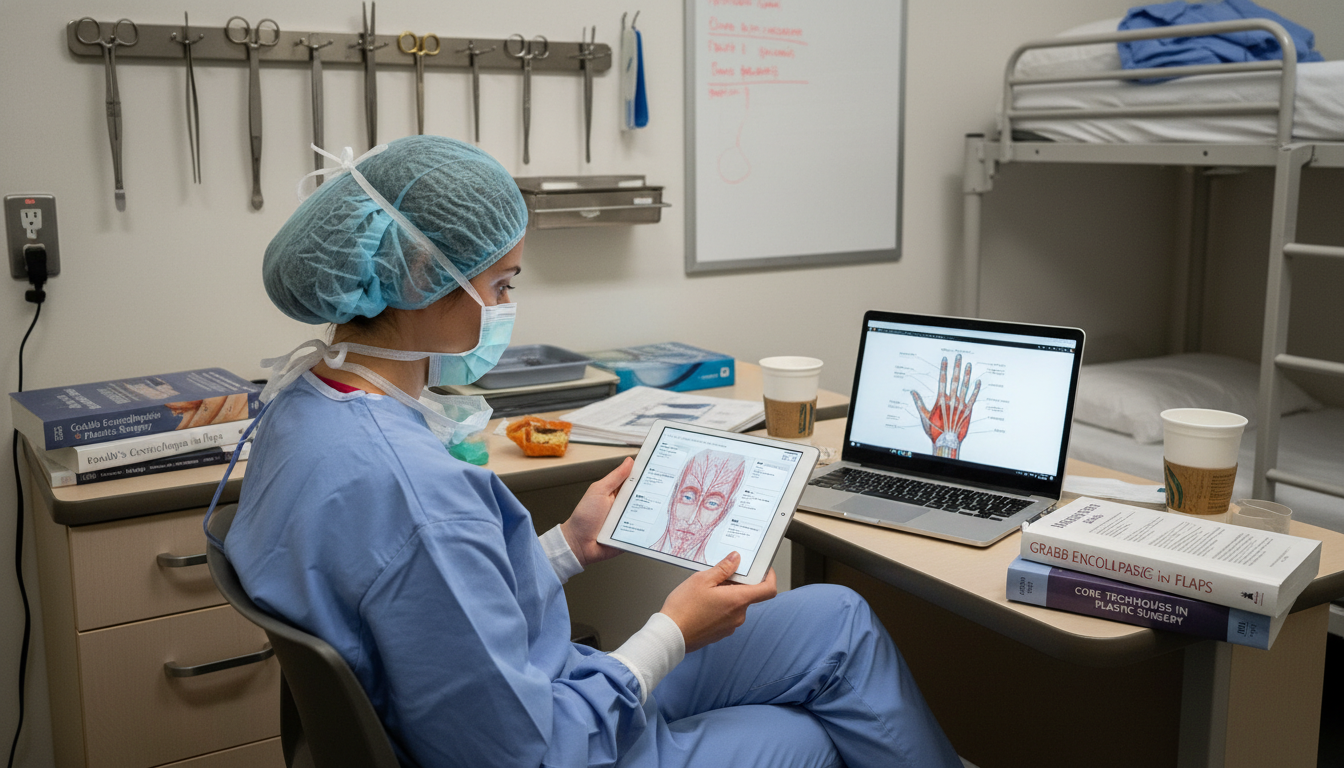
Stage-Based Strategy: From Integrated Plastics Match to Board Certification
Your choice of resources and how you use them should shift at each training stage. Below is a year-by-year framework that many residents find helpful.
Early Residency (PGY1–2): Foundations and Habits
If you’re in an integrated plastic surgery residency:
Goals:
- Solidify general surgery and core medical knowledge.
- Maintain strong test-taking skills after the USMLE era.
- Start building plastic surgery fundamentals.
Key Resources:
- General Q-banks (UWorld, other surgery-focused banks) if available.
- Grabb and Smith: basic principles chapters.
- Early plastic surgery Q-banks (slower pace, focus on learning).
- Light but consistent Anki usage.
Practical Weekly Plan:
- 50–100 general surgery questions/week.
- 25–50 plastic surgery questions/week, untimed, in tutor mode.
- Read 1–2 short chapters (or sections) aligned with your current rotation.
- Anki: 15–20 min/day.
This is also when you begin to transition your mindset from “USMLE-style memorization” to “surgical judgment and pattern recognition.”
Mid-Residency (PGY3–4): Exam Performance and Depth
Goals:
- Aim for meaningful improvement on the in-service exam each year.
- Develop deep familiarity with bread-and-butter plastics and key anatomy.
- Identify weak areas early (e.g., hand, craniofacial, burns).
Key Resources:
- Primary plastic surgery Q-bank (commit to one main platform).
- ACAPS in-service review questions and practice sets.
- Essentials of Plastic Surgery (Janis) for concise reinforcement.
- Targeted subspecialty readings (e.g., hand chapters from Neligan or Green’s).
- Anki: more robust and structured.
Practical Weekly Plan (Non-Exam Season):
- 75–125 plastic surgery questions/week.
- One half-day or evening devoted to topic review:
- E.g., Monday questions → Tuesday/Wednesday reading about missed topics.
- Subspecialty focus:
- During a hand rotation: extra 10–20 questions/session on nerve injuries, tendon repairs, fractures.
- Monthly: simulate a short timed exam (50–75 questions) under real conditions.
As your clinical responsibilities grow, efficiency matters. You are no longer just “doing questions”; you’re diagnosing your knowledge gaps and patching them methodically.
Senior Residency (PGY5–6 / Chief Years): Board-Oriented Preparation
Goals:
- Perform strongly on the in-service, particularly in your final year.
- Transition from “knowing facts” to “thinking like the board expects.”
- Begin structured preparation for the ABPS Written (Qualifying) Exam.
Key Resources:
- Complete pass-through of at least one comprehensive plastics Q-bank.
- Targeted second pass in problem areas.
- Essentials of Plastic Surgery and select Grabb and Smith chapters for quick reference.
- Mock written exams (institutional, society-based).
- Consolidated Anki decks focused on high-yield topics.
Pre-In-Service or Pre-Written Exam 3–4 Month Plan:
Month 1–2:
- Finish remaining untouched questions.
- Begin second pass of previously missed or flagged questions.
- Read 1–2 high-yield chapters per week (e.g., breast reconstruction, facial fractures, facial nerve, microsurgical free flaps).
Month 2–3:
- Switch most Q-bank work to timed blocks of 40–60 questions.
- Weekly full practice tests (100–150 questions if available).
- Start condensing notes into checklists and algorithms.
Final 2–4 Weeks:
- Focus on:
- High-yield repetition (questions + Anki).
- Reviewing your “error log” and weak areas.
- Avoid starting brand-new, dense resources; it’s too late for deep dives.
- Focus on:
Example: Converting Errors into Learning
- Missed question: “Best management of exposed cranial hardware after radiation.”
- Log:
- Topic: Craniofacial / Post-radiation wound healing.
- Key point: Importance of vascularized flap coverage vs. local rearrangements.
- Action: Read 2–3 pages in Janis + Anki card summarizing management algorithm.
Transition to Practice (Written and Oral Boards)
Once you finish residency and are eligible for the ABPS Qualifying and Certifying Exams, your resource focus shifts again.
Written (Qualifying) Exam:
- Resources:
- Same Q-banks you used for residency, with tighter focus.
- Any updated or new ABPS-focused banks or board review courses.
- High-yield notes, algorithms, and Anki decks you've accrued.
- Strategy:
- 2–3 months of structured, exam-level preparation:
- 1–2 hours on weekday evenings.
- Longer blocks on weekends.
- Heavy emphasis on:
- Bread-and-butter reconstruction (trauma, cancer, breast).
- Aesthetic surgery complications and safety.
- Burns, craniofacial anomalies, and pediatric topics.
- 2–3 months of structured, exam-level preparation:
Oral (Certifying) Exam:
- Shift in emphasis: less about obscure details, more about judgment, sequencing, and safety.
- Resources:
- Case logs and your own operative experience.
- Mock oral sessions (institutional, regional, national courses).
- Oral boards prep courses (ASPS, commercial providers).
- Review of complications and “what I would do differently” analyses.
How to Practice for Orals:
- Weekly mock sessions with peers or faculty:
- 2–3 cases per session.
- Full presentation → examiner-style questioning.
- Structured frameworks:
- Indications → workup → operative plan → intraoperative pitfalls → postoperative care → complication management.
- Record yourself during practice and critique:
- Clarity.
- Logical structure.
- Avoiding dangerous answers.

Integrating Board Exam Prep with Clinical Life
Studying for plastic surgery boards cannot be separate from your clinical practice; it has to be integrated.
Turn Every Case into a Board Question
For each consult or operative case, ask yourself:
What would the boards ask here?
- Differential diagnosis?
- Optimal reconstruction options?
- Most likely complication?
- Best next step if something goes wrong?
What algorithm would I use?
- Example: Lower extremity trauma with exposed tibia:
- Questions:
- “What are the options at the knee vs. mid-tibia vs. distal third?”
- “What factors determine limb salvage vs. amputation?”
- Questions:
- Example: Lower extremity trauma with exposed tibia:
Create mini write-ups after complex cases, then convert these into flashcards or notes.
Leverage Teaching and Conferences
- Journal club: Turn key takeaways into Anki cards (e.g., trial results affecting breast reconstruction timing or implants vs. autologous).
- Grand rounds: Summarize 3–5 board-relevant points per talk.
- Teaching juniors and medical students:
- Explaining principles out loud solidifies your own understanding and highlights where your knowledge is shaky.
Avoid Common Pitfalls
Resource Overload
- Don’t buy every book and Q-bank. Choose:
- 1–2 core texts.
- 1 primary plastics Q-bank (maybe 1 secondary).
- One note/flashcard system (Anki or equivalent).
- Don’t buy every book and Q-bank. Choose:
Cramming Without Spaced Review
- Reading large amounts once is less effective than shorter, repeated exposure.
- Aim for cycles of: Question → Read → Review → Re-question.
Ignoring Process and Test-Taking Technique
- Practice pacing: finish sets of 40–50 questions comfortably in allotted time.
- Learn when to move on from a question to avoid time pressure at the end.
Neglecting Aesthetic Surgery
- Even if your residency is reconstructive-heavy, the boards still test cosmetic principles and complications.
- Integrate at least a baseline aesthetic curriculum: rhinoplasty, facelift, breast augmentation, body contouring.
Frequently Asked Questions (FAQ)
1. When should I start “serious” board exam prep during residency?
You should treat every year’s in-service exam as early board preparation. By PGY3–4, you should be using a structured question bank and at least one core text consistently. Dedicated, exam-focused study for the ABPS Written Exam usually begins 3–6 months before the test date, but the residents who perform best have accumulated years of steady, low-intensity preparation.
2. What is the best Q-bank for plastic surgery boards?
There isn’t one universally agreed-upon “best” Q-bank. The most effective bank for you is:
- Up-to-date and aligned with ABPS/ACAPS style.
- Large enough to be comprehensive.
- Includes good explanations and references to standard texts.
Ask senior residents and recent graduates at your program which platforms correlated best with actual exam performance. Then commit to that bank and complete it systematically rather than dabbling across many.
3. How should I balance textbooks vs. questions?
Use questions to drive your reading, not the other way around:
- Start with questions on a topic.
- Identify gaps from missed questions.
- Read the relevant chapters or sections in Grabb and Smith, Janis, or Neligan.
- Create short notes or flashcards for high-yield points.
- Re-test yourself later with another question block on the same topic.
Over time, your study becomes tightly focused on what you actually need to know rather than reading entire volumes indiscriminately.
4. Do I still need USMLE-style resources like Anki USMLE or UWorld once I start plastics?
You don’t need to continue generalized USMLE/COMLEX resources long-term, but the skills you developed using them are valuable:
Anki USMLE decks:
- Useful early on to refresh anatomy and physiology.
- Over time, transition to plastics-specific decks you create yourself.
UWorld tips and habits:
- Reading explanations carefully.
- Reviewing missed questions.
- Asking “what was the key decision point?”—all of this directly transfers to plastic surgery Q-banks and board exams.
The tools can evolve, but the approach—active, question-based, and reflective studying—remains the same.
By choosing a focused set of board exam resources, integrating them with your day-to-day clinical experience, and using structured, stage-appropriate strategies, you can turn the intimidating process of plastic surgery board preparation into a manageable, even rewarding, part of your training.




















