
Understanding the Challenge: Interventional Radiology as a Caribbean IMG
Interventional Radiology (IR) is one of the most competitive specialties in the US—and that bar is even higher if you’re a Caribbean IMG. You’re competing not only with US MD and DO seniors, but also with a growing number of integrated IR/DR applicants who have been planning since pre-med.
To succeed, you need to think in terms of an ultra-competitive specialty strategy, similar to what you’d use for matching derm or matching ortho, but tailored to IR and the additional challenges of being a Caribbean graduate.
Why IR Is So Competitive
Integrated interventional radiology residency spots are limited and heavily sought after. IR combines:
- High-tech procedures and imaging
- Immediate, visible impact on patients
- Strong lifestyle and compensation
- Rapidly expanding clinical scope (oncology, vascular disease, structural heart work, and beyond)
This naturally attracts top performers. From a residency program’s point of view, there’s risk in taking anyone who looks “borderline” on paper. As a Caribbean IMG, you sit outside their historical comfort zone, so you must overcompensate strategically.
The Caribbean Medical School Residency Context
The Caribbean medical school residency pathway is well-established for primary care and some hospital-based specialties (IM, FM, psych, peds, etc.). But for ultra-competitive specialties like IR, derm, ortho, neurosurgery, or plastics, the bar is much higher.
Some key realities:
- Caribbean grads are underrepresented in IR: Program directors are aware of this and often have limited experience with your school.
- Perception bias: Fair or not, many assume Caribbean IMGs had weaker undergraduate metrics or MCATs, or had academic struggles. You need to counter that with current performance.
- Visa and funding issues: Some programs avoid applicants who may require visas or are perceived as higher risk to complete training.
That’s why your strategy must be built around de-risking your application in every possible way and building undeniable value as a future IR resident.
Choosing the Right IR Pathway as a Caribbean IMG
Before you plan how to match IR, you need to understand which pathway is realistic and how to use it strategically.
Pathways into Interventional Radiology
There are three main ways to become an IR attending in the US:
Integrated IR/DR Residency (NRMP Match)
- 6-year program: Intern year + DR + IR
- Matches directly from medical school
- Extremely competitive—comparable to or above most “competitive specialty” fields (like derm and ortho)
Independent IR Residency
- 2-year (usually) program after Diagnostic Radiology (DR) residency
- Requires at least some pre-existing IR training (e.g., ESIR—Early Specialization in Interventional Radiology) or DR background
- Still competitive, but applicants are screened after they’ve already proven themselves in DR
Legacy Pathways (becoming rare)
- Older pathways via DR fellowships or grandfathering are largely phased out or ending.
Realistic Strategic Options for Caribbean IMGs
For most Caribbean IMGs, the safest strategic primary goal is:
Match into a strong Diagnostic Radiology (DR) or Internal Medicine (IM) program first, then pivot to IR via independent IR or ESIR.
Why?
- The integrated IR match is punishingly competitive and most programs rarely accept IMGs, let alone Caribbean grads, unless there is a specific, strong connection or extraordinary CV.
- A DR pathway gives you:
- Time to publish IR-related research
- Time to obtain strong IR letters
- Access to ESIR tracks that shorten the independent IR timeline
- An IM → IR path is less common but can sometimes work via:
- Transitioning into DR then IR
- Rare hybrid IR-focused roles (e.g., vascular, interventional-heavy practices) after additional training
This doesn’t mean you should never apply integrated IR. It means you should:
- Treat integrated IR applications as a “reach strategy” (similar to ultra-competitive programs when matching derm or matching ortho).
- Simultaneously maintain a solid, realistic “safety path” via DR or another specialty.
SGU Residency Match and Other Big Caribbean Schools
If you’re coming from a school like SGU, AUC, Ross, or Saba, you’ll hear a lot about SGU residency match success and other impressive numbers. They are real—but you must interpret them correctly:
- Most matches are in Internal Medicine, Family Medicine, Pediatrics, Psychiatry, and Transitional Years.
- Only a very small fraction are in IR, radiology, ortho, derm, or other ultra-competitive fields.
- Use your school’s match list:
- Identify which DR and IR programs have taken grads from your school
- Reach out to upper-year residents or alumni who matched into DR or IR
- Prioritize clinical rotations and sub-internships at these institutions
If your school has any history of SGU residency match‑style success into DR or IR, those institutions become priority targets for networking, research, and audition rotations.

Academics and Boards: Building a “No-Question” Profile
In ultra-competitive fields, your scores don’t get you “in”—they just prevent you from being filtered out. As a Caribbean IMG, that filter risk is higher. You need to look better than typical DR and IR applicants, not just adequate.
USMLE Strategy for an IR Target
- Step 1 is now pass/fail, but:
- You must pass on the first attempt.
- A fail as a Caribbean IMG is often a deal-breaker for IR or DR; it pushes you heavily into non-competitive fields.
- Step 2 CK is now a key differentiator:
- For an IR-level strategy, aim for:
- ≥ 245 as a workable competitive baseline
- 250+ to stand out, especially as a Caribbean IMG
- Scores below ~235–240 don’t automatically eliminate you, but dramatically reduce odds in integrated IR and many DR programs.
- For an IR-level strategy, aim for:
Clerkship Performance and Clinical Evaluations
Programs will scrutinize your core rotation performance and narrative comments:
- Aim for Honors in:
- Internal Medicine
- Surgery
- Radiology electives
- Seek strong comments such as:
- “Prepared beyond level”
- “Functioned at intern level”
- “Showed genuine interest and initiative in IR/radiology”
Avoid any:
- Professionalism concerns
- Repeated leaves or unexplained absences
- Documentation of poor reliability
Class Rank, Dean’s Letter, and MSPE
If your school provides:
- Class rank or quartile: Being in the top quartile significantly helps de-risk your Caribbean background.
- Honors in rotations: Emphasize radiology-adjacent strengths (medicine, surgery, emergency medicine).
- No red flags: Academic probation, professionalism write-ups, or multiple exam failures are almost always fatal to an IR application as a Caribbean IMG.
Clinical Exposure and IR Experience: Proving Genuine Commitment
IR is small and tight-knit. Program directors want applicants who know what IR really is—not just “cool procedures on YouTube.” You need to demonstrate depth and consistency of commitment.
Early and Longitudinal IR Exposure
Start early—ideally in pre-clinicals or early clinical years:
Shadow IR attendings:
- Even a few half-days early on can plant the seeds for future research or mentorship.
- Learn the basics: angiography, embolization, ablation, venous interventions, IR oncology, drainage procedures.
IR electives and sub-internships (Sub-Is):
- Target US hospitals that:
- Have integrated or independent IR programs
- Have taken Caribbean IMGs or IMGs at all
- Use your Sub-I to:
- Show up early, read about every planned case
- Help with notes, consults, and follow-ups
- Ask smart questions, but don’t slow down the team
- Target US hospitals that:
This exposure should build toward letters of recommendation from IR faculty and potentially spark research projects.
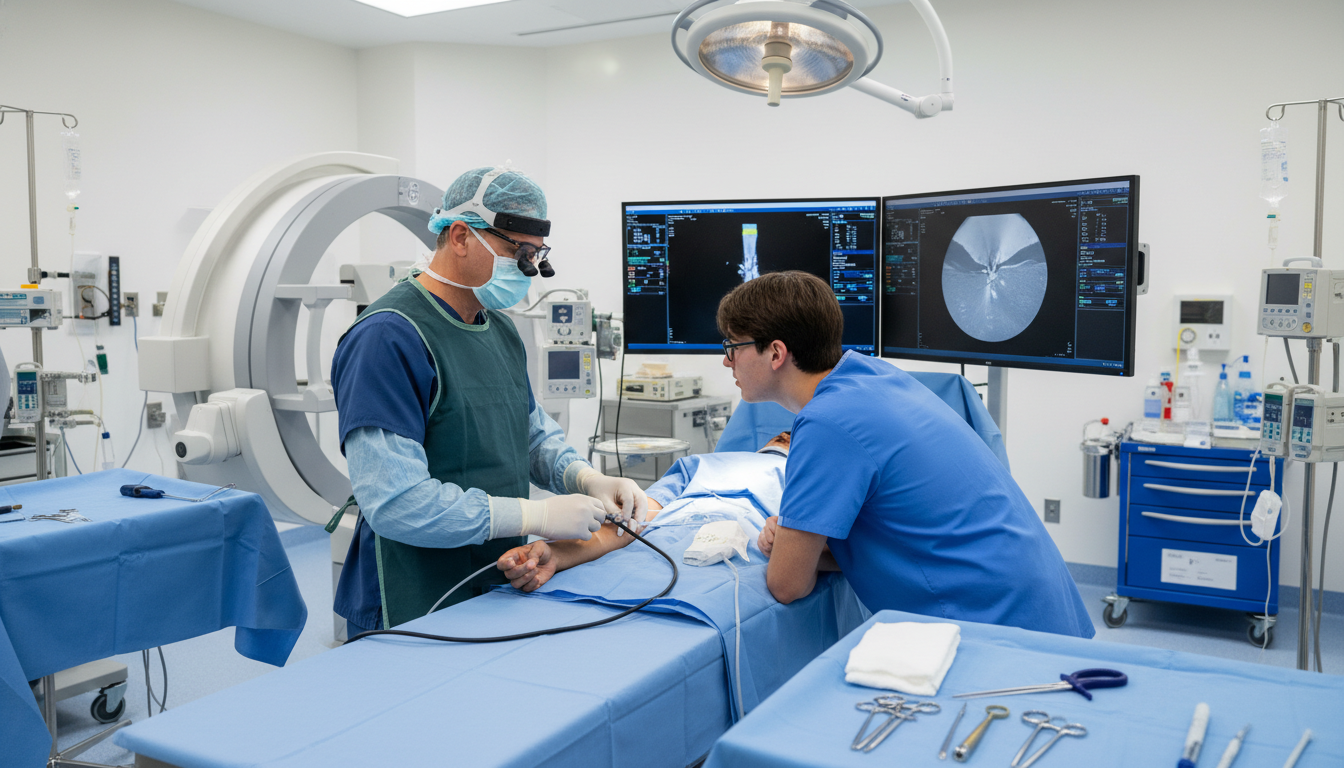
Radiology and IR in Core Rotations
When on Internal Medicine, Surgery, or EM:
- Identify patients who may need IR involvement (e.g., GI bleed, PE, abscess, oncology).
- Ask your residents/attendings if you can follow cases to IR.
- Document this IR-adjacent activity in:
- Your CV
- Your ERAS experiences
- Your personal statement, with specific cases illustrating your interest
This makes your story believable: you aren’t just chasing a competitive specialty; you understand what IR does for patients.
Research, Networking, and Letters: Your IR Differentiators
In a field this small and competitive, who knows you often matters as much as what you’ve done—especially if you’re an IMG.
IR-Focused Research Strategy
IR programs love applicants who contribute academically. As a Caribbean IMG, targeted research is one of your most powerful tools.
Types of IR Research That Count
- Retrospective chart reviews: Outcomes of specific interventions (e.g., TACE outcomes, DVT interventions, TIPS complications).
- Case reports and series: Unique or complex IR cases.
- QI projects: Reducing complication rates, optimizing radiation dose, improving throughput or post-procedure follow-up.
- Technical or workflow innovations: New protocols, patient education materials, or clinical pathways.
Aim for:
- Multiple abstracts/posters at:
- SIR (Society of Interventional Radiology)
- RSNA
- ARRS
- Regional IR societies
- At least one or two publications by application time (even if online-ahead-of-print, or in smaller journals).
How to Get IR Research as a Caribbean IMG
- Identify IR programs willing to work with IMGs remotely:
- Search for program websites listing IR research coordinators or faculty with robust publication records.
- Reach out with a polite, concise email including:
- Your CV
- Your board scores (if strong)
- A clear statement of interest in IR and willingness to do data work, nights/weekends, or remote tasks.
- Use alumni or rotations:
- Ask any IR faculty you rotate with if they need help with:
- Data collection
- Chart review
- Writing sections of manuscripts
- Ask any IR faculty you rotate with if they need help with:
- Be the reliable workhorse:
- Turn around assignments quickly.
- Volunteer for the less glamorous tasks.
- Over time, push to be included on abstracts and manuscripts.
Networking and Mentorship: Building a Reputation
IR is small enough that program directors and senior faculty often know each other personally. You want your name circulating positively.
- Attend IR conferences (SIR, state/regional meetings):
- Even as a student, attend posters, network at resident events, and approach speakers with specific, respectful questions.
- Join SIR as a medical student:
- Use their student/resident sections, webinars, and mentorship programs.
- Seek a primary IR mentor:
- Ideally someone in academic IR who:
- Knows your work ethic and capabilities
- Is willing to advocate for you
- Can guide target program selection strategically
- Ideally someone in academic IR who:
Letters of Recommendation for IR Applications
You’ll need letters that show IR potential and clinical maturity:
At least one strong IR letter:
- From a US-based IR attending (ideally academic, at a program with residency training).
- Should highlight:
- Your reliability in the IR suite and consults
- Clinical reasoning and interest in the whole patient (not just procedures)
- Evidence of academic or research contributions
One letter from Diagnostic Radiology or another imaging-heavy field:
- To show your imaging aptitude.
One strong letter from a core clinical field:
- Internal Medicine, Surgery, or EM, to prove you function well on wards and understand longitudinal patient care.
For DR as a backup, you can weight letters accordingly (more DR/radiology letters), but still include IR where possible to show your future trajectory.
Application Strategy: IR vs DR vs “Safety Net” Specialties
You are not applying like a typical US MD. You must manage risk, optics, and realistic outcomes simultaneously.
Integrated IR Applications: “Ultra-Reach” Strategy
Use integrated IR applications as a high-risk, high-reward shot, not your sole plan.
- Number of programs:
- Apply to nearly all integrated IR programs that consider IMGs, filtered by:
- IMG-friendliness (based on match lists, past residents)
- Any prior Caribbean or SGU residency match‑type history
- Apply to nearly all integrated IR programs that consider IMGs, filtered by:
- Target where you have connections:
- Places where you did an IR elective/Sub-I
- Institutions where you’ve done research with IR faculty
- ERAS content:
- Make your primary personal statement IR-focused.
- Highlight your research, IR exposure, IR mentors, and multi-year commitment.
Recognize: even with strong scores and CV, your probability of an integrated IR match as a Caribbean IMG is low. But if you don’t apply, it’s zero.
Diagnostic Radiology as the Strategic Core
Treat Diagnostic Radiology as your primary strategic target if you’re serious about IR but realistic about being an IMG.
- Apply broadly to DR programs:
- Community and university-affiliated programs
- Programs with a track record of:
- Taking IMGs (especially Caribbean)
- Having IR facilities and faculty (even if they don’t have integrated IR spots)
- Highlight IR interest without undermining DR:
- Emphasize that you want to be a strong DR resident first, then pursue IR via ESIR or independent IR.
- Make it clear you value imaging excellence and understand DR is the backbone of IR.
Once in DR, you can:
- Seek ESIR designation (accelerates IR training).
- Build IR research, rotate through IR heavily, obtain IR letters.
- Later apply to independent IR programs with a much stronger position than as a med student.
Transitional Year (TY) and Preliminary Year Considerations
Integrated IR spots often require:
- A clinical prelim year (typically surgery, TY, or IM) as the first year of the 6-year program.
- DR programs may be advanced positions requiring separate prelim/TY applications.
As a Caribbean IMG:
- Consider applying to both categorical and advanced DR/IR positions.
- Broadly apply to:
- Transitional Year programs with a record of supporting residents into IR/DR.
- Prelim internal medicine or surgery programs that are IMG-friendly.
Absolute Backup Plan: Non-IR, Non-DR Specialties
To avoid going unmatched:
- Decide how aggressively you are willing to “chase IR” vs. “guarantee a match.”
- Some Caribbean IMGs will:
- Apply primarily to DR + some integrated IR, with essentially no non-radiology backup—high risk.
- Others will include Internal Medicine or another field (e.g., anesthesia, neurology) as a true safety net.
If your scores, rank, and CV are not strong (especially Step 2 CK < 240), consider a step-down in risk:
- Make DR the “reach,” IM the core plan, IR an eventual pivot if doors open later.
- Or choose a more attainable field and accept that IR may not be realistic.
Interview Season, Signaling, and IR-Focused Messaging
Once you’re getting interviews, your goal shifts from being screened in to convincing them you’re worth their risk as a Caribbean IMG.
Signaling and Supplemental Applications
If IR and DR use any form of program signaling or supplemental ERAS questions in the cycle you’re applying:
- Use top signals for:
- Programs where you have IR mentors or research.
- Programs with a history of IMG-friendly DR and IR pipelines.
- In essays, be laser-specific:
- Reference faculty by name (if appropriate).
- Mention concrete projects or experiences that connect you to that program’s strengths.
How to Talk About Being a Caribbean IMG
Programs may not ask explicitly, but many will be thinking about:
- Why you chose a Caribbean school
- Whether you can handle academic rigor
- Whether you’re committed to long-term training in the US
Your message should:
- Acknowledge your path factually, without defensiveness.
- Emphasize:
- Growth, resilience, and adaptability.
- Recent performance: strong USMLE scores, honors, research, polished English/communication.
- How your diverse background may enrich patient care and team culture.
Avoid:
- Blaming others or circumstances.
- Over-explaining personal issues unless asked or absolutely necessary.
Demonstrating IR-Specific Fit in Interviews
In both IR and DR interviews:
Be ready to:
- Discuss specific IR cases you’ve followed (with clear understanding of indications, alternatives, and complications).
- Articulate why IR vs other competitive specialties (e.g., if they ask why not matching derm or matching ortho, explain that your interest is procedural + imaging + longitudinal care with minimally invasive techniques).
- Show interest in the entire scope of IR (oncology, vascular, trauma, women’s health, PE/DVT, etc.), not just “cool embolizations.”
For DR programs:
- Show that you would be happy and fulfilled in DR even if IR doesn’t work out.
- Highlight your genuine appreciation for diagnostic imaging and multidisciplinary collaboration.
Frequently Asked Questions (FAQ)
1. Is it realistic for a Caribbean IMG to match directly into integrated IR?
It is possible but uncommon. As a Caribbean IMG, you are competing with top US MD/DO students for very few spots. To have a realistic chance, you generally need:
- Excellent Step 2 CK (ideally 250+)
- Strong clinical performance (honors, top quartile)
- Robust IR research and presentations
- Powerful IR letters from US academic faculty
- rotations and networking at IR programs
Even then, many strong Caribbean IMGs do not match integrated IR on the first try. That’s why it’s wise to treat integrated IR as a reach and lean heavily on DR as your primary route.
2. If I match Diagnostic Radiology, what are my chances of getting into IR later?
Your chances increase significantly once you’re in DR, especially at a program with:
- A strong IR division
- ESIR options
- Faculty involved in IR education and research
If you:
- Perform well clinically
- Build IR research
- Obtain strong IR letters
you can be competitive for independent IR programs. Many IR attendings today have come through this DR → ESIR/independent IR pathway rather than integrated IR.
3. Are big Caribbean schools like SGU better for an IR or DR path?
Larger Caribbean schools (e.g., SGU, AUC, Ross, Saba) may offer advantages:
- Larger alumni network in US residencies
- More structured US clinical rotation sites
- More visibility with program directors
However, even for SGU residency match successes, the number in IR and DR is still relatively small compared to primary care fields. Attending a larger Caribbean school can help, but does not replace:
- High board scores
- Strong clinical performance
- IR exposure and research
- Strategic applications
4. What if my Step 2 CK is below 240—should I still try for IR?
If your Step 2 CK is below ~240, the odds of matching integrated IR or a top DR program drop significantly, especially as a Caribbean IMG. You should:
- Honestly discuss your profile with trusted mentors.
- Consider prioritizing:
- DR as a reach, with broad applications.
- Internal Medicine or another field as your primary target.
- Keep IR as a potential long-term aspiration, but protect yourself from going unmatched.
Some paths may open later (e.g., via DR after IM, or non-IR interventional roles), but for ultra-competitive IR training tracks, sub-240 scores place you at a marked disadvantage.
By thinking of IR the way applicants think of matching derm or matching ortho—as an ultra-competitive specialty needing an aggressive, multi-year, multi-layered strategy—you can dramatically improve your odds as a Caribbean IMG. Your goal is not only to show that you can handle IR training, but to make programs feel that choosing you is a rational, low-risk, high-upside decision.