Pediatrics-Psychiatry is a uniquely rewarding space at the intersection of child health and mental health. For students thinking “what specialty should I do?” and drawn to both developmental medicine and behavioral sciences, this field offers several compelling pathways. Understanding your options—and yourself—is essential when choosing a medical specialty in this niche.
This guide walks you through the main training routes (including peds psych residency options like Triple Board), how to evaluate your fit, and practical steps to strengthen your application and decision-making.
Understanding the Landscape: What Does Pediatrics-Psychiatry Mean?
Before you can decide how to choose specialty in this area, you need to understand what “Pediatrics-Psychiatry” actually encompasses.
The clinical reality
Pediatrics-psychiatry involves:
- Caring for children and adolescents with:
- Developmental disorders (e.g., autism spectrum disorder, intellectual disability)
- Behavioral challenges (ADHD, oppositional defiant disorder, conduct disorder)
- Mood and anxiety disorders
- Trauma-related conditions
- Neuropsychiatric issues (tics, Tourette’s, PANS/PANDAS, epilepsy with behavioral effects)
- Working with families, schools, and community systems
- Balancing physical health, development, and mental health in a single clinical framework
You might:
- See a teenager with poorly controlled diabetes and severe depression
- Evaluate a preschooler with global developmental delay, feeding issues, and self-injury
- Consult on an inpatient pediatric floor for a suicide attempt or eating disorder
- Lead multidisciplinary teams in autism centers, early psychosis clinics, or residential facilities
Core identity: Physician of the “whole child”
Physicians drawn to this space tend to:
- Think across systems (medical, psychological, educational, social)
- Value longitudinal relationships with patients and families
- Enjoy complex cases without clear boundaries between “medical” and “psychiatric”
- Feel comfortable with ambiguity and advocacy
If you find yourself frustrated by artificial dividing lines between “this is medical” vs “this is psych,” pediatrics-psychiatry pathways may be a strong fit.
Training Pathways: Peds, Psych, Triple Board, and Beyond
One of the hardest parts of choosing medical specialty in this area is navigating the training choices. There is no single “peds psych residency” track, but rather several structured pathways that lead into pediatric and child mental health careers.
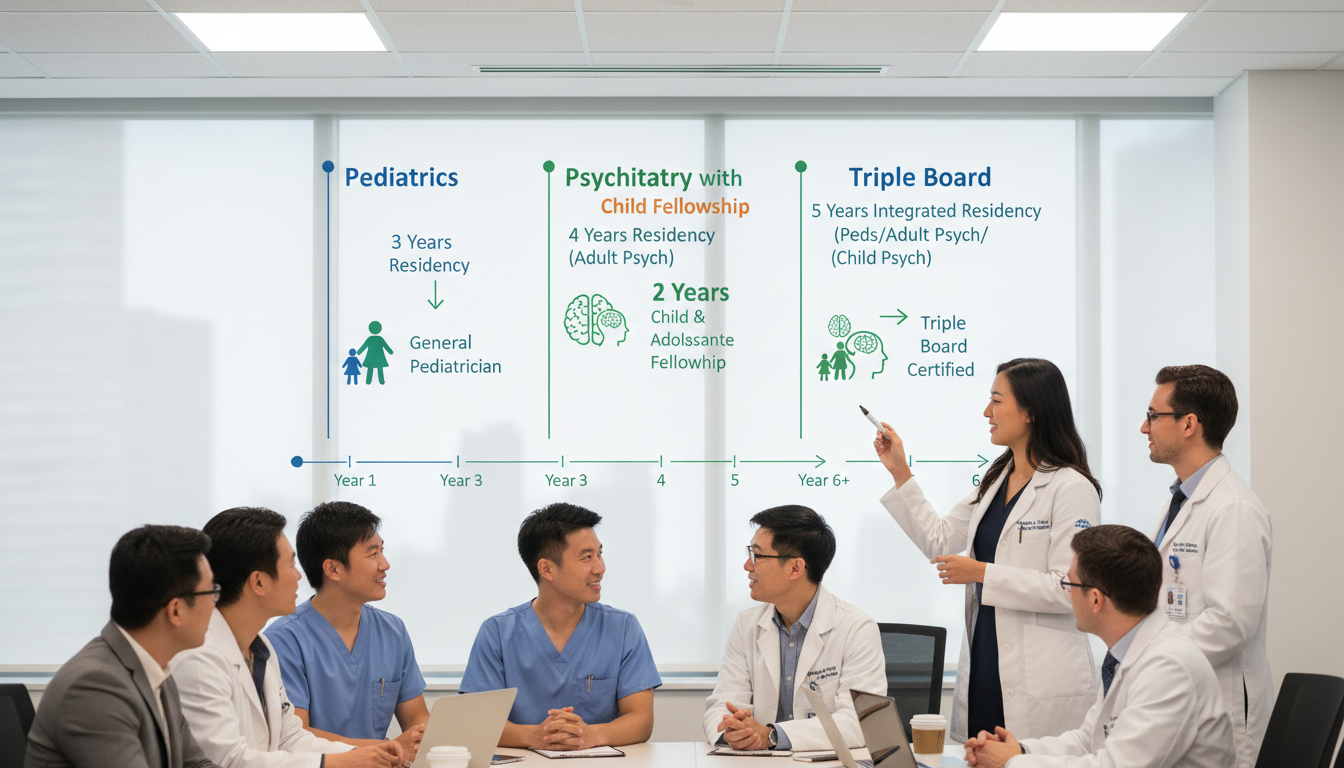
Broadly, you have four main options:
- Categorical Pediatrics → Child and Adolescent Psychiatry (CAP) exposure/fellowship
- Categorical Psychiatry → Child and Adolescent Psychiatry Fellowship
- Combined Pediatrics–Psychiatry–Child and Adolescent Psychiatry (Triple Board)
- Less common combined or sequential paths (e.g., med-peds + psych, or peds then psych)
Option 1: Categorical Pediatrics with strong mental health focus
Training structure:
- 3 years of pediatrics residency
- Optional:
- Extra electives in behavioral/developmental pediatrics or integrated behavioral health
- Fellowship in Developmental-Behavioral Pediatrics (DBP) or related fields
Career outcomes:
- General pediatrician with strong behavioral health focus
- Developmental-behavioral pediatrician
- Pediatric hospitalist or subspecialist with psych-savvy practice
- Leadership in integrated behavioral health in pediatric practices
Pros:
- You are fully a pediatrician; clear identity to patients and colleagues
- Strong foundation in physical health, growth, and development
- Shorter total training if you don’t pursue fellowship
- Broad job market; every pediatric setting needs better mental health care
Cons:
- Limited formal training in the full spectrum of psychiatric disorders and psychopharmacology
- Less authority to manage severe mental illness or complex psychopharm regimens independently
- If you later want to be primarily a psychiatrist, the path is longer (would require additional training)
Best for you if:
- You ask “what specialty should I do” and your heart says “I’m a pediatrician first”
- You want to be a primary care or subspecialty pediatrician who’s highly skilled with mental health
- You enjoy developmental and behavioral cases but don’t need a full psychiatrist identity
Option 2: Categorical Psychiatry → Child and Adolescent Psychiatry Fellowship
Training structure:
- 4 years of adult psychiatry
- Optional early entry: Many programs allow 3 years adult + 2 years CAP (5 years total instead of 6)
- 2 years child and adolescent psychiatry fellowship
Career outcomes:
- Child and adolescent psychiatrist
- Adult + child psychiatrist (depending on your practice mix)
- Work in:
- Outpatient clinics
- Hospital consult-liaison services
- Residential treatment centers
- Inpatient psych units
- School-based or community mental health agencies
Pros:
- Deep mental health expertise across the lifespan
- Flexibility to treat children, adolescents, and adults
- Strong training in psychotherapy, psychopharmacology, and systems of care
- Growing need and high demand for CAP across the country
Cons:
- Less formal training in general pediatrics and complex pediatric medical conditions
- Comfort with pediatric physical exam and management may depend on your own initiative and rotations
- For certain medically complex cases, you’ll still rely heavily on pediatricians
Best for you if:
- When you ask how to choose specialty, you consistently imagine yourself as a psychiatrist
- You enjoy understanding family systems, developmental trauma, psychodynamics, and psychopharm
- You are willing to learn pediatric medical issues on the psychiatry side as needed
Option 3: Triple Board (Pediatrics–Psychiatry–Child and Adolescent Psychiatry)
Triple Board is the quintessential peds psych residency structure and often the focus when students search “triple board” or “choosing medical specialty” in this arena.
Training structure:
- 5 years total
- Integrated rotations in:
- Pediatrics (meets requirements for ABP board eligibility)
- Adult Psychiatry (meets requirements for ABPN psychiatry board eligibility)
- Child and Adolescent Psychiatry (meets CAP board requirements)
- Graduates are eligible to sit for:
- Pediatrics boards
- General Psychiatry boards
- Child and Adolescent Psychiatry boards
Career outcomes:
- Highly varied, including:
- Integrated medical-psychiatric care for complex pediatric populations
- Leadership in children’s hospitals, consultation-liaison, and integrated care models
- Specialized programs (e.g., eating disorders, neurodevelopmental clinics, pediatric psychosomatic medicine)
- Academic roles at the intersection of peds and psych
- Hybrid practices (e.g., inpatient peds consults + outpatient CAP)
Pros:
- You are fully trained and board-eligible in all three disciplines
- Structured to prepare you for “borderland” cases where medical and psychiatric issues are inseparable
- Strong identity as a bridge between pediatrics and psychiatry
- Ideal for systems-level innovation and leadership roles
Cons:
- Intense, fast-paced, and integrated; you switch contexts frequently
- Shorter time in each discipline than categorical + fellowship routes; requires self-directed learning
- Risk of role diffusion: you must intentionally craft a coherent career identity post-training
- Limited number of programs and positions; geographic flexibility may be constrained
Best for you if:
- When wondering “what specialty should I do,” you feel torn equally between pediatrics and psychiatry
- You want a career explicitly at the intersection of medical and psychiatric care for children
- You enjoy variety, systems thinking, and complex patients
- You can tolerate ambiguity and a non-traditional training structure
Option 4: Other combined or sequential paths
Less common but occasionally relevant options:
- Med-Peds → Psychiatry (or CAP) later
- Full Pediatrics residency → Psychiatry residency (for those who discover psychiatry later)
- Psychiatry → fellowship in psychosomatic or consult-liaison psychiatry with a pediatric focus
These paths can be powerful but are often longer and less standardized. They may fit if your interests evolve over time rather than being clear at the start of residency.
How to Choose Specialty: A Structured Self-Assessment
When choosing medical specialty in this domain, you’re not just comparing fields; you’re comparing combinations of identities. Here’s a practical framework.
1. Clarify what energizes you clinically
Reflect on rotations, cases, and experiences:
- When do you feel most “in flow”?
- In the NICU or PICU managing acute medical issues?
- In clinic talking for 45 minutes with a teen struggling with anxiety?
- Discussing medication titrations for ADHD or SSRIs for depression?
- Leading a family meeting about trauma or chronic illness adjustment?
Try this exercise:
- List your top 5 most meaningful patient encounters in medical school.
- For each, ask:
- What exactly did I love about this?
- Was it the physical exam? The diagnostic reasoning? The conversation? The systems advocacy?
Patterns will emerge that point you more toward pediatrics, psychiatry, or a genuine blend.
2. Consider your preferred patient population
Ask:
- Do I feel most at home with:
- Infants and toddlers + families?
- School-age children?
- Adolescents and transition-age youth?
- Adults as well as kids?
If you are drawn to:
- Only children and adolescents: Triple Board or CAP-focused paths may be best.
- Across the lifespan: Categorical psychiatry + CAP training gives you flexibility to see both adults and kids.
- Younger children and medically complex kids: Pediatrics or Triple Board may suit you more.
3. Evaluate your tolerance for medical vs. psychological complexity
Rate yourself (1–5) on how much you enjoy:
- Performing detailed physical exams
- Managing acute physiology (fluids, sepsis, respiratory distress)
- Longitudinal management of chronic medical conditions (asthma, diabetes)
- Exploring trauma histories and family dynamics
- Doing psychotherapy and motivational interviewing
- Monitoring and adjusting psychiatric medications with subtle side effect profiles
If your “medical complexity” scores tower above “psychological complexity,” you may lean toward pediatrics with behavioral focus. If the reverse is true, psychiatry + CAP fits better. If both are high and you truly don’t want to give either up, that’s when Triple Board deserves serious consideration.
4. Reflect on your work style and environment preferences
Different paths come with different day-to-day realities:
- Pediatrics:
- More acute care, procedural elements (depending on subspecialty)
- Team-based work in hospitals and clinics
- Shorter visits in primary care; longer in subspecialty
- Psychiatry / CAP:
- Longer, conversation-heavy visits
- More outpatient, less procedural work
- Emphasis on therapy, psychopharm, and interdisciplinary collaboration
- Triple Board:
- Frequent switching between environments
- Need to adapt rapidly to different teams and expectations
- Significant cognitive flexibility
Ask yourself:
- Do I like frequent transitions or prefer consistency?
- How do I feel about procedures? (e.g., lumbar punctures, line placements, etc.)
- Do long, in-depth conversations drain or energize me?
Your honest answers will help guide how to choose specialty in this niche.

Practical Steps to Explore and Decide
Once you have a sense of your inclinations, here’s how to concretely move forward toward a decision.
1. Seek targeted clinical experiences
Whenever possible, arrange electives that sit at the peds-psych interface:
- Inpatient pediatric consultation-liaison psychiatry
- Child and adolescent psychiatry outpatient
- Developmental-behavioral pediatrics
- Autism or neurodevelopmental clinics
- Eating disorders programs
- Pediatric pain or psychosomatic medicine clinics
As you rotate:
- Take notes after each clinic day:
- Did I enjoy this?
- Which aspects felt natural, and which felt forced?
- Compare your experiences across different settings.
2. Find mentors in each pathway
Aim for at least one mentor in:
- Pediatrics (ideally someone with strong behavioral/developmental interest)
- Child & Adolescent Psychiatry
- A Triple Board graduate or faculty member, if possible
With each mentor, ask:
- What do you love about your career?
- What do you find most challenging?
- If you were choosing again today, would you pick the same path?
- How do you see the future of your field over the next 10–20 years?
Mentors who understand your goals can help you answer “what specialty should I do” in a way aligned with both your strengths and the real-world landscape.
3. Attend specialty-specific events
Look for:
- AAP Section on Developmental and Behavioral Pediatrics programming
- AACAP (American Academy of Child and Adolescent Psychiatry) events
- Local or national Triple Board information sessions
- Institutional seminars on integrated pediatric behavioral health
These experiences help you:
- Hear from people living the careers you’re considering
- See the diversity of job types within each path
- Learn which training backgrounds lead to which roles
4. Use reflective tools and formal advising
Many schools have formal “choosing specialty” workshops or career advisors. When using them:
- Come prepared with:
- A brief narrative of your interests
- Concrete clinical experiences that shaped you
- Specific questions (e.g., “Should I do Triple Board versus psychiatry + CAP?”)
- Consider structured tools:
- Specialty interest inventories
- Personality and values assessments (e.g., what work-life balance you prefer, tolerance for overnight calls, etc.)
These don’t make your decision, but they clarify your priorities.
Building a Competitive Application in Peds-Psych Pathways
Once you’ve leaned toward a path, you need to align your CV and application.
For Triple Board
Programs look for applicants who:
- Are genuinely committed to pediatrics and psychiatry
- Understand what Triple Board actually is (and isn’t)
- Show resilience, adaptability, and systems thinking
To strengthen your application:
- Clinical:
- Honors or strong performance in both pediatrics and psychiatry clerkships
- Electives in child psych, CL, or behavioral peds
- Research / scholarly work:
- Projects on topics like integrated care, autism, ADHD, pediatric trauma, or chronic illness and mental health
- Leadership / advocacy:
- Involvement with school-based mental health initiatives, advocacy groups, or community programs
- Personal statement:
- Clearly articulate why only Triple Board (or a similar integrated path) makes sense for your goals
- Provide concrete patient stories that show you thrive at the intersection
For Categorical Pediatrics (with psych focus)
Emphasize:
- Strong academic pediatrics performance
- Evidence of interest in mental health:
- Quality improvement projects on depression screening in pediatrics
- Advocacy around children’s mental health
- Involvement in DBP or behavioral electives
- Your ability to manage busy clinical settings while still attending to psychosocial aspects of care
For Psychiatry → Child & Adolescent Psychiatry
Highlight:
- Strong evaluations on psychiatry rotations
- Evidence of interest in child and adolescent work:
- Rotations or electives in CAP
- Research in developmental psychopathology, trauma, school-based mental health, etc.
- Experiences that show you can collaborate with pediatricians, schools, and families
In all paths, letters of recommendation from mentors who understand your interest in the peds-psych interface are invaluable.
Long-Term Career Considerations: Beyond Residency
When choosing a medical specialty, you are also choosing a future professional identity and lifestyle. For the pediatrics-psychiatry space, consider:
1. Job market and flexibility
- Pediatrics:
- Widely available positions (hospital, outpatient, academic, rural, urban)
- Increasing emphasis on integrated behavioral health → added value if you’re psych-savvy
- Child and Adolescent Psychiatry:
- High demand nationwide; significant shortages in many regions
- Flexibility in practice structure and setting
- Triple Board:
- Highly valued in:
- Children’s hospitals
- Programs serving medically and psychiatrically complex children
- Academic centers developing integrated services
- Some employers may not fully understand the training; you may need to educate and define your own role
- Highly valued in:
2. Scope of practice and identity
Ask yourself:
- Do I see myself as:
- A pediatrician who’s particularly good with mental health?
- A psychiatrist who specializes in kids and teens?
- A hybrid physician bridging medical and psychiatric care?
None of these is “better” than the others. But misalignment between your training and your desired identity can lead to frustration.
3. Lifestyle and work-life integration
In general (with wide variation by job):
- Pediatrics:
- Depending on subspecialty, may involve more call, inpatient time, and acute care
- Primary care may be more daytime-focused but busy and fast-paced
- Psychiatry / CAP:
- Often more outpatient, with more predictable schedules
- Fewer overnight emergencies relative to other fields, though crisis work exists
- Triple Board:
- During residency: very busy and cognitively demanding
- After training: lifestyle depends entirely on how you shape your practice—could be very outpatient-focused or include high-acuity settings
Think about:
- How important are evenings and weekends free to you?
- How much do you mind overnight call or shift work?
- Do you thrive on variety and intensity, or prefer steadier rhythms?
Putting It All Together: A Decision Roadmap
Here’s a simplified decision aid you can adapt:
Start with your core identity:
- “I’m clearly more pediatrician” → Favor Pediatrics (with mental health focus/DBP)
- “I’m clearly more psychiatrist” → Favor Psychiatry → CAP
- “I truly cannot split them; I want both deeply and persistently” → Explore Triple Board
Check alignment with your preferred patient ages and settings:
- Only children/teens → Triple Board or CAP-focused paths
- Children + adults → Psychiatry + CAP
- Medically complex kids → Pediatrics or Triple Board
Reality-check with mentors:
- Bring your tentative decision to at least 2 mentors (one from each relevant field)
- Ask them to “poke holes” in your reasoning and help refine it
Try on the identity:
- Write a short paragraph:
- “I am a pediatrician whose niche is…”
- “I am a child psychiatrist who specializes in…”
- “I am a Triple Board-trained physician who works at the interface of…”
- Which version feels most authentic and exciting?
- Write a short paragraph:
Decide early enough to tailor your final year:
- Schedule relevant sub-internships, electives, and research during your MS4 year
- Prepare applications that clearly reflect a coherent story
FAQs: Choosing a Medical Specialty in Pediatrics-Psychiatry
1. How do I know if Triple Board is right for me versus psychiatry with CAP fellowship?
Triple Board may be right for you if:
- You are genuinely committed to both pediatrics and psychiatry—not just hedging
- You want to manage both medical and psychiatric aspects of complex pediatric cases yourself
- You enjoy variety, systems-level work, and integrated care models
Psychiatry + CAP may be better if:
- Your deepest interest is in mental health, psychotherapy, and family work
- You care about medical issues but don’t need full pediatric training
- You want flexibility to treat adults as well as children in your career
2. Is it a disadvantage to be “undecided” between pediatrics and psychiatry at the start of MS3?
No. Many students clarify their interests during clinical rotations. Use your core clerkships to:
- Pay attention to which patient encounters energize you most
- Seek early electives in child/adolescent psychiatry, DBP, or pediatric CL
- Talk with mentors early once you notice a consistent pattern of interests
You only need to make a final decision about applications by late MS3 or early MS4, but starting your reflection early helps.
3. Will choosing pediatrics limit my ability to work in mental health compared to psychiatry?
It will shape the type of mental health work you do, but not necessarily limit your impact. As a pediatrician, you can:
- Lead integrated behavioral health in primary care practices
- Specialize in developmental-behavioral pediatrics
- Influence systems and policy around children’s mental health at scale
Psychiatry/CAP provides more depth in psychiatric diagnosis and treatment, while pediatrics gives breadth in medical care and development. Both are crucial; the “right” choice depends on which role you want to play.
4. What if I choose one path and later realize I want the other?
It happens. Options include:
- After Pediatrics residency:
- Apply to Psychiatry residency
- Pursue DBP or related fellowships to deepen your behavioral expertise
- After Psychiatry residency:
- CAP fellowship to focus on youth
- Additional pediatric-focused experiences (e.g., pediatric CL, rotations at children’s hospitals)
Changing directions typically adds training years, but your prior experience can still enrich your eventual practice. Being deliberate upfront reduces this risk, but it’s not irreparable if your interests evolve.
Choosing a medical specialty in the pediatrics-psychiatry space is less about finding a single “right” answer and more about aligning your personality, values, and interests with one of several excellent paths. Whether you become a pediatrician with strong behavioral skills, a child and adolescent psychiatrist, or a Triple Board-trained bridge between worlds, there is profound and meaningful work to be done for children and families.
Take the time to explore deeply, listen honestly to what excites you, and use mentors and experiences to guide you. Your future patients—both their bodies and their minds—will benefit from the clarity and intentionality you bring to this choice.