Neurosurgery is one of the most demanding—and most misunderstood—paths in medicine. As a student or early trainee, you may be drawn to brain surgery residency programs by the intellectual challenge, the high-stakes environment, and the opportunity to change the trajectory of a patient’s life in a single operation. At the same time, you might be asking yourself: What specialty should I do? and wondering whether neurosurgery is truly the right fit.
This guide walks you through how to choose a medical specialty with a specific focus on neurosurgery residency. We’ll explore who thrives in neurosurgery, what the training and lifestyle really look like, and how to make an informed, realistic decision.
Understanding What Neurosurgery Really Is
Before deciding whether a neurosurgery residency is right for you, it’s critical to understand what neurosurgeons actually do—day to day, over years, and at different stages of training.
Scope of Practice
Neurosurgery is far more than “brain surgery.” It encompasses the diagnosis and surgical management of disorders of:
Brain
- Tumors (primary and metastatic)
- Vascular lesions (aneurysms, AVMs)
- Trauma (hematomas, contusions, skull fractures)
- Hydrocephalus and CSF flow disorders
- Epilepsy surgery in specialized centers
Spine and Peripheral Nerves
- Degenerative spine disease (disc herniations, stenosis)
- Spinal trauma and instability
- Spinal tumors (intramedullary, intradural, extradural)
- Peripheral nerve entrapment and tumors
Functional and Pain Neurosurgery
- Deep brain stimulation for movement disorders and psychiatric conditions
- Neuromodulation for chronic pain
- Surgery for intractable epilepsy
Pediatric Neurosurgery
- Congenital malformations (spina bifida, Chiari malformations)
- Pediatric brain tumors
- Pediatric hydrocephalus and craniosynostosis
Neurosurgery is also highly collaborative. Neurosurgeons regularly work with neurology, critical care, oncology, radiology, orthopedics, psychiatry, and rehabilitation teams.
Daily Life: What a Typical Week Can Look Like
A “typical” week in neurosurgery varies by training level and practice setting, but it often includes:
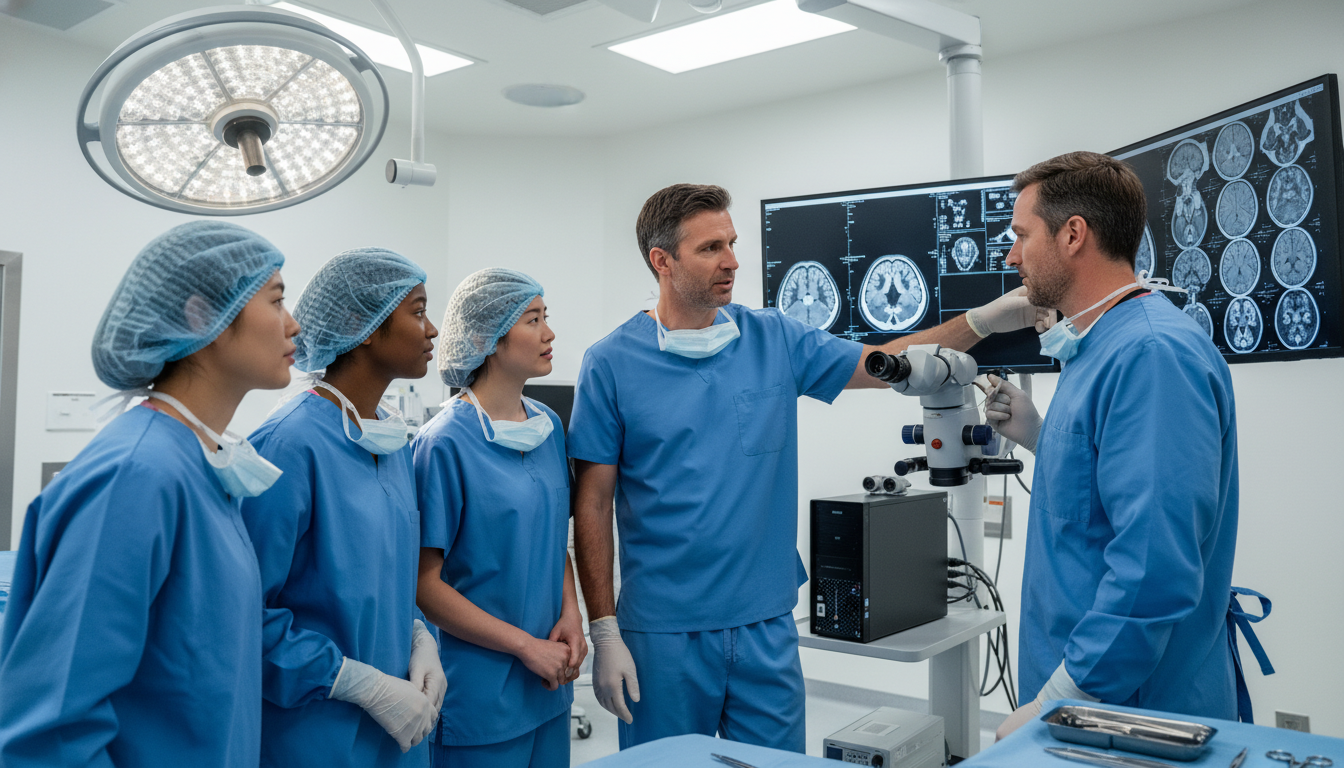
Operating Room (OR)
- Long, complex cases (e.g., 8–12+ hours for skull base tumors)
- Higher-volume, shorter cases (lumbar decompressions, elective spine)
- Emergency cases added unpredictably (traumatic brain injury, acute hemorrhage)
Inpatient Care
- ICU and step-down rounds
- Management of critically ill patients with neuromonitoring, drains, and ventilators
- Frequent reassessments after surgery and during acute neurological changes
Outpatient Clinic
- New patient consultations for surgical vs. non-surgical decisions
- Preoperative counseling and risk-benefit discussions
- Postoperative follow-up and long-term management, especially in spine
Imaging and Planning
- Reviewing CT, MRI, angiograms, functional imaging
- Preoperative planning with navigation software and multidisciplinary conferences
Even as an attending, many neurosurgeons have long days that start early with rounds and end late after the last surgery or clinic patient. For residents, this schedule is intensified by night call, weekend coverage, and frequent emergencies.
Emotional Landscape of Neurosurgery
The emotional reality of neurosurgery is as important as the technical one:
- High-stakes decision-making: Outcomes are often binary—dramatic recovery or devastating disability.
- Uncertainty and risk: Some cases carry a high risk of complications despite perfect technique.
- Family communication: You’ll regularly discuss life, death, and quality-of-life decisions with families on very short notice.
- Emotional highs and lows: Saving a life in the OR one day; delivering bad news about a malignant glioma the next.
If you’re choosing a medical specialty and neurosurgery is on your list, you must account not only for your interest in the brain, but also your comfort with this emotional terrain.
Core Traits of People Who Thrive in Neurosurgery
When students ask “how to choose a specialty” or “what specialty should I do,” they often focus on what interests them intellectually. In neurosurgery, personality, resilience, and values are just as critical as interests.
1. Comfort with Responsibility and Pressure
Neurosurgery is not just another high-responsibility field—it is near the top of the spectrum.
You might thrive here if you:
- Don’t shy away from being the last word in a tough decision.
- Can make time-sensitive choices with incomplete information.
- Remain functional and systematic under visible stress and scrutiny.
Example:
A patient with a large intracranial hemorrhage arrives in the ED. The neurologic exam is changing every minute. CT shows mass effect and herniation risk. An emergent craniotomy is needed within the hour. As the on-call neurosurgeon, you must consent the family, mobilize the OR, and proceed—fully aware the patient might not survive regardless.
If that type of situation energizes rather than paralyzes you, neurosurgery may be a good fit.
2. Long-Horizon Commitment and Work Ethic
Neurosurgery residency in the U.S. is typically 7 years, sometimes more if you add dedicated research or fellowships. It demands:
- Long hours: Clinical services, OR time, and call.
- Physical endurance: Standing for hours, operating with intense focus.
- Intellectual stamina: Lifelong study of complex, evolving literature.
Ask yourself honestly:
- Can I sustain 60–80+ hour weeks for many years?
- Do I tolerate chronic fatigue reasonably well?
- Am I still kind, safe, and professional when tired and stressed?
3. Manual Dexterity and Spatial Reasoning
Neurosurgeons operate in millimeter-scale spaces with devastating consequences for small errors.
Signs this might suit you:
- You excel in procedures during rotations (lumbar punctures, suturing, central lines).
- You enjoy tasks requiring fine motor control (instruments, robotics, even hobbies like drawing or playing instruments).
- You find 3D anatomy intuitive and can “mentally rotate” complex structures.
Note: You do not need to be a prodigy in the OR on day one of medical school. But if procedural work consistently frustrates or bores you, reconsider.
4. Emotional Resilience and Recovery
You will see tragedy: young patients with glioblastoma, catastrophic trauma, potentially preventable injuries. Some cases will not go well despite excellent care.
Key questions:
- How do I process grief, error, or unforeseen complications?
- Can I seek support, learn, and return without becoming detached or burned out?
- Do I have strategies (or am I willing to build them) for healthy coping?
If your personality leans toward catastrophic thinking or you deeply internalize every adverse outcome, neurosurgery can be emotionally overwhelming without strong support and intentional coping mechanisms.
5. Intrinsic Interest in the Nervous System
Choosing a medical specialty in neurosurgery also requires genuine, sustained curiosity about the nervous system:
- Do you enjoy neuroanatomy and neurophysiology?
- Do neurology and neurosurgery patients capture your attention effortlessly?
- Are you drawn to imaging, especially brain and spine MRI/CT?
Passion alone won’t carry you through residency, but without real interest, the sacrifices will feel disproportionate.

Training Path: What a Brain Surgery Residency Actually Involves
If you’re seriously considering neurosurgery, you need a clear picture of what neurosurgery residency training looks like—so you know what you’re signing up for.
Length and Structure of Neurosurgery Residency
In the U.S., a brain surgery residency (neurosurgery residency) is typically:
- 7 years total
- PGY-1: Surgical internship year, heavy in neurosurgery with some rotations in related fields (ICU, neurology, general surgery).
- PGY-2–3: Junior resident years, call-intensive; you manage ER consults, ICU patients, and assist in the OR.
- PGY-4–5: Mid-level years; increased operative responsibilities, subspecialty exposure, sometimes protected research time.
- PGY-6–7: Senior/chief years; lead services, run ORs, supervise juniors, and solidify independent practice skills.
Some programs integrate 1–2 years of dedicated research, which can extend or be incorporated into the 7 years.
Subspecialization and Fellowships
After residency, many neurosurgeons pursue fellowships, such as:
- Cerebrovascular and Endovascular Neurosurgery
- Skull Base Surgery
- Spine Surgery
- Functional and Epilepsy Neurosurgery
- Pediatric Neurosurgery
- Neuro-oncology
Consider whether you’re comfortable with the idea that your “full training” could easily extend into your mid-30s or beyond.
Lifestyle and Workload Realities
While duty hour limits exist, neurosurgery residents often experience:
- Early mornings (5–6 AM): Pre-rounding, prepping cases.
- Long OR days: Especially on heavy operative services.
- Frequent night call: In-house or home call with frequent returns to the hospital.
- Unpredictability: Traumas and hemorrhages don’t respect schedules.
As an attending, you may gain more control over your schedule—but emergency call, weekend coverage, and long cases remain part of the lifestyle in most practice settings.
When choosing a medical specialty, be realistic: could you see yourself maintaining relationships, health, and personal goals within this framework?
How to Explore Neurosurgery Before You Commit
If you’re wondering “choosing medical specialty: where do I start for neurosurgery?” the best approach is structured exploration.
1. Maximize Your Neurosurgery Exposure in Medical School
Use the formal curriculum and electives intentionally:
- Early shadowing (M1/M2):
- Observe in the OR and clinic.
- Ask to see both routine and emergency cases.
- Clinical electives and sub-internships (M3/M4):
- Do at least one home program rotation in neurosurgery.
- Consider an away rotation at another neurosurgery department if seriously interested in a neurosurgery residency.
- Related rotations:
- Neurology, ICU, trauma surgery, orthopedics/spine, radiology (especially neuroradiology).
Take notes after each experience:
- What did I enjoy?
- What drained me?
- What did I envy in other specialties during this rotation?
2. Talk to People at Different Career Stages
Diverse perspectives help prevent a skewed view.
Seek out:
- Residents (PGY-1 to PGY-7):
- Ask about their daily life, biggest challenges, and what surprised them most.
- Young attendings:
- Ask about the transition to practice, work-life balance, and job market.
- Mid-career and senior neurosurgeons:
- Ask about long-term career satisfaction, burnout, and how the field has changed.
Concrete questions to ask:
- “If you could go back, would you choose neurosurgery again?”
- “What personality traits struggle most in this field?”
- “How do residents who decide not to continue in neurosurgery typically realize that, and when?”
3. Participate in Research and Academic Activities
Neurosurgery is a research-heavy field. Exposure to neurosurgical research can:
- Deepen your understanding of disease mechanisms and treatment.
- Clarify whether you enjoy the academic side of the specialty.
- Strengthen your neurosurgery residency application if you decide to apply.
Options include:
- Clinical outcomes research (spine, tumors, trauma).
- Basic or translational neuroscience projects.
- Quality improvement projects in the neurosurgical ICU or OR.
If you strongly dislike the intellectual ecosystem (conferences, journals, academic discussions), think carefully—many brain surgery residency programs lean heavily academic.
4. Compare Neurosurgery Against Other Specialties You Like
When choosing a medical specialty, decisions are rarely about “yes or no to neurosurgery” in a vacuum. Common alternative interests for future neurosurgeons include:
- Neurology
- Orthopedic surgery (especially spine)
- General surgery or trauma
- Interventional radiology
- Anesthesiology/critical care
Ask yourself:
- What specific aspects of neurosurgery do I love that these fields don’t fully offer?
- Which aspects of neurosurgery are major downsides for me that other specialties handle better?
- If I couldn’t match into neurosurgery, what would I genuinely be happy doing?
Write this out. Seeing it on paper makes patterns clearer.

A Step-by-Step Framework for Choosing Neurosurgery (or Not)
Here’s a structured way to approach choosing a medical specialty with neurosurgery in mind.
Step 1: Clarify Your Core Values and Non-Negotiables
Before focusing on any specialty:
- List your top 5 life values (e.g., family time, intellectual challenge, financial security, geographic flexibility, research, teaching).
- Define non-negotiables:
- “I need at least X evenings/week free by 7 PM.”
- “I want to live near extended family long-term.”
- “I want or do not want high-acuity, life-or-death work daily.”
Neurosurgery may still be compatible with many of these—but you should know where you’re willing to compromise and where you are not.
Step 2: Reality-Check Your Perceptions
Write down what you think neurosurgery residency and eventual practice look like. Then compare with real data:
- A few days of shadowing.
- Detailed conversations with residents.
- Reading neurosurgery lifestyle articles or forums (with caution for bias).
Look for discrepancies such as:
- You imagined mostly brain tumor cases, but see predominantly spine.
- You assumed residents scrub every case, but see heavy ward and ICU responsibilities.
- You thought attendings are mostly in the OR, but see large outpatient demands and admin work.
If your idealized version and reality diverge significantly, do more exploration.
Step 3: Assess Your Fit Across Multiple Dimensions
Use the following self-check:
- Intellectual Interest:
- Do you naturally gravitate to neuro topics when studying?
- Procedural Enjoyment:
- During surgical rotations, do you feel energized or drained by long OR days?
- Stress and Responsibility Tolerance:
- How do you handle time-sensitive, high-pressure decisions in clinical settings?
- Endurance and Lifestyle:
- Can you realistically sustain the schedule of a neurosurgery residency, and later, practice?
- Emotional Load:
- How do you respond emotionally to severely disabled or dying patients, and their families?
Evaluate yourself honestly. You don’t need a perfect score, but major mismatch in several categories should prompt reconsideration.
Step 4: Try a “Test Year” Mindset
Especially in clinical years, act as if you’re preparing for neurosurgery, even if you’re uncertain:
- Take call opportunities seriously.
- Seek procedural experiences.
- Volunteer for neurosurgery-adjacent research and talks.
Ask periodically:
- “If my life looked like this, amplified, for 7 years, could I tolerate—and even enjoy—it?”
If the answer is consistently “no,” that’s valuable information while you still have time to pivot.
Step 5: Secure Honest Mentorship
Find at least one mentor who will put your well-being above “recruiting” you into the field.
A good neurosurgery mentor should:
- Be candid about the challenges and rewards.
- Ask you tough questions about your motivations and limits.
- Help you develop a backup plan if neurosurgery doesn’t work out.
Bring specific questions like:
- “Do you think my strengths match what this field demands?”
- “Where do you see me struggling based on what you know of me?”
- “What would you want your own child to know before choosing neurosurgery?”
Step 6: Plan for Multiple Outcomes
When choosing a medical specialty as competitive as neurosurgery, you must plan for:
- Scenario A: You choose neurosurgery, build a strong application, and match.
- Scenario B: You choose neurosurgery, apply, and do not match.
- Scenario C: You seriously explore neurosurgery, then decide another field fits better.
Each scenario is okay. The goal is not to “prove” you’re good enough for neurosurgery; it’s to find the specialty where your talents, values, and life goals align.
Practical Tips if You Decide to Pursue Neurosurgery
If, after thoughtful exploration, you decide a brain surgery residency is your path, you’ll need a strategic approach.
Build a Strong Neurosurgery Application
Academic Excellence
- Strong preclinical and clinical grades.
- Solid board scores (if applicable in your system).
- Honors in neurology, surgery, and neurosurgery rotations where possible.
Neurosurgery-Specific Research
- Aim for projects that can lead to posters, presentations, or publications.
- Don’t chase prestige alone; prioritize mentors who are engaged and supportive.
Meaningful Letters of Recommendation
- From neurosurgeons who truly know you and your work ethic.
- From other surgical or neuro-related faculty who can speak to your clinical ability and character.
Demonstrated Commitment to the Field
- Involvement in neurosurgery interest groups, conferences, or teaching.
- Thoughtful personal statement reflecting realistic understanding of the specialty and your motivations.
Take Care of Your Health and Relationships Early
Because neurosurgery is so immersive, it’s easy to postpone your life until “after training.” That’s risky.
- Develop healthy coping mechanisms: Exercise, sleep hygiene, therapy or coaching if needed.
- Nurture supportive relationships: Family, friends, and peers who understand your path.
- Learn boundary-setting skills: Even in neurosurgery, there must be protected time and mental space for recovery.
The habits you build as a student and resident lay the foundation for your long-term well-being in a demanding field.
FAQs: Choosing Neurosurgery as a Medical Specialty
1. How do I know if neurosurgery is right for me?
Neurosurgery might be right for you if:
- You are genuinely fascinated by the brain, spine, and nervous system.
- You enjoy procedural work and long OR days.
- You tolerate high responsibility and emotional intensity reasonably well.
- You can realistically commit to a 7-year neurosurgery residency and a career with ongoing unpredictability and emergencies.
The only way to know with confidence is to combine self-reflection, direct exposure, and honest mentorship.
2. What if I love neurology but I’m not sure about surgery?
Consider:
- Doing both neurology and neurosurgery rotations early.
- Asking yourself whether you prefer diagnostic reasoning/longitudinal care (more like neurology) or intervention/procedures (more like neurosurgery).
- Exploring interventional neurology or endovascular paths as additional procedural options.
If the OR consistently feels more draining than exciting, neurology or another neuro-focused specialty might be a better fit.
3. Is the lifestyle in neurosurgery always terrible?
“Terrible” is subjective. Objectively:
- Neurosurgery involves long hours, frequent call, and high stress, especially in residency and early practice.
- Some practice settings (e.g., elective spine-focused, large group with distributed call) can be more lifestyle-friendly than others (e.g., solo or small-group trauma-heavy practices).
- Burnout is a real risk, but many neurosurgeons report high meaning and satisfaction in their work.
When choosing medical specialty options, think in terms of fit rather than good vs. bad lifestyle. For the right person, neurosurgery’s demands feel like an acceptable trade-off for the work they love.
4. What’s my backup plan if I apply to neurosurgery and don’t match?
This is crucial to consider early. Common backup paths include:
- Neurology, especially with a plan to subspecialize (neurocritical care, epilepsy, stroke).
- Orthopedic surgery with interest in spine.
- General surgery or other surgical fields if your core interest is operative work.
Talk with mentors before applying:
- Decide whether you’ll apply to neurosurgery only, neurosurgery plus a backup specialty, or sequentially.
- Build experiences that keep multiple reasonable doors open (e.g., research and rotations relevant to more than one field).
Choosing a medical specialty is one of the defining decisions of your career. For neurosurgery, that choice carries unique weight given the intensity of training and practice. If you approach the decision with honesty, curiosity, and a willingness to confront both your strengths and your limits, you’ll be far more likely to land in a specialty—neurosurgery or otherwise—where you can thrive, grow, and practice medicine with purpose.