Preparing for the Clinical Informatics board examination can feel overwhelming—even for experienced clinicians. The exam spans medicine, information science, health systems, leadership, data analytics, and patient safety. The right board exam study resources in clinical informatics, however, can transform that complexity into a structured, manageable plan.
This guide walks you through the major resource types—textbooks, online courses, question banks, flashcards, and more—plus practical strategies to use them effectively. Whether you’re a practicing physician, a recent residency graduate, or entering a clinical informatics fellowship, you’ll find a roadmap to success here.
Understanding the Clinical Informatics Board Exam
Before selecting resources, it helps to understand what you’re preparing for.
Exam scope and structure
The American Board of Preventive Medicine (ABPM) and American Board of Pathology (ABPath) sponsor the Clinical Informatics subspecialty exam. While specifics may evolve, the exam generally covers:
Fundamental Informatics Concepts
- Information science, data structures, vocabularies and ontologies
- Standards (HL7, FHIR, LOINC, SNOMED CT, ICD, RxNorm)
- Human–computer interaction, usability, workflow analysis
Clinical Decision Making and Care Process Improvement
- Clinical decision support (CDS)
- Evidence-based medicine, guideline implementation
- Quality improvement, patient safety, measurement and reporting
Health Information Systems
- Electronic health records (EHRs), CPOE, PACS, LIS
- Interoperability, interfaces, integration engines
- Health information exchange (HIE), telehealth platforms
Leading and Managing Change
- Project management, governance, implementation science
- Change management, stakeholder engagement
- Regulations, privacy (HIPAA), security, ethics
Data Analytics and Research
- Databases, SQL basics, data warehouses
- Study design, basic statistics, predictive modeling concepts
- Public health informatics, population health analytics
Board exam vs. day-to-day practice
Clinical informatics practice is messy, contextual, and political; the exam is structured and standardized. That difference has implications:
- Exam questions often test core principles and definitions, not just practical workarounds.
- You’ll see idealized scenarios that assume best practices and guidelines are followed.
- Content can be more quantitative (data models, statistics) than many clinicians use daily.
Your study resources should therefore balance conceptual depth with exam-focused practice questions.
Core Reference Texts and How to Use Them
You don’t need to read every informatics textbook cover-to-cover. However, anchoring your studying with 1–2 core texts provides structure and fills knowledge gaps you’ll miss with questions alone.
1. Essential textbooks for Clinical Informatics
Below are commonly used references that align well with exam content:
a. Shortliffe & Cimino – “Biomedical Informatics: Computer Applications in Health Care and Biomedicine”
- Often seen as the “classic” informatics reference
- Strong for:
- Fundamental informatics concepts
- Historical context and theory
- Clinical decision support, AI, knowledge representation
- How to use:
- Focus on overview chapters and those directly tied to exam domains
- Don’t get lost in technical math or code-heavy sections unless you need them
- Use as a deep-dive reference when question explanations feel too superficial
b. Hoyt & Yoshihashi – “Clinical Informatics Board Review: Fundamentals of Clinical Informatics”
- Designed specifically for the board exam
- Organized around ABPM content domains
- Strong for:
- Summaries of key concepts with exam-style framing
- Tables, figures, and high-yield lists
- How to use:
- Read systematically during the first half of your study period
- Highlight and create notes that you can convert into flashcards
- Revisit high-yield chapters in the final 4–6 weeks
c. “Clinical Informatics Board Review” (multiple authors, various editions)
- There are several similarly titled board review books; many are case- or Q&A-based
- Strong for:
- Quick refreshers
- Clinically oriented scenarios
- How to use:
- Supplement your main textbook
- Use at the end of a study block as a “knowledge check”
d. AMIA/ACMI educational materials
- AMIA often recommends key readings and curricula aligned with the core content
- Fellowship programs use these for health IT training and didactic sessions
- How to use:
- Ask your fellowship or local informatics group for recommended reading lists
- Target articles that clarify topics you’ve repeatedly missed in questions

2. Strategy: Reading efficiently
You likely don’t have the time—or patience—to read 1,000+ pages linearly. Use a targeted approach:
Map chapters to exam domains
- Use the ABPM content outline as your “table of needs”
- For each domain (e.g., CDS, interoperability, governance), identify 1–3 core chapters
Use the “30-60-10 method” for a chapter
- Spend 30% of your time skimming headings, figures, tables, conclusions
- Spend 60% focusing on complex or unfamiliar sections
- Spend 10% summarizing into short notes or potential flashcards
Prioritize breadth, then depth
- First pass: aim to “know what you don’t know” across the full syllabus
- Second pass: revisit weak areas identified by questions or practice tests
Question Banks and Practice Exams: Your Primary Exam Trainer
Textbooks give you the “what” and “why,” but question banks train your brain to think in the exam’s style. For most candidates, Q-banks become the highest-yield resource.
1. Types of question resources
Unlike USMLE prep, there isn’t a single universal Q-bank (like UWorld) dominating the market for Clinical Informatics. Instead, you’ll typically combine several sources:
a. Board-specific question books
- Many “Clinical Informatics Board Review” titles include 200–400 practice questions
- Pros:
- Often peer-reviewed and aligned to core content
- Provide rationales and references
- Cons:
- Question quality and difficulty can vary
- May be less detailed than major USMLE-style banks
b. Online commercial question banks
- A few vendors now offer dedicated Clinical Informatics question banks
- Pros:
- Digital platform mirrors exam interface
- Timed tests, performance analytics, and custom quizzes
- Cons:
- Subscription cost
- Variable question quality; some emphasize recall over reasoning
c. Institutional or fellowship Q-banks
- Many clinical informatics fellowships accumulate internal question sets
- Pros:
- Often tailored by recent test-takers
- May reflect emerging topics or recent guideline changes
- Cons:
- Access may be limited to current or former trainees
2. How many questions should you aim for?
A practical target is 1,000–1,500 high-quality questions across all sources. If you can find more and maintain quality, even better. Prioritize:
- Variety of topics across all exam domains
- Mix of single-best-answer and scenario-based questions
- Questions that explain both “why correct” and “why incorrect”
3. Borrowing strategies from UWorld-style prep
While there’s no exact equivalent to UWorld for Clinical Informatics, UWorld tips from USMLE prep adapt well:
Do questions in “tutor mode” early on
- Read explanations in depth, including for options you didn’t choose
- Note any unfamiliar terminology to research
Shift toward timed blocks later
- 40–60 question blocks in exam-like conditions
- Simulate the mental fatigue of long testing sessions
Turn questions into content maps
- For each frequently missed topic (e.g., FHIR resources, CDS rule types, project governance models), create a mini-outline
Track performance by domain
- Use spreadsheets or built-in analytics to watch trends
- Intentionally over-sample weaker areas in the final 4–8 weeks
4. Reading and using explanations
The true value of a Q-bank is in the explanations, not just the answer key. For each missed or guessed question:
Identify the concept
- Is it about a standard (e.g., LOINC vs. SNOMED CT)?
- A governance or regulatory question?
- A design principle in human–computer interaction?
Summarize the principle in your own words
- Example: “Use LOINC for lab tests, SNOMED CT for clinical findings; both can coexist in the same message but serve different semantic roles.”
Decide where to store the learning
- Add to a dedicated digital note
- Turn into a flashcard (see next section)
- Bookmark a textbook page for deep reading
The more active you are with explanations, the less passive memorization you’ll need later.
Flashcards and Spaced Repetition: Making Knowledge Stick
Clinical informatics is vocabulary- and concept-heavy. Standards, acronyms, statistical terms, governance frameworks, and design principles can blur together without reinforcement. This is where flashcards and spaced repetition shine.
1. What to put in flashcards
Not every fact deserves a flashcard. Focus on:
- Commonly tested acronyms and their functions
- HL7 v2 vs. HL7 FHIR
- SNOMED CT vs. ICD-10-CM vs. LOINC vs. RxNorm
- Core definitions and distinctions
- Sensitivity vs. specificity vs. PPV vs. NPV
- Usability heuristics (e.g., Nielsen’s principles)
- Types of CDS: alerts, reminders, order sets, documentation templates
- Governance and regulatory facts
- HIPAA components, meaningful use / Promoting Interoperability themes
- Roles of ONC, CMS, FDA in health IT
- Data and statistics
- Types of data models (relational, star schema)
- Common tests (t-test, chi-square, logistic regression basics)
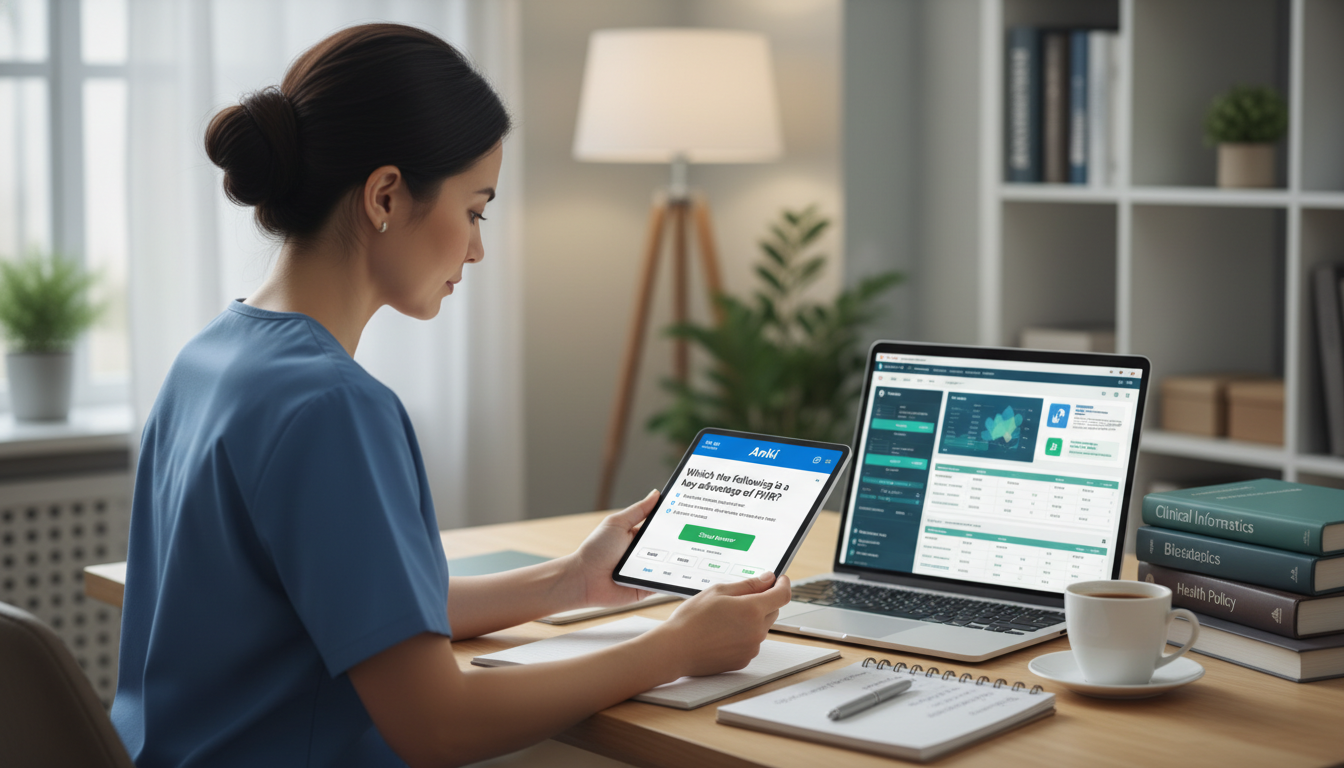
2. Using Anki for Clinical Informatics
Anki USMLE decks are famous in undergraduate and graduate medical education. That same spaced-repetition approach can work well for Clinical Informatics:
Create your own deck
- Building cards forces you to process and reorganize information
- Pull content from your Q-banks and core texts
Use cloze deletions for context
- Instead of “What is FHIR?” write:
- “FHIR stands for Fast Healthcare Interoperability Resources and is designed around modular resources like Patient, Observation, and Encounter.”
- Instead of “What is FHIR?” write:
Schedule daily reviews
- 30–60 minutes per day is usually enough if you start early
- Prioritize consistency over long, intermittent sessions
Tag cards by domain
- Tag examples:
standards,CDS,statistics,governance,safety - In the final month, filter by weak domains for targeted refresh
- Tag examples:
If you prefer not to build from scratch, ask colleagues or fellows whether they’ve created or curated informatics decks. Even if you adopt a pre-made base, customize it with your own high-yield notes.
Online Courses, Conferences, and Fellowships as Study Platforms
While self-study can carry you far, structured educational programs and communities can give you both content and accountability.
1. Formal education: fellowships and master’s programs
If you’re currently in, or considering, a clinical informatics fellowship, you have built-in health IT training resources:
Didactic curricula
- Many fellowships align directly with ABPM content domains
- Lectures on data standards, analytics, CDS, implementation science, and leadership
Journal clubs and case conferences
- Help contextualize theory with real-world examples
- Ideal for clarifying tricky topics like algorithm bias or EHR safety events
Capstone or quality improvement projects
- Reinforce core exam content (e.g., design of CDS, workflow analysis) via application
If you’re not in a formal program, consider:
- Graduate certificates or online master’s-level courses in biomedical/health informatics
- Health IT leadership programs offered by universities or large health systems
Use these to structure your reading and as a conceptual backbone, then reinforce with Q-banks.
2. Online courses and webinars
Several organizations offer targeted online courses for exam prep or core informatics domains:
AMIA courses and bootcamps
- Often include exam-aligned content and practice questions
- Helpful for networking with peers also preparing for the exam
MOOCs and university open courses
- Topics like data science, health data analytics, or digital health
- Use to deepen weaker areas (e.g., statistics, machine learning basics)
When selecting online courses, look for:
- Explicit mapping to CI exam domains
- Inclusion of case studies, exercises, or mini-quizzes
- Recent updates (reflecting current standards and regulations)
3. Conferences and professional networks
Professional meetings (e.g., AMIA annual symposium, informatics tracks at specialty conferences) can also indirectly support exam prep:
- Network with recent test-takers and ask what resources they found highest-yield
- Attend sessions on hot topics that may appear on newer exam forms (e.g., FHIR-based APIs, clinical AI governance, telehealth standards)
- Join online communities or listservs where informaticians share learning resources
Building a High-Yield Study Plan
You can have the best resources and still underperform if you don’t organize your time. A simple, realistic plan makes all the difference.
1. Backward design from exam day
Assume you have 4–6 months to prepare (adjust based on your background):
Months 1–2: Foundation
- Skim full exam outline
- Read your primary board review textbook
- Start flashcards (Anki or similar)
- Begin slow, deliberate Q-bank work (e.g., 10–20 questions/day in tutor mode)
Months 3–4: Integration
- Continue textbook, but focus now on weaker domains
- Increase Q-bank volume (30–40 questions per day, timed blocks 2–3x/week)
- Regularly review performance by topic and adjust reading accordingly
- Maintain daily flashcard reviews
Final 4–6 weeks: Simulation and fine-tuning
- Take 2–3 full-length practice exams
- Focus on error analysis, not just raw scores
- Re-read high-yield summaries and notes
- Lighten clinical workload if possible during the final 1–2 weeks
2. Weekly structure for busy clinicians
Balancing work, life, and exam prep is especially hard for practicing physicians. A sample week:
Weekdays (Mon–Thu) – “Maintenance mode”
- 30–60 minutes: Q-bank questions (timed)
- 20–30 minutes: Flashcard reviews
- 30 minutes: Reading or summarizing a high-yield chapter (3–4 days/week)
Friday – “Catch-up and reflection”
- Short review of performance metrics
- Identify 1–2 topics to focus on over the weekend
Weekend – “Deep dive”
- 2–3 hours: Longer reading or online courses
- 40–60 question block under near-exam conditions
- Create or update flashcards from weak concepts
3. Common pitfalls to avoid
Over-relying on one resource
- Example: Only reading Shortliffe & Cimino without doing questions
- Fix: Combine at least one major text, 1–2 Q-banks, and flashcards
Avoiding weak domains
- Many clinicians avoid statistics or data models; the exam will not
- Fix: Schedule dedicated blocks to focus on these areas early
Cramming the final month
- Informatics knowledge is dense and interconnected; last-minute cramming leads to shallow understanding
- Fix: Start early, even with small daily time investments
Ignoring test-taking strategy
- Even if content is solid, pacing and reading comprehension can harm your score
- Fix: Take timed practice tests, practice eliminating distractors, and develop habits for interpreting tricky question stems
FAQ: Board Exam Study Resources in Clinical Informatics
1. What is the single most important resource for the Clinical Informatics board exam?
There is no true “one resource fits all,” but a board-focused textbook plus a high-quality Q-bank together are essential. Many successful candidates pair something like Clinical Informatics Board Review: Fundamentals of Clinical Informatics with a robust question bank and then layer in additional readings (Shortliffe & Cimino, AMIA materials) for depth. Questions are crucial to prepare for exam style; textbooks ensure your conceptual foundation is solid.
2. How do I adapt Anki or spaced repetition if I’ve never used it before?
Start small. Create 5–10 flashcards per study session based on what you just learned from questions or reading. Focus on definitions, standards, and formulas. Review daily—Anki’s algorithm will handle spacing automatically. Don’t obsess over card design; clarity and consistency matter more than aesthetics. Over a few months, even a modest deck becomes a powerful long-term memory tool.
3. Are formal clinical informatics fellowships necessary to pass the exam?
No. Many practicing physicians pass the exam without a fellowship, especially those with substantial health IT responsibilities. However, clinical informatics fellowship training does provide structured didactics, project experience, and mentorship that can make exam prep more efficient. If you’re not in a fellowship, compensate by being intentional about your study plan and making full use of textbooks, Q-banks, and online resources.
4. How far in advance should I start studying?
For most clinicians with some informatics exposure, 4–6 months of consistent study (5–8 hours per week initially, increasing closer to the exam) is reasonable. If you’re newer to informatics or have gaps in statistics, programming concepts, or data models, consider starting 6–9 months before exam day. The key is regular, spaced engagement rather than late cramming.
By combining thoughtfully chosen board exam resources—textbooks, Q-banks, flashcards (including tools like Anki USMLE-style spaced repetition), online health IT training, and the experiential learning of a clinical informatics fellowship—you can build a targeted, sustainable preparation plan. Focus on understanding core principles, practicing exam-style questions, and reinforcing your learning over time, and you’ll be well-positioned to succeed on the Clinical Informatics board examination.