
Deciding between combined vs categorical programs in internal medicine is one of the most strategic choices you’ll make as a residency applicant. Your decision will shape not only your training structure but also your career options, lifestyle during residency, and long‑term professional identity.
This guide walks you through everything you need to know about internal medicine residency structures—especially combined programs (like Med-Peds, IM-Psych, IM-EM) versus categorical internal medicine—so you can align your decision with your goals, personality, and application profile.
Understanding the Key Terms: Categorical vs Combined in Internal Medicine
Before you compare paths, it’s crucial to be clear on the vocabulary programs and applicants use during the IM match.
What is a Categorical Internal Medicine Residency?
A categorical internal medicine residency is the standard three-year internal medicine training pathway:
- Length: 3 years (PGY-1 to PGY-3)
- Accreditation: ACGME-accredited Internal Medicine program
- Outcome: Board eligibility in Internal Medicine
- Common Next Steps:
- Fellowship (e.g., cardiology, GI, heme/onc, pulmonary/critical care, ID, nephrology)
- Primary care internal medicine
- Hospitalist roles
- Academic medicine, quality improvement, or clinician-educator tracks
This is what most people mean when they say they are applying for internal medicine residency. When you see “Categorical” in ERAS or program websites, that is this traditional three-year track.
What is a Combined Residency?
A combined residency (also called dual training or combined program) integrates two specialties into a single, structured program that satisfies requirements for both boards. In Internal Medicine, the two most common combined options are:
- Medicine-Pediatrics (Med-Peds)
- Internal Medicine–Psychiatry (IM-Psych)
There are also less common combinations such as Internal Medicine–Emergency Medicine (IM-EM) or Internal Medicine–Anesthesiology, but these are rarer and highly specialized.
Med-Peds Program
A Med-Peds program is a four-year combined residency in Internal Medicine and Pediatrics:
- Length: 4 years
- Outcome: Board eligibility in both Internal Medicine and Pediatrics
- Training structure: Alternating blocks of IM and pediatrics throughout residency
- Typical careers:
- Primary care across the age spectrum (infants to geriatric patients)
- Hospitalist work (adult, pediatric, or both)
- Fellowship in either IM subspecialties or pediatric subspecialties
- Transitional care, complex chronic disease, global health
Internal Medicine–Psychiatry (IM-Psych)
An IM-Psych combined residency is a five-year program:
- Length: 5 years
- Outcome: Board eligibility in both Internal Medicine and Psychiatry
- Training structure: Integrated blocks of IM and Psychiatry with specific combined rotations
- Typical careers:
- Consultation-liaison psychiatry and collaborative care
- Primary care with strong behavioral health focus
- Inpatient medicine or psychiatry with a dual skillset
- Leadership in integrated care, addiction medicine, psychosomatic medicine
How Combined Programs Differ from Preliminary or Transitional Years
Don’t confuse combined residency with preliminary or transitional years:
- Preliminary Internal Medicine: 1-year IM training, usually before advanced specialties like neurology, anesthesiology, or radiology.
- Transitional Year: 1-year broad-based internship (often includes multiple disciplines) before another specialty.
These do NOT lead to Internal Medicine board eligibility on their own. A combined residency, by contrast, results in full board eligibility in both specialties.
Training Structure: How Categorical and Combined Paths Actually Look
Understanding the day-to-day and year-to-year structure of training is essential before making your decision.
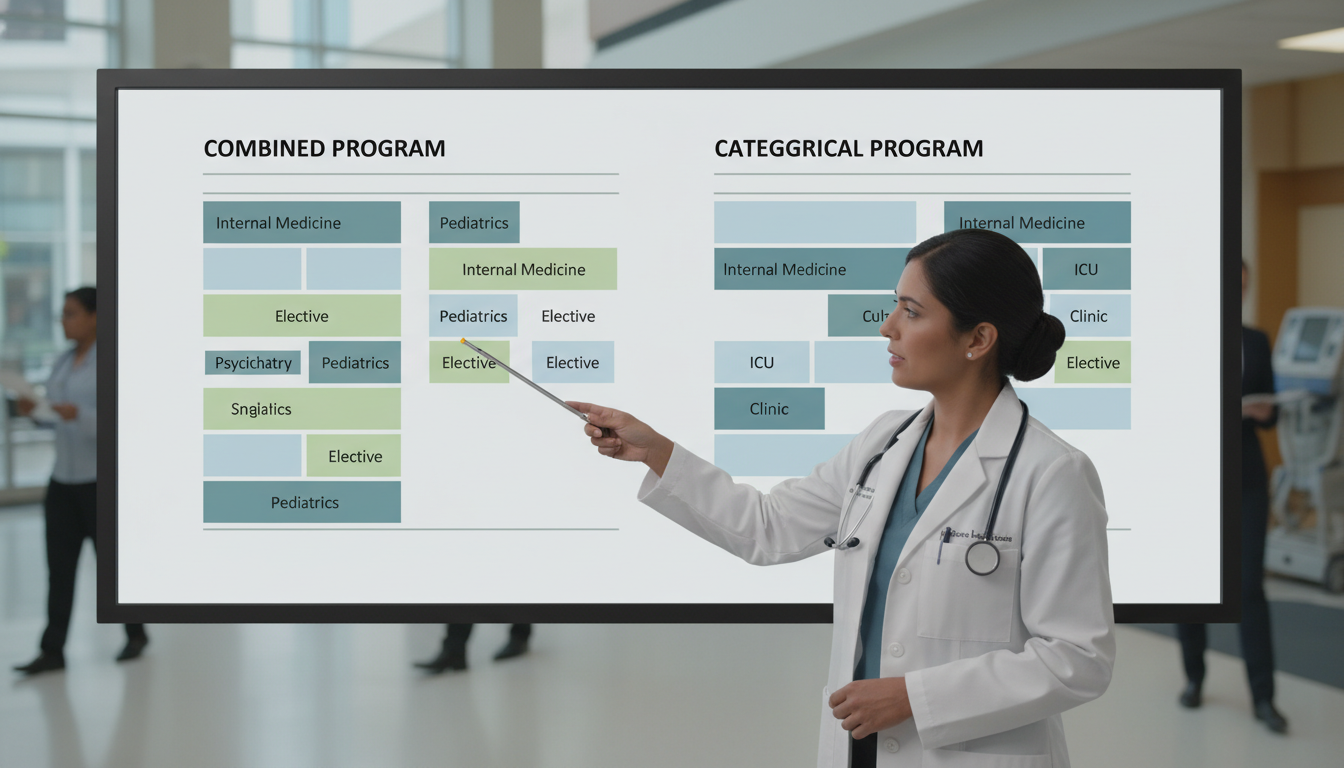
Length and Overall Time Investment
- Categorical IM: 3 years
- Med-Peds: 4 years
- IM-Psych: 5 years
- Other IM combinations: Typically 4–5 years depending on the pair
This extra year(s) is a critical consideration: more training means delayed attending salary, but increased expertise and flexibility.
Rotation Patterns
Categorical Internal Medicine
In a typical internal medicine residency, your three years might look like:
- PGY-1:
- Heavy inpatient medicine ward months
- Night float and ICU
- Some electives and ambulatory blocks
- PGY-2:
- Greater responsibility on wards and ICU
- More electives and subspecialty exposure
- PGY-3:
- Senior resident leadership roles
- Subspecialty clinics and electives
- Planning for fellowship or job search
You’re immersed in internal medicine most of the time, building depth in one specialty.
Med-Peds Program Structure
In a Med-Peds program, you split time between Internal Medicine and Pediatrics:
- Usually 50% IM / 50% Pediatrics over four years
- Alternating blocks (e.g., 2–3 months IM, then 2–3 months Peds)
- Each specialty’s board requirements must be met within the combined structure
A simplified four-year schedule:
- Year 1–4 overall:
- Adult inpatient medicine, ICU, and clinics
- Pediatric inpatient, NICU, PICU, newborn nursery, and continuity clinic
- Combined experiences like transition-of-care clinics for adolescents with chronic conditions
IM-Psych Program Structure
In IM-Psych programs, you integrate Internal Medicine and Psychiatry across five years:
- Roughly 50% IM / 50% Psychiatry, but specifics vary by program
- Exposure to:
- Inpatient internal medicine wards and ICU
- Outpatient primary care
- Inpatient psychiatry, consult-liaison services, emergency psychiatry
- Outpatient psychiatry, psychotherapy, addiction services
- Often includes integrated rotations such as collaborative care primary care clinics or medical-psychiatric units
Call, Workload, and Identity During Training
Categorical IM residents generally:
- Form a clear identity as internists early on
- Share a call schedule only with fellow IM residents
- Have a relatively unified peer group and culture
Combined residents often:
- Switch “hats” frequently between specialties
- Integrate into two different departments, with different cultures and expectations
- Juggle two sets of conferences, didactics, and sometimes clinic panels
- Need to constantly adjust to very different clinical environments (e.g., PICU to adult wards, or medicine wards to inpatient psych)
Some residents love the variety; others find the switching mentally draining.
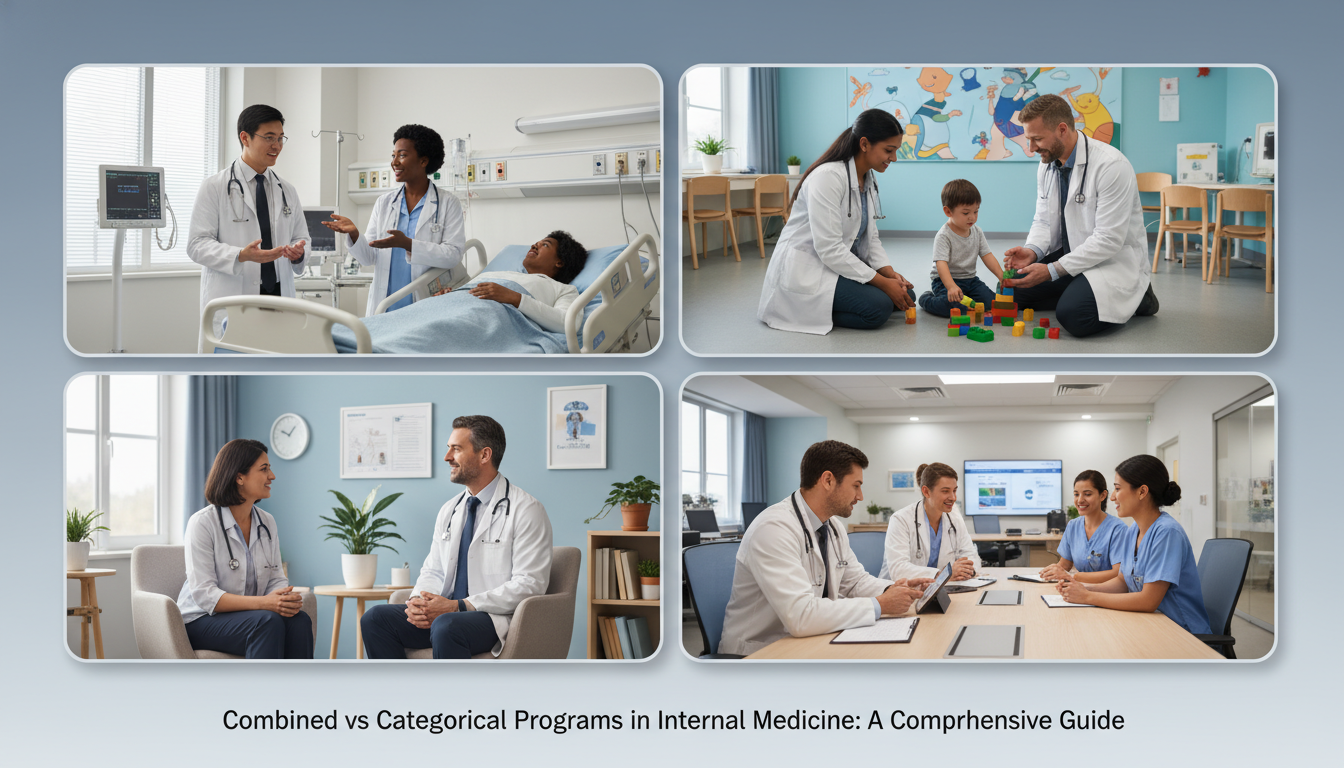
Career Outcomes: What You Can Do With Each Path
The biggest question: What will this choice mean for your future career?
Categorical Internal Medicine: Broad and Flexible
With a categorical internal medicine residency, your career options are very broad:
Subspecialty Fellowship
- Common fellowships:
- Cardiology
- Gastroenterology
- Pulmonary/Critical Care
- Hematology/Oncology
- Infectious Diseases
- Nephrology
- Rheumatology
- Endocrinology
- Geriatrics
- Categorical IM is the most direct and common path to these fields.
- Common fellowships:
Hospitalist Medicine
- Adult inpatient care only
- Shifts often structured in 7-on/7-off models
- Growing area with a lot of demand
Primary Care Internal Medicine
- Outpatient adult medicine clinic
- Chronic disease management, preventive care
- Often patient panels skew older (middle-aged and elderly adults)
Academic Medicine and Leadership
- Teaching residents and medical students
- Quality improvement and patient safety roles
- Possible division or departmental leadership later in your career
Med-Peds: Lifespan Care and Cross-Specialty Flexibility
A Med-Peds program opens unique doors:
Dual Outpatient Practice
- Caring for both children and adults in clinic
- Attractive for:
- Underserved or rural settings needing broad scope
- Longitudinal care for congenital or childhood-onset conditions into adulthood
Hospitalist Work
- Adult hospitalist, pediatric hospitalist, or both (depending on institution)
- Some Med-Peds physicians work in combined roles or rotate between services
Fellowships in Either Field
- You can pursue:
- Any IM fellowship (e.g., cardiology, GI, heme/onc, pulm/crit)
- Any pediatrics fellowship (e.g., NICU, peds cardiology, peds heme/onc)
- You cannot formally subspecialize in “Med-Peds” per se, but your dual background is a major asset in certain fellowships (e.g., transitional care, congenital heart disease).
- You can pursue:
Transitional and Complex Care
- Care for:
- Adults with congenital heart disease
- Cystic fibrosis patients transitioning from pediatric to adult care
- Childhood cancer survivors
- Roles in global health, combined medicine-pediatrics clinics, and systems-level work
- Care for:
IM-Psych: Integrated Medical and Behavioral Health Careers
With IM-Psych training, your career typically involves blending both fields:
Integrated Care and Consultation-Liaison
- Hospital consultation services for medically ill patients with psychiatric needs
- Primary care clinics with embedded behavioral health services
- Collaborative care models (e.g., managing depression/anxiety in medical clinics)
Academic or Systems Leadership
- Program development for:
- Integrated behavioral health
- Addiction services in medical settings
- Psychosomatic medicine
- Administrative roles in quality improvement and cross-disciplinary systems
- Program development for:
Clinical Roles
- Inpatient medicine with strong mental health expertise
- Inpatient psychiatry with advanced medical management ability
- Outpatient combined clinics for complex conditions (e.g., HIV with psychiatric comorbidities, transplant patients, chronic pain)
Fellowships and Advanced Training
- Can pursue:
- IM-based fellowships (e.g., ID, geriatrics)
- Psychiatry-based fellowships (e.g., addiction, CL psychiatry, geriatric psychiatry)
- Your dual perspective is particularly valued in addiction medicine, psychosomatic medicine, and primary care mental health.
- Can pursue:
Categorical vs Combined: Impact on Competitiveness and Flexibility
Flexibility:
- Categorical IM is already very flexible—especially with the wide range of fellowships.
- Combined residencies add dual-board flexibility, at the cost of more training time and complexity.
Marketability:
- Categorical IM graduates are widely employable almost anywhere.
- Med-Peds and IM-Psych physicians can be uniquely valuable in systems that appreciate integrated care, transitions, or behavioral health—but some job markets may not fully understand or utilize the dual skill set.
Geographic Considerations:
- Categorical IM jobs are available in every region and hospital type.
- For Med-Peds or IM-Psych, academic centers and large health systems tend to better recognize and leverage your dual training.
Application Strategy: How the IM Match Differs for Categorical vs Combined
When planning for the IM match, you need a clear strategy if you’re considering combined residency programs.
Competitiveness and Program Numbers
Categorical Internal Medicine
- Large number of positions nationwide
- Wide spectrum of competitiveness (from community programs to highly competitive academic centers)
- Generally attainable for most U.S. MD/DO graduates who meet minimum thresholds; more competitive for top academic centers and subspecialty-focused programs
Med-Peds Program
- Fewer total positions than categorical IM
- Typically competitive, especially at top academic centers
- Applicants must convincingly demonstrate a commitment to both adult and pediatric care
IM-Psych and Other IM Combined Programs
- Very small number of programs and slots
- Often quite competitive because of limited positions
- Applicants need clear motivation for integrated care and dual training
Should You Apply to Both Categorical and Combined Tracks?
Many applicants apply to both categorical IM and combined programs. You should consider:
Yes, apply to both if:
- You are genuinely open to either path
- You want a safety net if you don’t match into a competitive combined program
- You can honestly explain in interviews why you applied to both, without sounding unfocused
Be cautious if:
- Your personal statement or letters only emphasize combined training (e.g., Med-Peds) but you’re applying widely to categorical IM; programs may worry you see them as a backup.
- You aren’t prepared to discuss how you’d still be happy and fulfilled in a categorical IM position.
Personal Statements and Letters of Recommendation
For the IM match, tailor your application materials:
Personal Statement
- If you’re applying only categorical IM:
- Focus on why you want to be an internist, your exposure to IM, and your future goals (e.g., primary care vs fellowship).
- If you’re applying Med-Peds:
- Address your passion for lifespan care, working with both adults and children, and experiences that span age groups.
- If you’re applying IM-Psych:
- Emphasize your interest in the interface of medical and psychiatric illness, integrated care, and specific experiences in both fields.
- If you apply to both categorical and combined:
- Consider creating slightly different versions of your statement tailored to each track.
- If you’re applying only categorical IM:
Letters of Recommendation (LoRs)
- For categorical IM:
- Prioritize strong letters from Internal Medicine attendings and possibly one subspecialty.
- For Med-Peds:
- Aim for at least one IM letter and one Pediatrics letter, plus others as appropriate.
- For IM-Psych:
- A mix of IM and Psychiatry letters, ideally from people who can speak to your cross-disciplinary interests and abilities.
- For categorical IM:
Interview Day: What Programs Look For
Categorical IM Programs Want:
- Reliable, team-oriented residents
- Clear interest in internal medicine (clinical reasoning, complexity)
- Some sense of your career direction, though it doesn’t have to be fixed
Combined Programs Want:
- Applicants who genuinely understand the dual identity and are excited for it
- Emotional maturity and adaptability to switching roles and environments
- Longitudinal commitment to multiple populations (e.g., adults and children, or medically and psychiatrically complex patients)
- Evidence you’ve explored both fields—not just a last-minute decision
How to Decide: Is Categorical or Combined Right for You?
This is the heart of the issue: Should you choose categorical vs combined internal medicine training?
Clarify Your Clinical Interests
Ask yourself:
Do I genuinely enjoy both halves of the proposed combination?
- Med-Peds: Do you like kids and adults, not just one more than the other?
- IM-Psych: Are you drawn to both medical complexity and psychiatric illness, not merely interested in “understanding people better”?
If I had to choose only one specialty, which would it be? Would I be happy or resentful?
What patients do I picture myself caring for most days of the week in ten years?
If your passion is strongly skewed to adult medicine plus fellowship, a categorical internal medicine residency is usually the best choice.
Consider Lifestyle and Training Length
Are you comfortable with:
- Four years of training (Med-Peds) or five (IM-Psych) instead of three?
- Delaying higher attending salary and possible life milestones (e.g., major financial goals) by one or more years?
Are you someone who finds variety energizing or exhausting?
- Combined programs involve constant transitions—new teams, new roles, new patient populations.
Think About Career Vision and System Fit
Do you envision a role in:
- Integrated care, transitions, or cross-disciplinary leadership? Combined programs may be a strong match.
- Highly specialized IM fellowship with deep focus in one area (e.g., interventional cardiology)? Categorical IM is usually more direct and efficient.
Will your future practice environment actually use your dual training?
- Some health systems have well-developed Med-Peds or IM-Psych roles.
- Others may simply slot you into a single-specialty job, underutilizing your combined skills.
A Practical Decision Framework
You might lean toward:
Categorical Internal Medicine residency if:
- You love adult medicine, complex diagnostics, and subspecialty care.
- You’re highly interested in an IM fellowship.
- You prefer a 3-year residency with more straightforward identity and career paths.
Med-Peds program if:
- You’re equally excited about adult and pediatric care.
- You want to care for patients from infancy through adulthood, especially those with chronic or congenital conditions.
- You can see yourself leveraging dual training in primary care, hospitalist work, or specific fellowships.
IM-Psych combined residency if:
- You have a sustained interest in both internal medicine and psychiatry.
- You’re drawn to complex, comorbid patients and integrated care models.
- You can imagine a career bridging medical and psychiatric services, consultation, or systems leadership.
FAQs: Combined vs Categorical Internal Medicine Programs
1. Is a combined residency “better” than a categorical internal medicine residency?
Neither is inherently better. A categorical internal medicine residency is more direct, shorter, and widely applicable, especially if you’re focused on IM subspecialties or adult medical care. A combined residency is better if you have a clear, long-term desire to practice across two specialties and are willing to invest extra years of training to gain dual board eligibility.
2. Will a Med-Peds or IM-Psych background make me more competitive for IM fellowships?
Not automatically. For IM-based fellowships, you will be evaluated much like a categorical IM graduate. Program directors focus on:
- Your performance on IM rotations
- Letters from internal medicine faculty
- Research and scholarly work in the relevant area
A Med-Peds or IM-Psych background can be an asset for specific niches (e.g., transitions of care, behavioral health, psychosomatic medicine), but it is not a guaranteed advantage over categorical IM applicants, and it requires extra training time.
3. Can I switch from a combined program to categorical internal medicine (or vice versa)?
Switching is sometimes possible but not guaranteed:
- From combined to categorical IM:
- More feasible: you may receive credit for IM rotations already completed.
- Requires program and institutional approval and available positions.
- From categorical IM to combined:
- Much more difficult, as combined programs have very limited, structured slots.
If you are unsure and strongly leaning toward IM, it’s usually safer to start with categorical IM rather than counting on later transitions.
4. How many combined vs categorical programs should I apply to in the IM match?
It depends on your competitiveness and how open you are to each path:
- If you are truly split and open to both:
- Apply more broadly to categorical IM (because there are many more positions).
- Apply selectively to combined programs (Med-Peds or IM-Psych) where your interests fit well.
- If you’re strongly committed to Med-Peds or IM-Psych:
- Apply broadly within that combined specialty.
- Consider also applying to a targeted number of categorical IM programs as a backup, and be prepared to explain your reasoning during interviews.
Choosing between combined vs categorical programs in internal medicine ultimately comes down to your long-term clinical passions, your appetite for additional years of training, and how you want to shape your professional identity. Take time to reflect, talk to residents and faculty in both paths, and build an IM match strategy that aligns with who you are now—and the physician you want to become.