
Understanding COMLEX Level 1–3 as a Caribbean IMG
For a Caribbean IMG pursuing U.S. residency—especially in osteopathic programs or ACGME programs that recognize DO board exams—the COMLEX sequence (Levels 1–3) can be both an opportunity and a challenge. You must prove you can compete with U.S. DO students while navigating the realities of Caribbean medical training: variable clinical exposure, distance from U.S. systems, and potential bias in the residency selection process.
COMLEX Level 1–3 preparation, when done strategically, can strengthen your Caribbean medical school residency prospects, especially if you pair strong scores with excellent clinical performance and a focused specialty strategy. Understanding the structure, content, and expectations of each exam is the foundation of your preparation plan.
Quick Overview of the COMLEX Sequence
COMLEX Level 1
- Timing: End of preclinical years or early in clinical phase.
- Focus: Basic sciences, pathology, physiology, pharmacology, microbiology, OMM/OMT.
- Format: Pass/Fail (but programs may still stratify by internal score reports if they have access).
- Goal as a Caribbean IMG: Solid pass on first attempt, demonstrating you are safe and well-grounded in core sciences.
COMLEX Level 2-CE
- Timing: During or after core clinical rotations.
- Focus: Clinical medicine, diagnosis, management, patient safety, ethics, plus OMM/OMT.
- Format: Numeric score (and pass/fail); more heavily evaluated by PDs than Level 1.
- Goal: Competitive score to offset potential bias against Caribbean schools; show clinical readiness.
COMLEX Level 3
- Timing: Usually in PGY-1 (or late 4th year / early postgraduate depending on state and program policy).
- Focus: Advanced clinical management, systems-based practice, long-term care planning, with integrated OMM.
- Format: Multiday exam with multiple-choice items and Clinical Decision-Making (CDM) cases.
- Goal: Pass on first attempt; avoid red flags that could complicate licensing and credentialing.
As a Caribbean IMG, your SGU residency match (or any other Caribbean school match) prospects can be significantly improved by:
- Passing all COMLEX Levels on the first attempt
- Achieving above-average Level 2-CE scores
- Showing consistent performance across USMLE and COMLEX (if you take both)
Building a COMLEX-Focused Study Framework as a Caribbean IMG
Preparing for COMLEX as a Caribbean IMG requires extra intentionality. Your environment (offshore campus, variable clinical sites) and schedule may not be optimized for DO board exams, so you must create that structure for yourself.
Step 1: Clarify Your Exam Timeline and Residency Goals
Before diving into question banks, define:
Residency specialty interests
- Primary care (FM, IM, Pediatrics) vs. more competitive fields (EM, Anesthesiology, PM&R, etc.)
- DO vs. MD programs; some DO-heavy fields (FM, IM, EM) weigh COMLEX more heavily.
Exams you will take
- COMLEX only, or COMLEX + USMLE?
- If aiming at both DO and MD programs strongly, COMLEX + USMLE may be advisable.
Ideal test windows
- Level 1: Within 0–3 months of finishing basic sciences.
- Level 2-CE: After completing core rotations (IM, Surgery, Pediatrics, OB/GYN, Psychiatry, FM).
- Level 3: After you have begun residency (unless your state permits earlier and your program agrees).
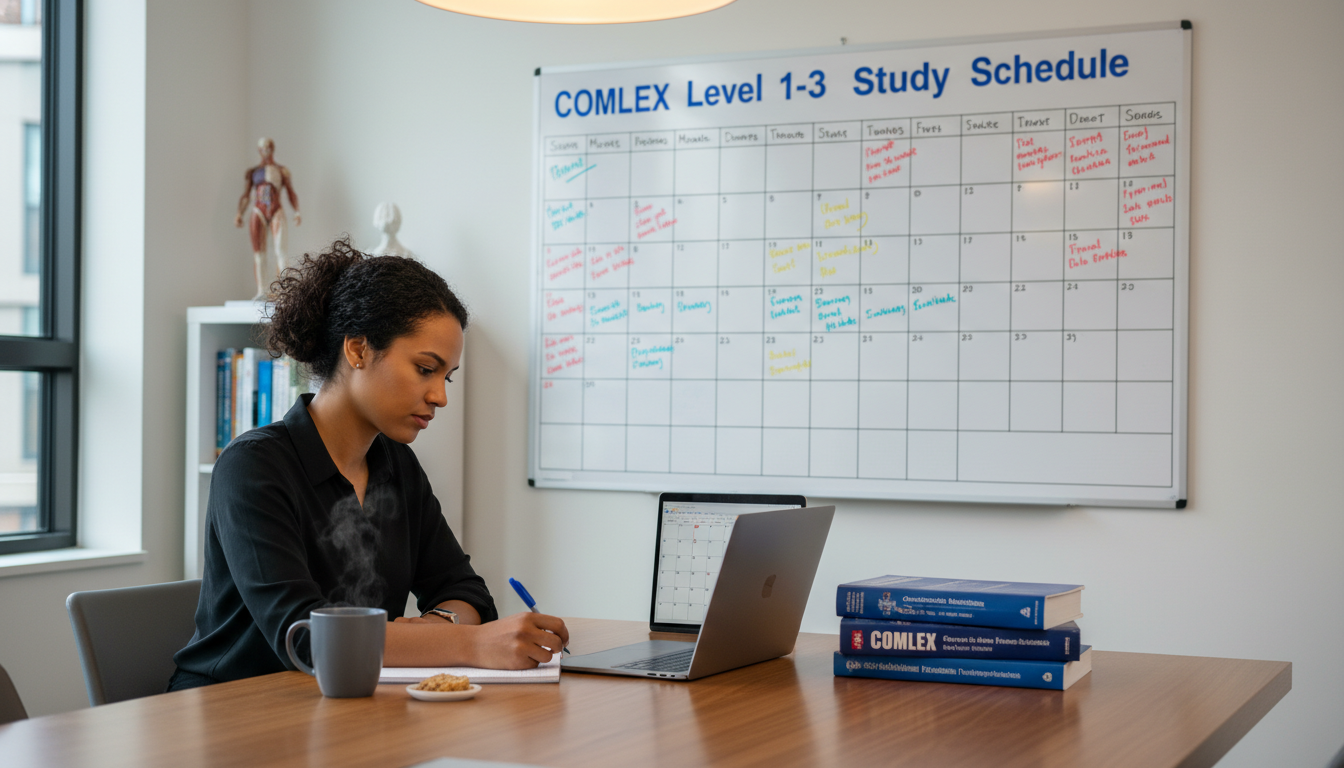
Map these out in an Excel sheet or planner and work backward to set study start dates, NBME/COMSAE practice dates, and UWorld/COMBANK question goals.
Step 2: Understand the COMLEX-Specific Angle
Unlike USMLE, COMLEX has:
- More emphasis on OMM/OMT (somatic dysfunction, HVLA, muscle energy, viscerosomatic reflexes, Chapman points).
- A primary care, holistic orientation: prevention, health maintenance, cost-effective care, and patient-centered management.
- Slightly different style of question writing:
- Wordier stems.
- More emphasis on safety, systems-based practice, and “what would you do next in the real clinic?”
As a Caribbean IMG, you may have less structured OMM teaching in clinical years. You must deliberately build that content into your study.
Step 3: Core Resources for COMLEX Level 1–3
You don’t need every resource, but you do need depth with a select few.
Foundational Content (All Levels):
- Primary systems-based texts or videos (e.g., Boards & Beyond, Pathoma, Sketchy for micro/pharm).
- A high-yield OMM resource:
- “Savarese OMT Review” (The Green Book) or equivalent.
- An OMT flashcard set (Anki or personal).
- A comprehensive clinical reference for Level 2–3:
- Step-Up to Medicine / Master the Boards / UWorld notes.
Question Banks (Absolutely Non-negotiable):
- For Level 1:
- UWorld (USMLE-style) as core.
- A COMLEX-focused bank (COMBANK, COMQUEST) to adapt to format and OMM emphasis.
- For Level 2-CE:
- UWorld for Step 2 CK.
- COMBANK/COMQUEST for COMLEX stylistic and OMM prep.
- For Level 3:
- UWorld Step 3 QBank for general clinical reasoning.
- A COMLEX Level 3-specific bank for CDM and OMM integration.
Self-Assessments:
- COMSAE forms for Levels 1 & 2.
- Any available COMLEX Level 3 practice items from NBOME or QBank-provided simulations.
- USMLE practice tests (NBMEs, UWSAs) if you are also preparing for the USMLE.
COMLEX Level 1 Preparation Strategies
Level 1 is your demonstration of basic science mastery and your ability to apply that science clinically, including osteopathic principles. As a Caribbean IMG, your basic science training may be compressed and highly exam-driven, so you must convert that cramming culture into long-term retention and application.
1. Designing a 3–6 Month Study Plan
A typical structure:
Months 1–2: Content-heavy with integrated questions
- Daily:
- 2–3 hours of video/reading (Pathoma/Boards & Beyond).
- 40–60 UWorld questions (timed, random blocks) with deep review.
- 20–30 OMM-focused questions (COMBANK/COMQUEST) or OMM reading.
- Weekly:
- 1–2 OMM sessions exclusively (Savarese chapters).
- Systems-based consolidation (Anki or notes).
Months 3–4: Question and practice test focus
- Daily:
- 80–100 questions (mix of UWorld and COMLEX-style).
- 1–2 hours of targeted review based on missed concepts.
- 30–45 minutes OMM practice (flashcards, Savarese quick reads).
- Every 2 weeks:
- 1 COMSAE practice test or equivalent.
- Score trend tracking and adjustment of weak areas.
If you have a shorter window (e.g., 8–10 weeks), compress by prioritizing questions + OMM + your weakest systems.
2. Integrating OMM into Daily Study
Because your Caribbean curriculum may not reinforce OMM:
- Dedicate at least 30–45 minutes daily to:
- Reading Savarese.
- Reviewing key OMM charts (Fryette’s laws, Chapman points, viscerosomatic reflexes).
- Drilling high-yield tables (autonomic levels, cranial strain patterns).
- Create condensed one-page “cheat sheets” for:
- Ribs mechanics and treatments.
- Sacral and innominate diagnoses.
- Sympathetic/parasympathetic innervations and corresponding findings.
Make OMM non-negotiable. Many otherwise strong students fail or struggle on COMLEX because they neglect this area.
3. Converting Basic Science Knowledge into COMLEX Thinking
When reviewing questions, don’t just ask, “What is the correct answer?” Ask:
- What is the underlying pathophysiology?
- How does osteopathic structural exam relate?
(e.g., a patient with MI and T1–T4 paraspinal findings — what does that mean?) - How would a DO-trained physician approach this with:
- Medical management, and
- Possible OMT.
Create notes that explicitly connect:
- Autonomics → Organ pathology → Somatic dysfunction.
- Lymphatic principles → Infection, edema, post-op care.
4. Common Caribbean IMG Pitfalls on COMLEX Level 1
- Over-relying on Caribbean school notes rather than board-focused resources.
- Minimal exposure to OMM labs during clinical years → weak OMM performance.
- Taking Level 1 too late, after losing touch with basic sciences.
- Neglecting practice tests (COMSAEs), leading to poor time management and misjudged readiness.
To avoid this, commit to:
- At least 2–3 full-length COMSAE or equivalent assessments before your exam.
- Tracking performance over time and postponing if your practice scores indicate risk.
COMLEX Level 2-CE Preparation Strategies
COMLEX Level 2-CE is often the most important exam for residency selection, especially for Caribbean IMGs. It reflects your ability to manage real patients and is more closely aligned with intern-level responsibilities.
1. Using Clinical Rotations Strategically
Caribbean rotations can be variable in teaching quality and structure. Convert each core rotation into Level 2 prep:
- On each rotation:
- Read a high-yield resource (e.g., Step-Up to Medicine for IM, Case Files).
- Do rotation-specific questions in UWorld and one COMLEX bank.
- Keep a running log of:
- Classic patient presentations.
- Guideline-based management (first-line treatments, screening tests).
- Conditions where OMM is relevant (back pain, post-op ileus, pregnancy complaints).
As a Caribbean IMG, proactively ask attendings and residents about:
- Institutional protocols.
- Evidence-based management.
- How they might view COMLEX vs. USMLE when evaluating candidates.
2. Building a 2–3 Month Dedicated Level 2-CE Plan
During dedicated:
- Daily:
- 80–120 questions (mix UWorld + COMLEX-style).
- 60–90 minutes reviewing missed concepts and guidelines.
- 20–30 minutes of OMM (especially clinical OMT use).
- Weekly:
- Mini-mocks: 2–4 blocks simulating test conditions.
- Focus review on:
- Infectious disease.
- Cardiology and pulmonary.
- OB/emergencies (pre-eclampsia, postpartum hemorrhage).
- Psych emergencies and risk assessment.
Emphasize:
- Next best step type thinking.
- Patient safety (never missing red flags like meningitis, ACS, ectopic pregnancy).
3. Clinical OMM for Level 2-CE
Shift from structural exams to clinical scenarios:
- How OMT can:
- Improve post-op recovery.
- Support respiratory function (rib raising, lymphatic pumps).
- Help with pregnancy-related lower back pain or headaches.
- Know when OMT is contraindicated:
- Osteomyelitis, fractures, severe osteoporosis, certain malignancies, spinal metastases.
- In questions:
- Recognize patients who might benefit from OMT,
- And when standard medical/surgical management must come first.
4. COMLEX-Specific Question Strategies
COMLEX Level 2-CE questions can feel wordy and sometimes vague. To adapt:
- Train with COMLEX-oriented banks to calibrate to their style.
- Practice identifying:
- The specific clinical goal (diagnosis, risk stratification, management).
- Subtle hints about social determinants of health or resource limitations.
- Practice timed blocks where you:
- Skim the last line first (“What is the next best step?”),
- Then read the stem with a clear purpose.
As a Caribbean IMG, you may feel under pressure to “crush” Level 2-CE to compensate for school stigma. Use that pressure productively but protect yourself from burnout with structured breaks, regular exercise, and sleep discipline.

COMLEX Level 3 Preparation Strategies
Level 3 is about independent clinical decision-making across inpatient, outpatient, and emergency settings. As a Caribbean IMG entering residency, this exam can be challenging due to workload and adaptation to the U.S. system.
1. Timing Level 3 Wisely as a Caribbean IMG
Coordinate with your program:
- Many residencies prefer you to take Level 3 during PGY-1 or early PGY-2.
- As a Caribbean IMG, ensure:
- You’ve had enough clinical exposure in U.S. settings.
- You can carve out study time around call schedules.
Discuss your COMLEX Level 3 timing with your PD early. A failure can be very disruptive; better to take it slightly later but more prepared.
2. Understanding the CDM (Clinical Decision-Making) Component
CDM cases simulate longitudinal care, requiring:
- Initial differential and diagnostic workup.
- Interpretation of labs/imaging.
- Management across multiple visits or settings.
To prepare:
- Use a Level 3-focused QBank with CDM-style cases.
- Practice:
- Ordering appropriate tests (avoiding overuse).
- Choosing correct medications (dose, route, contraindications).
- Focusing on patient safety and cost-effective choices.
As a Caribbean IMG, you may initially feel less comfortable with U.S.-specific guidelines. Lean on:
- UWorld Step 3 explanations.
- Current U.S. guidelines (ACC/AHA, ADA, USPSTF, etc.) summarized in your notes.
3. Structuring Study During Residency
Realistically, you may have:
- 6–10 weeks of “semi-dedicated” time with shift work and call.
A practical plan:
- Weekdays:
- 10–20 UWorld Step 3 questions/day.
- 1 CDM case.
- Quick OMM review 2–3 days per week.
- Weekends:
- 40–60 questions per day.
- 2–4 CDM cases.
- Simulated test block under timed conditions.
Focus on:
- Bread-and-butter inpatient IM and FM.
- Cross-coverage issues (electrolyte disturbances, sepsis, AKI).
- OB and pediatrics emergencies.
- OMM indications, contraindications, and integration.
4. OMM and Global Osteopathic Approach at Level 3
At Level 3, OMM is less about naming techniques, more about integrating board-safe osteopathic care:
- Recognize patients in which OMM:
- Can be safely and appropriately adjunctive.
- Is secondary to life-saving interventions.
- Demonstrate understanding of:
- Holistic, preventive care.
- Biopsychosocial model and long-term follow-up.
A strong performance on Level 3 as a Caribbean IMG shows PDs and licensing boards that you function at the same level as U.S. DO graduates.
Integrated Strategy: Balancing COMLEX with USMLE and Residency Applications
Many Caribbean IMGs pursue both USMLE and COMLEX to broaden residency opportunities, especially MD programs. Balancing both demands efficiency.
1. Efficient Overlap: One Content Base, Two Exam Styles
Core content (path, pharm, physio, clinical reasoning) is largely the same. The main differences:
- OMM (exclusive to COMLEX).
- Question style and emphasis.
Strategy:
- Use USMLE-focused resources (e.g., UWorld, Pathoma) as your base.
- Layer OMM and COMLEX question banks on top.
- During question practice:
- For UWorld blocks: Focus on deep pathophysiology and management.
- For COMLEX blocks: Focus on OMM, holistic/primary care orientation, and test style.
2. Scheduling Exams to Support Your Residency Timeline
Possible pattern (example):
- Step 1 + COMLEX Level 1 around the same period (within a few weeks).
- Step 2 CK + COMLEX Level 2-CE during/after cores.
- Step 3 + COMLEX Level 3 during residency if needed.
Align exam dates with:
- ERAS application deadlines.
- SGU residency match or other Caribbean school advising suggestions.
- State licensing requirements (some require all three Levels of COMLEX for DO licensure).
3. Using COMLEX Performance to Strengthen Your Application
As a Caribbean IMG, program directors will sometimes question:
- Academic rigor of your school.
- Readiness for residency workload.
High performance on COMLEX (especially Level 2-CE) helps by:
- Demonstrating objective competence.
- Compensating for:
- Lower GPA/Class rank.
- Concerns about offshore training.
- Supporting a narrative in your personal statement and letters:
- “Despite nontraditional training, I mastered the DO board exams and am well prepared for residency.”
Practical Tips and Mindset for Caribbean IMGs
1. Embrace Your Nontraditional Path
You may feel behind U.S. DO students in terms of OMM exposure or clinical polish. Reframe this:
- You have likely:
- Adapted to new countries and systems.
- Managed high-stakes exams in challenging environments.
- These resilience skills are an asset when facing multi-level exams like COMLEX.
2. Build a Support Network
Use:
- School-based COMLEX/USMLE advising.
- Study groups with fellow DO-tracked Caribbean IMGs.
- Senior residents or alumni who matched into DO-friendly programs to mentor you on:
- Study schedules.
- Resource selection.
- COMLEX Level 3 timing.
3. Monitor Burnout and Mental Health
Long-term COMLEX preparation across Levels 1–3 plus USMLE and residency is exhausting. Protect yourself by:
- Scheduling regular days off (at least ½ day weekly).
- Maintaining sleep as a priority, especially in final exam weeks.
- Seeking professional support if anxiety, depression, or burnout become overwhelming.
You are not only preparing for exams; you are preparing for a career in medicine. Sustainability matters.
FAQs: COMLEX Level 1–3 Preparation for Caribbean IMGs
1. Do I really need to take COMLEX if I’m a Caribbean MD student, not a DO student?
In general, COMLEX is taken by DO students. Some Caribbean IMGs with dual pathways or special circumstances may take COMLEX in addition to USMLE to appeal to DO programs. If you are an MD-only student, USMLE is typically sufficient. Always clarify requirements with your school and target programs.
2. How important is OMM/OMT for my COMLEX score as a Caribbean IMG?
OMM/OMT is crucial and often a differentiating factor. Many students neglect it, lowering their scores or risking failure. You should integrate OMM daily into your COMLEX preparation, especially using resources like Savarese and OMM-focused question banks. Even if your clinical rotations are weak in OMM, self-study can bridge the gap.
3. Can strong COMLEX scores offset being a Caribbean graduate in the residency match?
Strong performance on COMLEX, especially COMLEX Level 2, can significantly improve your Caribbean medical school residency prospects. It doesn’t erase all program bias, but it provides objective evidence that you meet (or exceed) the academic standard of U.S. DO schools. When combined with solid clinical evaluations and targeted applications to DO-friendly programs, it can make a real difference.
4. How should I balance COMLEX preparation with my residency duties when studying for Level 3?
For Level 3, plan early with your PD and schedule the exam during a lighter rotation if possible. Use small, consistent study blocks (60–90 minutes on workdays, longer on off days) and focus heavily on question-based learning (UWorld Step 3 + a COMLEX Level 3 bank). Protect sleep and avoid trying to “cram” during heavy call months; it’s better to take the exam slightly later and pass comfortably than early with higher risk of failure.
By approaching COMLEX Level 1–3 preparation with a structured strategy tailored to your reality as a Caribbean IMG, you can transform these exams from a source of anxiety into a powerful tool to strengthen your COMLEX preparation, your DO board exams portfolio, and ultimately your chances in the residency match—whether in DO or MD pathways.