
Understanding COMLEX as an MD Graduate
If you trained at an allopathic medical school and now need to take COMLEX Level 1-3 (for example, to enter an osteopathic-focused residency program or meet a state licensing requirement), you’re facing a unique challenge. You probably feel comfortable with USMLE-style content and format, but COMLEX adds layers of osteopathic principles and practice (OPP), different question style, and slightly different exam expectations.
Before diving into strategies, it’s important to understand what you’re dealing with:
What is COMLEX?
The Comprehensive Osteopathic Medical Licensing Examination (COMLEX) series is the primary licensure pathway for DO students. It consists of:
- COMLEX Level 1 – Basic science, systems-based pathophysiology, and foundational OPP
- COMLEX Level 2-CE – Clinical knowledge, diagnosis, management, and OPP integration
- COMLEX Level 3 – Advanced clinical decision-making and longitudinal management, including OPP in real-world practice
For an MD graduate, these are essentially parallel licensure exams to USMLE, but with a distinctive osteopathic emphasis.
Why Might an MD Graduate Need COMLEX?
Common scenarios include:
- Applying to dual-accredited or historically osteopathic programs that still value or require COMLEX scores.
- Seeking licensure in states or positions where COMLEX can substitute for, complement, or be preferred alongside USMLE.
- Expanding options beyond traditional allopathic medical school match pipelines and demonstrating commitment to holistic or osteopathic-oriented care.
Wherever you fall, your preparation must acknowledge two realities:
- Your MD training already covers most of the non-OPP content well.
- You must explicitly learn and practice OPP and COMLEX-style reasoning to avoid underperforming on items that DO students are specifically trained to master.
Key Differences: COMLEX vs USMLE for MD Graduates
Understanding the differences helps you target your study time efficiently instead of repeating what you already know.
1. Content Emphasis
Shared core: Pathology, physiology, pharmacology, microbiology, and systems-based clinical medicine overlap substantially with USMLE.
Distinct osteopathic elements:
Osteopathic Principles and Practice (OPP)
- Models: biomechanical, respiratory-circulatory, neurologic, biopsychosocial, metabolic, behavioral
- Somatic dysfunction diagnosis: TART (tissue texture, asymmetry, restriction, tenderness)
- OMT (Osteopathic Manipulative Treatment) techniques and indications
Holistic, function-oriented framing
- More explicit integration of structure-function relationships
- Emphasis on body’s self-healing and self-regulating mechanisms
As an MD, your biggest knowledge gap is OPP and OMT—and this gap is testable on all levels.
2. Question Style and Exam Feel
COMLEX questions tend to:
- Be wordier and sometimes less polished than USMLE stems.
- Include multiple reasonable answers where you must prioritize the “most osteopathic” or guideline-consistent choice.
- Use OMT/OPP scenarios and terminology (e.g., diagnosis from motion testing, naming spinal dysfunctions, choosing OMT techniques).
For someone trained in an allopathic program, the format can feel foreign even when the medicine is familiar. That makes exposure to COMLEX-style questions a key strategic objective.
3. Scoring and Passing Culture
While numeric scores are still used, the high-stakes focus has been shifting towards pass/fail thresholds, similar to recent trends in USMLE Level 1/Step 1. Nonetheless:
- Program directors familiar with COMLEX may still interpret relative performance (percentiles).
- A solid pass with no red flags is usually sufficient for residency applications if your USMLE transcript is already strong.
Your strategic goal as an MD graduate is often:
“Minimize study redundancy, plug OPP gaps, and comfortably pass all three levels without derailing ongoing training or application timelines.”
Foundation First: Global Strategy for COMLEX Level 1-3
Even though Level 1-3 differ in focus, MD graduates preparing for all three benefit from a tiered, integrated approach:
Leverage your USMLE background
- Don’t re-learn basic pathophysiology from scratch.
- Use your old Step 1/2 resources for quick review instead of full rebuild.
Add a dedicated OPP/OMT curriculum
- Treat OPP like an “additional subject” similar to pharmacology or biostats.
- Aim for functional fluency, not DO-level procedural mastery.
Train COMLEX-specific test-taking skills
- Practice with COMLEX-style question banks and/or NBOME practice exams.
- Learn to think in “COMLEX logic”: holistic framing, functional diagnosis, appropriate OMT.
Sequence your prep based on your timeline
- Some MD grads need only Level 3 later, others decide to sit for Level 1-3 systematically.
- Coordinate with your residency or employer on timing and expectations.
Let’s break down level-specific strategies.

COMLEX Level 1 Preparation for MD Graduates
If you’re freshly out of an allopathic medical school or have recently completed USMLE Step 1, you’re in a strong position for Level 1. The main difference is layering in OPP and COMLEX-style execution.
Core Content Strategy
Leverage Existing Step 1 Knowledge
- Use high-yield review sources (e.g., your preferred USMLE review text or Anki deck) for:
- Pathophysiology (cardio, pulm, renal, neuro, GI, etc.)
- Basic pharmacology and mechanisms
- Microbiology and immunology
- Aim for a compressed review (4–6 weeks) instead of a full Step 1-style build.
- Use high-yield review sources (e.g., your preferred USMLE review text or Anki deck) for:
Add Structured OPP Learning
As an MD, you must build OPP from scratch:
Key domains to learn:
Basic OPP concepts
- Somatic dysfunction definition and TART criteria
- Five models of osteopathic care (biomechanical, respiratory-circulatory, neurologic, metabolic, behavioral)
- Concept of viscerosomatic and somatovisceral reflexes
Spinal and rib dysfunctions
- Fryette’s principles: Type I and II dysfunctions
- How to name dysfunctions (e.g., L3 N SLRR; L4 F RLSL)
- Inhalation vs exhalation rib dysfunction patterns
Major OMT techniques and when to use them
- Muscle energy, counterstrain, HVLA (conceptual), myofascial release, balanced ligamentous tension, Still technique
- General indications, contraindications, and which patients benefit from which approach
How to study OPP efficiently as an MD:
- Use a concise OPP textbook or a dedicated COMLEX OPP review book.
- Combine reading with:
- Short video demonstrations (not to perform them clinically, but to understand what the test is referencing).
- Diagram-based notes for naming dysfunctions and recognizing patterns.
Practical 4-week OPP plan (for Level 1):
Week 1–2: Basic OPP concepts + spine mechanics
- Study 1–2 hours/day: definitions, models, spinal dysfunction
- Do 10–15 OPP questions daily from a COMLEX Qbank
Week 3–4: OMT techniques + integration
- Learn major techniques conceptually
- Continue Qbank, focusing on integrating OPP with basic science
Question Bank Strategy
For Level 1, use:
- A USMLE-style Qbank (if you haven’t used it before, or for targeted refreshers)
- A COMLEX-specific Qbank that:
- Incorporates OPP questions
- Uses COMLEX-style stems and answer choices
Daily pattern (6–8 weeks total until exam):
- 40–60 COMLEX-style questions/day (mixed systems)
- Review all explanations, especially:
- Vignettes with OPP elements
- Any topic where your DO peers would have explicit OMT teaching
Test-Taking Tactics for Level 1
On OPP questions:
- Identify the dysfunction precisely (e.g., which segment, flexion/extension, sidebending/rotation).
- Align your answer with the osteopathic model emphasized in the question (e.g., biomechanical vs respiratory-circulatory).
On basic science questions:
- Expect similar concepts as USMLE, but with slightly different emphasis or question grammar.
- Don’t overcomplicate: pick the most straightforward mechanistic answer consistent with standard guidelines.
COMLEX Level 2-CE: Clinical and OPP Integration
COMLEX Level 2-CE parallels USMLE Step 2 CK but retains a strong OPP integration. MD graduates who’ve already taken Step 2 CK have a major advantage.
Clinical Core for MD Graduates
You’ve likely already mastered:
- Diagnosis and management of common conditions in:
- Internal medicine, pediatrics, OB/GYN, surgery, psychiatry, neurology, emergency medicine
- Use of guidelines, risk stratification, and preventive care
Thus, your priority is to:
- Recalibrate to COMLEX clinical style
- Elevate OPP integration into clinical scenarios
Building COMLEX-2 Skills
- Bridge from Step 2 CK to Level 2-CE
If your Step 2 CK is recent:
- Spend 2–3 weeks on high-yield clinical review (especially areas you scored weaker on).
- Do mixed blocks from a COMLEX-oriented Qbank (not just USMLE-style).
If your Step 2 CK is >1–2 years old:
- Plan 4–6 weeks of more directed review, emphasizing:
- Updated guidelines in cardiology (ACS, heart failure, anticoagulation)
- Infectious disease (sepsis, pneumonia, meningitis)
- OB emergencies and prenatal care
- Pediatrics well-child and acute care
- Plan 4–6 weeks of more directed review, emphasizing:
- OPP in Clinical Context
Here Level 2-CE becomes distinct:
OPP is now wrapped into cases like low back pain, headaches, pregnancy, sports injuries, or post-operative care.
You need to:
- Recognize when OMT is appropriate as part of the treatment plan, not the only treatment.
- Know red-flag contraindications to OMT:
- Acute fractures, severe osteoporosis (for some techniques), spinal metastases, cauda equina, severe neurologic deficits, unstable vital signs, etc.
- Understand how OPP can modify management:
- For example, chronic low back pain: combine NSAIDs, PT, and OMT; for pregnancy-related sacroiliac dysfunction, OMT can be added when safe.
- Prioritization in Multi-step Questions
COMLEX Level 2-CE may ask:
- First best diagnostic step
- Most appropriate initial management
- Best osteopathic intervention as adjunct therapy
As an MD, your instinct is typically correct for standard-of-care medicine. You then layer in:
- “Among reasonable options, which incorporates OPP safely and beneficially?”
Sample Thought Exercise
A patient with chronic nonspecific low back pain, negative red flags, wants to avoid surgery and limit opioids. Options include:
- High-dose opioids
- Trial of NSAIDs and physical therapy
- OMT focused on lumbar and pelvic somatic dysfunction
- Immediate MRI
- Bed rest for 2 weeks
On COMLEX Level 2, the best holistic plan often includes NSAIDs + PT + OMT (if available), reflecting multimodal, functional care.
Study Timeline for Level 2-CE (for an MD)
6–8 weeks total:
- Weeks 1–2: Brief systems-based clinical review using your Step 2 CK resources, 30–40 questions/day (USMLE or generic).
- Weeks 3–6: COMLEX-specific questions 40–60/day:
- Mark every OPP/OMT question and build a mini-notebook of patterns.
- Focus on OB, pediatrics, EM, and primary care preventive medicine.
- Last 1–2 weeks:
- NBOME practice exams or full-length simulations.
- Adjust timing, pacing, and endurance for the real exam.
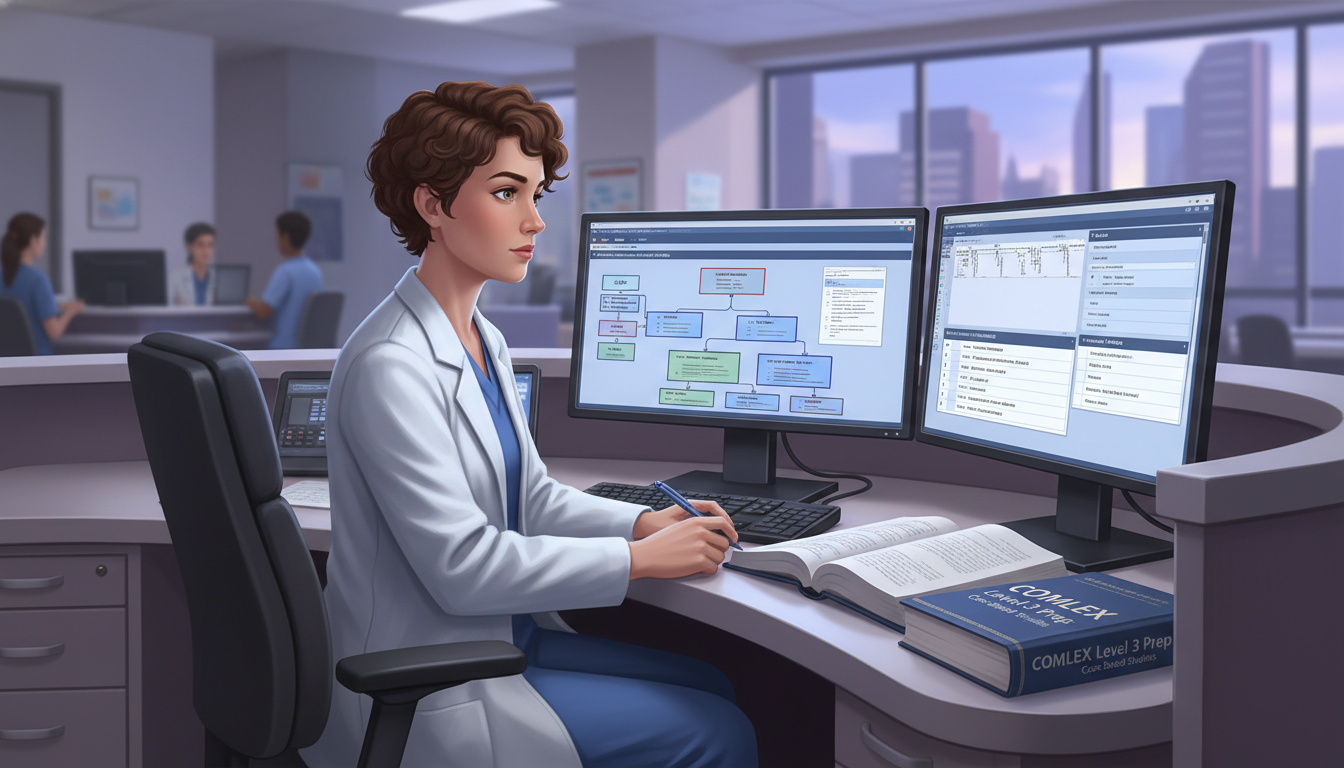
COMLEX Level 3: For MD Residents and Beyond
COMLEX Level 3 is typically taken during residency. If you’re an MD graduate now in training—perhaps in a program that values both USMLE and COMLEX—preparation must fit around clinical duties.
Level 3 focuses on:
- Longitudinal patient management
- Systems-based practice
- Advanced clinical reasoning and prioritization
- Incorporation of OPP in real-world practice
Step 1: Clarify Your Goals and Constraints
Ask yourself:
- Does my program have a deadline for taking/passing COMLEX Level 3?
- How many hours/week can I realistically study?
- How strong is my current clinical knowledge base from daily work?
Typically, MD residents will:
- Need 6–10 weeks of part-time study if Step 2 CK is recent and clinical skills are sharp.
- Require targeted refreshers in outpatient, preventive medicine, and OPP.
Core Strategy for Level 3
- Anchor in Real Clinical Practice
Use cases from your own inpatient and clinic experiences as mental scaffolding. When reading COMLEX questions:
- Think: “What would I actually do on the wards or in my continuity clinic?”
- Then: “How might an osteopathic physician integrate OMT or OPP in this scenario?”
- Emphasize Outpatient and Longitudinal Care
Level 3 emphasizes:
- Chronic disease management (DM, HTN, COPD, CHF, CKD)
- Preventive care and screening timelines
- Geriatrics, polypharmacy, and transitions of care
- OB care over time: prenatal, intrapartum, postpartum
- Pediatric vaccination and developmental milestones
- Refine OPP for Real-world Integration
As an MD, your role is not to become an OMT practitioner overnight, but you must:
- Know where OMT fits into multidisciplinary care, and where it doesn’t.
- Recognize red flags/contraindications quickly.
- Understand which OMT approaches (e.g., muscle energy vs. HVLA) would be conceptually selected in a vignette even if you don’t perform them personally.
Sample Level 3-Style Reasoning
A 45-year-old with chronic neck pain post-MVA, stable imaging, no neurologic deficits. You’ve already:
- Ordered PT
- Optimized NSAIDs and non-opioid analgesics
- Counseled on activity modification
COMLEX might ask: Which additional management step aligns best with osteopathic principles?
Answer likely: Add OMT targeted at cervical somatic dysfunction, assuming no contraindications.
Practical Study Plan for MD Residents (8 Weeks)
Weeks 1–2: Structured Baseline
- 20–30 mixed clinical questions per day (COMLEX-oriented if possible).
- Identify 2–3 weakest areas (e.g., OB, pediatrics, outpatient internal medicine).
Weeks 3–6: Intensify and Focus
30–40 questions/day, with weekly emphasis:
- Week 3: Chronic disease and preventive care
- Week 4: OB/GYN and pediatrics
- Week 5: Psychiatry, neurology, geriatrics
- Week 6: EM, critical care, inpatient medicine
Add short OPP review 3 times/week:
- Contraindications to OMT per body region
- OMT options for common complaints (back pain, pregnancy pain, headaches)
Weeks 7–8: Simulation and Polishing
- Do 2–3 full-length practice exams or timed blocks to mimic exam fatigue.
- Review every OPP and ethics/systems question carefully.
- Clarify uncertain guidelines using up-to-date references (e.g., USPSTF, ACC/AHA, IDSA).
Integrating COMLEX Prep with an MD Graduate’s Career Path
MD Graduate Residency and the Allopathic Medical School Match Context
For many MD graduates, COMLEX is not the primary determinant of your residency prospects; your USMLE performance and clinical record typically drove your allopathic medical school match. However:
- Taking and passing COMLEX can broaden future options:
- Positions in institutions with strong osteopathic presence
- Flexibility in state licensure where COMLEX may suffice or be preferred
- Demonstrated appreciation for holistic and function-oriented care
To integrate COMLEX prep without derailing your career:
Time exams strategically
- If still in medical school, align COMLEX Level 1 and 2-CE near Step 1 and Step 2 CK to reuse knowledge.
- If in residency, schedule Level 3 during a lighter rotation when possible.
Avoid duplicative study
- Don’t re-do entire Step curricula.
- Focus on OPP, COMLEX-style questions, and guideline refreshers.
Document your commitment to holistic care
- In personal statements or interviews (when applicable), you can highlight:
- Why you chose to take DO board exams
- How osteopathic principles align with your approach to patient care
- Examples of holistic, function-focused care from your clinical experiences
- In personal statements or interviews (when applicable), you can highlight:
Practical Tips and Common Pitfalls
High-Yield Tips for MD Graduates
- Start OPP early, even if only 20–30 minutes/day. It’s a new language; cramming is inefficient.
- Use visual aids for spine mechanics and somatic dysfunction naming; repetition matters.
- Practice on COMLEX-style interfaces if available, to normalize the look/feel.
- Keep a dedicated OPP notebook or digital document:
- Summarize each technique
- Note indications, contraindications, and sample vignettes
Frequent Pitfalls
- Ignoring OPP until the last minute
- This is the single biggest avoidable reason MDs underperform on COMLEX.
- Studying only with USMLE-style resources
- Great for core medicine, inadequate for exam nuances.
- Overestimating the need for ultra-high scores
- For most MD grads, a clean pass without complications is the practical target.
- Underestimating fatigue on Level 3
- Long exam + residency fatigue = performance risk. Simulate long test days at least once.
FAQs: COMLEX Level 1–3 for MD Graduates
1. Do MD graduates really need to take all three COMLEX levels?
Not always. Many MDs never take COMLEX at all. Whether you need COMLEX Level 1–3 depends on:
- Your residency program’s requirements
- State licensing rules where you plan to practice
- Career goals involving osteopathic-focused institutions
If you already have complete USMLE scores and a stable residency, some circumstances require only COMLEX Level 3, but others might not require COMLEX at all. Confirm with your program director and state board.
2. How much time should I budget for COMLEX preparation if I already passed USMLE Step 1 and 2?
For most MD graduates:
- COMLEX Level 1: 6–8 weeks part-time
- COMLEX Level 2-CE: 6–8 weeks part-time
- COMLEX Level 3: 8–10 weeks part-time during residency
If your USMLE exams are recent and you’ve stayed clinically active, you may manage with the shorter ends of these ranges—provided you systematically address OPP and exam format.
3. What are the best resources for OPP and COMLEX-style practice for MDs?
Look for:
- A concise OPP textbook or review designed for COMLEX
- COMLEX-specific question banks that include:
- OPP/OMT items
- COMLEX-style stems and answer structures
- Online video demonstrations of common OMT techniques to visualize what questions describe
Pair these with your existing USMLE or general board review resources; you do not need to discard what already works.
4. If my USMLE scores are strong, how heavily will residency programs weigh my COMLEX results?
For MD graduates who already matched through the allopathic medical school match system, most programs:
- View COMLEX primarily as a licensure requirement, not as a new competitive metric.
- Expect a clean pass, without failures or irregularities.
- Rarely compare COMLEX percentiles among MD residents the way they might compare USMLE scores among applicants.
Your strongest priority is to avoid a failure or irregular attempt, as that can be more concerning than a modest pass.
By approaching COMLEX Level 1–3 with a targeted, strategic plan that respects your existing MD background while filling in OPP and format gaps, you can efficiently meet exam requirements, maintain licensure options, and demonstrate a thoughtful appreciation of osteopathic principles in your practice.