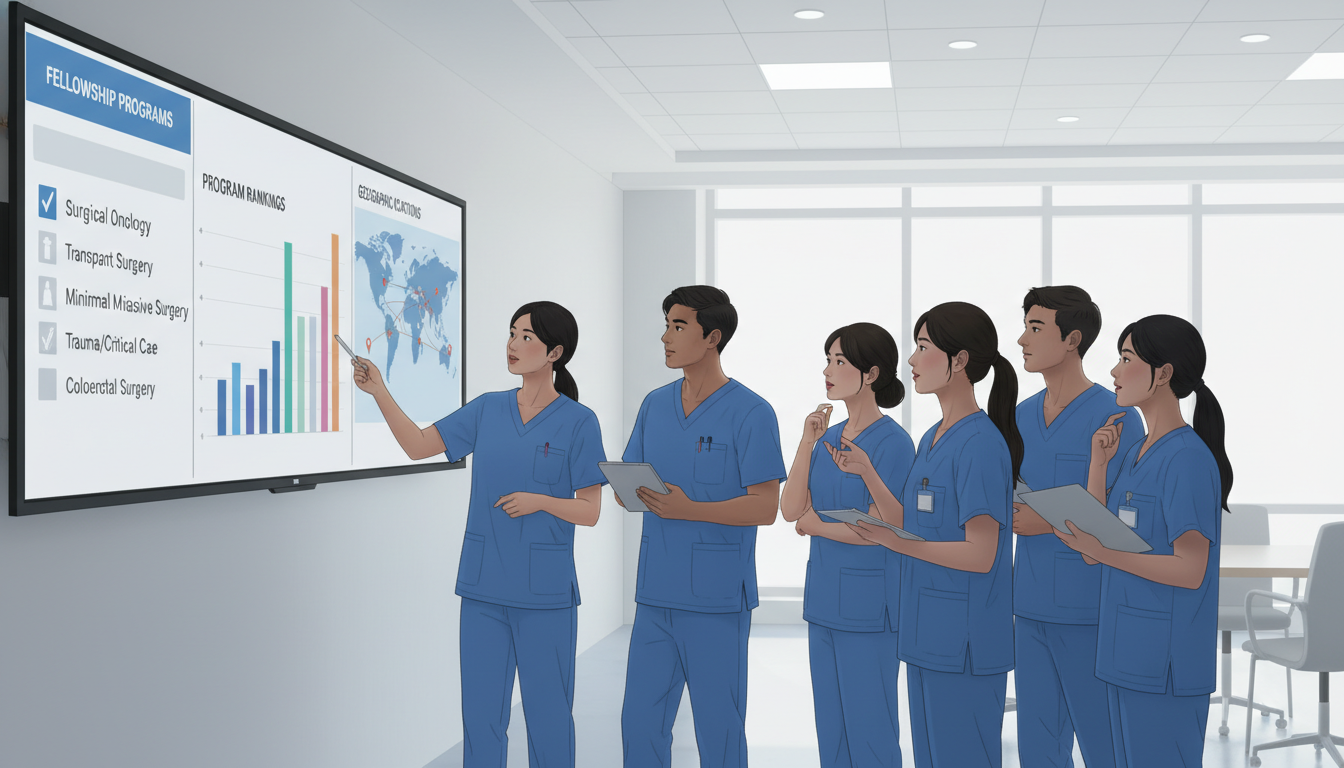
Preparing for competitive fellowships as a general surgery resident is not a “senior year project”—it’s a strategy that ideally begins in medical school and evolves throughout residency. Whether your goal is a cardiology fellowship match after a surgical prelim year (less common but occasionally relevant), a GI fellowship despite its competitiveness after a general surgery-backed career change, or more commonly, surgical subspecialties like surgical oncology, minimally invasive surgery, pediatric surgery, vascular surgery, or hepatobiliary/transplant, the principles of building a strong fellowship application are remarkably similar.
This guide focuses on how general surgery residents can systematically prepare for highly competitive fellowships, with practical steps you can take from day one through the surgery residency match and beyond.
Understanding the Landscape: Where General Surgery Leads
Before planning your path, you need to understand what “competitive fellowship” means within general surgery.
Common Fellowship Paths After General Surgery
Most general surgery residents interested in advanced training consider one or more of the following:
- Surgical Oncology
- Minimally Invasive / Bariatric Surgery
- Colorectal Surgery
- Trauma / Critical Care / Acute Care Surgery
- Hepatopancreatobiliary (HPB) Surgery
- Transplant Surgery
- Pediatric Surgery
- Vascular Surgery
- Breast Surgery
- Plastic & Reconstructive Surgery (independent track)
- Cardiothoracic Surgery (traditional or integrated pathways)
While “cardiology fellowship match,” “GI fellowship competitiveness,” and “heme onc fellowship” are usually internal medicine–based pathways, you will occasionally see crossovers:
- Someone starting in general surgery, then transitioning into internal medicine for cardiology or GI.
- Residents doing a preliminary surgery year before switching to an IM-based track.
The core message: the habits and profile that get you into a strong general surgery residency are the same ones that open doors to elite surgical fellowships—and are strikingly similar to those that lead to competitive IM fellowships like GI or heme onc.
What Makes a Fellowship “Competitive”?
A program or specialty tends to be competitive when:
- There are far more qualified applicants than spots
- It is concentrated at a small number of prestige-heavy academic centers
- It requires high research productivity (e.g., pediatric surgery, surgical oncology, HPB)
- It is perceived to offer:
- High case complexity
- Niche expertise
- Stable or higher compensation
- Academic career opportunities
- Geographic concentration in desirable areas
For surgery, pediatric surgery, transplant, HPB, and surgical oncology are often among the most competitive, with some having match rates similar in intensity to IM’s GI fellowship competitiveness or heme onc fellowship levels.
Step 1: Building Your Foundation During the Surgery Residency Match
Your fellowship trajectory starts before residency, during your general surgery residency application and match process. The strength and type of residency program you join can strongly influence your fellowship prospects.
Choosing a Program with Strong Fellowship Outcomes
When interviewing for general surgery residency, ask explicitly about fellowship placement:
- “Where have your recent graduates matched for fellowship?”
- “What proportion of graduates pursue fellowship versus general practice?”
- “Are there in-house fellowships, and how often do residents match into them?”
- “How is resident involvement in research and subspecialty exposure structured?”
Red flags if:
- The program cannot name recent fellowship destinations.
- Residents report difficulty getting research support.
- Faculty seem indifferent to academic or fellowship-oriented careers.
Green flags include:
- Consistent placement into top-tier surgical oncology, vascular, HPB, or pediatric surgery programs
- Protected research time or support for research years
- Access to subspecialty services with high case volumes and academic output
Balancing General Surgery Training with Future Goals
A good general surgery residency should provide:
- High case volume and autonomy
- Strong operative training across core procedures
- Robust academic infrastructure: conferences, morbidity and mortality (M&M), grand rounds
- Mentorship from faculty in multiple subspecialties
Fellowship programs look for technically solid surgeons who can become subspecialty experts—not just “paper tigers” with publications but minimal operative skill. Choose an environment where you can grow in both arenas.
Step 2: Strategic Planning Early in Residency (PGY-1 to Early PGY-2)
Your first two years are foundational. You don’t need everything figured out on day one, but you do need a deliberate plan.
Clarify Your Interests, But Stay Flexible
Early on, notice:
- Which rotations energize you (trauma vs HPB vs breast vs colorectal)
- What type of pathology and pace you prefer
- Whether you are drawn to acute, elective, cancer, or technology-heavy (robotic/MIS) cases
It’s normal to change interests. Your goal is not to lock in immediately—it’s to gather information and start laying down optionality.
Develop Core Habits That Translate to Any Competitive Fellowship
Regardless of specialty, the most sought-after fellowship applicants share a few attributes:
Reliability and Work Ethic
- Show up prepared, on time, and accountable.
- Complete notes, follow up on results, own your patients.
- Senior residents and attendings notice who “makes their life easier.”
Clinical Curiosity
- Read daily about your cases.
- Know the “why” behind operative plans, not just the “what.”
- Ask thoughtful (not incessant) questions.
Technical Engagement
- Focus on fundamentals: tying, suturing, exposure, tissue handling.
- Be deliberate about improvement: ask for feedback on specific skills.
- Early technical competence makes faculty more willing to support your fellowship goals.
Professionalism
- Treat staff respectfully.
- Maintain composure under stress.
- Avoid gossip and political missteps.
Fellowship directors frequently call your PD or mentors and ask, “Would you want this person operating with you at 2 a.m.?” You want the answer to be an unqualified “Yes.”
Start a Simple Career Development Plan
By the end of PGY-1, you should:
- Identify 1–2 subspecialties of interest (even tentatively)
- Have approached at least one faculty mentor in each area
- Begun or joined one research project (even a retrospective chart review)
Document:
- Possible fellowship targets (e.g., surgical oncology vs HPB vs colorectal)
- Research ideas or clinical questions
- Skills you want to develop (robotics, complex laparoscopic, vascular anastomoses)
This plan can evolve, but having one pushes you to act intentionally.

Step 3: Building a Fellowship-Ready Academic Profile
For the most competitive fellowships, your academic and research profile matters a lot. Think of high-demand surgical subspecialties as being somewhat analogous to GI fellowship competitiveness or heme onc fellowship in internal medicine—programs may receive many applications for a few spots, and research productivity helps distinguish applicants.
Choosing the Right Research Environment
Ask yourself:
- Does my program support residents taking dedicated research time (1–2 years)?
- Are there faculty with national reputations and active projects in my interest area?
- Are there collaborations with cancer centers, transplant institutes, or research labs?
If you want extremely competitive fields—like pediatric surgery, surgical oncology, HPB, or transplant—dedicated research time is often a major advantage, sometimes a de facto expectation.
Types of Research That Matter
Different fellowships value slightly different things, but in general:
Clinical Outcomes and Database Studies
- Common in surgical oncology, colorectal, minimally invasive, transplant.
- Often feasible to start as a junior resident.
- May allow for multiple first- or co-author publications.
Basic or Translational Science
- Valued in academic surgical oncology, transplant, HPB.
- Longer timeline; often aligned with 1–2 year research fellowships.
- Demonstrates commitment to an academic career.
Quality Improvement & Implementation Science
- Highly relevant for trauma, acute care surgery, and MIS.
- Can lead to conference presentations and institutional improvements.
Education and Simulation
- Attractive if you aim to be an educator or hold leadership roles in residency programs.
- Complements but usually does not replace clinical research for very competitive fields.
Setting Realistic Research Milestones
By typical timeline (can vary by program):
- End of PGY-2 (before/starting research time)
- 1–2 ongoing projects
- 1 abstract submitted or accepted for a meeting
- End of dedicated research time (if applicable)
- Multiple abstracts/posters
- 2–5 publications (first-author if possible)
- Experience presenting at regional or national meetings
- By fellowship application (PGY-4/5)
- A cohesive body of work in your target area
- Clear narrative: “My interest in X is reflected in these projects and presentations”
Don’t underestimate presentations—poster and podium presentations at meetings like SAGES, ACS, AHPBA, SSAT, or regional surgical societies carry significant weight.
Mentorship and Sponsorship
You need both:
- Mentors: Guide your development, give feedback, help you avoid missteps.
- Sponsors: Actively advocate for you—emailing colleagues, making phone calls, inviting you onto high-visibility projects.
Identify at least one mentor who:
- Works in your desired field (e.g., surgical oncologist if interested in that fellowship)
- Is academically active
- Has a track record of helping residents match into fellowships
Meet them at least twice a year with a clear agenda:
- What you’ve done since last meeting
- What you plan to do next
- Any obstacles you’re facing
- Feedback on your CV and fellowship trajectory
Step 4: Maximizing Clinical and Technical Strength
Fellowship programs expect you to be a safe, competent, and progressing general surgeon by the time you arrive. Academic output is not enough.
Excel on Key Rotations
On rotations aligned with your future fellowship:
- Be the most prepared person on the team:
- Pre-round thoroughly
- Know imaging, labs, pathology
- Read about each case the night before
- Show operative growth:
- Ask to perform parts of the case
- Request feedback: “How was my exposure today? What can I do better?”
- Demonstrate longitudinal interest:
- Follow clinic patients into the OR and post-op
- Help with tumor boards or complex case conferences
Strong rotation evaluations and phone-call-worthy impressions from subspecialty attendings often matter more than small differences in case log numbers.
Case Logs and Breadth of Experience
While fellowship directors won’t usually obsess over specific case counts, they care about:
- Adequate exposure across core general surgery (hernia, gallbladder, bowel, emergency surgery)
- Demonstrated participation in relevant subspecialty cases:
- For HPB: pancreatic resections, liver resections, complex biliary
- For MIS: advanced laparoscopy, bariatric, foregut
- For trauma/critical care: high-level trauma cases, ICU management
- For vascular: arterial and venous reconstructions, endovascular cases
Ask your program leadership annually:
- “How are my case numbers compared to my peers?”
- “Are there gaps we should address for my career goals?”
Deliberate Technical Skill Development
Use:
- Simulation labs (laparoscopic, endoscopic, robotic)
- Wet labs and cadaver sessions
- Skills curricula provided by your program
Set concrete goals like:
- “By the end of PGY-2, I will be comfortable performing an open appendectomy skin-to-skin with supervision.”
- “By mid-PGY-3, I will be leading laparoscopic cholecystectomies with my attending assisting.”
Technical maturity is a powerful differentiator when programs compare similarly productive applicants.

Step 5: Assembling a Standout Fellowship Application
When you reach PGY-4 or PGY-5 (depending on specialty), you will transition from preparation to execution.
The Application Timeline
Timelines vary by fellowship (e.g., some trauma/critical care vs pediatric surgery vs MIS), but broadly:
- 12–18 months before starting fellowship
- Clarify target specialties and ideal geographic regions
- Update CV and bibliography
- Intensify research productivity and submissions
- 9–12 months before
- Register in the relevant match system (e.g., NRMP, SF Match, specialty-specific)
- Request letters of recommendation
- Draft and refine personal statement
- Submit application early in the window
- 6–9 months before
- Interview season
- Follow up with thank-you notes
- Communicate professionally with programs
- Match rank list and result
- Meet with mentors to finalize rank order strategy
- Prepare for likely scenarios (match vs no match, backup plans)
Letters of Recommendation
For a competitive fellowship, letters should ideally come from:
- At least one subspecialist in your target field
- A program director or chair who can speak to your global performance
- Another senior surgeon who knows your work ethic and technical ability
Strong letters:
- Are detailed and specific
- Include direct observations (“I have personally supervised Dr. X in >50 major cases”)
- Comment on:
- Work ethic
- Technical skill trajectory
- Professionalism and teamwork
- Academic potential
- Integrity and reliability
Ask early, and provide:
- Your updated CV
- Personal statement draft
- A bullet list of projects and key rotations
- Any specific fellowship programs you’re targeting
Personal Statement and Narrative
Your personal statement should answer:
- Why this field?
- Why you?
- How do your experiences and research demonstrate genuine commitment?
- What are your short-term and long-term career goals?
Avoid:
- Generic statements (“I like working with my hands”)
- Overly dramatic personal stories not tied to concrete professional steps
- Criticizing prior institutions or colleagues
Aim for a clear narrative:
“From my early exposure to complex HPB surgery as a PGY-2, through two years of dedicated research in pancreatic cancer outcomes, and culminating in leading our institutional ERAS pathway implementation, my career has been oriented toward academic HPB surgery.”
The Interview: Demonstrating Fit and Maturity
On interview day, programs are gauging:
- Are you someone we want to work with for 1–2 years at close range?
- Are your goals aligned with what our fellowship offers?
- Will you represent our program well after graduation?
Prepare to discuss:
- Your most meaningful clinical cases
- Your research in detail:
- Study design
- Limitations
- Your exact role
- Career goals and flexibility:
- Academic vs community practice
- Interest in teaching and leadership
- How you handle complications and setbacks
Have thoughtful questions ready:
- Caseload and fellow autonomy
- Interactions with other fellows and residents
- Opportunities for continued research and national presentation
- Graduates’ practice patterns and locations
Step 6: Contingency Planning and Broad Career Strategy
Even strong applicants may not match their first choice, especially in the most competitive niches—similar to what applicants see in cardiology fellowship match, GI fellowship competitiveness, or heme onc fellowship in internal medicine.
If You Don’t Match the First Time
Options may include:
- Reapplying after:
- Additional research time or a research fellowship
- A year or more of general surgery practice with enhanced clinical portfolio
- Pivoting to a related but less competitive field (e.g., from HPB to MIS or general surgical oncology vs very niche program)
- Accepting a strong general surgery position and revisiting fellowship later
If you don’t match:
- Ask for honest feedback from mentors and, if possible, from program directors where you applied.
- Identify whether weaknesses were:
- Academic (lack of publications)
- Clinical (concerns in letters or performance)
- Fit/communication (interview impression)
- Geographic or personal constraints (too narrow a rank list)
Then create a clear 1–3 year remediation plan.
Long-Term Career Vision
Remember that fellowship is a tool, not a destination in itself.
Clarify for yourself:
- What kind of daily work you want (case mix, patient population, intensity)
- How important location is vs subspecialty
- Whether you envision a primarily academic, hybrid, or community career
Some surgeons build highly satisfying careers as:
- Community general surgeons with niche focus (e.g., breast, MIS)
- Acute care surgeons with leadership roles
- Surgeons who pivot into admin, education, or global surgery roles
Fellowship can amplify your options, but your reputation, judgment, and relationships will ultimately shape your trajectory.
FAQs: Competitive Fellowship Preparation in General Surgery
1. When should I decide on a specific fellowship during general surgery residency?
You don’t need a final decision as an intern, but by mid-PGY-2 you should have narrowed down to 1–2 likely paths and positioned yourself accordingly:
- Seek aligned rotations and mentors
- Join or initiate research in those areas You can still pivot later, but early direction makes your application stronger and more coherent.
2. Do I need dedicated research years to match a competitive surgical fellowship?
Not always, but for ultra-competitive fields (e.g., pediatric surgery, surgical oncology, transplant, HPB), 1–2 years of dedicated research significantly improve your chances, especially at top academic centers. For other fellowships (MIS, colorectal, trauma/critical care), strong productivity without formal research time can still be very competitive—if your institution supports robust research while in clinical training.
3. How many publications do I need for a strong application?
There is no strict cutoff, but for competitive programs:
- A cluster of focused work (e.g., 3–5 publications/abstracts in your subspecialty) is often more impactful than a long list of unrelated projects.
- Quality, first- or second-authorship, and presentations at respected meetings weigh heavily. Fellowship directors look for evidence of follow-through and scholarly curiosity, not just numbers.
4. How important is my general surgery program’s “name” for fellowship?
Program reputation matters, but it is not the only variable. Fellowship programs look for:
- Strong letters from respected surgeons
- Evidence of high-quality operative training
- Research and academic engagement Residents from smaller or less famous programs regularly match into excellent fellowships when they:
- Build strong mentorship relationships
- Produce focused, high-quality research
- Demonstrate superb clinical and professional performance
By thinking about fellowship preparation as a longitudinal process—starting from your general surgery residency match and continuing through each year of training—you maximize your options for the most competitive surgical fellowships. Align your clinical performance, academic work, and mentorship relationships with your evolving goals, and you will be well-positioned to match into a fellowship that fits both your skills and your long-term vision as a surgeon.