Understanding the Premed Journey
Preparing for medical school begins long before you click “submit” on your AMCAS or AACOMAS application. Premed preparation is a multi-year process involving academic planning, strategic extracurricular choices, careful MCAT timing, and early exposure to clinical environments. When done thoughtfully, it doesn’t just help you “check boxes”—it helps you decide whether you truly want to practice medicine and how to become a doctor in a way that aligns with your values and strengths.
This guide focuses on the complete spectrum of premed advice—from choosing the right courses and majors to building a compelling portfolio of experiences for residency applications down the line. Even though you’re still years away from the residency match, smart preparation now will pay off throughout medical school and into your residency applications.
We’ll cover:
- Core premed requirements and how to sequence them
- Academic strategy and GPA management
- MCAT planning and resources
- Clinical, research, and service experiences
- Professional development and long-term planning
- Frequently asked questions about premed life
Whether you’re a high school student exploring how to become a doctor, a college freshman declaring a major, or a nontraditional applicant changing careers, you can adapt these principles to your specific path.
Academic Foundations: Premed Requirements and Course Planning
Choosing a Major vs. Meeting Requirements
A common misconception is that you must major in biology or a hard science to get into medical school. You don’t. Admissions committees welcome a wide range of majors—as long as you complete the premed requirements and demonstrate academic rigor.
Typical majors chosen by premed students:
- Biological sciences (biology, biochemistry, neuroscience)
- Physical sciences (chemistry, physics)
- Social sciences (psychology, sociology, public health)
- Humanities (philosophy, English, history)
- Engineering or computer science
Key principle: Your major should be something you genuinely enjoy and can excel in, not just what you believe admissions committees want. A humanities major with strong science grades and a high MCAT is just as competitive as a traditional biology major.
Core Premed Requirements (Typical U.S. MD/DO Programs)
Each medical school has its own prerequisites, but most expect completion of:
- Biology: 2 semesters with lab
- General (Inorganic) Chemistry: 2 semesters with lab
- Organic Chemistry: 2 semesters with lab (some schools accept 1 organic + 1 biochemistry)
- Physics: 2 semesters with lab
- Biochemistry: 1 semester (increasingly required, nearly universally recommended)
- English/Writing: 1–2 semesters (composition and/or writing-intensive courses)
- Math/Statistics:
- Some schools require calculus
- Many strongly recommend statistics (especially for evidence-based medicine and research)
- Social and Behavioral Sciences:
- Introductory psychology
- Sociology or another social science (very helpful for the MCAT and understanding health disparities)
Always verify premed requirements on:
- Individual medical schools’ admissions pages
- The AAMC Medical School Admission Requirements (MSAR) database
- AACOM College Information Book for DO schools
Planning a Four-Year Premed Timeline
Below is a sample timeline for a traditional 4-year college student who will apply in the summer after junior year (to matriculate immediately after graduation). Many students now take one or more gap years; you can adjust this plan accordingly.
Year 1 (Freshman)
- Courses:
- General Biology I & II (with lab)
- General Chemistry I & II (with lab)
- College Writing/Composition
- Intro Psychology or Sociology
- Goals:
- Transition to college-level studying
- Explore premed interest groups
- Begin light clinical exposure (occasional shadowing, hospital volunteer orientation)
Year 2 (Sophomore)
- Courses:
- Organic Chemistry I & II (with lab)
- Physics I & II (with lab)
- Biostatistics or general statistics
- Additional social science course
- Goals:
- Start or continue research and clinical volunteering
- Take on a small leadership or consistent club role
- Begin light MCAT familiarity (content overview, diagnostic)
Year 3 (Junior)
- Courses:
- Biochemistry
- Upper-level biology (e.g., physiology, cell biology, genetics, immunology)
- Writing-intensive or ethics course
- Goals:
- Intensify MCAT study and take exam by spring or early summer
- Expand leadership roles, deepen clinical exposure
- Begin crafting personal statement ideas and school list
Year 4 (Senior)
- Courses:
- Electives that interest you and support your narrative (public health, ethics, anthropology, advanced science)
- Goals:
- Finish remaining prerequisites
- Interview prep and travel
- Complete degree and maintain strong academic performance
If you’re a nontraditional student or taking a gap year, the order is similar, but you might spread core sciences over more time or take them in a formal post-bacc program.

GPA Strategy: Building a Strong Academic Record
Admissions committees look closely at your:
- Overall (cumulative) GPA
- Science GPA (biology, chemistry, physics, math—often abbreviated BCPM)
- Trend over time (improvement or decline)
Targets (general guidance, not strict cutoffs):
- Competitive MD applicants:
- Overall GPA ≥ 3.7, Science GPA ≥ 3.6
- Competitive DO applicants:
- Overall GPA ≥ 3.4–3.5, Science GPA ≥ 3.3–3.4
These are not absolute; many successful applicants fall below these ranges, especially if they have strong MCAT scores, upward trends, or outstanding experiences. But understanding benchmarks can guide how aggressively you manage coursework.
Practical academic strategies:
Balance your schedule
- Avoid stacking too many demanding lab sciences in the same semester, especially early.
- Example: Instead of taking Organic Chemistry, Physics, and Biochemistry all at once, pair one high-intensity course with lighter or gen-ed classes when possible.
Adapt your study techniques
- Use active learning over passive rereading: practice problems, teaching the material aloud, spaced repetition flashcards.
- Form small, serious study groups where you quiz each other and work through problem sets rather than just “studying together.”
Seek help early
- Office hours, teaching assistants, tutoring centers, and online resources (Khan Academy, Anki decks, etc.) can prevent small gaps from becoming major weaknesses.
- If you perform poorly on an early exam, meet with your professor to understand why and develop a specific plan for improvement.
Manage course withdrawals and repeats strategically
- One W (withdrawal) with a valid reason isn’t fatal, but multiple withdrawals suggest poor planning.
- Retaking a key prerequisite after a poor grade (e.g., C– in Organic Chemistry) can demonstrate mastery—but only if you significantly improve.
MCAT Preparation: Timing, Strategy, and Resources
The MCAT is a central element of how to become a doctor in the U.S. It assesses your readiness for medical school science and critical reasoning.
When to Take the MCAT
Optimal timing depends on:
- Completion of key content courses (biology, general and organic chemistry, physics, biochemistry, intro psychology and sociology)
- Your application timeline
For traditional applicants:
- Take the MCAT by spring or early summer of your junior year (March–June) so scores are back before or shortly after you submit your primary application.
For nontraditional or gap-year applicants:
- Many choose to take it 1–1.5 years before planned matriculation, often during a gap year after completing prerequisites.
Never rush the MCAT just to “stay on schedule.” A strong score a bit later is usually better than a mediocre score taken early.
Building an MCAT Study Plan
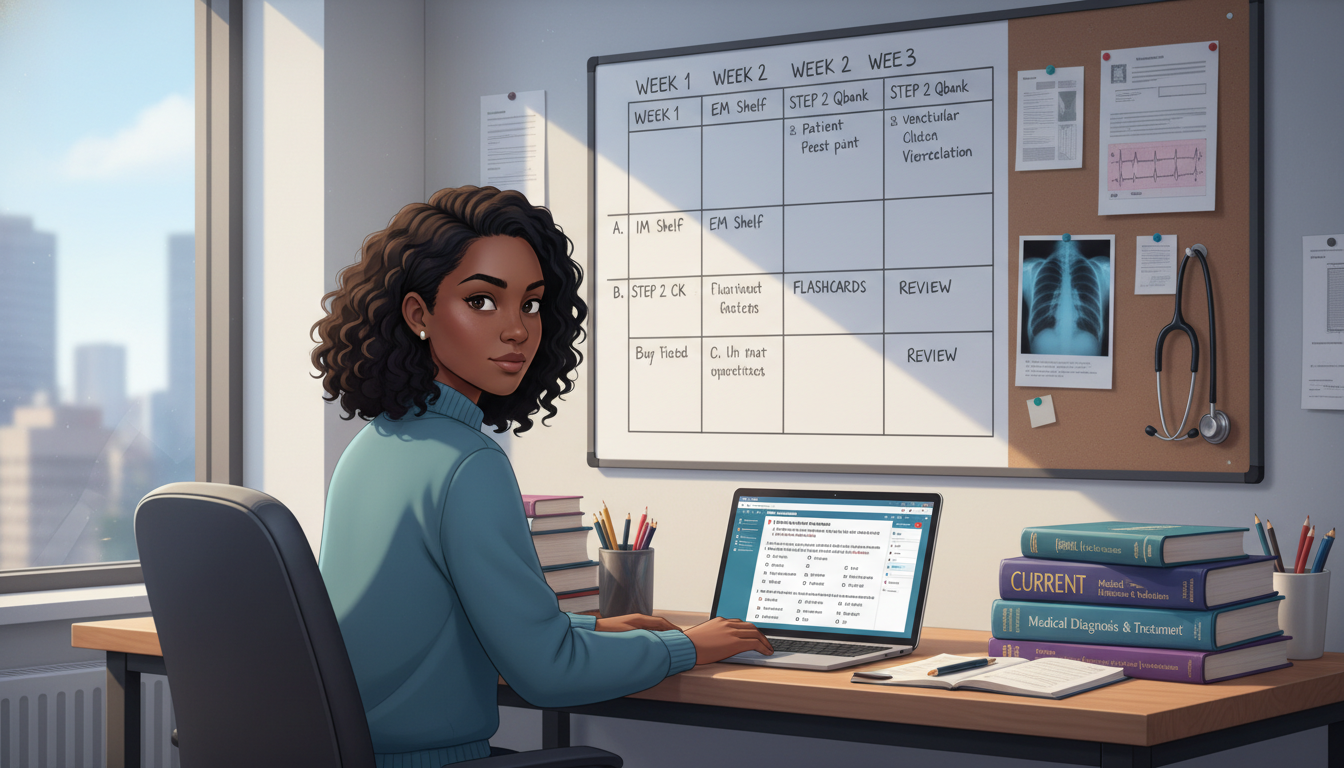
Most successful applicants dedicate 3–6 months of focused preparation, balancing content review and practice.
Step 1: Diagnostic assessment
- Take a full-length diagnostic (from AAMC or a reputable test prep company) to:
- Determine your baseline
- Identify weak content areas
- Estimate how much time you’ll need
Step 2: Structured content review (first phase)
- Use central resources:
- MCAT review books (Kaplan, Princeton Review, Examkrackers, Blueprint, etc.)
- AAMC’s free and low-cost resources
- Schedule 2–4 hours per day (on average), more during lighter academic or work periods.
Step 3: Practice-heavy phase (second phase)
- Shift emphasis to:
- AAMC Question Packs and Section Bank
- AAMC full-length exams (aim for at least 4–6 full-lengths overall)
- Review of mistakes and test-taking strategy
- Simulate test conditions: same start time, 7.5-hour duration, minimal interruptions.
Common MCAT Pitfalls and How to Avoid Them
Over-focusing on memorization
- MCAT heavily tests reasoning and data interpretation rather than rote recall.
- Practice analyzing graphs, experiments, and passages under time pressure.
Underestimating CARS (Critical Analysis and Reasoning Skills)
- Treat CARS like a skill you build over months: read dense articles (philosophy, ethics, social sciences), practice timed passages, and reflect on why each answer is right or wrong.
Neglecting non-science sections
- Psychological, Social, and Biological Foundations of Behavior requires serious study; don’t assume it will be easy.
Burnout
- Build regular breaks and rest days into your schedule. Burnout leads to lower test performance and can harm your ongoing coursework.

Clinical, Research, and Service Experiences
Grades and MCAT scores get you noticed; experiences show who you are as a future physician. For both medical school admissions and eventual residency applications, your activity choices will communicate your values, resilience, and commitment to patient care.
Clinical Exposure: Seeing Medicine Up Close
Admissions committees expect evidence that you understand what physicians do and what clinical environments are really like.
Common clinical experiences:
- Hospital volunteering (transport, patient liaison, unit support)
- Clinic volunteering (free clinics, community health centers)
- Medical scribing (emergency department, outpatient clinics)
- Certified Nursing Assistant (CNA), Emergency Medical Technician (EMT), or medical assistant roles
- Hospice or palliative care volunteering
Quality over quantity:
- Aim for consistent involvement over at least 1–2 years if possible, rather than a short, intense burst.
- Depth matters: returning to the same site allows you to develop relationships and insight.
Shadowing physicians
Shadowing gives you a close-up view of a physician’s day-to-day reality.
- Aim for 40–80 hours total spread across different specialties (primary care plus 1–2 others).
- Be engaged: jot down reflections after each day:
- What surprised you?
- What aspects energized you or drained you?
- How did the physician communicate with patients?
These reflections are invaluable for your personal statement and interview answers later.
Research Experience: Understanding the Science of Medicine
Research is not strictly required at all schools, but it’s highly valued, especially at academic or research-heavy institutions.
Types of research:
- Basic science (lab bench work, cell culture, animal models)
- Clinical research (chart reviews, clinical trials, patient outcomes)
- Translational research (bridging lab discoveries and clinical applications)
- Public health, epidemiology, or health services research
- Social science or education research related to healthcare
How to get involved:
- Explore your university’s research opportunities page
- Email faculty whose work interests you with a concise, professional message:
- Brief intro (year, major, premed)
- Specific interest in their project (mention a recent paper or topic)
- Your availability and willingness to learn
- Start small: data entry, literature reviews, assisting with experiments. Responsibility grows with reliability and time.
Long-term goal:
Ideally, you’ll spend at least 1–2 years with one research group, possibly contributing to a poster, presentation, or publication. But even without publications, meaningful, reflective research experience is valuable.
Community Service and Non-Clinical Volunteering
Medicine is fundamentally a service profession. Schools want to see that you care about others, especially vulnerable populations, beyond the hospital walls.
Examples:
- Tutoring or mentoring underserved youth
- Volunteering at shelters, food banks, refugee organizations
- Health education workshops (nutrition, sexual health, smoking cessation)
- Advocacy or policy-related work focused on health disparities
Try to align your service with genuine interests. If you’re passionate about education, consistent tutoring in an underserved school may be more meaningful than a random assortment of unrelated activities.
Leadership, Hobbies, and Work Experience
Your application should reflect that you are a whole person, not only a test-taker.
- Leadership: Club officer roles, founding an initiative, team captain, resident assistant, etc.
- Hobbies and creative outlets: Music, art, sports, writing, coding—these demonstrate balance and resilience.
- Paid employment: Working during school is respected. It demonstrates time management, responsibility, and often socioeconomic context.
When you eventually apply to residency, program directors will look back through your academic and professional trajectory, including your medical school activities. The self-discipline, empathy, and leadership you build now will influence your success in clerkships, Step exams, and residency applications.
Professionalism, Planning, and Personal Development
Building Professional Habits Early
Professionalism isn’t something you flip on when medical school starts; it’s cultivated now.
Key habits:
- Reliable communication: Respond to emails professionally and promptly; use appropriate salutations and signatures.
- Punctuality and follow-through: Show up on time, meet deadlines, and follow instructions carefully.
- Ethical behavior: Never exaggerate hours or experiences. Protect patient confidentiality when discussing clinical encounters.
- Respect and humility: Treat everyone—from custodial staff to department chairs—with equal respect.
Faculty, supervisors, and physicians you meet now may later become letter writers for medical school and residency applications. Their impressions of your professionalism will matter.
Crafting Your Narrative: Why Do You Want to Be a Doctor?
The core question underlying your entire premed journey is: Why medicine?
Start reflecting early:
- When did you first seriously consider medicine?
- What experiences strengthened or challenged that interest?
- What kind of problems in healthcare motivate you—individual patient care, health equity, global health, research, or something else?
- How do your background, values, and strengths shape the kind of physician you hope to be?
Keep a simple reflection journal. After notable experiences (shadowing, a meaningful volunteer interaction, a research milestone), write a short entry:
- What happened?
- What did you learn about yourself?
- How did this affect your view of medicine?
These notes will later supply rich material for your personal statement, secondary essays, and residency personal statement years down the line.
Strategic Long-Term Planning (Premed → Medical School → Residency)
Although you’re currently in the RESIDENCY_MATCH_AND_APPLICATIONS pipeline only as a future goal, it helps to understand the broader path:
- Premed phase (college or post-bacc)
- Build academic foundation, MCAT, and experiences.
- Medical school (4 years)
- Preclinical years: classroom and early clinical exposure.
- Clinical years: rotations, evaluations, USMLE/COMLEX, specialty exploration.
- Residency applications and match
- Choice of specialty (e.g., internal medicine, surgery, pediatrics) is shaped by your interests, performance, and experiences.
- Research, leadership, and clinical evaluations from medical school—and the maturity and discipline you build as a premed—directly influence your residency competitiveness.
Understanding this continuum can help you prioritize depth and authenticity over superficial resume-building. The qualities that make a strong medical student and resident—curiosity, empathy, resilience, teamwork—start now.
Practical Action Plan: Step-by-Step Premed Advice
To make all of this concrete, here’s a distilled roadmap you can act on:
If You’re in High School
- Take the most rigorous science and math courses you can handle (AP/IB if available).
- Explore healthcare careers via volunteering, summer programs, or informational interviews.
- Develop strong study habits and time management—these will matter more than any single course.
- Apply to colleges with solid science departments, premed advising, and access to hospitals or clinics.
If You’re an Early College Student (Years 1–2)
- Meet with a premed advisor to map out your four-year plan.
- Start prerequisites but protect your GPA: don’t overload before you’re ready.
- Join 1–2 meaningful clubs; avoid joining too many without real involvement.
- Begin low-intensity clinical exposure and explore fields and research possibilities.
If You’re a Late College or Post-Bacc Student (Years 3–4+)
- Refine your academic record; if needed, take upper-level sciences and aim to demonstrate an upward trend.
- Commit more deeply to a few key activities (research, clinical, or service).
- Create a concrete MCAT plan (test date, resources, weekly schedule).
- Start your personal statement early; seek feedback from mentors or writing centers.
- Research schools and compile a realistic application list based on your metrics and mission fit.
If You’re a Nontraditional or Career-Changer Premed
- Consider a formal post-bacc or structured coursework to complete prerequisites and demonstrate readiness.
- Use your prior career experiences as assets—leadership, communication, maturity.
- Be prepared to explain how and why you decided to pivot to medicine and what you’ve done to confirm this choice.
FAQ: Common Premed Questions
1. Do I need to major in biology to get into medical school?
No. Medical schools accept a wide range of majors, including humanities, social sciences, business, and engineering. What matters most is:
- Completing all required premed coursework
- Demonstrating you can excel in rigorous science classes
- Building a coherent story about your interests and goals
Choose a major you enjoy and can perform well in; use electives to fulfill premed requirements.
2. How many clinical hours do I need?
There is no strict minimum, but competitive applicants often have:
- Several hundred hours of clinical exposure (volunteering, scribing, EMT, etc.) over multiple years
- At least 40–80 hours of physician shadowing
- Evidence of consistent, not just last-minute, involvement
Focus on consistency and reflection rather than chasing a specific number.
3. Is research required to get into medical school?
Not strictly, especially at schools that emphasize primary care. However:
- Research is highly valued, particularly at academic and research-intensive institutions.
- It teaches critical thinking and familiarity with how medical knowledge is generated.
If you enjoy science, try at least one significant research experience; if not, you can still be competitive by emphasizing strong clinical and service experiences.
4. What if my GPA isn’t perfect? Should I still apply?
A less-than-perfect GPA doesn’t automatically disqualify you. Consider:
- Trend: Have your grades improved over time, especially in upper-level sciences?
- Context: Did you work significant hours, have personal challenges, or switch majors?
- Strengths: A strong MCAT, compelling experiences, and powerful letters can offset some academic weaknesses.
If your GPA is significantly below average, a formal post-bacc or special master’s program (SMP) with strong performance can help demonstrate readiness. Speak with a premed advisor to create a tailored plan.
Preparing for a medical career is a marathon, not a sprint. By understanding premed requirements, planning your coursework, engaging meaningfully in clinical and service activities, and cultivating professionalism and self-awareness, you’ll not only become a stronger applicant—you’ll become the kind of future physician patients and colleagues trust.