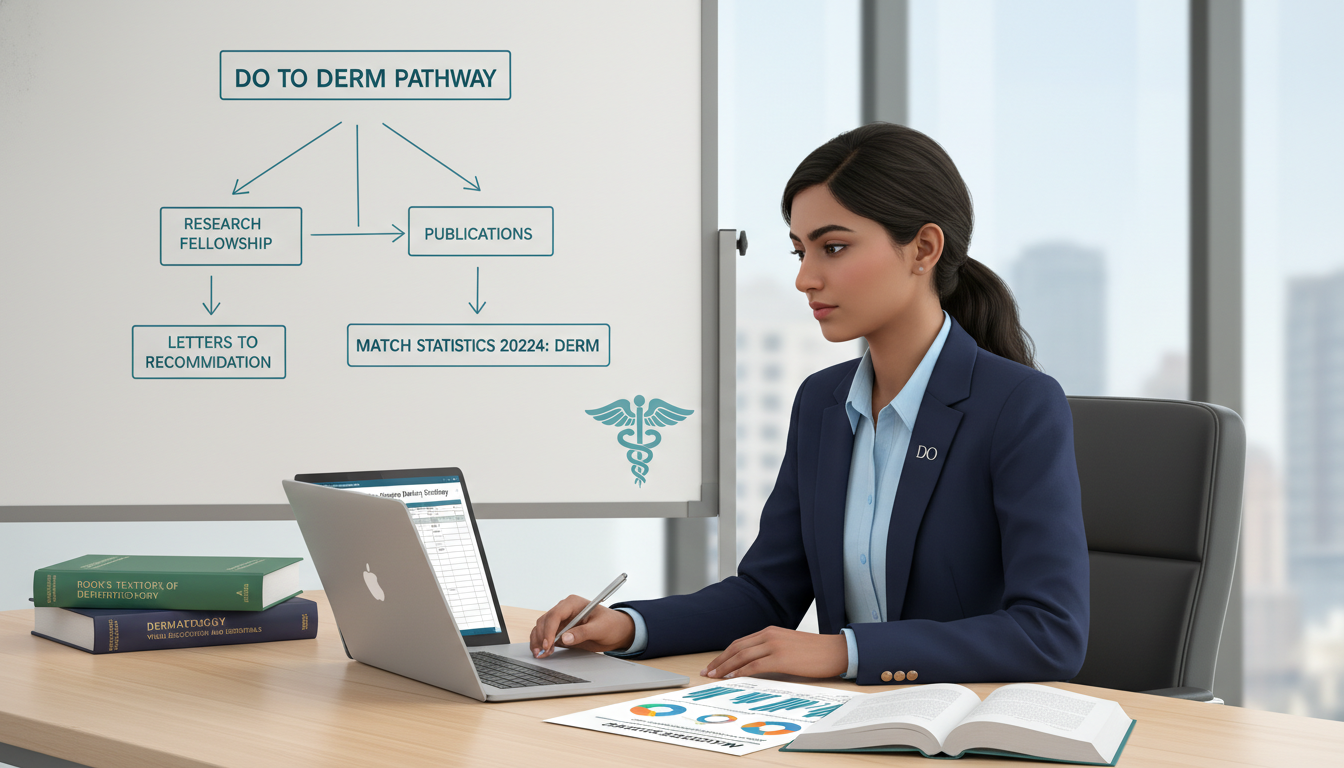
Understanding the Landscape: DOs and the Dermatology Match
Dermatology is one of the most competitive specialties in the residency match, and this is especially true for a DO graduate. When people talk about an “ultra-competitive specialty,” dermatology is often in the same sentence as orthopedic surgery, plastic surgery, and ENT. For a DO applicant, matching derm is absolutely possible, but it requires planning, data-driven strategy, and early execution.
Why Dermatology Is So Competitive
Several factors drive the competitiveness of dermatology residency:
- Limited number of positions compared with applicant interest
- Lifestyle appeal (predictable hours, few emergencies, high satisfaction)
- High compensation relative to many specialties
- Subspecialty prestige and academic opportunities
This means even highly qualified applicants can go unmatched. For a DO graduate, the bar is often higher because some programs still demonstrate an historical preference for MDs, even in the single accreditation era.
Derm Match Reality for DO Graduates
Key realities to recognize as a DO graduate:
- Some programs do not consistently rank DOs, regardless of individual merit.
- Other programs are DO-friendly and match DOs regularly; these should be your primary targets.
- Objective metrics (COMLEX, USMLE, class rank, publications) are often weighed more heavily for DOs to “prove equivalence” in the eyes of skeptical programs.
- Strategic planning can neutralize much of the perceived disadvantage.
Your goal is to build a profile that would be competitive anywhere, then deploy it strategically toward programs and pathways where DOs demonstrably succeed.
Core Metrics: Boards, Grades, and Class Rank
For ultra-competitive specialties like dermatology and orthopedics, metrics are the first screen. If your numbers don’t clear basic thresholds, many programs won’t read further.
COMLEX and USMLE: Do You Need Both?
If you are early in your training and serious about matching derm, the honest answer is: yes, you almost certainly should take the USMLE in addition to COMLEX, if it is still an option.
Why USMLE Still Matters
- Many dermatology programs compare applicants primarily on USMLE Step 1 and Step 2 CK, even though Step 1 is now pass/fail.
- Some program filters are built only around USMLE scores; a missing USMLE can auto-exclude you in their systems.
- When programs review DO applicants, strong USMLE scores help remove doubt about test-taking ability in their familiar metric.
Target Score Ranges (Approximate Benchmarks)
These ranges are not official cutoffs but are reasonable targets based on trends seen for ultra-competitive specialties:
- Step 2 CK:
- Highly competitive: 250+
- Solidly competitive: 245–249
- Possible but challenging: 240–244, requires strong compensatory strengths
For COMLEX, conversion is imperfect, but in general:
- Level 2-CE:
- Highly competitive: >640–650
- Solidly competitive: 620–640
- Possible but challenging: 600–620, requires strong compensatory strengths
If you are beyond testing, your strategy will pivot more heavily to research, away rotations, and networking. But if you’re pre-boards, a major part of your derm match strategy is optimizing your Step 2 and Level 2 performance.
Grades, Honors, and Class Rank
Dermatology programs often look for:
- High class rank (top 25%, ideally top 10–15%)
- Honors in core clinical clerkships, especially:
- Internal Medicine
- Surgery
- Pediatrics
- Dermatology electives
- AOA or Sigma Sigma Phi if available at your school
Actionable steps:
- Meet early with your dean or academic advisor to understand exactly how your school calculates class rank and honors.
- Prioritize clinical excellence: show up early, volunteer for procedures, own your patients, and request mid-rotation feedback so you can correct problems quickly.
- If your school has an official dermatology elective, aim to honor; this becomes a critical signal in your ERAS application.
Strategic Timeline: From OMS-II Through Application Year
To match an ultra-competitive specialty as a DO graduate, you must plan early and treat this as a multi-year project.
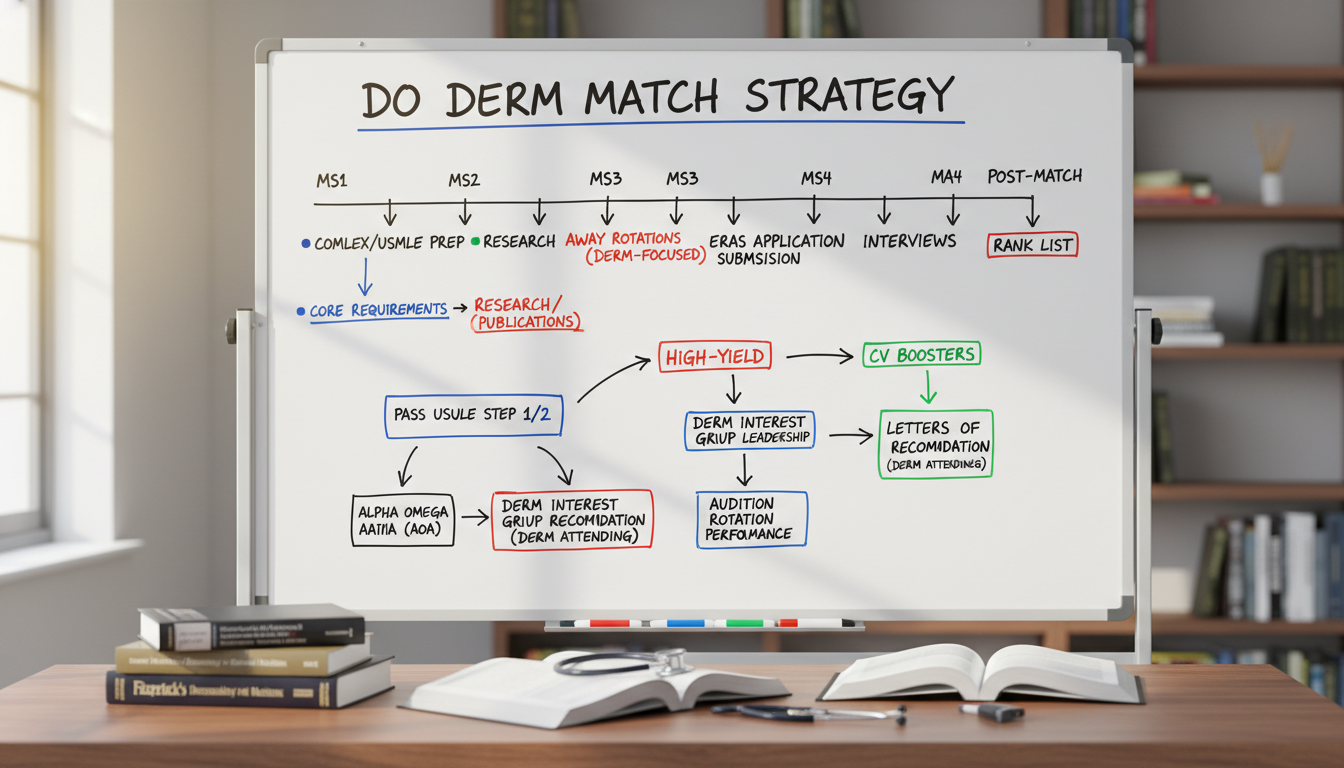
OMS-II / Preclinical Planning
Goals: Build knowledge foundation, explore interest, and prep for boards.
- Shadow dermatologists (academic and community) to confirm your interest.
- Start light involvement in dermatology-related research projects if available (chart reviews, case reports, lit reviews).
- Join dermatology-related student organizations; pursue small leadership roles.
- Begin serious board prep 6–9 months before Step 1/Level 1 with a focus on long-term memory (Anki or similar).
If your school has limited derm exposure, look for:
- Virtual derm electives or didactics
- Online derm case libraries (e.g., VisualDx, DermNet NZ)
- Telederm opportunities if any faculty are involved
OMS-III: Clinical Year Strategy
Goals: Excel clinically, explore allied specialties, and deepen mentorship.
- Aim to honor core rotations, especially those perceived as “rigorous,” like Internal Medicine and Surgery.
- Use your internal medicine rotation to truly learn systemic disease that manifests in the skin (e.g., lupus, vasculitis).
- On every rotation, look for skin findings and discuss them with your attendings; this strengthens your derm-specific thinking.
During OMS-III:
- Identify at least one committed mentor—ideally a dermatologist, but any academic physician with derm connections can help.
- Ask explicitly:
- “What would make a DO applicant stand out for dermatology here?”
- “Do you know programs that are DO-friendly or have matched DO grads recently?”
Begin to build your research portfolio more seriously now if you haven’t already.
OMS-IV / Application Year
Goals: Maximize exposure to programs, complete research outputs, and nail applications.
- Plan 2–3 away rotations in dermatology at DO-friendly or historically inclusive programs.
- Finalize and submit manuscripts, posters, and case reports before ERAS opens, whenever possible.
- Prepare for interviews (derm and any backup specialty) with mock interviews and targeted story practice.
If you will be a DO graduate applying for dermatology after a transitional year or prelim year, your timeline shifts slightly, but the core tasks—research, networking, rotations—remain the same, just spread across an additional year.
Building a Derm-Competitive Portfolio as a DO
Metrics get you past the filters; your portfolio convinces a program you are a future colleague.
Research: Quality, Quantity, and Strategy
Dermatology is a research-heavy field; many applicants have multiple publications. As a DO graduate, strong research can significantly raise your stock.
Aim for:
- Multiple dermatology-related abstracts/posters
- At least 1–2 peer-reviewed dermatology publications (case reports, reviews, or original work)
- Involvement in multi-institutional projects or registries if possible
Practical ways to do this as a DO:
Find Derm-Focused Mentors Anywhere
- They do not have to be at your COM. A mentor at a nearby MD institution or via virtual collaboration can work.
- Email faculty with a concise message:
- Who you are (DO student/graduate interested in dermatology)
- Your specific interest (e.g., cutaneous oncology, pigmentary disorders)
- 2–3 sentences highlighting your reliability and any relevant skills
- Clear ask: “Do you have any ongoing projects where I could assist with data collection, chart review, or literature review?”
Be the Workhorse
- Offer to help with the “unsexy” parts: data entry, IRB, referencing.
- Deliver early and exceed expectations; this leads to more authorships and better letters.
Leverage Case Reports and Series
- On clinical rotations, when you encounter rare or interesting skin findings, ask if they are publishable as case reports.
- Learn the structure and publication process; dermatology journals often welcome quality case images.
Non-Derm Research Still Helps
- If derm research is limited, cardio, rheum, or oncology research can still show scholarly ability.
- Emphasize the skin-systemic disease interface in your narrative.
Letters of Recommendation (LoRs) for Matching Derm
Strong letters are crucial, especially from dermatologists.
Aim to obtain:
- 2 letters from dermatologists, ideally:
- One from your home institution or primary derm mentor
- One from an away rotation where you performed very well
- 1 letter from a non-derm core faculty (e.g., Internal Medicine or Surgery) who can attest to your clinical excellence and work ethic
How to get strong letters:
- Let attendings know early you are interested in dermatology.
- Ask for specific feedback during rotations and act on it.
- Near the end of a rotation, ask explicitly:
- “Based on my performance, do you feel you can write me a strong, detailed letter of recommendation for dermatology?”
If an attending hesitates or seems lukewarm, thank them but do not use that letter. Mediocre letters can quietly sink applications.
Away Rotations: Critical for DO Applicants
For a DO graduate in dermatology, away rotations (also called audition rotations or visiting electives) are often the single most important strategic move.
Why they matter:
- They let programs see you as an individual, not just as ‘a DO’.
- You can prove you can work at the level of their MD peers.
- Away rotations can turn into:
- Interview invitations
- Strong letters
- Advocates in the rank meeting
Choosing away rotations:
- Prioritize DO-friendly programs—those that:
- Have recently matched DOs
- List DOs among current or former residents
- Publicly state DO-equivalency policies
- Consider programs that are:
- Regional matches to your background (where you have geographic ties)
- Known to value strong clinical performance and interpersonal skills heavily
On rotation:
- Arrive early, stay late, and volunteer to see more consults.
- Learn basic derm procedures (biopsies, cryotherapy, intralesional injections) and show procedural enthusiasm.
- Ask thoughtful questions, but never at the expense of efficiency.
- Be collegial with residents; their informal input is often heavily weighted.
Application Strategy: Targeting Programs and Backups Wisely
To match an ultra-competitive specialty as a DO graduate, program selection and backup planning are just as important as personal achievements.

Identifying DO-Friendly Dermatology Programs
Use a combination of:
- Program websites (check current and past residents’ degrees)
- FREIDA and program directories
- Word-of-mouth from:
- Upperclass DO students who matched derm
- DO mentors or PDs
- National DO derm interest groups and forums
Make a categorized list:
- Tier 1 (High Priority DO-Friendly)
- Clear track record of DO residents
- Positive mentorship reports
- Tier 2 (Possibly DO-Friendly)
- Mixed MD/DO history, limited but present DO residents
- Tier 3 (Unclear/MD-Heavy)
- Historically all-MD programs with minimal or no DO presence
Your ERAS list should be dominated by Tier 1 and Tier 2 programs, with only a small number of aspirational Tier 3 applications unless you are an exceptionally strong DO candidate (stellar USMLE/COMLEX, publications, prestigious derm mentors).
Application Components: ERAS and Personal Statement
For an ultra-competitive specialty, your application must read like a coherent narrative.
Key elements:
- Clear motivation for dermatology (beyond lifestyle):
- Specific clinical interests (e.g., cutaneous oncology, complex medical derm, pediatric derm)
- Cases or research experiences that shaped your path
- Integration of osteopathic identity:
- How OMM/holistic training influences your derm practice (e.g., chronic pruritus, musculoskeletal comorbidities, whole-person care for chronic skin disease)
- Demonstrated commitment:
- Longitudinal derm interest, not a last-minute pivot from another competitive specialty
Structure your personal statement to:
- Open with a concrete patient story or research moment that reflects a dermatology-specific insight.
- Show progressive engagement in dermatology through shadowing, electives, and research.
- Articulate how your DO background enriches your approach to patients with chronic skin disease.
- End with a forward-looking paragraph about your career goals (academic vs community, research vs clinical emphasis).
Backup Strategy: Avoiding an “All or Nothing” Outcome
For a DO graduate aiming at an ultra-competitive field, a smart backup plan is non-negotiable.
Common backup routes for dermatology:
- Preliminary or Transitional Year + Reapplication
- Internal medicine prelim or transitional year with strong derm exposure
- Continue derm research and maintain relationships with mentors
- Applying simultaneously to a backup specialty that you genuinely like, such as:
- Internal Medicine (with intention to pursue derm fellowship alternatives like allergy/immunology, rheum with cutaneous interest)
- Family Medicine (with future focus on procedural or community derm, if allowed locally)
- Pathology (with a dermpath interest)
How this compares to matching ortho (another competitive specialty):
- Like ortho, attempting to match derm as a DO graduate with no backup can leave you unmatched.
- Unlike ortho, derm sometimes allows for reapplication from a strong prelim year plus significant research, but this path is demanding and uncertain.
Your advisor, derm mentors, and dean’s office should help you calibrate risk based on:
- Your board scores
- Research output
- Clinical performance
- Letters and institutional support
Interview and Ranking: Converting Interest into a Match
Once you secure interviews, the playing field levels somewhat. Your goal shifts from proving that a DO graduate can match derm to showing you are the best fit for this specific program.
Interview Preparation
Common dermatology interview themes:
- Why dermatology, specifically? (Expect to answer this multiple times)
- Tell me about a dermatology patient who changed how you think.
- Discuss a challenging case or complication.
- Talk about a research project: what did you actually do?
- How have you handled a mistake or conflict on a team?
- Where do you see yourself in 10 years (academic vs community)?
As a DO, also prepare for:
- “Why did you choose a DO school?”
- “How do you see osteopathic principles influencing your derm practice?”
Practice concise, confident, non-defensive answers that:
- Show you chose osteopathy intentionally (e.g., emphasis on whole-person care)
- Demonstrate you are fully comfortable in MD-dominant environments
Mock interview strategies:
- Practice with:
- A derm mentor or faculty member
- Career advisors familiar with ultra-competitive specialties
- Record yourself answering 5–10 common questions.
- Refine your story arcs (board performance, research, clinical experiences) to be clear and impactful in 1–2 minutes each.
Signaling, Communication, and Post-Interview Strategy
If signaling or preference signaling is used in your application cycle:
- Use top-tier signals on programs with genuine interest that are DO-friendly.
- Avoid wasting signals on programs with no history of matching DOs unless your mentors strongly advise otherwise.
Post-interview etiquette:
- Some programs welcome brief, sincere thank-you notes; others discourage it.
- If allowed, send short, specific emails:
- Reference a particular conversation or case
- Reiterate your interest and fit
- Avoid “love letters” that make explicit rank promises unless:
- You truly intend to rank that program #1
- You understand that communications should always remain honest and professional
When building your rank list:
- First, prioritize program culture, training quality, and fit, not prestige alone.
- Consider:
- How residents interact with each other and faculty
- Breadth of clinical exposure (medical derm, procedural derm, dermpath)
- Research opportunities aligned with your interests
- Geographic factors and family needs
If you also applied to a backup specialty, build two coherent rank lists that reflect where you’d be genuinely happy, rather than using your backup as a “dumping ground.”
FAQs: DO Graduate Strategy for Matching Dermatology
1. As a DO graduate, can I realistically match dermatology, or should I pivot to another specialty?
Yes, a DO graduate can absolutely match dermatology, but your odds depend on your metrics, research output, derm exposure, and program targeting. If you have competitive scores (e.g., high Step 2/Level 2), strong letters, derm research, and multiple away rotations at DO-friendly programs, your chances are meaningful. If several of these elements are weak, it may be wise to either:
- Strengthen your application with a research year or prelim year, or
- Pivot to a slightly less competitive but still fulfilling specialty while retaining a derm-related focus (e.g., rheum or allergy after IM, derm-heavy family medicine practice where allowed).
2. How does an “ultra-competitive specialty strategy” for dermatology compare with one for matching ortho?
Dermatology and orthopedics share common themes for DO graduates:
- Need for high board scores and strong clinical performance
- Heavy emphasis on letters from specialty faculty and away rotations
- Benefit from research productivity
Key differences:
- Dermatology places a stronger relative emphasis on research and academic output, including publications and posters.
- Orthopedics often focuses more on athletic identity, technical skills, and OR performance.
- Backup strategies differ: ortho backups often include general surgery or prelim surgery; derm backups more often involve IM, FM, or a research/transitional year.
Both matching derm and matching ortho as a DO require early planning and realistic self-assessment, but the derm pathway is often more research- and mentorship-intensive.
3. Do I need a dedicated research year to match dermatology as a DO?
Not always, but a research year can be high-yield if:
- Your board scores are moderate for derm
- You lack dermatology-specific publications
- Your home institution has limited derm exposure
A well-structured research year that produces multiple publications, conference presentations, and strong mentorship ties can significantly improve your derm match prospects. It’s most beneficial if:
- You are based at a dermatology department with active research, ideally at a derm-residency program.
- You remain clinically engaged (e.g., shadowing, derm clinics) to avoid skill atrophy.
A poorly organized research year with minimal output and weak mentorship is far less valuable. Before committing, secure:
- A clear supervisor
- An anticipated set of projects
- An understanding of likely abstracts/manuscripts within that year
4. If I go unmatched in dermatology, what is the best way to reapply?
If you go unmatched, pause and debrief thoroughly:
- Meet with your dean’s office and derm mentors to identify specific weaknesses: scores, research, letters, program list, interview skills.
- Consider these paths:
Preliminary/Transitional Year + Reapplication
- Choose a prelim year with dermatology exposure and faculty mentors.
- Continue active derm research and conference participation.
- Seek new or stronger derm letters.
Dedicated Research Year and Reapplication
- Especially if clinical skills are strong but research is lacking.
- Remain involved in clinical derm sessions or clinics as feasible.
Pivot to a Related Field
- Internal medicine, family medicine, or pathology with a skin-focused practice.
- Maintain a derm niche (e.g., rheum with cutaneous disease, dermpath).
Reapplying is most successful when you can clearly demonstrate substantial improvement in one or more domains (research output, stronger letters, more derm exposure, refined program targeting), not just “trying again.”
For a DO graduate, matching dermatology is a demanding but attainable goal when approached with early planning, strategic program selection, and relentless execution. Treat it as a multi-year project, seek mentors who have navigated this path, and build a portfolio that would impress any ultra-competitive specialty—derm or otherwise.