
Why a Research Year Can Be Strategic for a DO Graduate
For many DO graduates, especially those targeting competitive specialties or university-based programs, a dedicated research year can be a powerful lever in the residency application process. Used wisely, a research year can:
- Strengthen a weaker application (e.g., marginal scores, few research experiences).
- Open doors to more competitive specialties (dermatology, radiology, ortho, anesthesiology, etc.).
- Help with geographic targeting (getting known at a specific institution).
- Mitigate perceived bias some programs may hold against DOs by showcasing academic rigor.
But taking research year is also a major decision—time, money, lost attending income, and the emotional cost of watching peers move ahead. As a DO graduate, you have specific considerations: access to positions, differences in osteopathic vs. allopathic networks, and how to frame your osteopathic training in academic environments that may be more MD-heavy.
This guide will walk you through a comprehensive, step-by-step research year strategy tailored specifically for DO graduates navigating the osteopathic residency match and the broader residency landscape.
1. Clarifying Your Goals: Is a Research Year Right for You?
Before you commit to a gap year research position, be brutally honest about your current application and your future goals.
1.1 Who Benefits Most from a Research Year?
A research year is most valuable for DO graduates who are:
Targeting highly competitive specialties, such as:
- Dermatology
- Radiology (diagnostic or interventional)
- Orthopedic surgery
- Plastic surgery
- ENT
- Anesthesiology (for top academic programs)
- Certain subspecialty-focused internal medicine or pediatrics tracks
Aiming for academic or university-based programs where:
- The culture strongly values publications and abstracts.
- The program leadership has a track record of mentoring residents into fellowships.
Trying to overcome application gaps, such as:
- Low or marginal USMLE/COMLEX scores.
- A failed Step/Level attempt.
- Limited or no research experience.
- Minimal home-institution support for your specialty of interest.
Seeking to pivot specialties, for example:
- Initially aimed for FM/IM but now serious about radiology or anesthesia.
- Started osteopathic residency match attempts in one field, now redirecting to another with higher research expectations.
If you see yourself in one or more of these categories, a well-planned research year can be strategically valuable.
1.2 When a Research Year May NOT Be Necessary
A research year is often not essential if you are:
- Applying to less competitive specialties where clinical performance and fit matter more:
- Family Medicine
- Psychiatry
- Many Internal Medicine or Pediatrics community programs
- Already holding:
- Strong board scores (USMLE and/or COMLEX).
- Solid clinical evaluations and letters.
- Some research or quality improvement experience.
In these scenarios, a dedicated research year might not significantly improve your match odds. The lost year of income and training can outweigh the benefits.
1.3 Clarifying Your Primary Goal
Before taking research year, define a specific goal:
- “Increase my chances of matching dermatology at an academic program in the Northeast.”
- “Build a CV strong enough for university internal medicine with the aim of a cardiology fellowship.”
- “Overcome a low Step 1/Level 1 by demonstrating academic productivity and resilience for the upcoming residency cycle.”
The clearer your goal, the more targeted your research year strategy can be.
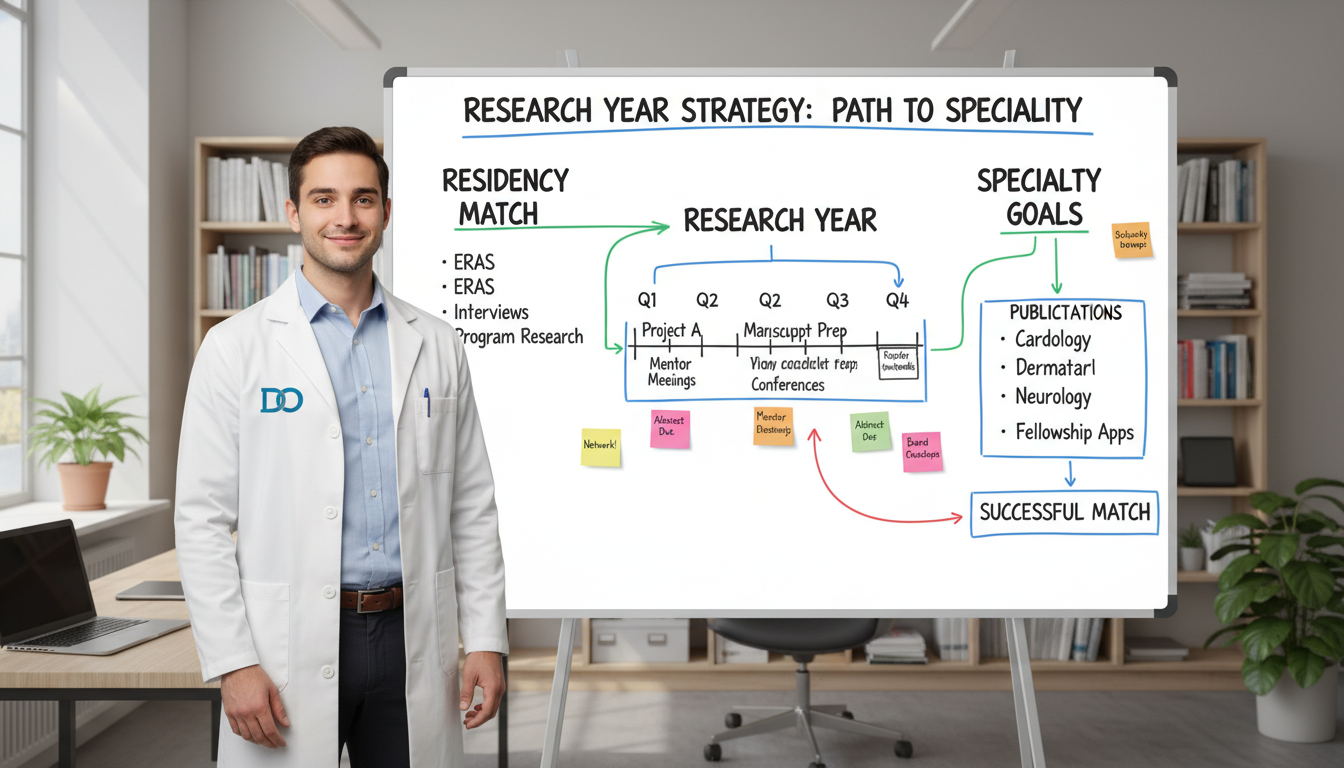
2. Choosing the Right Type of Research Year (Especially as a DO)
Not all research years are created equal. The structure, mentorship, and visibility of your position will directly impact how much it helps your osteopathic residency match.
2.1 Common Models of Research Year Positions
1. Formal Research Fellowship (often at large academic centers)
- Typically 1 year, sometimes 2.
- May have a title such as “Research Fellow” or “Postdoctoral Fellow.”
- Usually involves:
- Assigned mentor(s)
- Defined projects
- Expectations for abstracts and publications
- Often competitive; MDs and international grads also apply.
- Strongest for:
- High-profile publications
- Networking at national conferences
- Being seen by program leadership
2. Gap Year Research Assistant/Coordinator Roles
- Title: “Clinical Research Coordinator,” “Research Assistant,” etc.
- Duties:
- Patient recruitment and consent
- Data entry
- IRB paperwork, scheduling follow-ups
- May or may not be heavily publication-oriented; depends on PI and department.
- Strongest for:
- Hands-on understanding of clinical research operations
- Building long-term relationships within a department
3. Unpaid or Volunteer Research Year Positions
- Sometimes created through networking with faculty.
- You work on:
- Chart reviews
- Manuscript writing
- Data analysis
- Highly variable in productivity; success depends on:
- How organized the mentor is
- Whether there are pre-existing datasets and active projects ready for you
4. Virtual or Remote Research Positions
- Common in multi-center or database-driven projects.
- Pros:
- Flexibility; can be done from anywhere
- Can be combined with part-time work or additional clinical experiences
- Cons:
- Less daily face time with faculty who can advocate for you
- Harder to get “known” at a specific institution
For DO graduates, face time at your target institutions can be especially valuable to counteract any institutional or unconscious bias and demonstrate competence directly.
2.2 Academic vs Community Settings
Academic Centers (University Hospitals)
- Better for:
- Publishing in higher-impact journals
- Access to mentors with national reputations
- Visibility to academic residency program leadership
- Competitive, especially in big cities and popular specialties.
Community or Hybrid Programs
- May have:
- Emerging research infrastructure
- Fewer applicants for research positions
- Can be a strategic choice if:
- You plan to apply to that institution’s residency
- They’re building their scholarly profile and will value your work highly
2.3 Matching the Research to Your Target Specialty
Your research year should align as closely as possible with your specialty interest:
- Dermatology applicant: Aim for derm projects (e.g., psoriasis outcomes, dermatoepidemiology, procedural outcomes) rather than generic internal medicine topics.
- Radiology applicant: Work on imaging-based projects, AI in imaging, or radiology outcomes.
- Orthopedics: Sports medicine outcomes, fracture management, joint replacement registries.
- IM → Cardiology fellowship path: Cardiology outcomes, imaging, procedural registries.
This is especially important in competitive specialties where PDs will compare you to MD applicants with directly aligned research portfolios.
3. Finding and Securing a Research Year Position as a DO Graduate
DO graduates sometimes worry that their degree may limit access to top research positions. In practice, many PIs care more about your work ethic, reliability, and productivity than whether you are MD or DO. But you must be strategic and proactive.
3.1 Start Early: Ideal Timeline
18–24 months before your intended residency start
- Begin exploring whether a research year makes sense.
- Talk to mentors about specialty competitiveness and your current CV.
12–15 months before
- Aggressively search for positions:
- Email faculty
- Network at conferences
- Use school alumni networks and DO-specific organizations.
- Aggressively search for positions:
9–12 months before
- Ideally, secure a position.
- Clarify your start date (often June–July after graduation or end of MS4).
During the research year
- Apply to residency in the upcoming ERAS cycle while actively working on research.
3.2 Where to Look for Research Year Positions
1. Your Own Institution (If Available)
- Advantages:
- Familiar environment
- Easier access to mentors and IRB systems
- Ask:
- Traditionally research-active departments (IM, Surgery, Radiology, Derm).
- Division chiefs or fellowship directors in your field of interest.
2. Large Academic Centers in Your Target Region
- Prioritize:
- Programs where you would be thrilled to match.
- Institutions with a history of taking DO graduates for residency or fellowship.
- Strategies:
- Search department websites for “research fellows” or “clinical research positions.”
- Email specific faculty whose work you’re genuinely interested in.
3. National and Specialty-Specific Organizations
- Examples:
- AOAO, ACOI, ACOFP, AAD, RSNA, etc.
- Many list:
- Research opportunities
- Fellowships
- Mentorship programs
- As a DO, explicitly look for:
- Organizations with DO leaders on their boards or committees.
4. Online Job Boards and Platforms
- Hospital career pages
- Academic job boards (e.g., university HR sites)
- ResearchGate/LinkedIn (networking, not job postings per se)
3.3 Crafting Effective Outreach Emails
A cold email can open doors, but only if it’s specific, respectful, and clearly shows your value.
Key elements to include:
- Who you are: “I am a recent DO graduate from [School], planning to apply to [Specialty] in the upcoming cycle.”
- Clear purpose: “I’m seeking a 1-year full-time research position in [field] starting [month, year].”
- Why them: “I’ve read your work on [specific paper/project] and am particularly interested in [aspect].”
- What you offer:
- Prior experience (research, QI, leadership).
- Comfort with data analysis, literature review, etc.
- Willingness to work hard and learn quickly.
- Attachment:
- CV (polished, updated)
- 1-page research interest statement (optional but helpful in academic settings)
Example opening:
Dear Dr. Smith,
I am a graduating DO student from [School] planning to apply for the 2026 anesthesiology match. Given my strong interest in perioperative outcomes research and [Institution]’s outstanding work in this area, I am seeking a 1-year full-time research position in your department beginning July 2025…
This approach signals seriousness and specificity, rather than “any research anywhere.”
3.4 Addressing the DO Degree Proactively
In most outreach, you do not need to apologize for being a DO. Instead:
- Highlight your osteopathic training strengths:
- Holistic patient care
- Strong clinical skills
- Experience in hands-on medicine
- If relevant, mention:
- Any dual training (e.g., you also took USMLE).
- Strong clinical evaluations from MD attendings.
If you sense hesitation from an institution unfamiliar with DOs, calmly explain that DO graduates:
- Have full physician licensure in all 50 states.
- Are fully eligible for ACGME residencies.
- Are increasingly represented in academic medicine and research.

4. Maximizing the Value of Your Research Year
Once you start your research year, your job is not simply to be present—it’s to be productive and visible in ways that clearly strengthen your residency application.
4.1 Set Clear Deliverables Early
Within the first 2–4 weeks, meet with your PI/mentor and define:
- Expected outputs, such as:
- Number of abstracts to submit (e.g., 2–4).
- Number of manuscripts (e.g., 1–2 first-author, 1–3 co-author).
- Conference presentations (local, regional, national).
- Timeline for:
- Data collection
- Abstract submissions (aligned with specialty conferences)
- Manuscript drafts
Put this in writing (email summary) so expectations are aligned.
4.2 Ask for Projects at Different Stages
To ensure visible productivity in time for ERAS, you need:
- Short-term wins:
- Papers already in progress (near submission).
- Projects where data are already collected.
- Case reports or brief communications.
- Medium-term projects:
- Retrospective chart reviews.
- Database analyses with manageable scope.
- Longer-term/ambitious projects:
- Prospective studies.
- Multi-center collaborations.
Balance your portfolio so you have abstracts and manuscripts accepted or submitted by the time you apply.
4.3 Document Everything for ERAS
ERAS will have multiple lines for:
- Publications (published, accepted, submitted).
- Abstracts and posters.
- Oral presentations.
- Research experiences.
Maintain a running document (and updated CV) with:
- Complete author lists (exact sequence).
- Full titles.
- Journal or conference names.
- Status (submitted, under review, accepted, in press, published).
- PubMed IDs once available.
This will save time and reduce errors later.
4.4 Build Relationships, Not Just a Publication List
For the osteopathic residency match and beyond, strong letters of recommendation can matter as much as your publication count.
During your research year:
- Attend:
- Department meetings
- Grand rounds
- Journal clubs
- Ask for feedback:
- On your writing
- On your data presentations
- Volunteer to:
- Present at lab meetings
- Help residents with ongoing projects
- Co-author review articles or book chapters
Your goal is to ensure at least 1–2 strong, personalized letters from academic faculty who can speak to:
- Your work ethic and reliability.
- Your intellectual curiosity.
- Your fit for the specialty.
- Your ability to thrive in an academic environment despite or beyond any initial biases against DO graduates.
4.5 Integrate Clinical Exposure When Possible
Many PIs will allow some clinical exposure, which can be invaluable:
- Shadow in relevant clinics or ORs.
- Ask to attend resident didactics when appropriate.
- Identify opportunities for:
- Observerships
- Informal clinical rotations
- Participation in quality improvement projects
This has a dual benefit:
- Strengthens your clinical narrative (you’re not “just doing research”).
- Increases your visibility to the residency program and attendings who write letters.
5. Financial, Logistical, and Personal Considerations
Taking a research year has practical implications beyond CV building. DO graduates often carry substantial debt, and many are older or have family responsibilities.
5.1 Compensation and Cost of Living
Research year positions for DO graduates often come with:
- Range: $30,000–$60,000/year (highly variable by institution and role).
- Benefits may be:
- Limited or partial (health insurance, but no retirement).
- Sometimes none for volunteer roles.
Plan ahead:
- Create a realistic budget for:
- Rent
- Loans (may need to adjust or enter income-driven repayment)
- Health insurance
- Travel for interviews
- Consider:
- Cheaper housing options
- Roommates
- Geographic flexibility to lower cost-of-living areas
5.2 Loan and Visa Considerations
If you’re a DO graduate with loans:
- Contact your loan servicer:
- Explore deferment, forbearance, or income-driven repayment.
- Factor in:
- Interest accumulation during your research year.
If you are an international DO graduate:
- Research roles may require specific visa categories (e.g., J-1 research scholar vs. cap-exempt H-1B).
- Talk early with:
- Potential HR departments
- Your current international office
- Clarify:
- Whether the research year impacts your future J-1/H-1B options as a resident.
5.3 Well-Being and Identity During a Gap Year
Taking research year can feel emotionally challenging:
- Peers progress into residency while you’re in a quasi-student, quasi-staff role.
- You may worry about “falling behind.”
To maintain perspective:
- Frame the year as deliberate career investment, not a setback.
- Set:
- Personal growth goals (presenting at a national conference, leading a project).
- Self-care plans (exercise, sleep, social support).
- Stay connected with:
- Mentors who know your long-term vision.
- DO peers who also took research year or non-traditional paths.
6. Using Your Research Year to Strengthen Your Residency Narrative
Your research year only truly pays off if you can effectively communicate its value in the osteopathic residency match and broader residency application process.
6.1 Framing Your Research Year in Your Personal Statement
When writing your personal statement:
- Explain why you chose to take a research year:
- Insight into the specialty.
- Desire to contribute to knowledge and patient outcomes.
- Need to strengthen your application for an academic/competitive path.
- Emphasize:
- What you learned about the specialty.
- How research deepened your understanding of:
- Patient care
- Systems-based practice
- Evidence-based medicine
- Address any concerns preemptively:
- If you had prior struggles (e.g., low Step score), briefly acknowledge them, then pivot to how your research year shows resilience and growth.
6.2 Highlighting Research on ERAS and in Interviews
On ERAS:
- Organize experiences by:
- Relevance to specialty
- Complexity or leadership role
- Use concise but powerful descriptions:
- “Led data analysis and manuscript drafting for multi-site study on X; submitted to [Journal].”
- “Coordinated prospective cohort of 150 patients evaluating Y outcomes.”
In interviews:
- Prepare 2–3 “anchor stories”:
- A time you overcame a challenge in a research project.
- A project that changed how you think about patient care.
- An example of collaborating with residents/fellows/faculty.
These stories should also demonstrate:
- Maturity
- Communication skills
- Teamwork
- Reliability—all critical for residency success.
6.3 How Programs Interpret a Research Year for DO Graduates
Programs may interpret your research year as:
- A sign of:
- Commitment to the specialty.
- Comfort in academic environments.
- Willingness to go “above and beyond.”
- An opportunity to:
- See you as “one of their own” if you’re at their institution.
- Compare you favorably to MD candidates with similar research backgrounds.
However, programs could also raise questions if:
- Your year appears almost entirely unproductive (no abstracts, no manuscripts).
- You can’t clearly explain what you did.
- The research doesn’t align at all with your chosen specialty.
To avoid this, focus on clear outputs, strong mentorship relationships, and a coherent story linking your research to your specialty interest.
Frequently Asked Questions (FAQ)
1. As a DO graduate, do I need a research year to match into a good residency?
Not necessarily. Many DO graduates successfully match into strong programs, especially in less competitive specialties, without a formal research year. A research year becomes more important if:
- You’re targeting very competitive specialties or top academic centers.
- Your current CV is weak on research or academic productivity.
- You have a red flag (e.g., low board scores) and need to demonstrate resilience and growth.
2. Will a research year guarantee I match into a competitive specialty?
No research year—no matter how strong—can guarantee a match. It is one component of a holistic application that includes:
- Board scores (USMLE and/or COMLEX).
- Third- and fourth-year clinical performance.
- Letters of recommendation.
- Interview performance.
- Fit with the program’s culture and needs.
What a strong research year can do is significantly improve your competitiveness, especially as a DO graduate in specialties and institutions that value scholarship.
3. Can I do a research year after starting a DO graduate residency?
Yes, some residents take a dedicated research year during residency, especially in academic programs that support research tracks. This can be helpful if:
- You’re planning a competitive fellowship.
- Your long-term goal is academic medicine.
However, this is different from a pre-residency gap year research strategy. If your immediate concern is matching into a desired specialty or program, a research year before residency may be more impactful.
4. How many publications or abstracts should I aim for during a research year?
There is no single “magic number,” but for a full-time research year, a reasonable target might be:
- 1–2 first-author manuscripts submitted.
- 2–4 co-author manuscripts or abstracts.
- 2–4 conference presentations (posters or oral).
Quality and relevance to your specialty matter more than raw quantity. A few well-executed, clearly relevant projects can outweigh many low-impact, scattershot efforts.
A research year, when planned strategically, can be a turning point in a DO graduate’s journey through the osteopathic residency match and beyond. By clarifying your goals, choosing the right position, maximizing productivity, and telling a coherent story in your application, you can transform a gap year research experience into a powerful asset for your future career in medicine.