



Understanding the Ultra-Competitive Landscape as a DO Graduate
Ultra-competitive specialties—such as dermatology, orthopedic surgery, plastic surgery, otolaryngology (ENT), neurosurgery, and some interventional fellowships—are challenging for any applicant. As a DO graduate, you face an additional layer of complexity: program bias, uneven exposure to DO students at some institutions, and variable weighting of COMLEX versus USMLE.
Yet every year, DO graduates do match into these specialties. Matching derm, matching ortho, and other highly competitive fields is absolutely possible—but it requires planning, strategy, and relentless execution.
This article breaks down a practical, stepwise strategy tailored specifically to DO graduates pursuing ultra-competitive specialties. We’ll focus on:
- Evaluating your competitiveness honestly
- Building a deliberate testing and exam strategy
- Designing rotations and audition electives for maximum impact
- Crafting a research and networking plan as a DO
- Optimizing your actual residency application for the osteopathic residency match and beyond
- Making smart backup and parallel plan decisions
Throughout, you’ll see examples and specific action steps you can start applying now.
Step 1: Reality Check – Are You Competitive Right Now?
Before you design a strategy, you need a brutally honest assessment of where you stand.
Key Competitiveness Domains
For ultra-competitive specialties, program directors typically look at:
Board Exams
- COMLEX Level 1 and Level 2-CE
- USMLE Step 1 and Step 2 CK (if taken)
- Scores relative to national means and specialty-specific averages
Clinical Performance
- Core rotation grades, especially surgery, medicine, and any early subspecialty exposure
- Narrative comments in evaluations
- Early sub-internship performance (for those who have done them)
Research & Scholarly Work
- Peer-reviewed publications
- Abstracts, posters, oral presentations
- Specialty-specific research experience
Letters of Recommendation
- At least one to three strong letters from faculty in your target specialty
- Reputation of the letter writers within that field
Professional Identity & Fit
- Evidence of sustained interest in the specialty (organizations, projects)
- Leadership, advocacy, teaching
- Clinical judgment and maturity demonstrated on rotations
Program Fit & Geography
- Regional ties
- Rotations or sub-Is at target programs
- Alignment with program’s culture (academic vs community, research vs clinically heavy)
DO-Specific Considerations
As a DO graduate, you must factor in:
- USMLE vs COMLEX: Many historically ACGME programs still prefer or strongly value USMLE scores. Some will not consider applicants without them.
- Program DO-Friendliness: Some competitive programs routinely take DOs; others never have. This matters more for ultra-competitive fields.
- AOA vs ACGME Legacy: While accreditation is unified, certain programs are culturally more familiar with osteopathic training and may be more receptive.
Actionable Self-Assessment
Create a simple scorecard spreadsheet with columns for:
- Your metrics (board scores, grades, research, letters, leadership)
- Average or target benchmarks for your specialty
- Gap analysis (on target / slightly below / significantly below)
Then:
- Compare your board scores to:
- NRMP Charting Outcomes (for DO and MD), if available for your graduation year.
- Specialty-specific “average matched” scores.
- Ask for external feedback from:
- A trusted faculty mentor in your specialty of interest.
- Your school’s career advising or GME office.
- Label your current competitiveness:
- Strong: At or above average scores, early research, strong clinical feedback.
- Borderline: Slightly below average scores but compensating strengths.
- High Risk: Significantly below typical metrics; would need exceptional other factors and/or a parallel plan.
Your strategy will be different depending on which category you fall into.
Step 2: Strategic Testing Decisions – COMLEX, USMLE, and Score Use
Board scores remain a major gatekeeper for ultra-competitive specialties. As a DO graduate, you need to be deliberate about exams.
Should a DO Take the USMLE for Ultra-Competitive Specialties?
In almost all ultra-competitive fields, taking USMLE Step 1 and Step 2 CK is still highly advantageous for DO students.
Programs in ultra-competitive specialties often:
- Use USMLE Step scores for initial screening.
- Have less experience interpreting COMLEX scores.
- Have institutional filters based purely on USMLE.
If you haven’t yet taken USMLE and are early in school:
- Plan to take both Step 1 and Step 2 CK if you are even considering a competitive specialty.
- Prepare for COMLEX and USMLE together with an integrated study plan.
- Aim for well above average scores (not just passing).
If you have already graduated:
- If you have not taken USMLE, your options are more limited. Focus on:
- Strong Level 2-CE score; consider retaking if a catastrophic performance is truly not representative.
- Maximizing other areas (research, rotations, letters, networking).
- Targeting DO-friendly and COMLEX-accepting programs.
Interpreting and Using Your Scores
For ultra-competitive specialties, the typical pattern is:
- Strong scores (e.g., Step 2 CK > 245, Level 2-CE > 640): You can apply broadly, including academic and major urban centers.
- Middle-range scores: Emphasize programs with prior DO residents, smaller cities, and strong rotation connections.
- Lower scores: Either develop an exceptional application otherwise (heavy research + glowing letters + home/institutional support) or consider a revised/parallel specialty plan.
Action Steps
- If USMLE-eligible and early enough: Commit to taking Step 2 CK with adequate dedicated time, even post-graduation if your situation allows.
- Build a study schedule leveraging:
- Question banks (UWorld, Amboss).
- NBME practice exams (for USMLE) and COMSAEs (for COMLEX).
- Use practice exams to decide whether to:
- Delay testing for improved performance.
- Consider an alternative specialty if your best achievable scores won’t clear realistic thresholds.

Step 3: Clinical Strategy – Rotations, Auditions, and Letters
For ultra-competitive specialties, programs often value firsthand observation over paper metrics—especially for DO graduates who may be less familiar to them.
Designing Your Rotation Year
Create a rotation plan that includes:
Core Rotations Excellence
- Aim for Honors/High Pass in core surgery, medicine, and any elective time in your target field.
- Request mid-rotation feedback and act on it aggressively.
Early Exposure in Your Specialty
- Do a 2–4 week elective in your field of interest as early as possible (MS3 or early MS4 if not done).
- Use this to:
- Confirm fit.
- Understand lifestyle and expectations.
- Identify potential mentors.
Sub-Internships (“Sub-Is”) / Acting Internships
- For matching derm, matching ortho, ENT, neurosurgery, etc., sub-Is are critical.
- Prioritize:
- Your home institution (if available).
- Programs with a history of taking DOs.
- Geographic regions where you have ties.
Audition Rotations: How Many and Where?
In ultra-competitive specialties:
- Many applicants complete 2–4 audition rotations.
- As a DO graduate, consider 3–5 if feasible, focusing on:
- Programs known to be DO-friendly (look at current residents).
- A mix of academic and community programs.
- At least one “safety” tier program where your metrics are strong.
Choosing Programs for Auditions
Use this checklist:
- Do they accept DOs regularly? (Check residency website and resident lists.)
- Do they accept COMLEX alone, or strongly prefer USMLE?
- Does the program’s culture match your strengths (academic vs clinically heavy, research vs hands-on)?
- Is there a realistic chance of a strong letter from a faculty member if you perform well?
Performing on Rotations: What Programs Want to See
To stand out as a DO on audition rotations:
- Show up early, leave late. Consistent reliability makes a big impression.
- Do your homework. Read about patient cases nightly; know your patients cold.
- Be coachable. Show visible improvement based on feedback.
- Participate in the OR or clinic proactively but respectfully.
- Ask: “Is there anything I can read or prepare for tomorrow’s cases?”
- Offer to help with small but meaningful tasks (notes, orders under supervision, patient education).
- Never complain, especially about hours or scut.
- Demonstrate genuine enthusiasm for that program specifically (know their cases, strengths, faculty interests).
Letters of Recommendation (LORs)
Ultra-competitive specialties usually expect:
- 2–3 letters from faculty in your desired specialty.
- At least one from a faculty member who:
- Knows you well.
- Has an academic title or national reputation.
- Additional general letter from medicine or surgery can supplement.
How to Secure Great Letters as a DO:
- Identify letter writers early during your rotations.
- Ask directly:
“Do you feel you know my work well enough to write a strong letter of recommendation for [specialty]?” - Provide:
- Your CV.
- Personal statement draft.
- Brief bullet list of specific cases or contributions you made.
- Ask if they’d be comfortable advocating for you via personal emails or calls to programs where they have connections.
Step 4: Research, Networking, and Building Specialty-Specific Capital
In ultra-competitive specialties, research and networking can compensate for marginal scores and help you differentiate yourself as a DO graduate.
Research Strategy for DO Graduates
If your school has limited research infrastructure in your target field:
Identify potential mentors:
- Alumni in your target specialty.
- Local academic centers (even if not directly affiliated with your DO school).
- Professional organizations (e.g., AAD for derm, AAOS for ortho).
Start small, then scale:
- Case reports and case series from rotations.
- Retrospective chart reviews.
- Quality improvement projects related to your specialty.
- Systematic or narrative reviews.
Prioritize visible, completed projects:
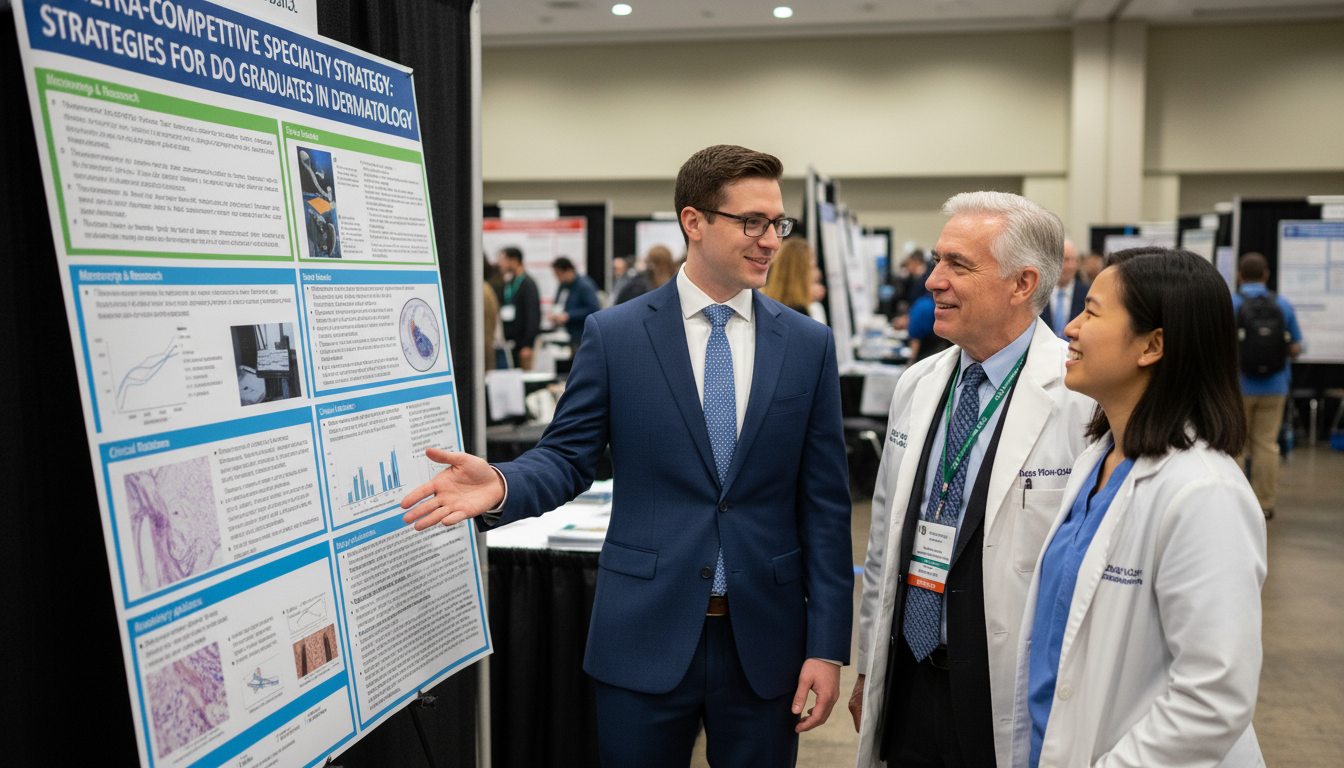
- Posters and oral presentations at regional or national conferences.
- Manuscripts submitted and, ideally, accepted for publication.
Make your DO identity an asset:
- Consider research questions intersecting osteopathic principles and your specialty (e.g., musculoskeletal/biomechanics topics for ortho).
Networking and Mentorship
Networking is crucial in fields where many positions are filled based on “known quantity” and personal recommendations.
Practical networking approaches:
- Join specialty organizations as a student member:
- Attend conferences and introduce yourself to faculty.
- Ask thoughtful, specific questions about training and careers.
- Present posters at conferences, then:
- Ask senior residents and faculty about their programs and DO experiences.
- Seek formal mentorship:
- Through specialty societies’ formal match/mentorship programs.
- Through your school’s alumni network.
- Ask your mentors:
- “Which programs you think might be most receptive to a strong DO applicant?”
- “Are there faculty you could introduce me to at X, Y, or Z program?”
Considering a Dedicated Research Year
For some DO graduates targeting ultra-competitive specialties, a research year can be transformative, especially if:
- You have solid clinical performance but borderline test scores.
- You lack specialty-specific publications.
- You can join a well-connected lab or research group in your desired specialty.
Key components of a successful research year:
- Clear expectations for:
- Publications submitted.
- Presentations.
- Letters of recommendation from research mentors.
- Daily presence in the lab/clinic (treat it like a full-time job).
- Regular check-ins with your PI about your match prospects and which programs to target.
Step 5: Application Strategy – Building a DO-Optimized ERAS and Rank List
Once you’ve built the strongest possible profile, execution during the application and interview season becomes critical.
Crafting a Convincing Narrative
Program directors in ultra-competitive fields want clarity:
- Why this specialty?
- Why you?
- Why now?
For a DO graduate, you also want to transparently and confidently own your osteopathic background.
Personal Statement Tips:
- Highlight a coherent, multi-year interest in your specialty (not a last-minute pivot).
- Show you understand the daily realities of the field (not just prestige aspects).
- Integrate your osteopathic training:
- How your DO education shaped your approach to patients.
- Any unique strengths in musculoskeletal medicine, holistic care, or communication.
- Avoid:
- Overemphasis on OMM in fields where it’s minimally used, unless you can connect it concretely (e.g., pain, function).
Program List Construction: How Many and Which Ones?
Ultra-competitive specialties require broad application strategies for DOs.
As approximate ranges (this varies by year and specialty):
- Dermatology: 60–80+ programs
- Orthopedic surgery: 60–80+ programs
- ENT, neurosurgery, plastics: 45–70+ programs
Prioritization factors for a DO graduate:
- Programs with current or recent DO residents.
- Programs that state COMLEX acceptance explicitly.
- Locations where you have regional or personal ties.
- Places where you have:
- Completed rotations.
- Strong faculty advocates.
Signaling and Supplemental Applications
If your specialty uses signaling or supplemental applications:
- Use your highest-priority signals on:
- Programs where you rotated.
- Institutions recommended by your mentors as realistic-but-competitive targets.
- Avoid wasting signals on “reach for everyone” programs unless:
- You have a unique connection.
- You are truly competitive (scores, research, letters, niche fit).
Interview Season as a DO Applicant
When you get interviews, your goal is to transform “we’re unsure what to make of a DO applicant” into “we’d be lucky to have this resident.”
On interview day:
- Be prepared to explain:
- Why you chose a DO school.
- How your osteopathic training will benefit you in this specialty.
- Be specific:
- Mention cases, rotations, and mentors by name.
- Show that you’ve researched each program thoroughly.
- Ask thoughtful questions:
- About resident life.
- About the program’s experience training DOs.
- About mentorship and fellowship placement.
Post-interview:
- Send concise, genuine thank-you notes.
- Keep mentors updated on your interviews; they may advocate for you behind the scenes.
Crafting a Rank List with Risk Management
Your rank list should reflect both your dreams and your reality.
- Rank all programs where you would be willing to train—never rank a program you genuinely would not attend.
- Consider:
- DO-friendly programs higher if the training is solid.
- Geographic preference after accounting for training quality and match probability.
- Discuss your list with:
- A specialty mentor.
- A knowledgeable dean or advisor familiar with DO graduate residency patterns in that field.
Step 6: Backup Plans, Parallel Strategies, and Long Game Thinking
Even with perfect strategy, the osteopathic residency match into ultra-competitive specialties has inherent risk. Your plan should include contingencies.
Building a Parallel Plan
Common parallel strategies include:
- Applying in your competitive specialty and a less-competitive but related field (e.g., internal medicine, prelim surgery).
- Planning for a transition:
- Match into a categorical program (e.g., medicine or surgery).
- Build your portfolio.
- Reapply or seek competitive fellowships later (e.g., dermatopathology, sports medicine, pain).
Considerations for dual-application:
- You must craft two coherent narratives, one for each specialty.
- Be honest about:
- Whether you’d truly be happy in the backup specialty long term.
- The logistics (interviews, rank lists, separate personal statements).
One-Year Gap or Research/Prelim Year
If you don’t match:
- Seek a SOAP position if appropriate.
- Strongly consider:
- A dedicated research year in your specialty at a well-known institution.
- A preliminary year in surgery or medicine plus research in your target field (if supported by a mentor).
During that time, you should:
- Double down on:
- Publications.
- Faculty connections.
- Substantial clinical contributions in the specialty.
- Address weaknesses:
- Improve exam scores where possible.
- Refine clinical skills.
- Strengthen letters.
Recognizing When to Pivot
There is also wisdom in recognizing when the numbers and repeated attempts suggest that a permanent pivot may be the healthiest choice.
Consider a more realistic specialty if:
- Your board scores are far below typical for your field and cannot practically be improved.
- You have already completed a research year or reapplicant cycle without meaningful progress.
- Mentors in the specialty gently but clearly advise you toward other options.
Finding a different field does not mean you failed; it means you are adapting your talents to a space where you can thrive without chronic uphill struggle.
Putting It All Together: A Sample Timeline for a DO Targeting an Ultra-Competitive Specialty
MS1–MS2 (or early training):
- Decide whether ultra-competitive specialties might be of interest.
- Plan an integrated COMLEX/USMLE strategy.
- Join specialty interest groups and organizations.
- Begin early research if possible.
MS3:
- Excel in core rotations, especially surgery/medicine.
- Do an early elective in your target specialty.
- Start compiling research, case reports, or QI projects.
- Identify at least one faculty mentor.
MS4 / Early Post-Graduation:
- Schedule 2–4 audition rotations at DO-friendly programs.
- Take Step 2 CK / Level 2-CE as early as realistically possible and aim for strong scores.
- Secure specialty-specific letters of recommendation.
- Apply broadly with a carefully constructed list and coherent narrative.
If unmatched:
- Explore SOAP, research years, or prelim-year options.
- Engage deeply with a high-volume research group.
- Reassess long-term goals and decide: reapply strategically or pivot.
FAQs
1. As a DO graduate, is it realistic to match into dermatology or orthopedic surgery?
Yes, DO graduates match into dermatology and orthopedics every year, but the path is steep. To maximize your chances of matching derm or matching ortho, you typically need:
- Strong board scores (often well above average for DO peers).
- Multiple high-quality letters from dermatologists or orthopedic surgeons.
- Meaningful research and scholarly activity in the field.
- Excellent performance on audition rotations.
- Strategic targeting of DO-friendly and COMLEX-accepting programs.
2. Do I absolutely need to take the USMLE to match an ultra-competitive specialty as a DO?
You can sometimes match without USMLE, particularly into historically osteopathic or DO-friendly programs, but your options will be narrower. For most ultra-competitive specialties, taking USMLE Step 1 and Step 2 CK significantly:
- Increases the number of programs that will consider you.
- Simplifies comparison to MD applicants.
- Helps you clear automated screening filters.
If you’re early enough in training and considering an ultra-competitive field, plan to take USMLE.
3. How many programs should I apply to in an ultra-competitive specialty as a DO applicant?
While numbers vary yearly and by specialty, DO applicants generally need to apply very broadly:
- Dermatology, orthopedics, ENT, plastics, neurosurgery: commonly 50–80+ programs.
- Include a substantial proportion of programs with current DO residents or stated DO-friendliness.
- Add a backup specialty if advised by your mentors based on your metrics.
Ultimately, your exact number should be tailored with help from advisors who know your specific profile.
4. If I don’t match into my competitive specialty, is my career ruined?
Not at all. Many physicians have fulfilling, impactful careers after not matching their initial choice. Common successful paths include:
- Completing a research year and reapplying with a stronger application.
- Training in a related field (e.g., internal medicine, general surgery) and pursuing a competitive fellowship afterward.
- Discovering a different specialty that better aligns with your interests and lifestyle.
What matters is intentional planning, honest self-reflection, and maximizing opportunities wherever you train. As a DO graduate, your adaptability, patient-centered training, and resilience are major assets—no matter which specialty you ultimately pursue.




















