
Why Step 2 CK Matters for a DO Graduate Targeting Urology
For a DO graduate aiming for urology residency, USMLE Step 2 CK preparation is not just another exam task—it’s a strategic tool for your urology match. As more programs adapt to the single accreditation system and COMLEX–US and USMLE coexist, your Step 2 CK score can:
- Validate your competitiveness across MD and DO applicant pools
- Offset a weaker Step 1 or COMLEX Level 1/2 score
- Demonstrate readiness for a demanding surgical subspecialty
- Distinguish you in a crowded urology residency and osteopathic residency match
Urology residency is among the most competitive specialties. Program directors know they’re selecting future surgical colleagues who must manage critically ill patients, interpret imaging, and collaborate across specialties. Step 2 CK performance is therefore seen as a proxy for:
- Clinical reasoning under time pressure
- Knowledge breadth in surgery, internal medicine, pediatrics, OB/GYN, and emergency medicine
- Your ability to handle in‑service exams, boards, and complex on‑call decision-making
As a DO graduate, you also have to navigate:
- Whether you need both COMLEX and USMLE for a given program list
- Any bias—implicit or explicit—toward USMLE scores in some academic centers
- Timing Step 2 CK around audition rotations, urology sub-internships, and application deadlines
This guide will give you a structured, realistic approach to USMLE Step 2 CK preparation with a urology lens, tailored to DO graduates who are serious about matching into urology.
Understanding Step 2 CK in the Context of Urology and DO Training
The Role of Step 2 CK in Urology Match Decisions
Step 2 CK is often more influential than Step 1 now that Step 1 is pass/fail. For urology programs, directors may use your Step 2 CK score to:
- Screen applicants with a numeric cutoff (often in the mid‑220s to 230s, sometimes higher for top programs)
- Compare you with MD applicants on a single metric
- Evaluate your trajectory (an upward trend from Step 1/Level 1 to Step 2/Level 2 is a strong positive signal)
For a DO graduate applying to urology:
- A strong Step 2 CK score can open doors to academic and university‑based programs that historically interviewed few DOs.
- A solid, if not stellar, score is still very acceptable if paired with strong letters (especially from urologists), research, and outstanding away rotations.
- Below-average scores don’t automatically exclude you, but they require strategic school selection, compelling application strengths elsewhere, and often broader geographic flexibility.
USMLE vs COMLEX: Strategic Considerations for DO Graduates
As a DO, you must decide early whether to take USMLE Step 2 CK in addition to COMLEX Level 2:
Reasons to take Step 2 CK for urology:
- Many urology residency programs explicitly require or strongly prefer USMLE scores.
- Some programs are not familiar with interpreting COMLEX alone.
- A strong Step 2 CK score normalizes your performance to MD peers.
Scenarios where Step 2 CK is particularly important:
- Your COMLEX Level 1 or Step 1 was borderline or below target.
- You are targeting highly competitive academic or big‑name institutions.
- You had limited research or urology exposure early and need every objective strength.
If you’re still unsure, review program websites and FREIDA for your target urology programs and see how often they mention USMLE cutoff scores. When in doubt, taking Step 2 CK is usually advantageous if you can prepare adequately.
Building a Strategic Study Plan: Timeline and Structure
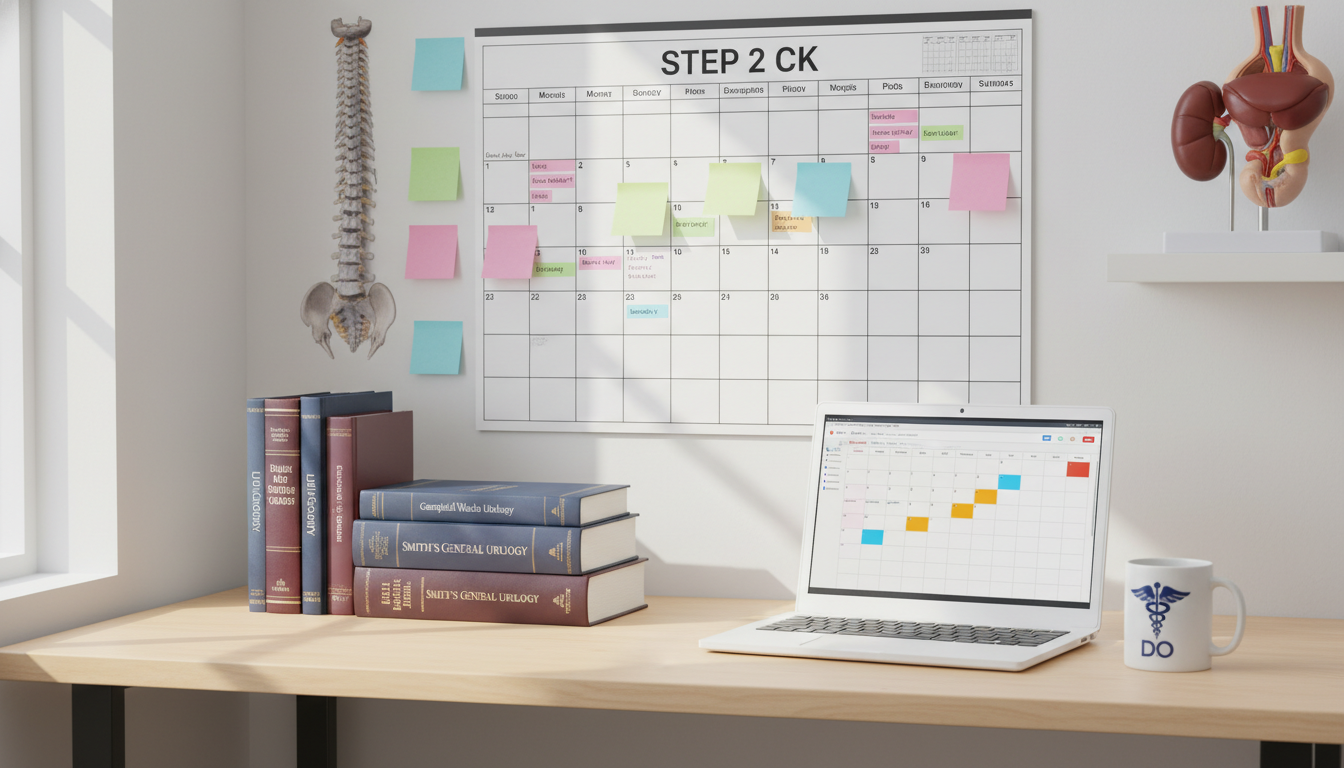
Step 2 CK preparation for a DO graduate in urology should be intentional, time‑bound, and realistic. You’ll often be studying while doing core or sub‑internship rotations, so efficiency is critical.
Ideal Timeline for DO Urology Applicants
For most students, Step 2 CK is taken between the end of third year and early fourth year. For urology, timing matters:
- Goal: Have an official Step 2 CK score available before ERAS and the AUA Urology Match application deadlines (typically September–October), and ideally before urology programs start reviewing applications.
- Target test date: Late June to mid‑August of the year you apply.
Common timelines for DO urology applicants:
Dedicated Period (4–6 weeks) After Core Rotations
- You finish your core clerkships (IM, surgery, OB/GYN, pediatrics, psychiatry, family medicine).
- You schedule 4–6 weeks of lighter electives or formal “Step 2 study” time.
- You sit for Step 2 CK in late June or July, right before away rotations.
Integrated During Rotations + Short Dedicated (2–3 weeks)
- You study consistently during third‑year rotations using a question bank (qbank) and review resources.
- You reserve 2–3 weeks for high‑intensity review and practice exams.
- You aim for an exam date in July or August.
If your schedule is already set, reverse‑engineer your study plan from your exam date and application deadlines.
Weekly and Daily Structure
For effective USMLE Step 2 study, your plan should include:
- Question-based learning (anchor of your day)
- Targeted content review (weak areas and high‑yield topics)
- Timed simulation (exam-like blocks)
- Periodic self-assessment (NBME, UWorld self-assessments)
A typical full‑time dedicated study day (8–10 hours) might look like:
- 4–6 hours: Timed qbank blocks (2–4 blocks of 40 questions) + full explanations
- 2–3 hours: Review of high‑yield content (video, notes, or textbook) based on missed questions
- 1–2 hours: Focused weak-area review (e.g., OB hemorrhage, renal failure, pediatric infections)
If you are on rotation full time (limited hours):
- 1 block (40 questions) per day on weekdays, timed + review
- 2–3 blocks per day on weekends
- 1–2 hours/night for rapid review (flashcards, notes, or Anki)
Consistency over time often outperforms cramming for this exam.
High-Yield Resources and How to Use Them as a DO Urology Applicant
The key is not to use every resource, but to master a few and use them correctly.
Core Question Banks
1. UWorld Step 2 CK Qbank (Primary Resource)
- Considered the gold standard for Step 2.
- Complete at least one full pass; many applicants aiming for a high Step 2 CK score do ~70–100% of the bank.
- Use timed, random blocks during the later phase to simulate the exam.
- During the early phase, you may choose timed, subject-specific blocks aligned with your current rotation.
For DO graduates, this approach also reinforces COMLEX Level 2 concepts.
2. NBME Practice Exams (Self-Assessments)
- Use them to predict your performance and identify gaps.
- Take your first NBME 4–6 weeks before the exam to set a baseline.
- Repeat NBMEs every 1–2 weeks during dedicated study to monitor progress.
Content Review Resources
Your USMLE Step 2 study doesn’t require massive textbooks. Instead, focus on concise, exam‑oriented materials:
- Online MedEd or similar video series – Good for building or refreshing core frameworks in internal medicine, surgery, pediatrics, OB/GYN, and psychiatry.
- Master the Boards Step 2 CK, Step-Up to Medicine, or similar – Use selectively, mainly to clarify weak areas identified from question review.
- UWorld Notes – Many students create or annotate a single master document from missed questions, tables, and “buzzwords.” Reviewing this document in the last week is powerful.
DO-Specific Considerations
As a DO, you may also be studying for COMLEX Level 2:
- There is heavy overlap in content with Step 2 CK, so a single integrated study plan is efficient.
- Use a COMLEX-specific qbank (e.g., COMLEX Qbank) for OMM and distinctive COMLEX-style items, but keep UWorld as your main clinical foundation.
- Be sure to review OMM if you are taking COMLEX near the same window, but do not overemphasize it at the expense of Step 2 CK core material.
High-Yield Clinical Domains for Urology Applicants

While Step 2 CK does not test procedural urology skills, urology residency directors expect strong performance in several clinical domains that touch urologic care: internal medicine (especially nephrology and infectious disease), surgery, emergency medicine, and pediatrics.
Internal Medicine and Nephrology
Urology often co‑manages patients with internists and nephrologists. Master these topics:
- Acute kidney injury (AKI): Pre‑renal vs intrinsic vs post‑renal; interpreting FeNa, urine osmolality, imaging.
- Chronic kidney disease (CKD): Staging, complications (anemia, bone disease, electrolyte abnormalities), indications for dialysis.
- Electrolyte disorders: Hyperkalemia management, hyponatremia workup, acid–base disturbances.
- Urinary tract infections (UTIs): From simple cystitis to urosepsis; appropriate antibiotics; when to image; complicated vs uncomplicated UTIs.
- Hematuria: Differentiating glomerular vs nonglomerular sources, initial work-up, risk factors for urothelial malignancy.
These are directly relevant to daily urology practice and frequently appear on Step 2 CK.
Surgery, Trauma, and Perioperative Care
Urology is a surgical field, and Step 2 CK tests your approach to:
- Preoperative risk assessment: When to delay surgery, managing anticoagulation, cardiac clearance.
- Postoperative complications: Fever, bleeding, infection, DVT/PE, urinary retention.
- Abdominal and pelvic trauma: Blunt vs penetrating trauma, indications for CT vs FAST vs ex-lap, bladder injuries, urethral injuries, renal lacerations.
- Acute scrotum: Torsion vs epididymitis vs other causes—this comes up on exams and in real-life urology.
Knowing standard surgical principles doesn’t just help your Step 2 CK preparation; it also builds the mindset expected in a surgical subspecialty like urology.
Pediatrics and Developmental Urology
Pediatric questions are common on Step 2 CK and have direct urologic relevance:
- Congenital anomalies: Hypospadias, undescended testis, posterior urethral valves, vesicoureteral reflux.
- Enuresis and voiding dysfunction: Workup and management principles.
- Pediatric UTIs: When to do imaging (e.g., VCUG, renal ultrasound), atypical presentations, prophylaxis.
If you can confidently tackle pediatric renal and urologic presentations, you’re building a strong foundation for both the exam and urology residency.
Emergency Medicine and Critical Care
From urosepsis to obstructing stones, urologists encounter acutely ill patients. Step 2 CK will test your ability to:
- Recognize unstable patients quickly: Hypotension, altered mental status, respiratory distress.
- Manage sepsis and septic shock: IV fluids, vasopressors, source control, appropriate antibiotics.
- Address acute urinary obstruction: Anuria, hydronephrosis, emergent decompression.
- Handle common ED presentations: Flank pain, testicular pain, gross hematuria, abdominal trauma.
Leveraging your interest in urology to master these emergency scenarios can also make your studying more engaging.
Practical Study Tactics for a High Step 2 CK Score
Beyond resources and timelines, execution determines your outcome. Here are practical, high-yield tactics for USMLE Step 2 CK preparation.
Master the Question-to-Concept Cycle
A powerful approach is to treat every missed question as a chance to upgrade your understanding:
Do questions in timed mode.
- Forces you to practice pacing and decision-making under pressure.
For each question (right or wrong), ask:
- What was the tested concept (not just the fact)?
- What was the key clue I almost or completely missed?
- How would I rephrase this concept into a one-line rule or takeaway?
Summarize these takeaways in a running document or flashcards (e.g., “Acute prostatitis in older men: avoid prostate massage, treat with fluoroquinolone or TMP-SMX; send urine culture.”)
This method accelerates conceptual learning and pattern recognition, making you stronger in both Step 2 CK and clinical rotations.
Use Urology Interest to Keep Motivation High
Studying broad clinical topics can feel distant from your urology goals, but you can “anchor” material to your chosen field:
- When you study renal and electrolyte issues, picture your future urology patients with nephrostomy tubes or obstructive uropathy.
- When you review infectious disease, connect UTIs, pyelonephritis, and prostatitis to conditions you’ll manage.
- When reviewing oncology, pay special attention to general principles that apply to prostate, bladder, and kidney cancers.
This narrows the gap between abstract exam prep and your daily future practice.
Address Common DO-Specific Challenges
1. Balancing COMLEX and USMLE Content
- Use UWorld as your primary clinical base for both USMLE Step 2 and COMLEX Level 2.
- Add OMM‑specific preparation in a concentrated block (e.g., 30–60 minutes daily, or a few hours on weekends) instead of diluting daily clinical review.
2. Dealing with Impostor Syndrome or Bias Concerns
- Recognize that many DOs successfully match urology every year and often excel in surgical settings.
- Use Step 2 CK as your platform to showcase parity or superiority in standardized test performance.
- Focus on controllable factors: your study plan, your question performance, your practice exams, and your application narrative.
Pacing, Endurance, and Test-Day Strategy
Step 2 CK is a long exam (8 sections, up to 40 questions per block). Build stamina:
Simulate test conditions once a week in the final 2–3 weeks:
- 3–4 blocks back-to-back with short breaks.
- Same start time as your actual exam if possible.
Learn your personal pacing metrics:
- Aim for ~1 minute 15 seconds per question, with time banked for more complex vignettes or multi-step calculations.
- Practice not obsessing over one question; make your best choice and move on.
On test day:
- Use your breaks strategically (e.g., 10–15 minutes mid-exam, shorter breaks between).
- Eat light, familiar foods; stay hydrated but not overhydrated.
- Stick to your habitual routines as much as possible.
Integrating Step 2 CK Performance Into Your Urology Application
Typical Score Ranges and Competitiveness
Score expectations evolve, but as general guidance for a urology residency applicant:
- Highly competitive academic programs:
- Traditionally liked applicants in the mid‑240s and above on Step 2 CK.
- Solid community and many academic programs:
- Often interview applicants in the 230s+, especially with strong other components.
- Below this range:
- Matching is still possible, particularly with a strong osteopathic background, great letters, and excellent auditions, but you’ll need to be especially strategic about program selection and geographic flexibility.
Remember: numbers are only one part of the application. For a DO graduate residency applicant targeting urology:
- Strong letters from urologists (especially if they’re known in the field) often outweigh modest differences in scores.
- Research in urology (case reports, QI projects, clinical research) shows commitment to the field even if not in top journals.
- Outstanding away rotations can convert marginal metrics into interview invitations.
When and How to Schedule the Exam
For urology match strategy:
- Set your exam date so the official score reports arrive before your application is complete.
- Avoid taking Step 2 CK too close to critical audition rotations where you’ll need peak clinical performance.
- Consider scheduling Step 2 CK:
- Directly after a strong run of internal medicine or surgery rotations, when clinical reasoning is sharp.
- With enough buffer time in case you need to reschedule due to illness or unexpected events.
If your practice exams are significantly below your target range, it is usually better to delay within reason (while still respecting application timelines) than to take the exam under-prepared.
FAQs: Step 2 CK Preparation for DO Graduates Entering Urology
1. Do I really need Step 2 CK if I already have COMLEX scores?
For urology, the answer is almost always yes. While some programs accept COMLEX only, many still prefer or require USMLE scores for direct comparison to MD applicants. A solid Step 2 CK score will broaden your program options and reduce the risk of being screened out simply due to missing data.
2. What is a “good” Step 2 CK score for a DO graduate applying to urology?
Context matters, but in general:
- Mid‑240s or higher: Competitive at many academic and university-based programs, assuming the rest of your application is strong.
- 230s: Reasonable for many programs, especially if paired with strong clinical grades, letters, and urology exposure.
- Below 230: You can still match, but you’ll need to be more selective and thoughtful about your program list, and place extra emphasis on research, networking, and stellar away rotations.
Your goal should be to maximize your personal outcome, rather than chase arbitrary cutoffs—focus on consistent improvement during your Step 2 CK preparation.
3. How should I split time between COMLEX Level 2 and Step 2 CK preparation?
Use a clinical-first approach:
- Spend ~80–90% of your study time on core clinical material using UWorld and concise reviews—this will help both exams.
- Dedicate ~10–20% of your time to COMLEX-specific topics, especially OMM and unique question styles, ideally clustered into dedicated sessions (e.g., evenings or weekends).
- If possible, schedule COMLEX Level 2 and Step 2 CK relatively close together (within a few weeks) to capitalize on overlapping content.
4. I’m behind on my Step 2 CK preparation. Should I delay the exam and risk a later score report for the urology match?
It depends on how far your practice scores are from your target band and how close you are to application deadlines:
- If your NBME or self-assessment scores are far below your realistic target (e.g., >15–20 points), a short delay (2–4 weeks) to study more can be wise.
- If you’re close to your target range and improving, it may be better to keep your date so that programs see your score early.
- Always weigh the potential benefit of a higher score against the risk of not having a score available when programs start screening.
When in doubt, seek individualized advice from a trusted mentor, advisor, or urology faculty member familiar with current urology match trends.
By approaching USMLE Step 2 CK preparation with a clear plan, focused resources, and a urology-specific mindset, you can turn this exam into a major asset for your urology match. As a DO graduate, your performance on Step 2 CK can help bridge perception gaps, showcase your clinical strengths, and position you as a capable future urologist ready to thrive in a demanding specialty.