
Understanding EM-IM Training Pathways
Emergency Medicine–Internal Medicine (EM-IM) is a unique niche for applicants who love acute care and longitudinal patient management. When you start exploring how to train in this space, you’ll quickly encounter several options and a bit of jargon: EM IM combined, med peds program, categorical vs combined, and more.
For EM-IM specifically, the core choice is usually framed as:
- Pursuing a combined residency in Emergency Medicine–Internal Medicine, or
- Training in separate categorical programs (Emergency Medicine alone or Internal Medicine alone) and then shaping your career afterward.
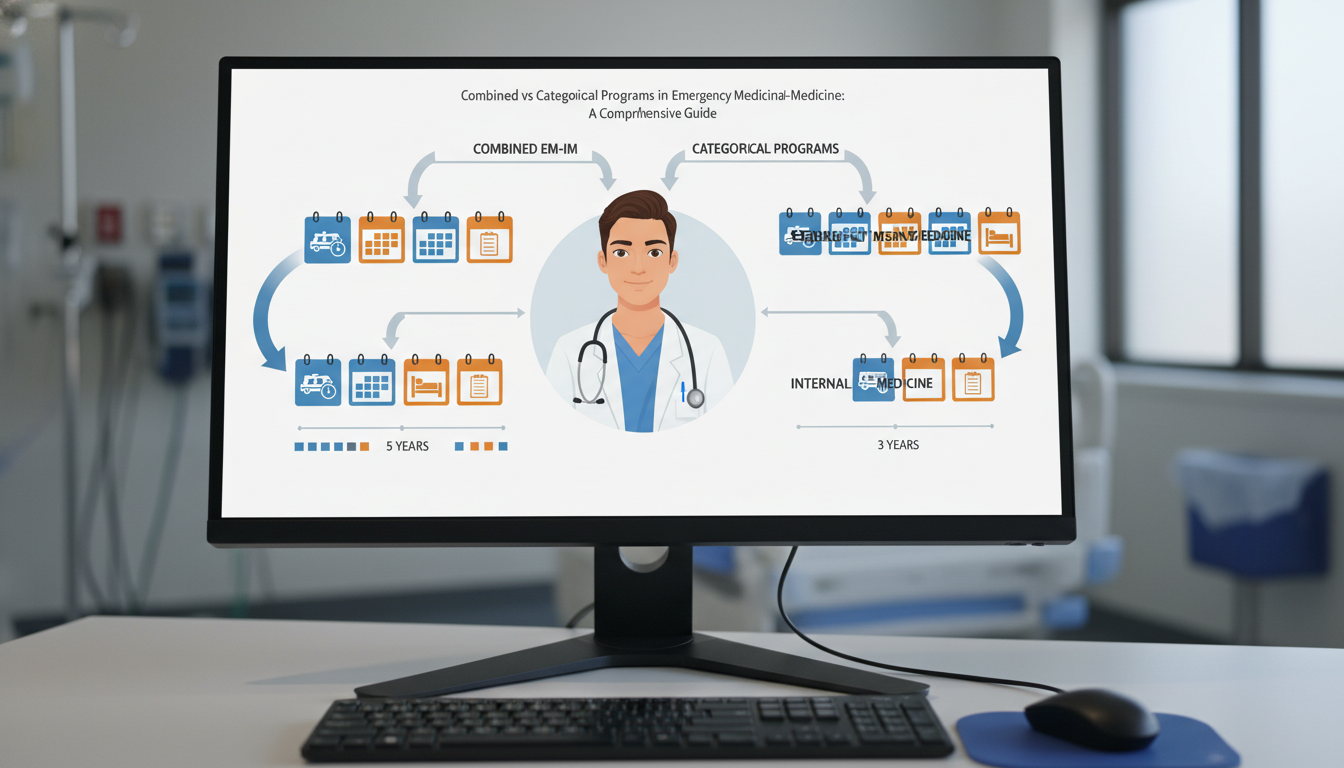
This article walks through the differences between combined vs categorical programs in the context of Emergency Medicine–Internal Medicine, how these choices affect your day-to-day training, board eligibility, lifestyle, and long-term career options, and how to decide which path aligns best with your goals.
Key Definitions: Categorical vs Combined in EM-IM
Before comparing pathways, it’s essential to clarify the terminology programs and advisors use.
What Is a Categorical Residency?
A categorical residency is a standard, single-specialty training program that leads to board eligibility in that specialty alone.
In the EM-IM universe, “categorical” usually means:
Categorical Emergency Medicine (EM)
- 3 or 4 years (depending on program design)
- Board-eligible in Emergency Medicine only
Categorical Internal Medicine (IM)
- 3 years
- Board-eligible in Internal Medicine only
You can apply to categorical EM, categorical IM, or both, and then tailor your post-residency training (fellowships, jobs) to approximate the combined skillset you’re aiming for.
What Is an EM IM Combined Residency?
An EM-IM combined residency is a single, integrated training track where you:
- Train in both Emergency Medicine and Internal Medicine
- Typically complete 5 years of residency
- Graduate board-eligible in both EM and IM (assuming you meet all requirements)
Core features:
- One NRMP match code and rank list entry for the EM-IM combined program
- A structured curriculum that alternates EM and IM rotations
- Coordinated oversight between the EM and IM departments
This is distinct from a med peds program, which combines Internal Medicine and Pediatrics. Med-peds is another well-established combined residency, but it does not include Emergency Medicine.
Other Relevant Pathways
While not the focus of this article, applicants sometimes compare EM-IM combined to:
- EM-only with fellowship (e.g., critical care, ultrasound, toxicology, EMS)
- IM-only with fellowship (e.g., critical care, cardiology, hospital medicine)
- Sequential training (e.g., complete EM, then an IM or critical care fellowship)
Those pathways can approximate some of the EM-IM combined benefits but differ in time, structure, and board structure.
Structural Differences: How Training Is Organized
The most immediate difference between categorical vs combined EM-IM programs lies in the nuts and bolts of how your training years are structured.
Length of Training
Categorical EM
- 3 years (most programs) or 4 years (some academic centers)
- Single board certification (EM)
Categorical IM
- 3 years
- Single board certification (IM)
- Often followed by a 1–3 year fellowship if you subspecialize
EM-IM Combined
- 5 years total
- Dual board eligibility (EM + IM)
- Some grads add an additional fellowship (e.g., critical care, ultrasound, palliative care)
Rotation Structure: How Time Is Split
EM-IM Combined Program
Most EM-IM combined programs:
- Alternate EM and IM blocks throughout all 5 years
- Ensure you meet all ACGME requirements for both specialties
- Have additional “hybrid” or elective rotations that leverage dual training (e.g., ED observation unit, ED-based ICU, complex medical consults)
A sample (simplified) EM-IM combined year might look like:
- 4–5 months EM (ED, trauma, pediatric EM)
- 4–5 months IM (wards, ICU, subspecialty clinics)
- 1–2 months electives/consults/combined experiences
You oscillate regularly between the ED and inpatient/clinic IM environments, often within the same academic year.
Categorical EM or IM
In categorical EM or IM programs:
- Your time is concentrated in one specialty’s environment
- You may have a few rotations in the other specialty (e.g., EM residents on IM wards, IM residents doing ED months), but it’s not designed to meet full dual-board requirements
- Your overall identity tends to be more clearly “EM resident” or “IM resident”
Dual Identity vs Single Specialty Focus
Combined EM-IM
- You are both an EM and IM resident, typically with:
- Two program directors
- Two advisory/mentor networks
- Two sets of conferences and didactics (you may split or alternate these)
- You need to navigate expectations from both departments:
- EM expects resuscitation, rapid decision-making, procedural competence
- IM expects deep medical reasoning, longitudinal management, systems-based thinking
Categorical EM or IM
- You build one clear identity and culture
- You usually attend one core set of conferences and QI projects
- Your portfolio (leadership, research, teaching) is focused in a single discipline
This structural difference becomes very important for:
- Workload and call/shift pattern
- Community and mentorship
- Board exam preparation
- Personal work-life balance
Lifestyle, Workload, and Culture: What Daily Life Feels Like
Beyond structure, the lived experience of EM-IM combined vs categorical training differs in pace, lifestyle, and culture.
Scheduling and Workload
EM-IM Combined
- Shift work + call:
- In EM blocks, you work ED shifts (days, evenings, nights, weekends)
- In IM blocks, you often have traditional ward schedules, call, night float, or ICU rotations
- Fewer “easy” years:
- You rarely have a plateau year where your overall load drops significantly; the 5-year track tends to remain consistently intense
- Switching gears frequently:
- One month: busy ED nights
- Next month: day team on the medicine service, following 10–15 patients every day
This can be rewarding if you like variety—but also fatiguing if you struggle with constant transitions.
Categorical EM
- Primarily shift-based schedule:
- Greater schedule predictability once you know your shift pattern
- More discrete off-days (especially compared to IM call systems)
- Many residents appreciate that when your ED shift ends, your responsibility for those patients usually ends too.
Categorical IM
- More continuity-based schedule:
- Wards, ICU, night float, clinic
- Fewer shift-style overnight ED blocks, more call or night float
The categorical paths tend to feel more internally consistent: you’re always “doing EM” or “doing IM,” which can be less cognitively jarring.
Culture and Peer Group
EM-IM Combined
- Cohort size is usually small (often 1–3 residents per class)
- You may feel like:
- A “guest” rotating between two primary homes
- Or a “bridge” who connects the cultures of EM and IM
- You may not always align perfectly with either group’s social or professional rhythms:
- EM colleagues may all go to EM conference while you’re scheduled for IM clinic
- IM peers may be planning a research project while you’re deep in trauma resus month
Categorical EM or IM
- Larger class sizes in one specialty
- Easier to:
- Find multiple mentors with careers you’d like to mirror
- Build a strong social cohort with shared schedules
- Develop a consistent identity as “an EM doc” or “an internist”
Burnout Considerations
Combined EM-IM
Pros:
- Variety can be protective against monotony or single-environment fatigue
- Mentally stimulating to alternate acute resuscitations with longitudinal diagnostics
Cons:
- Risk of never fully “powering down” because both EM and IM residencies are independently demanding
- Cognitive load of switching systems, teams, and expectations frequently
- Feeling pressure to perform at the highest level in two specialties
Categorical EM or IM
Pros:
- A single departmental culture and set of expectations
- More coherent pathway to mastery in one domain
Cons:
- Potential for boredom or burnout if you strongly crave the mix of acute and chronic care that EM-IM offers
Personal resilience, support systems, and the specific programs you join all significantly influence burnout, regardless of pathway.
Career Outcomes: What You Can Do With Each Path
Applicants usually weigh categorical vs combined EM-IM programs in terms of long-term flexibility, income, and job structure.
Board Certification and Marketability
EM-IM Combined
- Eligible for dual board certification:
- American Board of Emergency Medicine (ABEM)
- American Board of Internal Medicine (ABIM)
- Employers can hire you as:
- A full-time emergency physician
- A full-time internist or hospitalist
- A split-role clinician (e.g., 60% ED, 40% inpatient medicine or ICU)
This dual qualification is especially valued in:
- Community hospitals needing flexible coverage
- Rural sites where physicians must cover ED, wards, and possibly ICU
- Academic centers building ED-based observation units or ED-managed ICUs
Categorical EM or IM
- Single-board certification in your chosen field
- Career paths usually fall clearly into EM or IM, with some cross-pollination via fellowships.
Typical Job Models for EM-IM Graduates
Common career patterns after an EM IM combined program include:
Hybrid Clinical Roles
- Example: 8 ED shifts/month + 7 hospitalist shifts/month
- Or: 0.7 FTE ED + 0.3 FTE ICU
Academic Leadership and Systems Roles
- ED observation unit director
- Chair of hospital sepsis committee, bridging ED and inpatient pathways
- Quality improvement lead for transitions of care
Critical Care or Hospital-Based Specialization
- Many EM-IM grads pursue:
- Critical Care Medicine
- Pulmonary/Critical Care
- Palliative Care with strong ED interface
- They may work across ED, ICU, and inpatient consult services
- Many EM-IM grads pursue:
Global Health / Resource-Limited Settings
- Dual skill set is highly useful in settings where physicians cover ED, ward, and sometimes outpatient clinics
Career Options After Categorical EM or IM
You can still shape a “dual-feel” career after categorical EM or IM:
Categorical EM + Fellowship
- Critical care: may practice ED + ICU
- Observation medicine: focus on short-stay units bridging ED and inpatient
- EMS or ultrasound: ED-focused but with system-level roles
Categorical IM + Fellowship
- Critical care: can staff ICU and may be deeply involved in rapid response and ED-to-ICU transitions
- Hospital medicine: strong involvement in admitting ED patients and overseeing inpatient flow
However, it is generally more difficult to be formally employed in both ED and IM roles long-term without dual training or extra credentialing. EM-IM combined training makes that dual-practice structure straightforward and formally recognized.

How to Decide: Is EM-IM Combined or Categorical Right for You?
Choosing between EM IM combined and categorical vs combined pathways is ultimately about alignment with your specific goals, risk tolerance, and personality.
Signs You Might Be a Strong Fit for EM-IM Combined
You truly love both EM and IM for their own sake.
- You get excited about:
- Running resuscitations, trauma, and high-acuity undifferentiated cases
- Unraveling complex diagnostic puzzles, optimizing chronic disease, and following patients over time
- Losing access to either environment would feel like a genuine loss.
- You get excited about:
You want to maintain long-term flexibility.
- You can see:
- Early career: more EM shifts for pace and procedures
- Later career: shifting toward hospitalist or ICU roles for a different rhythm
- You like that you can negotiate hybrid jobs in varied practice settings.
- You can see:
You’re comfortable with prolonged, intense training.
- 5 years of integrated training doesn’t bother you; you see it as an investment
- You can tolerate complex schedules and high expectations from two departments.
You are drawn to leadership, systems, or academic roles.
- You envision a career:
- Directing ED observation units
- Leading pathways that bridge ED and inpatient services
- Working in global or rural health where breadth matters
- You envision a career:
You value being “bilingual” in EM and IM culture.
- You enjoy mediating between services and understanding both perspectives
- You’re energized, not drained, by having multiple professional identities.
Signs You May Prefer a Categorical EM or IM Program
You have a clear primary love: EM or IM.
- You enjoy the other specialty, but don’t feel compelled to practice it independently
- You can imagine satisfying that interest via rotations, electives, or fellowship experiences.
You prioritize finishing training sooner.
- An extra 1–2 years of residency is a major downside for you, either financially or personally
- You want to reach attending status as quickly as possible.
You want depth in one specialty more than breadth.
- You’d rather be an exceptionally strong EM or IM physician than a dual specialist
- You foresee pursuing a subspecialty fellowship that already offers plenty of complexity.
You’re wary of the dual expectations and potential burnout.
- You prefer one home department, one set of conferences, and a more coherent peer group
- You want to minimize role-switching and cognitive transitions.
Your long-term career goal doesn’t demand dual training.
- For example, you’re certain you want:
- Pure academic EM with ultrasound or EMS
- Pure academic IM with cardiology or heme/onc
- Traditional community EM or hospitalist practice without hybrid roles
- For example, you’re certain you want:
Practical Steps to Clarify Your Decision
Do honest self-reflection.
- Write down:
- What kinds of patient encounters energize you most
- What environments (ED vs wards vs ICU vs clinic) you feel best in
- How you envision your ideal week as an attending physician
- Write down:
Seek targeted mentorship.
- Talk to:
- Current EM-IM combined residents and graduates
- Categorical EM and IM residents who considered but did not choose EM-IM
- Ask them openly about:
- Burnout
- Job hunting
- Work-life balance
- What they would do differently
- Talk to:
Rotate in both EM and IM with intention.
- During core and sub-internship rotations:
- Compare how you feel at the start and end of each day
- Notice whether one environment consistently feels like “home”
- During core and sub-internship rotations:
Consider applying to both program types.
- Many applicants rank a mix of:
- EM-IM combined programs
- Categorical EM
- Categorical IM
- Your rank list can reflect how you resolve this internal debate over interview season.
- Many applicants rank a mix of:
Application Strategy: Navigating the Match for EM-IM vs Categorical
When you’re ready to apply, strategy differs a bit for combined vs categorical paths.
ERAS and NRMP Considerations
EM-IM combined programs:
- Have their own ERAS program codes and NRMP match numbers
- Usually require you to meet criteria similar to both EM and IM applicants
- Letters of recommendation:
- At least one from EM (often using the EM Standardized Letter of Evaluation—SLOE)
- At least one from IM
- A third from either specialty or a research mentor, depending on program guidelines
Categorical EM or IM programs:
- Require letters focused primarily in that one field
- EM: often 1–2 SLOEs plus additional letters
- IM: typically 2–3 IM letters, possibly one from another specialty
You can submit different personal statements and letter sets to different program types through ERAS to highlight your interest and fit.
How Programs Evaluate EM-IM Applicants
EM-IM combined programs look for:
- Academic strength: solid Step/COMLEX scores and clinical evaluations
- Breadth of interest: evidence that you’ve explored both EM and IM carefully
- Resilience and maturity: awareness of the demands of dual training
- Clear articulation of goals: why you’re choosing combined, not just “keeping options open”
Preparing a thoughtful personal statement that directly addresses why EM-IM combined training is the best path for your specific goals is critical.
FAQs: EM-IM Combined vs Categorical Programs
1. Is an EM-IM combined residency “better” than categorical EM or IM?
Neither path is inherently better. EM-IM combined is better for applicants who genuinely want to practice and identify as both an emergency physician and an internist, or who have strong hybrid/system-level career goals. Categorical EM or IM is better for those who are primarily drawn to one field and don’t require dual training to achieve their career vision. Competitiveness and “prestige” vary more by program than by combined vs categorical structure.
2. Will an EM-IM combined program make me less competitive for fellowships?
In most cases, no. EM-IM graduates are often viewed favorably by fellowship directors, especially in fields like critical care, pulmonary/critical care, palliative care, and hospital medicine. You will have a strong foundation in both acute and longitudinal care. The key is to build a focused CV in the area you’re targeting (research, electives, mentorship) during residency, just like any other applicant.
3. Can I do a combined career (ED + inpatient work) if I train in categorical EM or IM only?
Sometimes, but it’s more limited. Some hospitals allow:
- EM-trained physicians with critical care training to staff ICUs
- IM-trained physicians with emergency department experience to work in EDs, especially in resource-limited or rural settings
However, regulatory, credentialing, and malpractice structures usually favor physicians who are boarded in the specialty in which they primarily practice. An EM IM combined residency offers clearer, standardized dual-board eligibility, making hybrid practice more straightforward.
4. Will I make more money with dual training compared to a single categorical residency?
Compensation depends far more on practice setting, location, and workload than on whether you trained in EM-IM combined vs categorical EM or IM. Dual-trained physicians may have more negotiating power or flexibility (e.g., filling multiple roles, covering ICU + ED), but that doesn’t automatically translate to higher income. Some EM-IM graduates actually choose to work fewer total shifts because they enjoy multiple roles, not because of higher pay.
Choosing between combined vs categorical pathways in Emergency Medicine–Internal Medicine is a deeply personal decision. Clarify your long-term goals, talk honestly with people on both sides of the fence, and use your clinical rotations to identify where you feel most energized and authentic. Whether you pursue an EM IM combined residency or categorical EM or IM, you can build a meaningful, impactful career caring for patients across the continuum of acute and chronic illness.