
Why Board Exam Strategy Matters in Otolaryngology (ENT)
Passing otolaryngology boards—whether the American Board of Otolaryngology–Head and Neck Surgery (ABOHNS) or equivalent international exams—is not just about memorizing facts. It’s about mastering a structured, efficient approach that integrates the right board exam resources, question banks, and evidence-based study habits.
ENT residency is demanding: long OR days, busy clinics, and call. Without a smart plan, even excellent residents can underperform on boards and in-training exams. This guide walks you through:
- The major board exam study resources in otolaryngology
- How to combine core texts, question banks, and digital tools
- Practical UWorld tips–style strategies applied to ENT Qbanks
- Integrating Anki for USMLE-style spaced repetition into ENT studying
- A sample 3–6 month study plan tailored to ENT residents
Whether you’re early in residency, preparing for the otolaryngology match with an eye on the future, or months away from your board exam, you can use this as a roadmap.
Core ENT Knowledge: Textbooks and Review Books You Actually Need
Not every book on your shelf deserves a place in your board study plan. For high-yield ENT board preparation, think in layers: one core reference, one concise review, and optionally a subspecialty focus if you’re weaker in a particular domain.
1. Primary Core References
These are not “read in one month” books—they’re your backbone throughout residency.
a. Cummings Otolaryngology: Head and Neck Surgery
- Multi-volume, comprehensive reference.
- Strengths: Pathophysiology, detailed surgical approaches, excellent for clarifying complex concepts before a big OR case or exam.
- Best use:
- Targeted reading: one chapter a week tied to your current rotation (e.g., rhinology, otology).
- Deep dives for weak topics after doing questions.
- Clarifying board-relevant controversies or nuances (e.g., thyroid cancer management, chronic rhinosinusitis subsets, head and neck cancer staging).
b. Bailey’s Head and Neck Surgery – Otolaryngology
- Slightly more concise than Cummings; more clinically oriented.
- Strengths: Readable narrative, clearer focus on clinical decision-making.
- Best use:
- As your primary “readable” ENT textbook during PGY-2–3.
- For board prep, select high-yield sections: sleep surgery, facial plastics, laryngology, pediatric ENT, otology, rhinology, and head & neck.
Practical tip:
Pick one of these as your go-to core reference. For boards, you are not expected to have memorized every line. Use it to resolve questions that arise from Qbanks and in-training exam feedback, not as your primary study workload in the final 3–4 months.
2. Concise ENT Review Books
These are your board exam workhorses, especially in the final 3–6 months.
a. ENT Secrets / Otolaryngology: A Case-Based Approach (or similar high-yield review)
- Question-and-answer style or case-based formats make them digestible.
- Strengths: Emphasize clinical decision-making and differential diagnosis.
- Best use:
- Daily reading targets (e.g., one section of otology per day).
- Short review passes in the final 4–6 weeks.
b. Otolaryngology Board Review Books (various titles)
Look for books explicitly marketed as “Otolaryngology Board Review” or “ABOHNS Review.” Key features of a good board review book:
- Organized by subspecialty (otology, rhinology, laryngology, head & neck, pediatrics, facial plastics, sleep, allergy).
- Includes:
- Bullet-pointed facts
- Key classifications (e.g., Brodsky tonsil scale, Friedman staging)
- Common exam-tested algorithms and flowcharts.
High-yield reading strategy:
- First pass (4–6 months out):
- Read 10–15 pages per day.
- Underline or mark “exam smell” facts (things that sound like multiple-choice stems).
- Second pass (2–3 months out):
- Focus only on your highlights and margin notes.
- Third pass (final 2 weeks):
- Quickly skim tables, algorithms, and bolded facts.
3. Subspecialty Review: When to Go Deeper
If your in-training scores show you’re weak in a specific domain, consider:
- Otology/Neurotology mini-texts (e.g., concise otology review books):
- Emphasize vestibular testing, audiograms, middle ear pathology, cochlear implants.
- Head and Neck Oncology references:
- Focus on staging, margins, adjuvant therapy indications, and neck dissection patterns.
- Pediatric ENT review chapters:
- OSA, airway anomalies, congenital hearing loss, recurrent otitis media management.
Actionable advice:
Don’t let subspecialty deep dives replace general review. Use them as patch fixes: 1–2 targeted chapters for each proven weak area, followed by relevant practice questions.
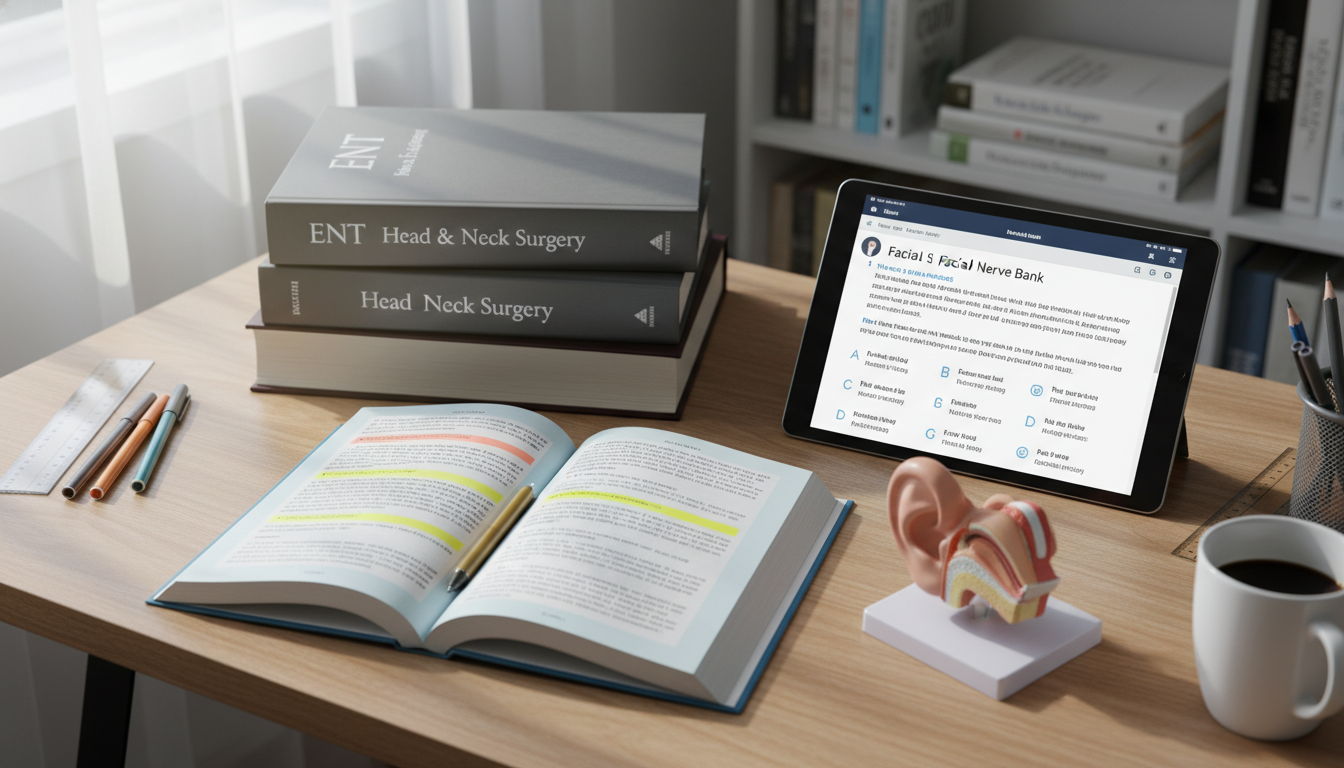
Question Banks and Practice Questions: ENT’s Equivalent of UWorld
For USMLE, UWorld is the gold standard; ENT doesn’t have one universal equivalent, but the same principles apply. You need high-quality questions, repeated exposure, and post-question review.
1. Major ENT Board Question Resources
While specific commercial names vary by region and year, most residents will have access to one or more of these common types:
ABOHNS or specialty board–aligned Qbanks
- Commercial ENT board review question banks.
- Often offer:
- Timed exam modes
- Subspecialty-based quizzes
- Explanations with references.
Otolaryngology in-service (in-training) exam question compilations
- Past questions or “modeled after” questions.
- Valuable for style and difficulty level.
- Often available through programs or societies.
Society resources
- Question sets from professional organizations (e.g., AAO-HNS, specialty societies).
- Online modules with self-assessment questions.
General surgery/oncology/critical care Qbanks
- Useful to reinforce cross-cutting topics:
- Antibiotic selection
- Oncologic principles
- Airway management
- ICU/post-op care
- Useful to reinforce cross-cutting topics:
2. UWorld-Style Strategy Applied to ENT Qbanks
Even though you’re not literally using UWorld, you can apply UWorld tips to any ENT board question resource:
Always do questions in “tutor mode” early on.
- Read every explanation, even for questions you got right.
- Ask:
- Why is the correct answer correct?
- Why are the other choices wrong?
**Tag questions by:
- Topic (e.g., “otology—otosclerosis”; “laryngology—vocal fold paralysis”)
- Confidence level (low, medium, high).**
Track your performance by subspecialty.
- Aim for balanced improvement, not just bringing your best areas to near-perfection.
- Use this data to guide what you reread in your core text or review book.
Prioritize pattern recognition.
- ENT boards test:
- Classic presentations (e.g., glomus jugulare tumors, vestibular schwannoma, cholesteatoma)
- Management pathways (e.g., early vs advanced laryngeal cancer, OSA surgical ladder)
- Build mental algorithms from explanations and reinforce them with brief notes or Anki cards.
- ENT boards test:
3. How Many Questions Should You Do?
For serious exam preparation over 3–6 months:
- Target total questions: 1,500–2,500 ENT-specific questions if available.
- If your program offers fewer ENT questions:
- Supplement with:
- General surgical oncology questions
- Critical care/airway questions
- Radiology imaging questions relevant to ENT (sinus CT, temporal bone CT, neck MRI)
- Supplement with:
Weekly structure example (3–4 months out):
- Weekdays:
- 20–30 questions/day (timed or tutor mode).
- 60–90 minutes reviewing explanations and taking brief notes or Anki.
- Weekends:
- 40–60 questions/day.
- One “mini exam” (50–75 questions timed) every 2–3 weeks.
Final 4–6 weeks:
- Shift to full-length practice exam blocks (60–100 questions at a time) in strict timed mode.
- Immediately review and classify missed questions:
- Knowledge gap → read/Anki
- Misinterpretation of stem → practice more timed blocks
- Fatigue/attention → adjust sleep, break schedule, or exam strategy.
Digital Tools: Integrating Anki, USMLE-Style Spaced Repetition & Multimedia
Many residents associate Anki with USMLE Step studying, but the same spaced-repetition principles work beautifully for ENT board prep.
1. Using Anki in Otolaryngology (ENT)
You can:
- Use existing ENT decks (if available and reputable).
- Or build a small, focused personal deck that directly reflects:
- Board review notes
- Qbank explanations
- High-yield guidelines.
What to put on cards:
- Algorithms and decision trees
- Example: Management pathway for unilateral vocal fold paralysis depending on etiology and duration.
- Staging systems and classifications
- Common head and neck cancer TNM nuances.
- Classification of laryngeal clefts, neck dissections, tympanoplasty types.
- Can’t-miss associations
- Juvenile nasopharyngeal angiofibroma + adolescent male epistaxis.
- Wegener’s (GPA) + subglottic stenosis + c-ANCA.
- Tricky histology/ pathology pairs
- Papillary vs follicular thyroid carcinoma features.
- Sinonasal tumors and key immunohistochemical markers (only the ones boards truly love).
Anki strategy:
- Keep cards brief: one discrete fact or decision point per card.
- Do 10–20 minutes of daily reviews, not marathon sessions.
- Use tags (e.g., “otology,” “laryngology,” “peds”) to focus on weak areas during crunch time.
2. Multimedia Resources: Videos and Surgical Atlases
Boards are increasingly image- and video-heavy, especially in otology, rhinology, and head and neck.
High-yield multimedia categories:
- Endoscopic sinus surgery videos:
- Identify anatomy, complications (e.g., skull base, lamina papyracea).
- Laryngoscopy and stroboscopy clips:
- Recognize vocal fold lesions (nodules, polyps, Reinke’s edema, granulomas).
- Otologic/endoscopic ear surgery videos:
- Middle ear anatomy, ossicles, cholesteatoma extension.
- Radiology collections:
- Temporal bone CT, sinus CT, neck CT/MRI, PET-CT for head and neck cancer.
How to study with multimedia:
- Watch in short, focused bouts (15–30 minutes).
- Pause and label structures out loud or in notes.
- Translate what you see into:
- Quick sketches
- Anki image occlusion cards
- Simple “if X imaging finding, think Y diagnosis” rules.
This visual literacy improves not just board scores but also intraoperative confidence.

Building a Study Plan: From Intern Year to Board Month
A strong board performance is the cumulative result of years of layered learning, not just a frantic final month. Here’s how to structure your approach across residency and especially in the crucial 3–6 months before the exam.
1. Early Residency (PGY-1–2): Laying the Foundation
Goals:
- Build a broad conceptual map of ENT.
- Learn from patients, ORs, and real cases first.
- Start light, regular exposure to board-style topics.
Suggested strategy:
- Core textbook reading:
- 1–2 chapters/week from Bailey or Cummings related to your current rotation.
- Light question exposure:
- 20–40 ENT questions/week (if available).
- Anki USMLE → ENT transition:
- If you used Anki for USMLE, adapt the same habit to a small ENT deck:
- 5–10 cards/day on high-yield topics you encounter clinically.
- If you used Anki for USMLE, adapt the same habit to a small ENT deck:
2. Mid-Residency (PGY-3–4): Align with In-Training Exams
Goals:
- Use in-training results to identify weaknesses.
- Start thinking of yourself as in the early phase of board prep.
Suggested strategy:
- Board review book pass:
- 10–15 pages/day, 4–5 days/week over 4–6 months.
- Question focus:
- 100–150 questions/month, ramping up closer to the in-service exam.
- Rotation-based focus:
- On otology: emphasize audiograms, temporal bone CT, otosclerosis, cholesteatoma.
- On head and neck: staging, neck dissections, thyroid/parathyroid, reconstruction principles.
- On peds: airway anomalies, OSA, ear disease, craniofacial anomalies.
3. Final 6 Months Before Boards
This is the most critical window. Think in terms of phases.
Phase 1 (6–4 months out): Broad Coverage
- Reading:
- Finish 1 full pass of your main ENT board review book.
- Supplement your weakest two subspecialties with extra chapters from Bailey/Cummings.
- Questions:
- 20–30 questions/day on average.
- Focus on understanding patterns and explanations.
- Anki:
- Build or refine a focused deck of your true blind spots—don’t try to encode all of ENT.
Phase 2 (4–2 months out): Intensification & Simulation
- Reading:
- Second faster pass through your review book.
- Focus on:
- Algorithms
- Tables
- Staging and management schemes.
- Questions:
- 30–50 questions/day, mixing:
- Timed blocks (to build test endurance)
- Tutor mode (to dissect tricky topics).
- 30–50 questions/day, mixing:
- Simulate exam conditions:
- Once every 2 weeks, do a several-hour block of timed questions with minimal breaks.
- Practice nutrition, hydration, and break strategies.
Phase 3 (Final 2–3 Weeks): Consolidation
- Stop learning new material.
- Focus on:
- Reinforcing high-yield facts.
- Reviewing your most-missed questions.
- Tightening decision-making on classic scenarios.
Daily tasks:
- 1–2 hours of fast review (notes/Anki/board book highlights).
- 30–50 mixed questions in timed mode.
- 15–20 minutes of radiology/endoscopy image review.
- Sleep, exercise, and mental health prioritized—fatigue can cost as many points as knowledge gaps.
Choosing the Right Mix of Resources for You
There is no single “perfect” ENT board resource stack, but there is a balanced one that works for most residents.
1. Minimum Effective Toolkit
At a minimum, you should have:
- One core ENT reference (Bailey or Cummings).
- One concise board review book clearly aligned with otolaryngology boards.
- One solid question bank with:
- Several hundred to a couple thousand ENT questions.
- A simple digital system (Anki or equivalent) for:
- Algorithms
- Classifications
- Can’t-miss associations.
2. Avoiding Common Pitfalls
- Resource overload:
- Collecting too many books or Qbanks dilutes focus.
- Better to master two resources than skim five.
- Passive reading without questions:
- Reading alone doesn’t mimic board conditions.
- Boards test application, not regurgitation.
- Ignoring weak areas:
- It’s tempting to reread your favorite topics.
- Use data (Qbanks, in-service scores) to drive your schedule.
3. Example Resource Stack for a Typical ENT Resident
- Core text: Bailey’s Head and Neck Surgery–Otolaryngology
- Review book: An otolaryngology board review book + ENT Secrets (or similar)
- Question banks:
- Primary ENT board-style Qbank
- In-service style questions (if available)
- Digital:
- Anki deck with ~500–1,000 cards containing:
- Cancer staging
- Key algorithms
- Can’t-miss pathologies
- Selected surgical/endoscopy video playlists for image-based learning
- Anki deck with ~500–1,000 cards containing:
Align all of these with your exam blueprint (topics and weightings) to prioritize time where it moves your score most.
FAQs: Board Exam Study Resources in Otolaryngology (ENT)
1. When should I seriously start studying for the ENT written boards?
Most residents benefit from a structured plan starting about 6 months before the exam, with steadily increasing intensity. However, your best preparation begins years earlier:
- PGY-2–3: Build strong foundations via core texts and case-based learning.
- PGY-4: Treat in-training exam prep as “board prep lite.” The final 3–6 months should be focused, exam-driven review with dedicated time blocked out.
2. How many hours per week should I study while still in residency?
This depends on your clinical schedule and baseline knowledge, but reasonable targets:
- 6–9 months out: 5–8 hours/week.
- 3–6 months out: 8–12 hours/week.
- Final 4–6 weeks: 12–20 hours/week, if possible. The key is consistency—short, regular sessions with questions + review are more effective than rare, long cram sessions.
3. Is Anki really worth the effort for ENT boards, or is it just for USMLE?
Yes, Anki is valuable for ENT if used strategically:
- Don’t try to memorize entire textbooks.
- Use it for:
- Staging systems
- Algorithms
- Recurrent “gotcha” facts from Qbanks. A well-curated 500–1,000-card deck reviewed in 10–20 minutes per day can significantly improve recall of high-yield material without overwhelming you.
4. How do I balance OR time, clinic, call, and board studying without burning out?
Practical approaches:
- Micro-study: 10–15 minutes of Anki or 5–10 questions during downtime.
- Protected blocks: 1–2 longer sessions each week (e.g., weekend mornings) for deep work: Qbanks + reviewing explanations.
- Rotation-based goals: Align your studying with your current service; studying otology while on otology makes it feel more relevant and less like extra work.
- Rest: Plan at least one evening per week with no studying to maintain long-term sustainability.
By choosing a focused set of board exam resources, applying UWorld-style Qbank strategies to ENT, and leveraging Anki USMLE principles for spaced repetition, you can build a sustainable, high-yield plan that fits within the demands of otolaryngology residency and sets you up for success on your board exams.