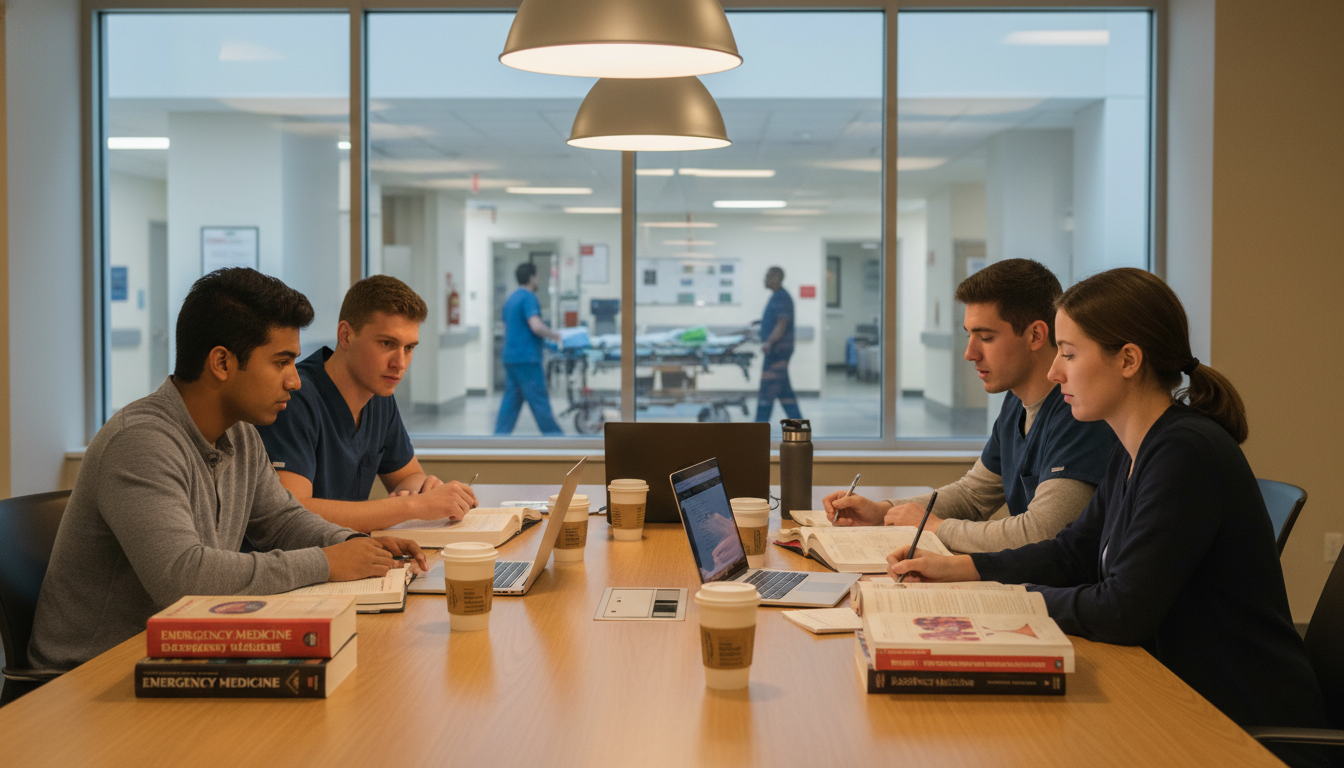
Understanding the Big Picture: Why M1 Matters for Emergency Medicine
Your first year of medical school (M1) can feel overwhelming: new content, new expectations, and constant pressure to “keep doors open” for competitive specialties like emergency medicine. While the emergency medicine residency match (EM match) is still years away, the habits and mindset you build in M1 will either set you up for success—or make the rest of the journey much harder.
You do not need to decide on your specialty in your first year. However, if you’re even mildly interested in EM, there are smart ways to “plant seeds” now without burning out or overcommitting.
How M1 Fits Into the EM Match Timeline
Here’s the rough arc from M1 to EM residency:
M1 (First year medical school)
- Learn how to learn medicine
- Build systems for time management, note-taking, and self-care
- Light exploration of emergency medicine: shadowing, interest groups
- Lay the foundation for strong Step/Level exam performance
M2
- Ramp up board prep
- More deliberate specialty exploration
- Begin small research or QI projects, possibly EM-related
M3
- Core clinical rotations
- EM rotations (depending on curriculum)
- Start building relationships with EM faculty and residents
M4
- Away rotations (audition rotations) in EM
- EM sub-internships
- Letters of recommendation in EM
- Apply and interview for emergency medicine residency
M1 is your foundation year. You don’t win the EM match in M1, but you can make it far easier—or far harder—by how you approach this year.
Building Habits to Survive (and Thrive) in First Year
M1 isn’t about memorizing every fact; it’s about building durable systems that work under stress. Think like an emergency physician: prioritize, act efficiently, and avoid chaos.
1. Time Management: Your Most Critical M1 Skill
Medical school is a full-time job plus overtime. Treat it that way.
Core principles:
Use time blocking
Divide your day into chunks:- Morning: lectures / live sessions / review
- Afternoon: active studying (Anki, practice questions, small groups)
- Early evening: review + next-day prep
- Late evening: personal time, sleep wind-down
Protect your “non-negotiables”
Schedule:- 7–8 hours of sleep
- Basic exercise (even 15–20 minutes)
- Meals that aren’t eaten at your desk every single time
Avoid constant context-switching
Don’t try to watch lecture, check email, chat with friends, and do Anki at the same time. EM physicians multitask, but they task-switch intentionally. Do the same:- 45–60 minutes focused study
- 5–10 minute break
- Use Do Not Disturb on your phone
Example weekly template for an M1 with EM interest:
Mon–Fri
- 8–12: Required sessions / lectures (in person or recorded)
- 1–3: Active review of the morning’s material
- 3–4: Anki / spaced repetition
- 4–5: Exercise or walk
- 7–9: Light review or practice questions + next-day planning
Sat
- 9–1: Cumulative review of the week, catch up on missed lectures
- Afternoon: Personal time, hobbies, socializing
Sun
- Light review only (1–2 hours) + plan your week
This structure is flexible, but having any consistent structure is what keeps you from drowning.
2. Study Strategies That Actually Work in Medical School
What worked in undergrad often fails in medical school. “Surviving medical school” academically is less about effort and more about method.
High-yield strategies:
Active recall > passive review
- Use practice questions, flashcards (Anki or similar), and self-quizzing
- Regularly close your notes and ask, “Can I explain this out loud?”
Spaced repetition
- Revisit material over days and weeks, not just once
- Build or use pre-made decks aligned with your curriculum
Teach back method
- Try explaining pathophysiology to a classmate (or your wall) as if they knew nothing; the gaps you find are where you should focus
Integrate clinical context early
Emergency medicine is all about pattern recognition under pressure:- When you learn a disease, ask: How would this present in the ER? What are the red flags?
- For example, when learning chest pain: MI, PE, aortic dissection, pneumothorax, GERD—what’s deadly and time-sensitive?
Common pitfalls:
- Re-watching lectures “to feel productive” instead of quizzing yourself
- Making elaborate, beautiful notes that you never have time to review
- Memorizing isolated facts without understanding the big picture
Aligning M1 With a Future in Emergency Medicine
You don’t need to be “all in” on EM as an M1, but subtle alignment now will pay dividends later—without taking over your life.
Exploring Emergency Medicine Without Overcommitting
You’re still early, but if EM interests you, here’s how to explore:
Join your school’s EM interest group
- Attend a few meetings—not all. Look for:
- Skills workshops (suturing, ultrasound demos, simulation nights)
- Panels with EM residents or attendings
- ED shadowing sign-ups
- Attend a few meetings—not all. Look for:
Shadow in the emergency department (ED)
Aim for a few shifts spaced throughout the year rather than a one-time experience.- Go with a clear purpose:
- What do EM physicians actually do minute-to-minute?
- How do they manage interruptions?
- How do they communicate with patients and consultants?
- Keep a simple reflection log:
- 3 cases that stood out
- 1 thing that surprised you
- 1 communication strategy you admired (or didn’t)
- Go with a clear purpose:
Connect with EM mentors early—but gently
- Ask your interest group or student affairs for EM faculty who enjoy working with students
- Send a brief, focused email:
- Introduce yourself (M1, early interest in EM)
- Mention 1–2 specific questions (e.g., “What should an M1 realistically focus on?”)
- Ask for a 15–20 minute conversation, not a big favor
- You’re planting networking seeds that may matter later when you’re closer to the EM match.
Building “EM-Friendly” Skills in M1
Emergency medicine values certain soft and hard skills that you can start developing now—even outside the ED.
1. Communication under pressure
Volunteer for roles that require you to:
- Present short summaries (case-based discussions, PBL sessions)
- Explain complex topics simply to non-medical audiences (community outreach, tutoring)
Practice “ED-style” case presentations:
- One-liner: “45-year-old male with 2 hours of chest pain started at rest…”
- Focus on: chief complaint, key history, vital signs, initial differential, and immediate concerns
2. Teamwork and leadership
EM physicians constantly coordinate teams. As an M1, look for situations where you can:
- Work in structured small groups (anatomy lab, PBL, sim sessions)
- Practice:
- Clarifying roles (“I’ll look up the anatomy; can you tackle the pathology?”)
- Summarizing group decisions
- Keeping discussions on time and on task
3. Tolerance of uncertainty
The ED is full of incomplete information. You can build this muscle by:
- Getting comfortable answering questions even when you’re not 100% sure
- When you’re wrong, focusing on:
- What assumption failed?
- How would I recognize that earlier next time?
These skills make you a better M1 and a stronger future EM applicant.
Taking Care of Your Mind and Body: Surviving Medical School Without Burning Out
Emergency medicine is fast-paced and emotionally intense. Long before residency, your M1 year is a stress test of your coping skills. Surviving first year of med school isn’t only about grades; it’s about staying well enough to continue.
Protecting Your Mental Health in M1
Normalize stress, avoid isolation.
- Nearly every M1 questions if they belong at some point
- When things feel heavy:
- Talk to classmates you trust—chances are they feel similarly
- Use your school’s counseling or wellness office early rather than waiting for a crisis
Create a small, trusted support circle:
- 2–4 people (inside or outside medicine) who:
- You can be honest with
- Don’t turn every conversation into a competition
- Respect your time and boundaries
Watch for warning signs:
- Weeks of:
- Persistent hopelessness or numbness
- Inability to focus despite trying structured strategies
- Insomnia or sleeping excessively
- Loss of interest in everything, even outside of school
These are not “weakness.” They are signals to get professional support.
Building Physical Resilience
You don’t need a perfect fitness routine to survive M1, but your body is not optional equipment.
Sleep as a performance enhancer
- 7–8 hours per night improves memory consolidation
- Build a simple sleep routine: lights dimmed 30–60 minutes before bed, screens down, same sleep/wake time as often as possible
Movement you’ll actually stick to
- 15–30 minutes, 3–5 times per week:
- Walking with a podcast
- Short bodyweight workouts
- Yoga or stretching routines
- Don’t try to “optimize” everything; just be consistent
- 15–30 minutes, 3–5 times per week:
Food as fuel, not perfection
- Aim for:
- Regular meals
- A reasonable mix of protein, complex carbs, and fats
- Prepare simple, repeatable meals to avoid last-minute junk food dependence
- Aim for:
Boundaries: The One Skill High-Achievers Struggle With
You will be asked constantly: “Can you help with this project / interest group / committee?” Saying yes to everything is a path to exhaustion.
Use a simple internal checklist before you say yes:
- Does this align with my values or genuine interests (e.g., EM, teaching, underserved care)?
- Do I realistically have 1–2 hours per week for this over the next month?
- Will it still matter a year from now (skills, relationships, CV impact)?
If the answer is no to any of these, it’s probably a no—or a “not right now.”

Practical M1 Tips With an Eye Toward Emergency Medicine
This section combines M1 tips with subtle EM-focused thinking.
Using Anatomy, Physiology, and Other Core Courses to Think Like an EM Physician
Even though you’re not seeing patients yet, you can practice EM-style thinking in your basic science courses.
Example: Anatomy
- Instead of just memorizing:
- “What happens if this nerve is injured in a trauma patient?”
- “What deficits guide me to localize the lesion?”
Example: Physiology
- Think in terms of:
- What happens to blood pressure and heart rate in sepsis vs. hemorrhage?
- What compensatory mechanisms fail first?
- How would this present in triage vitals?
Example: Microbiology / Infectious Disease
- Ask:
- Which infections are time-sensitive in an ED? (e.g., meningitis, necrotizing fasciitis, sepsis)
- What are the early clues that would make you worry?
Aligning your studying this way builds pattern recognition that will help when you encounter emergency medicine rotations later—and when you’re preparing for boards.
Strategic Involvement: CV Building Without Overload
For a future emergency medicine residency application, typical EM applicants have:
- A track record of:
- Clinical performance
- Some scholarly activity (research, QI, education)
- Consistent interest in EM or acute care
As an M1:
High-yield activities (one or two is enough):
- EM interest group with very limited but consistent participation
- One small research or QI project if genuinely interested (often starts M1/M2 and continues)
- Service or community work that you care about (e.g., homeless outreach, harm reduction, EMS ride-alongs where allowed)
Low-yield or risky as an M1:
- Taking on leadership titles before you understand the responsibilities
- Joining 6+ organizations because “everyone else is”
- Overcommitting to multiple research projects you can’t realistically support
You are not behind if you do not have research by the end of M1. Many EM residents start serious CV-building later. Focus first on grades, wellness, and building good habits.
Planning Ahead (Lightly) for Boards
Board exams (USMLE Step 1 / COMLEX Level 1) are often pass/fail now, but they still matter. For EM, your later clinical performance and Step 2/Level 2 scores will matter more—but M1 lays the foundation.
Practical M1 board prep mindset:
- Use a board-aligned resource (e.g., an integrated question bank or board-style review book) in parallel with your courses, but do not obsess over board prep in M1
- Focus on:
- Understanding mechanisms, not just memorizing lists
- Building familiarity with board-style questions very slowly over time (e.g., 5–10 questions a few days per week)
This approach reduces anxiety and helps M2 feel like an extension of M1, not a brand-new crisis.
Conclusion: A Sustainable Path From M1 to Emergency Medicine
Surviving first year of med school isn’t about heroics; it’s about designing a sustainable system that lets you learn deeply, stay reasonably healthy, and keep your curiosity alive. If you’re interested in emergency medicine:
Use M1 to:
- Learn how you study best
- Build time-management and stress-resilience skills
- Get a realistic, early glimpse of EM through shadowing and interest groups
- Begin to think clinically, especially in time-sensitive, acute-care ways
Avoid:
- Comparing your path minute-by-minute with classmates
- Overcommitting to projects or leadership to “look competitive”
- Ignoring your physical and mental health in the name of productivity
A grounded, steady M1 puts you on a strong trajectory toward doing well clinically, performing on boards, and ultimately succeeding in the EM match if that’s where you land. You don’t have to have everything figured out this year—but you can build the habits and perspective that will carry you all the way to residency.
FAQ: Surviving M1 With Emergency Medicine in Mind
1. Do I need to commit to emergency medicine during my first year for a successful EM match later?
No. Many EM residents discover the specialty during clinical years. As an M1, simply:
- Explore EM through interest groups and occasional shadowing
- Build strong foundational knowledge and study habits
- Keep your performance solid across disciplines so you have options
If you eventually choose EM, these foundations will serve you well; if you choose another specialty, nothing is wasted.
2. How important are grades in M1 for getting into an emergency medicine residency?
M1 grades matter as part of your overall academic record, but they are not the sole determinant of EM match success. Programs look more closely at:
- Clinical performance in M3/M4
- EM rotation evaluations and standardized letters (SLOEs)
- Step 2 / COMLEX Level 2 scores
- Professionalism, teamwork, and communication
Still, doing well in M1 makes everything else easier and shows you can handle the workload.
3. Should I start emergency medicine research in my first year?
You can, but you don’t have to. For M1:
- If you find a project that genuinely interests you and fits your schedule, it can be a good learning experience
- Don’t chase research just for its own sake or overload yourself with multiple projects
- Many strong EM applicants begin research later (M2 or early M3) and still match well
Focus first on learning how to function well as a medical student.
4. How can I tell if emergency medicine is a good fit for me this early on?
You won’t know for sure in M1, but you can gather clues. EM may be a good fit if you:
- Enjoy fast-paced, varied environments and quick problem-solving
- Like working in teams and communicating with diverse patients
- Are comfortable with some uncertainty and making decisions with limited information
Shadowing in the ED, talking with EM residents/faculty, and reflecting on how you feel in that environment are the best early signals. It’s fine if your interests evolve over time—that’s part of medical training.