Understanding the Challenge: Why Interventional Radiology Is Ultra-Competitive for IMGs
Interventional Radiology (IR) has rapidly evolved into one of the most sought‑after and competitive specialties in the United States. For an international medical graduate (IMG), breaking into an interventional radiology residency can feel like trying to enter a locked room through a very narrow door. But “ultra‑competitive” is not the same as “impossible.”
Before you build a winning strategy, you need to understand the landscape:
What Makes Interventional Radiology So Competitive?
Several factors put IR in the same conversation as matching derm or matching ortho:
Limited number of spots
- Integrated IR residencies (direct entry from medical school) have relatively few positions nationwide compared with big fields like internal medicine or family medicine.
- Many IR physicians still come through the Diagnostic Radiology (DR) → Independent IR pathway, which also has finite positions.
High procedure volume and lifestyle appeal
- Cutting‑edge minimally invasive procedures.
- Good compensation, procedural focus, evolving technology.
- Perception of “high‑tech, high‑impact” draws very strong applicants.
Early interest from top U.S. students
- IR has become a “dream specialty” in the U.S., attracting top‑tier US MD students who often have research and mentorship from prominent academic centers.
Unique Barriers for the International Medical Graduate
As an IMG, you face structural challenges:
- Lower program receptivity: Many Integrated IR programs are historically less IMG‑friendly compared with IM or Pediatrics.
- Visa sponsorship issues: Not all programs offer J‑1 or H‑1B visas, particularly competitive academic IR programs.
- Less built‑in exposure to IR: Many non‑U.S. schools have limited or non‑existent dedicated IR rotations.
- Perception gap: Program directors may be unfamiliar with your school’s reputation or grading system, making it harder to stand out.
Your IMG residency guide for IR must therefore be sharper, more deliberate, and longer‑term in planning than the average applicant’s approach. Success comes from controlling every variable you can and stacking advantages over several cycles if needed.
Step 1: Clarify the Pathways – Don’t Just “Apply IR”
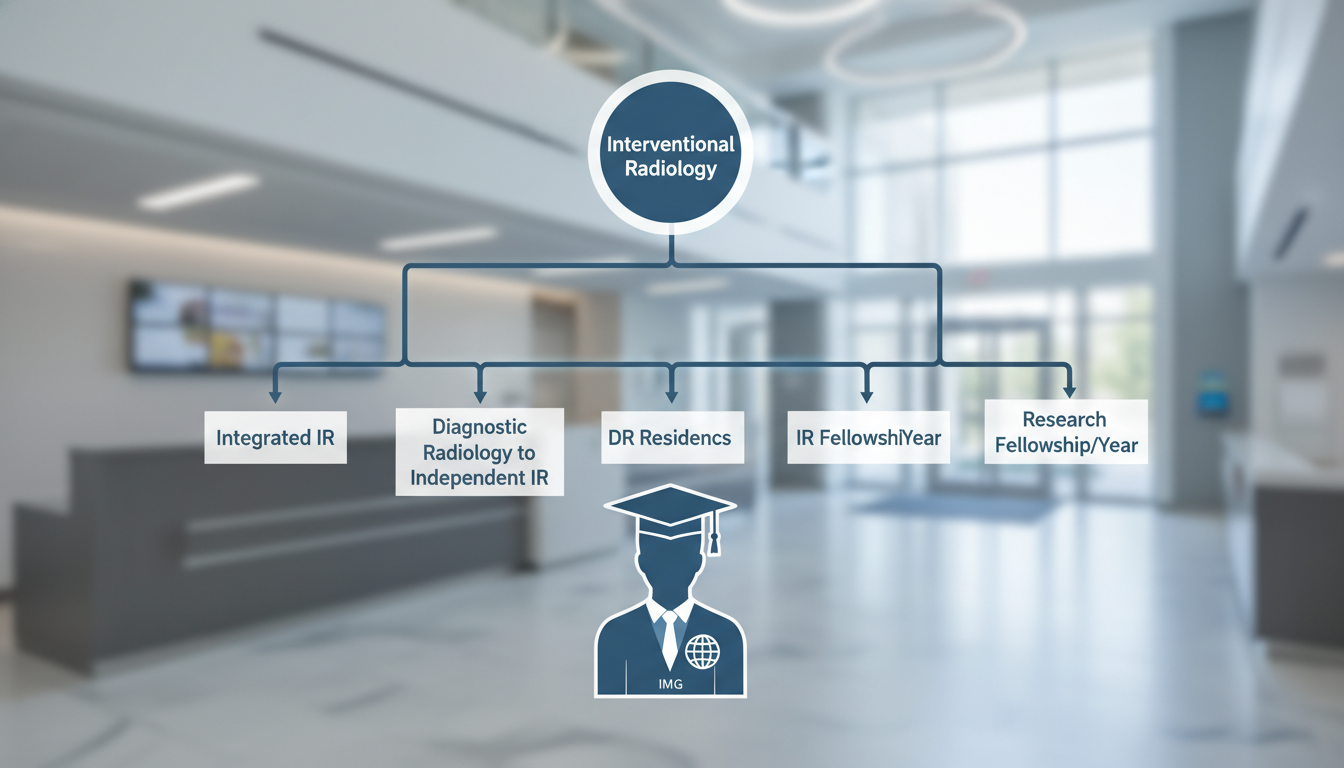
To build strategy, you must understand every possible entry point into interventional radiology, especially as a competitive specialty.
A. Integrated IR Residency (IR/DR)
- What it is: 6‑year residency starting after medical school (1 clinical intern year + 5 IR/DR years).
- Outcome: Dual board eligibility in Interventional Radiology and Diagnostic Radiology.
- Competitiveness for IMGs: Very high. Often similar to matching derm or matching ortho in difficulty, especially at top programs.
Who this path fits best:
- Recent graduates or final‑year students with:
- Excellent USMLE scores
- Strong U.S. clinical experience
- IR research and letters from U.S. interventional radiologists
- No significant academic gaps
B. Diagnostic Radiology → Independent IR Residency
This is a more flexible and, for many IMGs, more realistic pathway.
Step 1: Match into Diagnostic Radiology (DR)
- 4 years of diagnostic radiology training.
- DR is still competitive, but in many places somewhat more attainable for IMGs than integrated IR.
Step 2: Match into Independent IR Residency
- 2 additional IR training years after DR.
- Requires:
- Strong DR performance
- IR rotations and mentorship
- Letters from interventional radiologists
- Many IR programs recruit their own DR residents into their Independent IR spots.
Key strategic principle: For many IMGs, the DR → Independent IR route is the primary, realistic target; Integrated IR is the “bonus shot” if your profile is exceptionally strong.
C. Alternative On‑Ramp Strategies
For some IMGs, a multi‑step approach may be needed:
Preliminary Year → DR → Independent IR
- If your profile is not enough for DR initially, you might:
- Build U.S. clinical experience (medicine, surgery, or transitional year).
- Strengthen research and IR exposure.
- Re‑apply to DR with a stronger CV.
- If your profile is not enough for DR initially, you might:
Research → DR → Independent IR
- 1–3 years in a U.S. IR research position (paid or unpaid) can:
- Produce publications.
- Build relationships with IR faculty.
- Lead to strong letters.
- Improve program familiarity with you when you apply to DR and later IR.
- 1–3 years in a U.S. IR research position (paid or unpaid) can:
Step 2: Academic Profile – Building a “No‑Question” Application
In an ultra‑competitive specialty, the first filter is almost always academic. You must aim to become a “no‑question” candidate on paper before your IR story is even considered.
A. USMLE Strategy for IR as an IMG
Even with Step 1 now Pass/Fail, test performance still matters significantly:
Step 1 (Pass/Fail)
- A first‑attempt Pass is vital; multiple failures can be fatal for an IR application.
- Programs may dig deeper into:
- Basic science grades
- School reputation
- Research productivity, to compensate for less granular Step 1 info.
Step 2 CK
- This is your critical numeric signal.
- For an ultra‑competitive IR applicant, you should aim to score in the upper quartile of all test‑takers.
- A strong Step 2 CK can partly offset:
- Non‑top‑tier medical school
- Lack of home U.S. program
- Slightly weaker preclinical performance
Step 3
- Useful but not mandatory before applying.
- Helpful if:
- You are applying late in your career.
- You need to strengthen your academic narrative.
- You want to be more competitive for H‑1B sponsoring programs.
Tactical tip: If your Step 2 CK is not where you want it to be, lean more heavily on research, networking, and U.S. clinical performance to show excellence in other dimensions.
B. Medical School Performance and Timing
Programs will look at:
- Class rank or decile (if available)
- Honors in clinical rotations
- Trend over time (improving vs declining)
- Gaps in education
For current students (IMGs still in medical school):
- Prioritize:
- High performance in radiology, medicine, and surgery rotations.
- Early IR exposure through electives, observerships, or student IR societies.
- Finishing on time without unexplained gaps.
For older graduates:
- A gap isn’t automatically disqualifying, but:
- You must show continuous engagement in medicine (research, clinical work, teaching).
- You need to explain gaps clearly in your application and interviews.
C. Letters of Recommendation: Non‑Negotiable for Competitive Specialty
For IR or DR applications, you ideally want:
- At least one strong letter from a U.S. interventional radiologist
- One letter from a U.S. diagnostic radiologist
- One additional letter from:
- Internal medicine, surgery, or another U.S. specialty that knows you well.
What makes a letter “strong”:
- Clear, specific examples of your:
- Work ethic
- Clinical reasoning
- Technical aptitude
- Professionalism and teamwork
- Direct comparison to U.S. students:
- “Among the top 5% of students I have worked with in the last 10 years.”
- Evidence that the writer really knows you:
- Mentions specific projects, patient cases, or qualities observed.
Critical move for IMGs: Prioritize longer‑term U.S. experiences (4–8 weeks) where faculty can truly observe you. Short 1‑week observerships rarely lead to impactful letters.
Step 3: Targeted IR Exposure and Research – Outcompeting on “Fit”
In a field like IR, programs are looking not only for stellar numbers, but also for proof that you truly understand what IR is and what the training demands.
A. Clinical Exposure: Designing High‑Impact IR Experiences
You should aim for progressive exposure:
Observation (early phase)
- Attend IR procedures and clinic.
- Learn IR terminology, workflows, and common procedures (e.g., TACE, EVAR, biliary drainage, embolization).
- Begin informal mentorship relationships with attendings and fellows.
Elective Rotations (core phase)
- Ideally 4‑week IR electives at U.S. academic centers.
- Show up early, stay late, volunteer for call if allowed.
- Ask to:
- Present a case at IR conference.
- Help with chart review or research tasks.
- Request honest feedback and use it to improve quickly.
Longitudinal Relationships (advanced phase)
- Keep in touch with IR mentors:
- Send updates about your exams, research, and applications.
- Ask for guidance about programs and strategy.
- Offer ongoing help with research or data collection remotely.
- Keep in touch with IR mentors:
Your goal: When a PD calls your letter writer and asks, “Is this IMG truly ready for IR training?” the answer should be an immediate and confident “Yes.”
B. Research: Turning a Weakness into a Major Strength
In ultra‑competitive specialties, serious research can separate you from the pack—especially as an IMG without a home program.
Types of Research That Matter in IR
- Clinical outcomes studies
- E.g., comparing outcomes of different embolization techniques.
- Retrospective chart reviews
- E.g., complications after specific IR procedures.
- Case reports and case series
- Good entry point for beginners; show initiative and clinical curiosity.
- Educational projects
- Development of IR teaching modules, simulation curricula, or online resources.
How to Enter IR Research as an IMG
Cold emails (done well)
- Target:
- Academic IR divisions
- Assistant or associate professors who actively publish
- Email structure:
- Brief introduction: who you are, where you trained
- Why IR: 2–3 sentences max, focused and mature
- What you want: research involvement (remote or in‑person)
- What you offer: time, data skills, prior research experience
- Attach: CV and, if available, a sample of prior work
- Target:
Research/observership combo
- If you land short observerships, ask if you can:
- Help with ongoing retrospective studies.
- Assist with patient follow‑up or data entry (with appropriate approvals).
- If you land short observerships, ask if you can:
Formal research positions (ideal)
- IR research fellowship (often 1–2 years).
- Can be a powerful launchpad, providing:
- Multiple publications.
- IR conference presentations.
- Deep mentorship and name recognition.
Outcome you’re aiming for:
- A CV line that reads like:
- 3–10 IR‑related abstracts/posters
- Several peer‑reviewed publications
- IR conference presentations (SIR, RSNA, etc.)
- This signals to programs that you are deeply committed to IR and already academically productive in their field.

Step 4: Application and Match Strategy – Playing the Long Game
With academics, exposure, and research in place, you must deploy them strategically for the IR match and DR match cycles.
A. Choosing Where to Apply: IMG‑Friendly Targeting
Interventional radiology residency positions are limited. As an IMG, you need to be realistic and data‑driven.
For Integrated IR:
Prioritize:
- Programs that have previously matched IMGs (check NRMP and program websites).
- Academic centers with strong IR research (your publication record becomes a bigger asset).
- Institutions that explicitly state they sponsor visas if you need J‑1 or H‑1B.
Consider:
- Applying broadly across geographic regions.
- Including smaller or less famous institutions where the competition may be slightly lower.
For Diagnostic Radiology (as your main strategic pathway):
- Identify:
- Programs with a history of accepting IMGs.
- DR programs affiliated with strong IR departments (for later Independent IR entry).
- Apply broadly (often 60–100+ DR programs for many IMGs in competitive cycles).
B. Dual Application Strategy: IR + DR
A sophisticated IMG residency guide for IR will often recommend dual application:
Rank IR programs you interview at (Integrated IR)
- These are “direct hits” if you are fortunate to match.
Simultaneously apply to DR programs
- Ensure your application clearly states:
- Your interest in DR as a foundation.
- Your long‑term plan for IR through the Independent pathway.
- Avoid sounding like you see DR only as a “backup”; emphasize:
- The value of being a strong diagnostic radiologist.
- Your respect for DR as its own discipline.
- Ensure your application clearly states:
Apply to a solid number of advanced DR programs + transitional/preliminary medicine/surgery years
- DR is usually advanced (PGY‑2) and requires a separate PGY‑1 year.
- Be realistic and broad in PGY‑1 applications as well.
C. Personal Statement: Telling a Credible IR Story
Your personal statement should be:
- Focused: One page, clear and specific.
- Balanced: Emphasize both IR and DR, especially if applying to DR programs.
Key elements to include:
- An authentic origin story:
- First meaningful exposure to IR (patient case, mentor, procedure).
- Maturity and realism:
- Show that you understand:
- The demands of IR call.
- The burden of complications.
- The importance of diagnostic radiology skills.
- Show that you understand:
- IMG‑specific perspective:
- How your international background:
- Shapes your view of minimally invasive care.
- Prepared you to adapt, work hard, and handle challenges.
- How your international background:
Avoid over‑promising (“IR or nothing”) language, especially in DR applications. Instead, convey:
“I aim to become an outstanding diagnostic radiologist who can build on that foundation to practice interventional radiology.”
D. Interview Strategy: Communicating Like a Future Colleague
On interview day, IR and DR programs are assessing:
- Can you thrive in their culture?
- Will you be safe and reliable in high‑stakes procedures?
- Do you understand what the specialty really involves?
To stand out:
- Be ready with specific IR clinical examples:
- Cases you observed where IR changed management.
- Technical challenges you saw and how teams handled them.
- Demonstrate systems thinking:
- IR’s relationship with surgery, oncology, vascular medicine, and critical care.
- For IMGs, address:
- Why you want U.S. training specifically.
- How you have already adapted successfully to the U.S. system (if you have U.S. experience).
Have a clear answer to:
“If you do not match IR, what is your plan?”
- Strong answer:
- “I want to be a highly competent diagnostic radiologist and would pursue IR through the Independent pathway if possible. Even if that doesn’t occur, I would still be committed to excellence in DR.”
- Weak answer:
- “I’ll just try again next year” without a concrete, growth‑oriented plan.
Step 5: Contingency Planning – Intelligent “Plan B” Without Giving Up IR
Even among stellar candidates, the IR match can be unpredictable. Ultra‑competitive specialty strategy means planning for more than one outcome from the beginning.
A. If You Don’t Match Integrated IR
This is common even for strong applicants, including U.S. graduates.
Your best moves:
If you matched DR:
- You are still on a valid IR path.
- Maximize every DR rotation to:
- Build diagnostic excellence.
- Seek IR rotations and electives as a DR resident.
- Join IR projects and get IR mentorship from within your new institution.
- Express early interest in Independent IR to your PD and IR faculty.
If you did NOT match DR or IR:
- Consider a U.S. research year in IR or radiology.
- Strengthen:
- Publications
- U.S. letters
- Understanding of U.S. clinical practice
- Reapply to DR (with or without reapplying to Integrated IR, depending on your profile).
B. If You Don’t Match DR
This may signal that your application doesn’t yet reach the threshold for such a competitive specialty.
Consider these pathways:
Preliminary medicine or surgery year:
- Gain strong U.S. clinical performance.
- Obtain new U.S. letters.
- Use off‑days and evenings for IR/radiology research.
- Reassess competitiveness after 6–12 months.
Dedicated IR or radiology research fellowship:
- As discussed earlier, this can potentially transform your profile if you’re productive and well‑mentored.
C. When You Might Need to Recalibrate Your Career Goal
There is a point at which persisting in an ultra‑competitive path may not be in your best long‑term interest. Consider recalibration if:
- Multiple cycles pass with:
- No DR or IR interviews, despite improvements.
- Persistent academic or visa barriers.
- Your personal and financial situation makes more cycles unrealistic.
Even then, remember:
- Your IR‑driven research, procedural interest, and imaging understanding can translate into:
- Diagnostic radiology outside the U.S.
- Vascular medicine, cardiology, or interventional specialties in other systems.
- Hybrid careers in resource‑limited settings where you can pioneer minimally invasive techniques.
The key is to be strategic, not rigid. The mindset that gets many IMGs into IR is not “IR at any cost,” but rather “relentless improvement and honest assessment each year.”
FAQs: Ultra‑Competitive IR Strategy for IMGs
1. As an IMG, should I even try for Integrated IR, or just focus on DR?
If your academic profile is strong (excellent Step 2 CK, first‑attempt passes, strong U.S. letters, IR research), applying to some Integrated IR programs is reasonable. However, for most IMGs, the primary, realistic path is DR → Independent IR. Use Integrated IR as an “upside option,” but build your main plan around matching DR at an institution where IR opportunities exist.
2. How many IR‑related publications do I need to be competitive?
There is no fixed number, but in a competitive specialty, quality and relevance matter more than raw count. A strong IMG IR applicant might have:
- Several abstracts or posters at major meetings (SIR, RSNA, CIRSE).
- 2–5 IR‑related peer‑reviewed publications (original research, case reports, or reviews).
If your scores or school background are less competitive, additional productivity (more projects, first‑author papers, presentations) becomes even more important.
3. Is it okay to say I want to do IR when applying to DR programs?
Yes, but be thoughtful. Most DR programs know that many residents are interested in IR. Frame it as:
- Respect for DR as a necessary foundation.
- Commitment to being an excellent diagnostic radiologist.
- Interest in pursuing IR through the Independent route if appropriate.
Avoid phrasing that makes DR seem like a mere backup or temporary step.
4. I’m an older IMG graduate with gaps. Do I still have a chance in IR?
It is more difficult, but not automatically impossible. To have a realistic chance:
- You must show continuous, recent engagement in medicine, ideally in U.S. settings.
- IR or radiology research experience becomes especially important.
- You may need to:
- Spend time in research positions.
- Consider matching into a broader specialty first, then explore IR opportunities later.
- Be honest with yourself and mentors about your competitiveness each cycle and adjust your strategy accordingly.
Interventional Radiology is a competitive specialty, particularly for the international medical graduate, but with a structured plan—solid academics, deliberately built IR exposure, strong research, strategic applications, and realistic contingencies—you can significantly improve your chances in the IR match and DR match processes. Think in terms of multi‑year strategy, not a single application season, and continually position yourself as the kind of resilient, high‑performing physician that IR programs want in their angiography suites.