
Understanding Step 2 CK as an IMG Headed for Pediatrics
USMLE Step 2 CK is more than just another exam for an international medical graduate aiming for pediatrics. It sits at the intersection of your medical knowledge, your clinical judgment, and your competitiveness for the peds match. For many IMGs, the Step 2 CK score becomes the most current and most heavily weighted objective metric in the application—especially if Step 1 is pass/fail or lower than desired.
For pediatrics residency programs in the United States, Step 2 CK is often viewed as:
- A predictor of your ability to handle pediatric inpatient and outpatient responsibilities
- Evidence of your readiness to care for vulnerable populations (children, neonates, adolescents)
- A marker of your clinical reasoning, not just memorization
As an IMG, a focused, structured USMLE Step 2 study plan tailored toward pediatrics can both improve your score and signal genuine commitment to the specialty.
Why Step 2 CK Is Critical for IMGs in Pediatrics
Differentiator in the peds match
Many U.S. MD seniors have strong institutional backing, clinical evaluations, and home program support. IMGs frequently rely more on exam metrics, including Step 2 CK, to stand out. A strong Step 2 CK score can:- Offset weaker Step 1 performance
- Strengthen your application if you lack U.S. clinical experience
- Demonstrate up-to-date clinical knowledge
Reflects practical, clinical pediatrics knowledge
Step 2 CK is heavily clinical. Pediatric cases appear throughout:- Well-child visits and vaccination schedules
- Neonatal care and congenital conditions
- Pediatric emergencies and infectious diseases Being very strong in pediatrics on Step 2 CK directly supports your credibility as a future pediatrician.
Timing and application strategy
Residency programs often review applications as soon as ERAS opens. If your Step 2 CK score is available early (by August/September of the application cycle), it can significantly shape interview decisions, especially for an international medical graduate.
Defining a Target Step 2 CK Score for Pediatrics as an IMG
There is no official single “cutoff,” but we can outline strategic ranges for an IMG residency guide in pediatrics.
Score Ranges and Their Strategic Impact
Below 215–220
- Risk of failing screens at many academic or competitive pediatrics programs
- You may still match at some community programs, especially with excellent U.S. clinical experience, strong letters, and compelling personal narrative—but it will be challenging
220–230
- Often considered the lower bound of competitive for many standard pediatrics programs
- More viable if combined with:
- Strong clinical grades
- Solid U.S. letters of recommendation (especially from pediatricians)
- Some research or scholarly activity
230–245
- Competitive for a wide range of pediatrics residency programs, including many university-affiliated community programs
- For many IMGs, this is the “sweet spot” where program interest noticeably increases
245+
- Distinct advantage, particularly for:
- University-based pediatrics programs
- Programs in popular metropolitan areas
- Supports applications to pediatric subspecialty-focused programs or highly academic institutions
- Distinct advantage, particularly for:
Your ideal Step 2 CK score target should be set according to:
- Your Step 1 status (pass/fail vs numerical, and how high/low)
- Your prior exam performance trends
- The level of competitiveness you are aiming for (community vs university vs top-tier academic)
Actionable tip:
Set a minimum target (what you need) and an aspirational target (what would make your application stand out). For example:
- Minimum: 230
- Aspirational: 240–245+
Building a Step 2 CK Study Plan Tailored to Pediatrics and IMGs
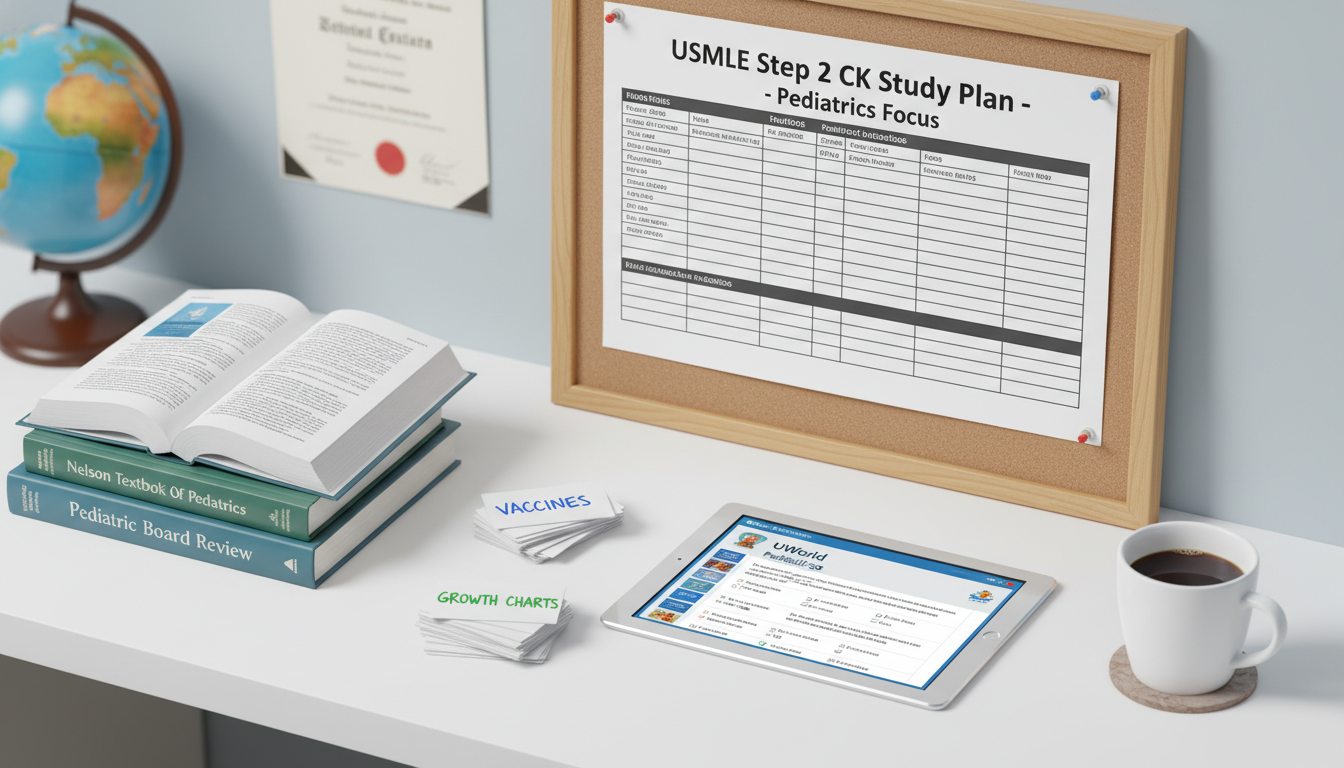
A good USMLE Step 2 study strategy for an IMG in pediatrics should be both structured and realistic. Below is a framework you can adapt based on whether you have 3, 6, or 9+ months.
Step 1: Assess Your Baseline
Before designing your study schedule, you need to know where you’re starting.
- Take a baseline NBME practice exam (or UWorld Self-Assessment) as early as possible
- Review:
- Overall score
- Performance by organ system (pediatrics-related systems: GI, cardio, pulm, endocrine, neuro, ID)
- Performance by competency (diagnosis, management, communication, ethics)
For an IMG residency guide, this baseline tells you:
- How far you are from your target Step 2 CK score
- Which content areas, especially in pediatrics, need urgent reinforcement
Step 2: Timeframe and Weekly Hours
Depending on your situation:
- Full-time studying (no clinical work): 40–50 hours/week
- 2–3 months may be enough if your foundation is strong
- Part-time with rotations or job: 20–30 hours/week
- 4–6 months is a more realistic timeframe
- Heavy responsibilities (job, family, visa issues):
- Build a longer schedule (6–9 months) with constant low-intensity progress
Step 3: Core Resources for Step 2 CK Preparation
Avoid resource overload. For most IMGs, 3–4 high-yield tools are ideal:
Question Bank (Primary Resource)
- UWorld Step 2 CK Qbank is considered the gold standard
- Use tutor mode early, then timed mode as you approach your exam
- Aim to complete 100% of the Qbank, preferably with incorrects reviewed at least once
Pediatric-specific use:
- Tag or flag pediatrics questions
- Maintain a separate log of recurring pediatric topics you miss (e.g., Kawasaki disease criteria, vaccine catch-up schedules, bronchiolitis vs asthma vs croup management)
USMLE-Style Text/Review Book
- Many IMGs use comprehensive Step 2 books (e.g., MTB or similar concise review texts)
- Use primarily for:
- Clarifying concepts you repeatedly miss in questions
- Rapid content review of pediatrics sections (development, vaccination, neonatology, common pediatric emergencies)
NBMEs and Self-Assessments
- Use NBME CCSSA exams at regular intervals
- Take at least 2–3 self-assessments:
- One early baseline
- One midway to adjust strategy
- One 2–3 weeks before exam to confirm readiness
Supplemental Pediatrics Resources (If Needed)
- If you are weak in pediatrics, consider a brief, targeted pediatrics review:
- A concise pediatrics handbook or review summaries
- Pediatric videos or rapid review lectures on high-yield topics (bronchiolitis, neonatal jaundice, congenital heart disease, developmental milestones)
- If you are weak in pediatrics, consider a brief, targeted pediatrics review:
Step 4: Structuring a Weekly Study Schedule
For a 12-week (3-month) intensive schedule:
Weekly goals:
- 200–300 Qbank questions/week (30–50 per day on most days)
- Thorough review of each block (answer explanations, figures, tables)
- 2–3 focused pediatrics content review sessions per week
Sample week:
Monday–Friday:
- 2 blocks/day (40 questions each) in timed mode → 80 questions/day
- 3–4 hours reviewing explanations and annotating:
- Add mislearned details to your notes or digital flashcards
- 1–2 hours content review (rotating systems; one day dedicated to pediatrics)
Saturday:
- 1 full NBME/simulated exam (every 2–3 weeks) OR 2 timed blocks with strict timing
- Review performance and adjust weekly plan
Sunday:
- Lighter day:
- Flashcards (especially vaccines, developmental milestones, genetic syndromes)
- Review of incorrect questions or weak pediatric topics
If you are combining this with U.S. clinical observerships or externships in pediatrics, reduce your daily question count but maintain consistent practice (at least 30–40 questions/day).
High-Yield Pediatrics Topics for Step 2 CK
Children appear throughout Step 2 CK—in cardiology, infectious disease, emergency medicine, psychiatry, endocrinology, and more. Focusing on high-yield pediatrics content will both help your Step 2 CK score and showcase your alignment with pediatrics for residency.
1. Growth, Development, and Preventive Pediatrics
Growth
- Normal growth patterns: weight, length/height, and head circumference
- Failure to thrive: caloric insufficiency vs malabsorption vs chronic disease
Developmental Milestones
- Gross motor, fine motor, language, and social milestones by age (4, 6, 9, 12, 15, 18, 24 months; 3–5 years)
- Recognizing red flags: e.g., no babbling by 9 months, no walking by 18 months
Preventive Care
- Well-child visit schedules
- Screening: anemia, lead, TB, cholesterol (in high-risk kids)
- Anticipatory guidance: safety counseling (car seats, drowning prevention, SIDS, screen time)
Vaccinations
- Routine vaccination schedule (birth through adolescence)
- Contraindications: live vaccines in immunocompromised children, pregnancy
- Catch-up schedules and special situations (asplenia, travel, premature infants)
Exam-style scenario:
A 2-month-old presents for a well-child visit. Weight is at 25th percentile, length at 50th, HC at 50th; parents ask about vaccines. You must know which vaccines are due and counsel on mild post-vaccine side effects.
2. Neonatology and the Newborn
- Immediate newborn assessment (Apgar)
- Common newborn conditions:
- Respiratory distress syndrome
- Transient tachypnea of the newborn
- Meconium aspiration
- Hyperbilirubinemia:
- Physiologic vs pathologic jaundice
- Direct vs indirect bilirubin
- Phototherapy and exchange transfusion thresholds
- Congenital infections (TORCH) and their features
- Screening: congenital hypothyroidism, hearing, heart disease (pulse oximetry)
3. Pediatric Infectious Diseases
- Common infections:
- Otitis media, pharyngitis, sinusitis, pneumonia (bacterial vs viral)
- Gastroenteritis (viral vs bacterial, signs of dehydration)
- Vaccine-preventable diseases:
- Measles, mumps, rubella, varicella, pertussis
- Serious infections:
- Meningitis (neonate vs older child pathogens)
- Sepsis and septic arthritis
- Osteomyelitis (S. aureus, SCD-related Salmonella)
- Antibiotic choices:
- Age-based and condition-based antibiotic regimens
4. Pediatric Cardiology and Pulmonology
Cardiology:
- Congenital heart diseases:
- VSD, ASD, PDA, TOF, transposition, truncus arteriosus
- Cyanotic vs acyanotic lesions
- Murmur recognition and first-line diagnostic tests
- Management of PDA (indomethacin vs surgery)
- Rheumatic fever and Kawasaki disease:
- Criteria, management, and long-term complications (coronary aneurysms)
Pulmonology:
- Asthma:
- Stepwise management; acute exacerbation treatment
- Bronchiolitis (RSV):
- Clinical features and supportive care
- Croup vs epiglottitis vs bacterial tracheitis:
- Stridor, drooling, x-ray findings (steeple sign, thumbprint sign)
- Cystic fibrosis:
- Recurrent infections, pancreatic insufficiency, infertility
5. Pediatric Endocrine, GI, and Neurology
Endocrine:
- Type 1 diabetes mellitus:
- DKA diagnosis and management
- Growth disorders:
- Constitutional delay vs pathologic short stature
- Congenital hypothyroidism
Gastroenterology:
- Pyloric stenosis vs GERD vs malrotation/volvulus
- Intussusception and Meckel diverticulum
- Inflammatory bowel disease in adolescents
Neurology:
- Seizures in children (febrile vs afebrile; absence vs generalized)
- Cerebral palsy
- Neurocutaneous syndromes (NF1, tuberous sclerosis)
6. Pediatric Emergencies and Ethics
- Shock in children (septic vs hypovolemic vs cardiogenic)
- Non-accidental trauma (child abuse):
- Classic findings: metaphyseal fractures, retinal hemorrhages, different aged bruises
- Mandatory reporting rules
- Pediatric resuscitation basics (modified for weight and age)
- Adolescent medicine:
- Confidentiality rules around sexual health, pregnancy, and substance use
- Consent and assent in minors
Integrating Pediatrics into Your Daily Step 2 CK Study

Turn Every Pediatric Question into a Learning Opportunity
When you encounter a pediatrics question in your Qbank, don’t just memorize the correct choice. Extract maximum value:
Ask: What clinical clues led to the diagnosis?
- Age of the patient
- Key symptoms and their timeline
- Physical exam findings specific to children
Ask: What was tested—diagnosis, management, next step in workup, or prevention?
Write one concise takeaway in your notes or flashcards, e.g.:
- “Kawasaki disease = 5+ days fever + 4/5 criteria → treat with IVIG + high-dose aspirin; echo for coronary aneurysms.”
Link the question to guidelines (e.g., AAP, CDC) when relevant.
Use Clinical Rotations to Reinforce Step 2 CK Knowledge
If you are doing U.S. clinical experience in pediatrics:
- After each clinic or inpatient day, write down:
- 2–3 interesting cases
- 1–2 management questions you weren’t fully confident about
- At home, look these up using exam-style resources
- Try to identify how those cases might appear in an exam vignette
This bridges the gap between real-world pediatrics and exam-style pediatrics.
Build Micro-Review Systems
For core pediatric facts that are easy to forget (like vaccine schedules, developmental milestones, congenital syndrome features), use:
- Flashcards (Anki or physical cards)
- Daily 10–15 minute review sessions
- Short “topic sprints”:
- One day: only vaccine tables
- Another day: only congenital heart disease features
Exam Day Strategy, Anxiety Management, and IMG-Specific Considerations
Exam Logistics and Strategy
Simulate full-length exam conditions at least once:
- 8 blocks of timed questions
- Only standard breaks
- Same start time as your exam
On exam day:
- Start with 1–2 strong blocks to build confidence
- Use your break time strategically (snacks, hydration, stretching)
- Don’t obsess over a few guessed questions in each block; Step 2 CK is designed for some uncertainty
Managing Test Anxiety as an International Medical Graduate
IMGs often face additional pressures:
- Visa limitations and deadlines
- Financial constraints
- Distance from family and support systems
To manage anxiety:
- Establish a stable daily routine (sleep, meals, exercise)
- Practice brief relaxation techniques before each block:
- Deep breathing
- Short mindfulness practice
- Limit last-minute resource switching; trust the plan you’ve followed for months
When to Postpone the Exam
Consider rescheduling if:
- Your last NBME within 2–3 weeks of the exam is more than 10–15 points below your minimum target Step 2 CK score
- You are still missing many basic pediatrics or core medicine questions
As an IMG, timing your Step 2 CK is delicate—postponing may push your score release past ERAS deadlines. Balance:
- The potential gain in score with extra time
- The risk of having no score available when programs first review applications
If you must choose, most IMGs benefit more from a solid, ready score, even if slightly later, than from rushing into the exam underprepared.
Aligning Step 2 CK Preparation with Your Pediatrics Residency Goals
Preparing for Step 2 CK is not separate from your pediatrics career—it is an early demonstration of how you think and work as a clinician.
Show Programs You’re Pediatrics-Focused
- Aim to excel on pediatrics-related questions in Qbanks and NBMEs
- During interviews and in your personal statement, you can:
- Highlight your interest in pediatric cases you saw while studying
- Mention how studying guidelines (e.g., vaccine schedules, asthma management) improved your patient care in rotations or observerships
Connect Your IMG Story to Your Exam Preparation
For many IMGs:
- You may come from a system with different disease prevalence, guidelines, or resources
- Demonstrating a systematic, guideline-driven approach to U.S.-style pediatrics in Step 2 CK preparation shows adaptability and commitment
You can later frame this in your application:
- “I supplemented my clinical experience with a structured USMLE Step 2 preparation plan focusing on AAP/CDC pediatric guidelines, which helped me care for children in a way consistent with U.S. practice standards.”
FAQs: USMLE Step 2 CK Preparation for IMGs in Pediatrics
1. What Step 2 CK score should an IMG aim for to be competitive in pediatrics?
For most international medical graduates, a Step 2 CK score of at least 230 is a reasonable minimum for broad competitiveness in pediatrics, with 235–245+ providing a stronger advantage, especially for university or academic programs. The exact target depends on your overall profile (Step 1 performance, clinical experience, research, and letters). Higher scores open more doors, but strong clinical experiences and letters can help compensate for a slightly lower score.
2. How early should I take Step 2 CK relative to the pediatrics residency application cycle?
Ideally, your Step 2 CK score should be available by the time ERAS opens (usually September). This means taking the exam by late June or July to allow for reporting time. If this is not possible, you can still apply, but some programs may hold or delay review of your application until the score arrives. As an IMG, earlier and stronger Step 2 CK performance typically improves your chances.
3. How much pediatrics is on Step 2 CK, and should I study it separately?
Pediatrics is significantly represented across systems (cardio, pulm, ID, neuro, endocrine). While you don’t need a separate pediatrics-only curriculum, it is wise to track your performance on pediatrics questions, review high-yield pediatric topics (development, vaccines, neonatology, emergencies, congenital diseases), and use brief pediatric-focused resources if you identify consistent weaknesses. Integrate these with your overall USMLE Step 2 study rather than treating them as an entirely separate project.
4. I am an IMG with weak Step 1 performance. Can a strong Step 2 CK score still help me match in pediatrics?
Yes. Many pediatrics program directors place strong emphasis on Step 2 CK because it is more clinically oriented and more recent. A substantially higher Step 2 CK score compared to Step 1 can:
- Demonstrate academic growth
- Counter concerns about earlier performance
- Reassure programs that you are prepared for clinical responsibilities
Combine a strong Step 2 CK with:
- Good U.S. clinical experience in pediatrics (if possible)
- Strong letters from pediatricians
- A clear, pediatric-focused personal statement
to create a compelling application for the peds match, even as an international medical graduate.
By approaching USMLE Step 2 CK preparation with a clear structure, an emphasis on pediatric content, and realistic score goals, you can transform this exam from a stressor into a strategic asset for your pediatrics residency journey as an IMG.