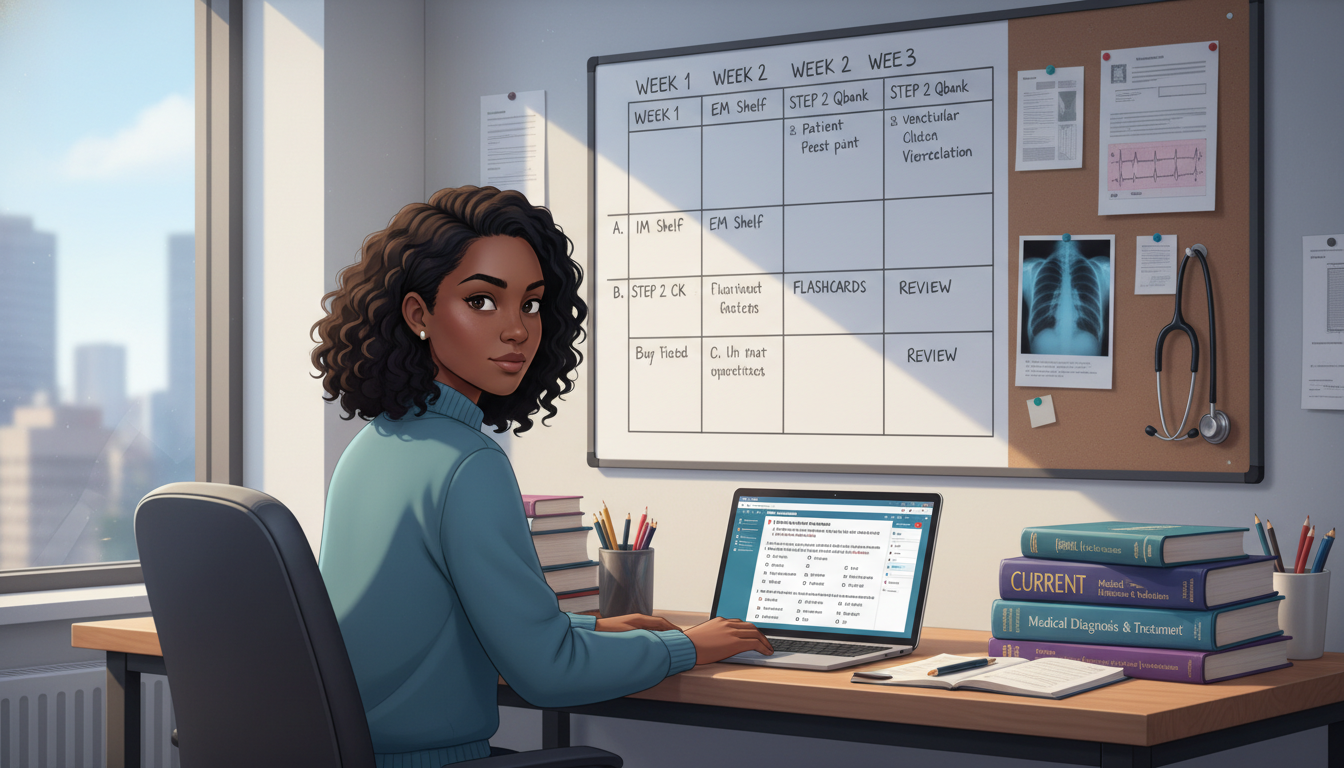
Preparing for USMLE Step 2 CK as an international medical graduate (IMG) with an interest in psychiatry is both a challenge and a strategic opportunity. Your Step 2 CK score is now one of the most important objective metrics residency programs use—especially for the psych match—since Step 1 is pass/fail.
This IMG residency guide will walk you through a comprehensive, psychiatry-focused approach to USMLE Step 2 CK preparation, with practical strategies, timelines, and examples specifically tailored for international medical graduates.
Understanding Step 2 CK in the Context of Psychiatry Residency
Step 2 CK is designed to test clinical application of medical knowledge. For future psychiatrists—and especially for an international medical graduate—this exam has several key roles:
- Objective academic signal: Programs may weigh your Step 2 CK score heavily to gauge your readiness, particularly if your medical school is less known in the U.S.
- Clinical reasoning benchmark: It assesses how well you integrate medical, psychosocial, and ethical dimensions—skills that are central to psychiatry.
- Tie-breaker in the psych match: In psychiatry, where holistic review is common, a strong Step 2 CK score can offset weaker elements (e.g., lower Step 1, older graduation year, or limited U.S. clinical experience).
What Psychiatry Program Directors Look For
While each program is different, you can assume most psychiatry residency programs pay attention to:
- Solid, not necessarily perfect, Step 2 CK score
- Many academic programs like to see scores at or above the national mean; competitive programs may prefer scores significantly above it.
- Consistent performance in behavioral health and neurologic domains
- Evidence of strong clinical judgement, ethics, and communication, often reflected indirectly through Step 2 CK performance
- Trajectory: Improvement from Step 1 to Step 2 CK is viewed positively, especially for IMGs.
As an IMG, your USMLE Step 2 study strategy must acknowledge that Step 2 CK is not just “one more exam”—it’s a core part of your psychiatry residency narrative.
Building a Psychiatry-Focused Step 2 CK Study Plan
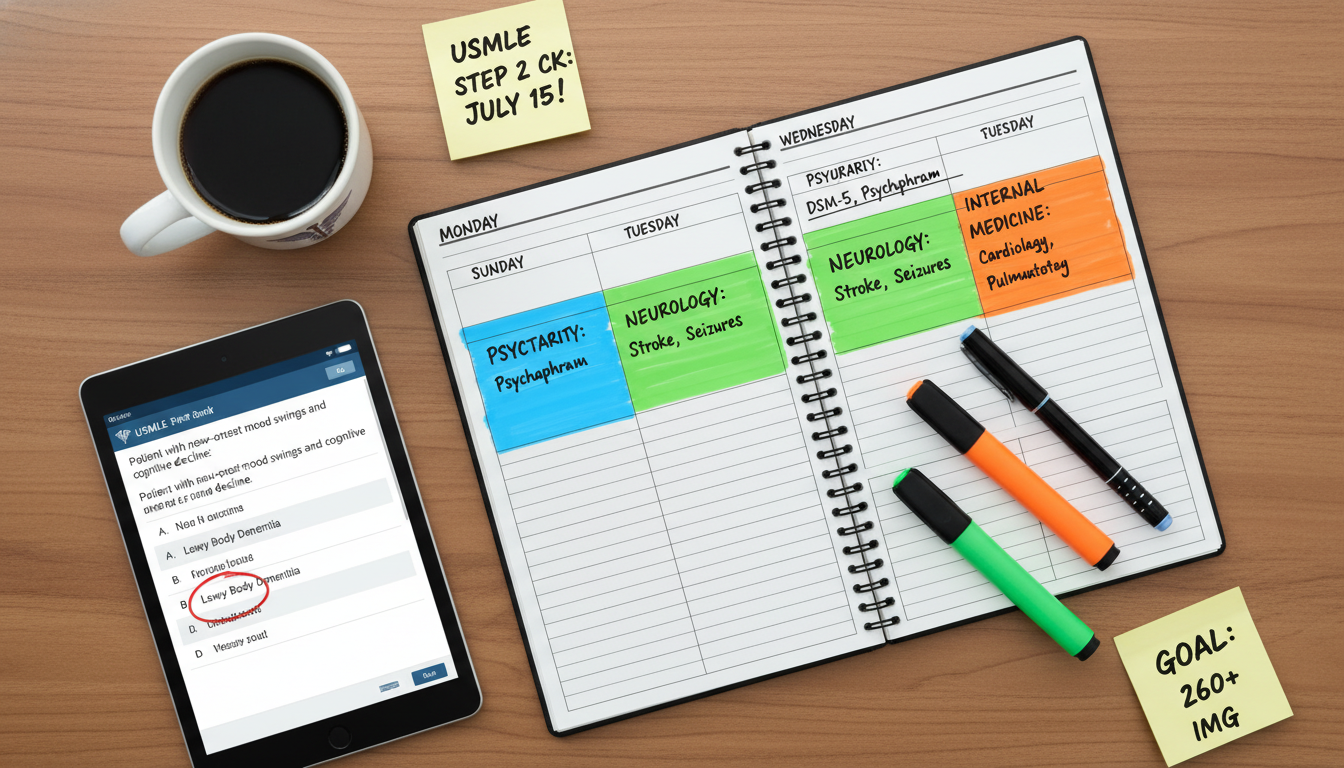
A successful USMLE Step 2 CK preparation plan for an international medical graduate in psychiatry should integrate three elements:
- Core clinical medicine foundation
- High-yield psychiatry and neurology mastery
- Strategic test-taking and schedule planning around your application timeline
Step 1: Define Your Timeline Backwards From the Match
For the residency match, timing is critical. Consider these general scenarios:
- You have not yet applied and plan to match in the upcoming cycle
- Aim to take Step 2 CK no later than August–September before ERAS opens, so your score is available early in the season.
- You are 1–2 cycles away from applying
- You can optimize for your best possible Step 2 CK score, even if that means testing slightly later, as long as it doesn’t delay your graduation or visa paperwork.
A common IMG prep timeline:
- Dedicated prep: 3–4 months for full-time study (ideal if you’re a recent graduate or on a break)
- Longer prep: 6–9 months if you’re working, doing observerships, or have family/visa constraints
In this case, use a structured, lower-intensity schedule with daily UWorld and weekly content blocks.
Step 2: Baseline Assessment
Before you build your detailed Step 2 CK preparation plan, you need a realistic baseline:
- Do a targeted assessment using:
- NBME Comprehensive Clinical Science Self-Assessment (CCSSA) or
- A short block of mixed UWorld Step 2 CK questions (40–80 items) timed and random
- Record:
- Overall percentage / predicted score
- Weakest systems and disciplines (psychiatry, neurology, internal medicine, OB/Gyn, etc.)
For many IMGs heading into psychiatry, baseline weak spots often include:
- U.S.-style ethics and patient safety
- Preventive medicine and health maintenance
- Ambulatory internal medicine, especially in U.S. guidelines context
- Structured approaches to emergency psychiatry and toxicology
This baseline will guide how you allocate your study time.
Step 3: Weekly Structure for IMGs Targeting Psychiatry
A practical weekly structure for full-time Step 2 CK preparation might look like:
- Question Bank (QBank):
- 40–80 timed, random questions/day (UWorld as primary, others optional)
- Review:
- 2–3 hours/day to review all questions, even those answered correctly
- Content Review:
- 1–2 hours/day using your main review resource(s) (e.g., OnlineMedEd, Boards & Beyond, or a concise Step 2 book)
- Psychiatry/Neurology Emphasis:
- At least 2 dedicated half-days per week focusing on:
- Mood, anxiety, psychotic, personality, neurocognitive, substance use disorders
- Pediatric/adolescent psychiatry
- Neurologic emergencies, seizures, stroke, dementia
- At least 2 dedicated half-days per week focusing on:
For IMGs working or in observerships, cut daily question volume but keep consistency—e.g., 20–40 questions per day, 6 days/week.
Core Resources and How to Use Them Effectively
The best USMLE Step 2 study strategy is not about collecting the most resources; it’s about using a few high-yield tools deeply and consistently.
Question Banks (QBank) Strategy
1. UWorld Step 2 CK (Primary)
This should be the backbone of your Step 2 CK preparation:
- Do questions timed and random, exam-style, not by single subject.
- Aim for:
- At least 1 full pass (~3,000+ questions)
- If time permits, a second pass focusing on incorrects or weak systems
- Pay attention to:
- Psychiatry, neurology, ethics, patient safety, and ambulatory medicine questions
- Explanation logic: why distractors are wrong is often more educational than why the correct answer is right.
2. Amboss or Other Secondary Banks (Optional)
Use only if:
- You finish UWorld early and still have >6–8 weeks; or
- You need more questions in a particularly weak area (e.g., neurology).
For IMGs, it’s better to know one QBank deeply than to skim multiple.
Content Review Resources
Because Step 2 CK is clinically oriented, your content review should focus on clinical decision-making, not raw memorization.
Common high-yield options:
- OnlineMedEd (videos + notes)
- Good for building or refreshing a clinical framework.
- For psychiatry-focused IMGs: pay extra attention to internal medicine, emergency, neurology, and OB/Gyn lectures, as these often intersect with psychiatric practice.
- Boards & Beyond Step 2 or similar review courses
- Useful if you prefer a more comprehensive but still structured content review.
- A concise Step 2 CK review book (e.g., First Aid for Step 2 CK or similar)
- Use as a reference; do not attempt to memorize it cover-to-cover in isolation from questions.
Psychiatry-Specific Reinforcement
As a psychiatry-bound IMG, use your interest to deepen high-yield Step 2 areas:
- DSM-5 criteria (conceptual rather than rote):
- Understand core symptom clusters distinguishing major depressive disorder vs bipolar vs schizoaffective vs schizophrenia.
- First-line treatment algorithms:
- Depression: SSRI as initial therapy, adjustments if inadequate response, augmentation vs switching strategies.
- Bipolar: mood stabilizers (lithium, valproate) and when to avoid antidepressant monotherapy.
- Psychosis: typical vs atypical antipsychotics, major side effect profiles (e.g., metabolic syndrome, extrapyramidal symptoms, neuroleptic malignant syndrome).
- Emergency psychiatry:
- Management of suicidal patients, violent/agitated patients, and acute intoxication/withdrawal.
- Special populations:
- Peripartum psychiatry, adolescent depression/suicidality, psych in medically ill or neurologic patients.
Many of these topics show up heavily on Step 2 CK and also align with what psychiatry programs expect you to know on day one.
High-Yield Psychiatry & Neurology Topics for Step 2 CK

While Step 2 CK is broad, certain psychiatry-related topics are disproportionately high-yield and highly relevant to your future specialty.
Mood and Anxiety Disorders
Know for each major disorder:
- Core diagnostic features
- Time course, impairment level, exclusion of medical/substance causes
- Most appropriate initial treatment
- Pharmacologic: SSRIs, SNRIs, bupropion, mirtazapine, benzodiazepines (short-term), mood stabilizers
- Psychotherapy: CBT, interpersonal therapy, exposure therapy, family therapy
- Management of treatment resistance:
- Stepwise adjustment, augmentation, and when to consider ECT
- Danger situations:
- Active suicidality: When inpatient admission is mandatory versus voluntary.
Example Step 2 scenario:
A 35-year-old patient with MDD who fails two adequate SSRI trials. The exam may ask for the next best step—augmentation vs switch, psychotherapy integration, or workup for underlying thyroid disease.
Psychotic and Bipolar Disorders
Be comfortable with:
- Differentiating:
- Schizophrenia vs schizoaffective vs mood disorder with psychotic features
- Recognizing:
- Catatonia and its benzodiazepine/ECT-based management
- Choosing:
- Appropriate antipsychotics in patients with metabolic risk, Parkinson’s disease, or pregnancy
- Handling emergencies:
- Acute agitation: non-pharmacologic de-escalation + IM medications (e.g., haloperidol + lorazepam)
For an international medical graduate, one major pitfall is relying solely on local treatment patterns rather than guideline-based U.S. practice. Focus on U.S.-standard algorithms.
Substance Use Disorders and Toxicology
Substance use and co-occurring mental illness are core to both psychiatry residency and Step 2 CK:
- Alcohol use disorder:
- Screening (AUDIT-C), withdrawal management (benzodiazepines, thiamine before glucose), long-term pharmacotherapy (naltrexone, acamprosate, disulfiram).
- Opioid use disorder:
- Withdrawal management, buprenorphine vs methadone vs naltrexone.
- Intoxication/withdrawal syndromes:
- Alcohol, benzodiazepines, opioids, stimulants, hallucinogens, PCP.
Also, know psychiatric medication toxicities:
- Lithium: toxicity, renal and thyroid monitoring, contraindications in pregnancy.
- Valproate: hepatotoxicity, thrombocytopenia, teratogenicity.
- Clozapine: agranulocytosis, myocarditis, seizure risk, mandatory ANC monitoring program.
Neurocognitive Disorders and Delirium
These are heavily tested and central to psych-neuro overlap:
- Distinguish:
- Delirium vs dementia vs depression (“pseudodementia”)
- Know:
- Workup for reversible dementias (B12 deficiency, hypothyroidism, normal pressure hydrocephalus, depression).
- Acute delirium management:
- Identify precipitating medical illness, avoid benzodiazepines except in specific contexts (e.g., alcohol withdrawal), use low-dose antipsychotics cautiously.
Ethics, Communication, and Psychiatry
Psychiatry cases are often used to test ethics and patient-physician relationships:
- Capacity assessment:
- Understand that capacity is decision-specific and dynamic; criteria include understanding, appreciation, reasoning, and expressing a choice.
- Involuntary commitment standards:
- Risk of harm to self/others or inability to care for self.
- Confidentiality exceptions (e.g., duty to warn if there is clear, imminent risk to an identifiable victim).
Consistent practice with ethics vignettes in your QBank will significantly improve this domain of your Step 2 CK score.
Test-Taking Strategy, Practice Exams, and Final Month Plan
Your knowledge base is only one part of USMLE Step 2 preparation; how you take the exam matters enormously.
Using Practice Exams (NBMEs, UWSA, etc.)
For an IMG aiming at psychiatry, practical use of assessments might look like:
- 8–10 weeks before exam:
- Take NBME CCSSA (e.g., Form 10 or 11) to measure progress and adjust.
- 4–6 weeks before exam:
- Take NBME CCSSA (another form) + UWorld Self-Assessment (UWSA 1).
- 2–3 weeks before exam:
- Take UWSA 2 (often closely predictive for many examinees).
Track:
- Score progression (aim for stable or upward trend).
- Subscore weaknesses (e.g., neurology, ethics, OB/Gyn).
- Specific pattern errors (e.g., misreading questions, running out of time, changing correct answers).
If assessments remain lower than your target range close to the exam date, you may need to postpone your test. As an international medical graduate, a modest delay is acceptable if it substantially increases your likely Step 2 CK score—especially before psychiatry application.
Time Management on Exam Day
Step 2 CK is a long exam with eight 1-hour blocks. For many IMGs, stamina and pacing are as big a challenge as content:
- Average:
- ~1 minute 15 seconds/question; leave buffer for harder items.
- During practice:
- Do full 40-question timed blocks consistently.
- Train yourself to:
- Quickly eliminate 2–3 obviously wrong options.
- Move on rather than obsess over a single question.
Between blocks:
- Take short breaks (5–10 minutes) more frequently rather than one long break.
- Hydrate, snack lightly, and avoid heavy meals that can cause fatigue.
Final 4 Weeks: What to Focus On
In the last month, your Step 2 CK preparation should become more targeted:
- Finish UWorld (or get as close as possible), including marked and incorrect questions.
- Review high-yield weak areas:
- For psych-focused IMGs, this often means:
- Neurology (stroke, seizures, headache, neuromuscular disease)
- OB/Gyn and pediatrics (where psychiatric and psychosocial issues often hide)
- Ethics and biostatistics if scores are low in these sections.
- For psych-focused IMGs, this often means:
- Condensed psychiatry review:
- Make or review a concise psych pharm chart:
- Class, mechanism, indications, key side effects, black-box warnings.
- Summarize major disorders in one-page frameworks (e.g., mood vs psychotic vs anxiety vs neurocognitive).
- Make or review a concise psych pharm chart:
- Practice reading speed:
- If English is not your first language (common for IMGs), spend extra time on:
- Reading long vignettes aloud during study.
- Timed practice to maintain comprehension without rushing.
- If English is not your first language (common for IMGs), spend extra time on:
During the last week:
- Avoid starting brand-new resources.
- Focus on:
- Light review of notes/formulas
- A manageable number of questions
- Sleep and routine to simulate exam conditions.
Integrating Step 2 CK Preparation With Psychiatry Match Strategy
For an international medical graduate, USMLE Step 2 CK preparation cannot be isolated from the bigger picture: achieving a psychiatry residency position.
How Step 2 CK Fits Into Your Overall Psych Match Story
Programs will see:
- Step 1: Pass/Fail (and possibly a numerical score if taken earlier)
- Step 2 CK score
- Psychiatry letters of recommendation (especially U.S.-based)
- Psychiatry electives, observerships, and research
- Personal statement and CV
A strong Step 2 CK score:
- Reinforces your clinical readiness, compensating for lack of U.S. school name recognition.
- Supports your claim of genuine interest in psychiatry when paired with:
- Psych-related experience
- Thoughtful psych-themed personal statement
- Can be especially powerful if:
- Your Step 1 performance was borderline, and Step 2 CK shows significant improvement.
Practical Tips for IMGs Balancing Prep and CV Building
- If you’re in observerships or electives:
- Dedicate protected time daily (even 60–90 minutes) for QBank practice.
- Use real patient encounters to reinforce Step 2 topics:
- Ask attendings about diagnostic reasoning and guideline-based management.
- If you’re doing research:
- Prioritize backing up your Step 2 CK preparation schedule in a calendar.
- Avoid agreeing to new major projects in the last 2–3 months before your exam.
Always remember: for many IMG psychiatry applicants, Step 2 CK score + strong psych experience is the most convincing pairing.
Frequently Asked Questions (FAQ)
1. What Step 2 CK score should an IMG targeting psychiatry aim for?
While there is no universal cutoff:
- Being at or above the national mean is usually adequate for many community and some academic programs.
- For more competitive or academic psychiatry programs, aim for a score significantly above average.
- As an international medical graduate, a higher Step 2 CK score can help offset lack of U.S. medical school training; therefore, set a realistic but ambitious goal based on your baseline and time frame.
2. How much time does an IMG typically need to prepare for Step 2 CK?
For most IMGs:
- 3–4 months of dedicated, full-time study is common.
- If you are working, in observerships, or have family/visa pressures, you may need 6–9 months with a lower daily volume but consistent practice.
- The best indicator of readiness is NBME and UWorld self-assessment performance, not just time spent.
3. Do I need psychiatry-specific resources beyond QBank and standard Step 2 materials?
Usually, no. For Step 2 CK:
- A high-quality QBank (like UWorld) plus general Step 2 review resources are sufficient.
- If you feel weak in psychiatry:
- You can briefly use a concise psychiatry textbook or dedicated review (e.g., a short clinical psychiatry handbook or lecture series).
- Focus on treatment algorithms, emergency management, and common diagnoses rather than esoteric details.
4. Should I delay my residency application to improve my Step 2 CK score?
It depends on your situation:
- Consider delaying if:
- Your practice scores (NBMEs/UWSAs) are well below your target range, and
- You truly believe you can significantly improve with additional dedicated preparation, and
- Delaying by a cycle won’t cause extreme visa or financial hardship.
- If you’re close to your target range and time is short before ERAS, it may be better to:
- Take the exam, apply broadly, and strengthen other parts of your application (letters, psychiatry experience, personal statement).
By approaching your USMLE Step 2 study with a structured plan, psychiatry-focused reinforcement, and deliberate test-taking strategies, you can turn Step 2 CK into a major asset for your psychiatry residency application as an international medical graduate.