



Understanding Step 2 CK as an IMG Aiming for Urology
For an international medical graduate (IMG) interested in urology residency in the United States, USMLE Step 2 CK is one of your most powerful tools. With Step 1 now pass/fail, program directors weigh your Step 2 CK score more heavily—especially in competitive fields like urology.
A focused IMG residency guide for urology must treat Step 2 CK not just as an exam, but as a strategic opportunity to show you can succeed in a demanding surgical specialty. Your performance signals:
- Clinical reasoning in acute and perioperative settings
- Ability to manage complex comorbidities (e.g., renal failure, sepsis, anticoagulation)
- Breadth of knowledge across internal medicine, surgery, pediatrics, OB/GYN, psychiatry, and emergency medicine
- Readiness to be a safe, effective intern
While Step 2 CK is not a “surgery-only” exam, many clinical scenarios overlap with urology practice (renal disease, electrolyte disorders, infections, oncology, reproductive issues, trauma). Your USMLE Step 2 study plan should therefore be broad, but with an eye toward skills that will strengthen your urology residency application.
Why Step 2 CK Matters More for Urology
- Highly competitive specialty: Urology match rates are lower than many other fields; program directors often use Step 2 CK score thresholds for interview offers.
- Step 1 is pass/fail: Without a numeric Step 1 score, the Step 2 CK score becomes a primary metric for academic comparison.
- IMG status: As an international medical graduate, you’re often compared to US graduates with home institution advantages. A strong Step 2 CK score helps close that gap.
- Clinical performance proxy: Urology involves rapid decision-making in acute settings (obstruction, sepsis, trauma). Step 2 CK tests this kind of thinking.
For IMGs, a competitive Step 2 CK score for urology will typically be well above the national mean. Exact numbers change by cycle, but aim to be as far above average as your circumstances allow. Many successful urology applicants score in the high 240s and above; IMGs especially benefit from maximizing their score to stand out.
Building a Strategic Step 2 CK Timeline as an IMG
As an IMG, your timeline may differ from US graduates due to internship obligations, visa issues, or delayed exam scheduling. Still, certain principles apply to almost everyone.

Step 1: Clarify Your Match Year and Urology Timeline
Urology has an early match through the AUA (American Urological Association). This means:
- Applications typically open earlier than NRMP main match
- Programs may review your file—and offer interviews—before some candidates have taken Step 2 CK
As an IMG, you should aim to have your Step 2 CK score available before urology programs review applications, which usually means:
- Taking Step 2 CK no later than June–July of the year you’re applying
- Allowing 3–4 weeks for score reporting
- Working backward to set your dedicated study period
If you are still in medical school (or early postgraduate training), coordinate with your dean’s office or hospital to ensure you can schedule your exam early enough.
Step 2: Assess Baseline and Available Study Time
Before locking in a test date, honestly evaluate:
- Clinical knowledge: Are you recently graduated or years out of school?
- Language & test-taking skills: Are you fully comfortable with long, complex English passages?
- Current obligations: Full-time internship, part-time work, or research?
- Prior USMLE performance: Strong Step 1 foundation vs. borderline pass?
Use one baseline self-assessment (like an NBME or UWorld self-assessment) early, even if your score is low. This will guide your study length. A common approach:
- Low baseline (<220): 4–6 months part-time, or 3–4 months full-time
- Average baseline (220–235): 3–4 months part-time, or 2–3 months full-time
- High baseline (235+): 2–3 months focused, possibly overlapping with clinical rotations
Step 3: Build a Realistic Study Schedule
A solid IMG residency guide for Step 2 CK emphasizes consistency over perfection. General guidance:
Daily time commitment
- Full-time study: 8–10 hours/day, 6 days/week
- Part-time (with work/rotations): 3–5 hours/day, 6 days/week
Weekly structure
- 4–5 days: System-based or discipline-based question blocks + review
- 1 day: Mixed review, weak areas, or practice test segments
- 1 rest/light day: Prevent burnout
Example (full-time) weekly structure:
Morning (4–5 hours)
- One or two timed blocks of 40 questions (UWorld or similar)
- Immediate detailed review of all questions
Afternoon (3–4 hours)
- Video or text resource for weak topics (e.g., cardiology, renal, OB, psych)
- Note-making or flashcards (especially for drugs, criteria, algorithms)
Evening (1–2 hours)
- Anki or spaced repetition
- Brief reading of high-yield summaries
Adjust this to your energy levels and commitments, but preserve daily contact with questions and regular mixed reviews.
Core Resources and How to Use Them Effectively
The best USMLE Step 2 study approach focuses on depth, not collecting too many resources. Most high scorers—IMGs included—use a narrow set very well.
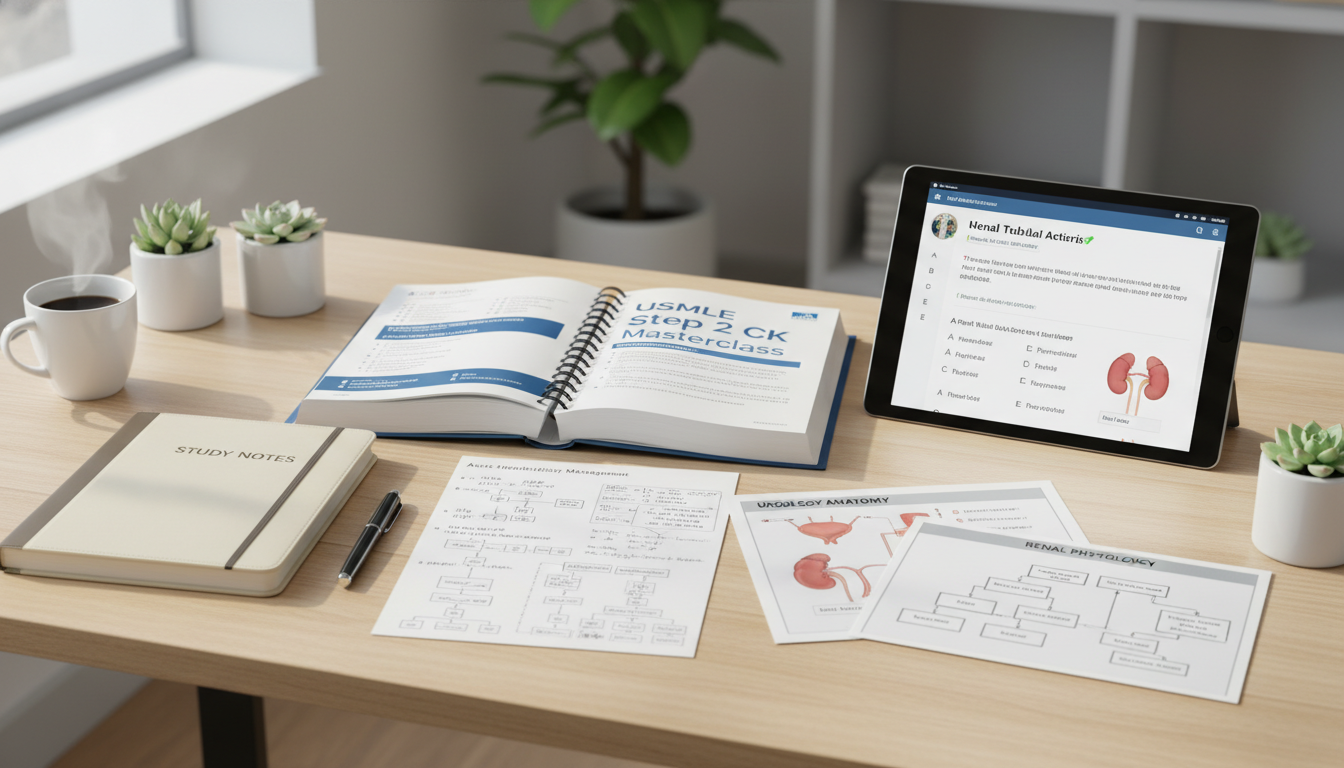
1. Question Banks (Qbanks): Your Primary Tool
UWorld Step 2 CK
- Non-negotiable for almost everyone; treat it as your core curriculum
- Use Timed, Random blocks as soon as possible, to simulate the real exam
- Aim to complete 100% of the questions, ideally 1.5–2 passes if time permits
How to use UWorld well:
- Do 40–80 questions/day depending on schedule
- Review each question thoroughly:
- Why was the correct answer right?
- Why was each wrong option wrong?
- What concept is being tested (diagnosis, first-line therapy, next best step, prognosis, screening)?
- Capture high-yield points in concise notes or Anki cards, especially algorithms for:
- Chest pain, dyspnea, syncope
- Acute abdomen, trauma, sepsis
- AKI, CKD, acid-base disorders
- Pregnancy complications, gynecologic emergencies
- Pediatric fevers, rashes, developmental milestones
Though not a urology exam, UWorld has many scenarios relevant to urology practice:
- Urinary tract infections, pyelonephritis, prostatitis
- Nephrolithiasis, hematuria workup
- Renal failure and dialysis indications
- Testicular torsion vs epididymitis
- Urologic oncology (bladder, prostate, renal, testicular cancers—mostly from medicine, surgery, and oncology perspectives)
Supplementary Qbanks (If Time Permits)
- AMBOSS or USMLE-Rx (secondary, for extra practice or explanation styles)
- Use selectively for weak areas or after finishing UWorld once
2. Content Review: Books and Online Resources
There is no single “urology residency” specific Step 2 CK book; focus on broad, clinical content.
Commonly used:
- Online MedEd (videos + notes):
- Great for initial overview of core subjects
- Especially useful for IMGs longer out of school or with weaker clinical exposure
- Master the Boards Step 2 CK or Step-Up to Medicine:
- Good for structured, high-yield text review
- Read selectively, especially for internal medicine, OB/GYN, pediatrics
How to integrate:
- Use videos or chapters to clarify UWorld-identified weak spots instead of trying to cover everything front-to-back.
- Prioritize systems that heavily influence your Step 2 CK score:
- Cardiology, pulmonology, gastroenterology, nephrology
- Infectious disease, rheumatology, endocrinology
- OB/GYN, pediatrics, psychiatry, neurology
3. Spaced Repetition (Anki or Similar)
Spaced repetition is particularly valuable for IMGs, as it reinforces terminology and guidelines in English.
- Use pre-made decks (e.g., popular Step 2 CK decks) or build your own from:
- UWorld notes
- Mistakes on practice exams
- Complex algorithms or diagnostic criteria
- Aim for daily review (20–60 minutes), not cramming
Focus cards on:
- Diagnostic criteria (e.g., major depression, SLE, Kawasaki disease)
- First-line treatments and alternatives
- Dosing and side-effect patterns for common drugs
- Clinical decision rules (e.g., Wells criteria, Ottawa ankle rules)
High-Yield Clinical Domains with Extra Relevance to Urology
Even though the exam isn’t specialty-specific, some areas are indirectly more important for someone targeting a urology residency. This doesn’t mean you over-study urology itself, but you strengthen domains that underpin urologic practice.
1. Nephrology and Fluid/Electrolyte Disorders
Urologists constantly manage or collaborate on renal issues:
- Obstructive uropathy and post-obstructive diuresis
- Perioperative fluid management in patients with CKD
- Electrolyte imbalances (especially Na+, K+, and acid-base status)
- Indications for urgent dialysis
Step 2 CK commonly tests:
- AKI: Pre-renal, intrinsic, post-renal differentials
- CKD: Staging, complications (anemia, mineral bone disease), ACEi/ARB use
- Electrolyte management:
- Hyperkalemia (ECG changes, urgent treatment)
- Hyponatremia (acute vs chronic, when to use hypertonic saline)
- Metabolic acidosis/alkalosis and respiratory compensation
Actionable tip: After each nephrology block in UWorld, draw out management algorithms. This habit both boosts your Step 2 CK score and prepares you for perioperative decision-making in urology.
2. Infections, Sepsis, and Antibiotic Stewardship
Urology involves frequent management of:
- Complicated UTIs and pyelonephritis
- Catheter-associated infections
- Postoperative sepsis
Step 2 CK expects you to:
- Recognize early signs of sepsis and septic shock
- Start appropriate empiric antibiotics based on setting (community vs hospital vs ICU, neutropenia, pregnancy)
- Adjust therapy based on culture results and local resistance patterns (conceptually)
- Distinguish sterile inflammation from infection (e.g., postoperative fever causes)
Actionable tip: Create a small antibiotic table for common infections (UTI, pneumonia, skin/soft tissue, intra-abdominal, meningitis) and memorize it early.
3. Oncologic Principles
Many urologists focus on oncology (prostate, bladder, kidney, testicular cancers). Step 2 CK tests:
- Basic cancer screening (PSA guidelines, colonoscopy, cervical cancer screening, lung cancer screening)
- Initial evaluation of a mass, hematuria, or incidental imaging findings
- Paraneoplastic syndromes
- Palliative care principles and communication
For urology-related topics:
- Hematuria workup (very commonly tested):
- Distinguish glomerular vs non-glomerular sources
- When to perform cystoscopy, imaging studies
- Testicular mass: urgent ultrasound, torsion vs tumor vs epididymitis
- Prostate cancer basics: screening controversies, biopsy indications, high-yield complications (e.g., spinal cord compression)
4. Surgical and Perioperative Medicine
Even though Step 2 CK is not a surgical exam, perioperative medicine is important:
- Preoperative risk stratification (cardiac, pulmonary, renal)
- Managing anticoagulants around surgery
- DVT prophylaxis
- Acute abdomen and abdominal trauma
- Postoperative complications (atelectasis, PE, wound infection, anastomotic leak)
Actionable tip: Group perioperative topics as a separate revision theme. This will benefit your urology match preparation because many interview questions explore your understanding of surgical risk and patient safety.
Test-Taking Strategy, Practice Exams, and Score Optimization
To achieve a competitive Step 2 CK score for urology, you must master not just content but exam behavior.
1. Full-Length Practice Exams
Use NBMEs and UWorld self-assessments (UWSA) strategically:
- Take your first NBME early (even if low) to identify gaps and set a realistic target
- Schedule at least 3–4 practice exams across your preparation:
- NBME early (diagnostic)
- NBME mid-way (adjust study plan)
- UWSA1 and UWSA2 in the final 4–6 weeks
- Try to simulate real conditions: timed, minimal breaks, quiet environment
You’ll often see that predicted scores from later NBMEs/UWSAs approximate your final Step 2 CK score within a reasonable range. If these are falling below what you think you need for a urology match, extend your study or adjust your exam date if possible.
2. Exam-Day Skills
Time management
- 8 or more blocks of 40 questions; you must sustain attention for 8+ hours
- Practice your own break strategy beforehand (e.g., short breaks after every 2 blocks, a longer one in the middle)
- Do full-length mock days (3–4 blocks back-to-back) in the last month
Question approach
- Read the last line of the vignette first for long stems, if it helps focus your reading
- Identify the question type: diagnosis? next best step in management? test of choice?
- Eliminate wrong answers aggressively; often you’re choosing the “most appropriate next step,” not the “perfect” intervention
- Don’t get stuck: mark and move if you’re spending more than 75–90 seconds on a question
3. Common IMG Pitfalls and How to Avoid Them
Language barriers
- Misreading question stems or answer choices can cost points
- Read US clinical guidelines or patient education material to adapt to phrasing
- Practice aloud explaining a case to “a colleague” in English: this builds fluency
Over-focusing on rare diseases
- Step 2 CK rewards common, bread-and-butter conditions
- Rare syndromes are tested far less than MI, COPD exacerbations, appendicitis, depression, etc.
- Follow the frequency reflected in UWorld and NBMEs
Poor review of mistakes
- Passive reading of explanations is not enough
- For every wrong question, document:
- What you chose and why
- Why it was wrong (knowledge gap, misreading, rushing)
- What rule you must remember next time
Integrating Step 2 CK with Urology Match Strategy as an IMG
The urology match looks at far more than test scores, but your Step 2 CK score is one of the first numbers programs see. Integrating exam preparation with your broader urology residency plan is wise.
1. Using Score Reports to Guide Applications
Once you have your Step 2 CK score:
- Compare it to published or anecdotal ranges for matched urology applicants (especially IMGs, when data is available).
- A strong Step 2 CK score can partially compensate for:
- Lack of home urology program
- Limited US clinical experience
- Non-elite medical school
- A borderline score does not make urology impossible, but you’ll need to emphasize:
- Strong urology research
- Excellent letters of recommendation from US urologists
- Evidence of persistence and clinical excellence in rotations
2. Crafting Your Application Narrative
In your personal statement and interviews, you don’t need to talk extensively about Step 2 CK preparation, but you can highlight:
- Persistence and self-discipline (balancing study with work or research as an IMG)
- Rapid improvement (if your self-assessment scores rose significantly)
- Love of problem-solving and complex clinical reasoning
These traits translate naturally to urology, a field that demands technical skill plus nuanced medical judgment.
Sample 12-Week Step 2 CK Study Plan for a Urology-Oriented IMG
Below is a condensed example to adapt:
Weeks 1–4: Foundation & UWorld Phase 1
- Daily:
- 1 block of 40 UWorld questions (timed, system-based initially)
- 3–4 hours of detailed review
- 1–2 hours of targeted content (Online MedEd or text) for weak systems
- 30–60 minutes Anki
- End of Week 2: First NBME for baseline and adjustment
- Focus systems: Internal Medicine heavy (cardio, pulmonary, GI, nephro, ID)
Weeks 5–8: Integration & Mixed Qblocks
- Daily:
- 1–2 blocks of 40 questions (timed, mixed)
- Review + algorithm building
- Short focused content review (OB, pediatrics, psych, neuro)
- Week 6: NBME or UWSA1
- Focus on:
- Perioperative medicine, sepsis, trauma, electrolyte disorders
- Pediatric and OB/GYN essentials (don’t neglect!)
Weeks 9–11: Refinement & Exam Simulation
- Finish remaining UWorld
- Re-do marked or incorrect questions if possible
- Weekly full-length practice exam (NBME or UWSA2) under exam-like conditions
- Targeted review of:
- Mistake patterns in practice tests
- High-yield tables and algorithms
- Weak domains (document them clearly and attack)
Week 12: Taper & Mental Preparation
- Light question practice (20–40/day)
- High-yield rapid reviews only
- Sleep hygiene and physical health focus
- Final 2–3 days: no heavy new content; focus on confidence and rest
FAQs: Step 2 CK and Urology for IMGs
1. What Step 2 CK score should an IMG aim for to be competitive in the urology match?
There is no official cutoff, and it varies by year and program. However, urology is highly competitive, and many matched applicants—especially from US schools—score in the mid- to high-240s or above. As an international medical graduate, you should aim as high as realistically possible relative to your baseline, recognizing that a stronger score gives you more options but does not guarantee a match. Programs evaluate the whole application, including research, letters, and US clinical experience.
2. Should I delay Step 2 CK to get a higher score, even if it means my result is available later in the urology application cycle?
If you believe that an extra 4–8 weeks of focused, efficient preparation could significantly raise your Step 2 CK score, it may be worth delaying—but only if you can still have your score reported before most programs finish initial reviews. Because urology uses an early match, careful planning is critical. If your practice scores are far below your target for urology, it’s usually better to delay a bit (within reason) than to rush and risk a weak outcome that is hard to “fix” later.
3. How much urology-specific knowledge do I actually need for Step 2 CK?
You do not need subspecialty-level urology expertise for Step 2 CK. Focus primarily on: UTIs, pyelonephritis, prostatitis, nephrolithiasis, hematuria evaluation, testicular torsion vs epididymitis, and basics of prostate/bladder/renal/testicular cancer assessment. The exam mostly tests general clinical medicine, so your time is better spent mastering high-yield internal medicine, surgery, OB/GYN, pediatrics, and psychiatry.
4. I’m an IMG with a heavy clinical schedule. How can I realistically prepare for Step 2 CK?
Prioritize efficiency and consistency:
- Use 1 high-quality qbank (e.g., UWorld) as your main resource
- Aim for at least one 40-question block per day with meticulous review
- Integrate 30–60 minutes of Anki or flashcards daily
- Use commute or short breaks for quick video segments or note review
- Protect 1 full day per week (or at least a half-day) for a larger study block
If your clinical schedule is extremely demanding, extend your total preparation timeline (e.g., 5–6 months) rather than trying to compress everything into a few chaotic weeks.
By anchoring your Step 2 CK preparation to a well-structured, clinically focused plan, you not only improve your Step 2 CK score but also cultivate the clinical reasoning, discipline, and resilience that urology residency programs value in IMGs.




















