Understanding the Interventional Radiology Board Exam Landscape
Board exam preparation in Interventional Radiology (IR) is unique because it spans both diagnostic radiology and procedurally focused content. Knowing which exam(s) you’re preparing for will determine the best study strategy and board exam resources to use.
Most trainees will navigate some or all of the following:
- USMLE/COMLEX (medical students, early trainees)
- Diagnostic Radiology (DR) Core Exam (during IR/DR residency)
- IR/DR Certifying Exam (after residency)
- Maintenance of Certification (MOC)/Continuous Certification (attendings)
While this guide focuses primarily on board exam study resources for IR residents and applicants interested in interventional radiology residency, you’ll see integrated advice for earlier and later stages because preparation is cumulative.
Exam types relevant to IR
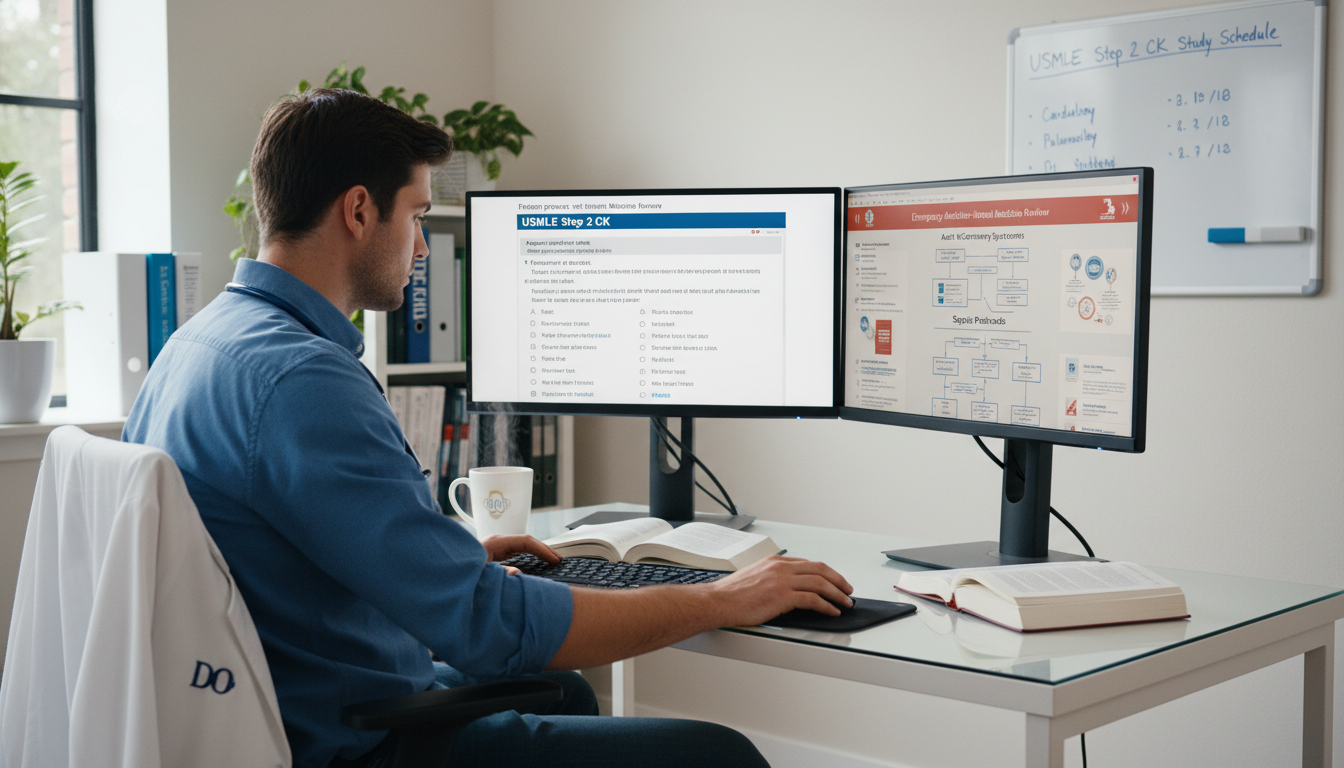
USMLE Step 1, Step 2 CK (and sometimes Step 3)
- Foundation for entering an interventional radiology residency (IR/DR).
- Performance impacts your IR match competitiveness.
- Resources here heavily overlap with classic “Anki USMLE” and UWorld tips.
ABR Core Exam (Diagnostic Radiology)
- Taken typically in PGY-4 (R3) during IR/DR training.
- Tests broad diagnostic radiology knowledge; some IR but not IR-heavy.
- Success is critical; failure can delay your IR/DR Certifying Exam timeline.
ABR IR/DR Certifying Exam
- Comes after training (with practice pathway requirements met).
- Focuses on interventional radiology, clinical decision-making, and image interpretation in procedural contexts.
- This is where IR-focused board exam resources matter most.
MOC / Continuing Certification
- Requires ongoing learning and periodic assessment.
- Many of the core resources (texts, Q-banks) remain relevant throughout your career.
The rest of this article will walk through high-yield, practical resources and strategies for each phase, with special emphasis on IR board preparation and how to integrate them throughout training.
Core Foundational Resources for IR Board Exams
Before diving into exam-specific prep, you need a solid base in IR concepts, procedural knowledge, and clinical reasoning. The IR/DR Certifying Exam will test not only “what” to do, but also why, when, and how safely.
Essential IR textbooks and references
These texts are not “read cover to cover in a month” books, but rather longitudinal learning resources you should use throughout residency and in the lead-up to your IR board exams.
Kandarpa & Machan – Handbook of Interventional Radiologic Procedures
- Highly practical, procedure-focused.
- Includes indications, contraindications, step-by-step technique, complications, and post-procedure care.
- Excellent for:
- Call nights
- Rotations on busy IR services
- Quick refresh before common cases (paracentesis, TACE, nephrostomy, embolization).
Ziv Haskal et al. – Vascular and Interventional Radiology: A Core Review
- Part of the Core Review series but extremely high yield for both the Core and IR/DR exams.
- Question-based with concise explanations.
- Great for transitioning from passive reading to active recall.
Valji – Vascular and Interventional Radiology
- More comprehensive introductory textbook.
- Good for PGY-2/PGY-3 IR rotations when you want more depth than a handbook but not full encyclopedic texts.
- Use as a conceptual framework that you later reinforce with question banks.
IR Bibles / Advanced Texts (e.g., Geschwind & Dake, “Interventional Radiology”)
- Excellent depth but often more than what you need for early exam prep.
- Use selectively for:
- Complex topics (e.g., portal hypertension interventions, complex aortic work).
- Fellowship-level or niche IR areas.
- Helpful for IR fellows and attendings preparing for certifying or MOC exams.
Must-know diagnostic radiology resources
Even for an interventional radiology residency, you are still required to be strong diagnostically:
- Core Radiology (Gupta)
- Great overview with emphasis on imaging patterns and exam-style content.
- CRQs and ABR Core-focused question books
- Help you develop the systematic thinking the ABR expects.
These are especially important as you balance IR enthusiasm with the reality that the IR/DR pathway is built on a diagnostic foundation.
Digital Study Tools: Anki, Question Banks, and Online Platforms
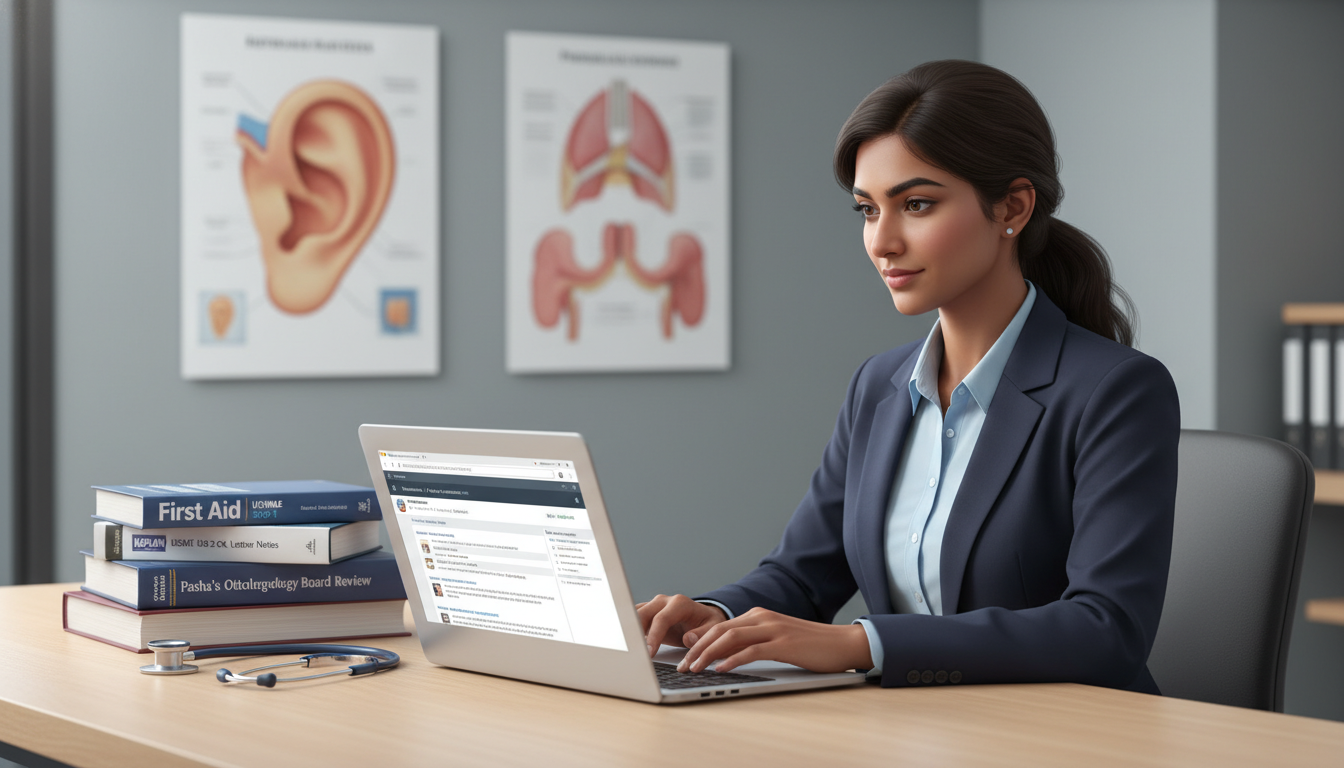
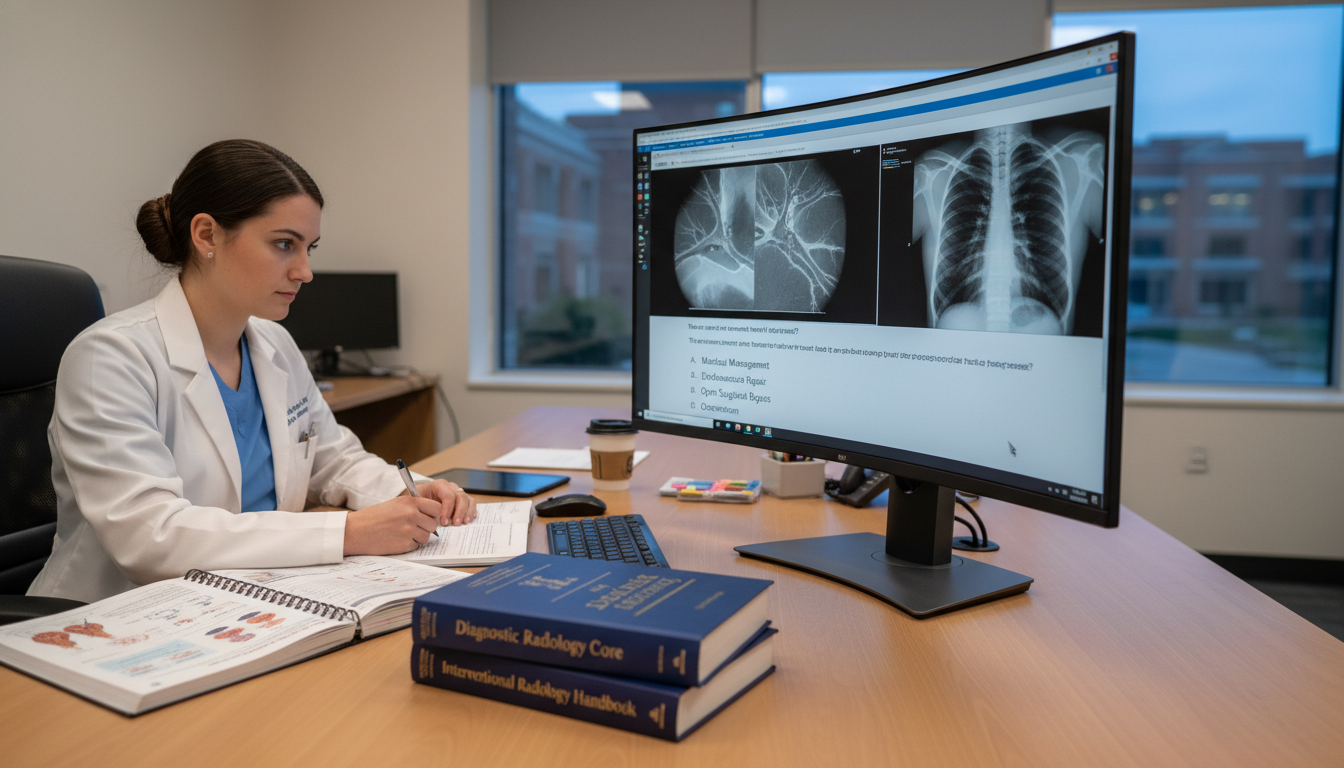
Modern board exam prep is built around spaced repetition, active recall, and repeated question exposure. For IR trainees, this means efficiently integrating Anki USMLE decks, radiology and IR question banks, and curated online resources.
Using Anki effectively for IR board prep
Many IR residents first encounter Anki for USMLE, but it remains powerful throughout residency.
1. During medical school and IR exploration (USMLE phase)
- Use established USMLE decks for:
- Anatomy (especially vascular anatomy, neuro, hepatobiliary, GU).
- Pathophysiology relevant to IR (e.g., coagulopathy, liver disease, oncology).
- Pharmacology of anticoagulants, antiplatelets, sedation, contrast agents.
These will:
- Strengthen your foundation for IR.
- Improve your competitiveness for the IR match.
- Make IR/DR concepts easier later because basic science and clinical medicine are more solid.
2. During IR/DR residency and Core/IR/DR exam prep
Create or adopt smaller, high-yield IR-specific decks:
What to include:
- Standard doses for common IR meds (heparin, protamine, thrombolytics).
- Complication rates and management (e.g., post-embolization syndrome, access site complications).
- Society guidelines (SIR indications/contraindications, anticoagulation management).
- Procedural workflows: TIPS steps, UFE algorithm, PAD management ladder.
Best practices:
- Keep cards short and focused.
- Use images: include angiograms, CT findings, stent types.
- Add cards immediately after conferences, error reviews, or “near misses” seen in practice.
Harnessing question banks: UWorld, Core-style Q-banks, and IR Q-banks
While there’s no single “UWorld for IR” equivalent yet, you can combine several platforms effectively.
UWorld tips for early radiology-bound trainees
For USMLE:
- Use UWorld to master internal medicine, surgery, and critical care scenarios that mirror IR consults (e.g., GI bleed, DVT/PE, sepsis, acute limb ischemia).
- Practice integrating imaging findings even when they’re only described, not visualized.
- Pay attention to:
- Coagulopathy management.
- Antibiotic selection.
- Vascular pathology and hemodynamics.
Translating UWorld learning into IR:
- For every vascular or oncologic UWorld question, ask yourself:
- “Could IR play a role here?”
- “What procedure would I consider?”
- “What risks and contraindications apply?”
- For every vascular or oncologic UWorld question, ask yourself:
Radiology and IR question banks
ABR Core-style Q-banks (e.g., RadPrimer, StatDx quizzes, Core-specific banks)
- Enhance pattern recognition and test-taking style for imaging-based questions.
- Good stepping-stone to the IR/DR exam’s imaging components.
IR-focused question resources
- IR sections within larger radiology banks.
- Dedicated IR review books with Q&A (e.g., Haskal’s “Core Review” question style).
- Online IR societies and organizations sometimes host:
- Case-of-the-day with questions.
- Self-assessment modules.
Strategy:
- Begin with broad radiology Q-banks in PGY-2/PGY-3.
- Intensify IR-specific questions in the 12–18 months before your IR/DR Certifying Exam.
- Track weak areas (e.g., hepatobiliary interventions, dialysis interventions, venous disease) and deliberately over-train them with targeted questions.
Online platforms and multimedia resources
- Radiopaedia & StatDx
- For imaging patterns and differential diagnosis across modalities.
- Society of Interventional Radiology (SIR)
- Guidelines, consensus statements, and clinical practice parameters.
- Frequently tested concepts on board exams (anticoagulation, consent, complication management).
- YouTube / IR teaching channels
- Step-by-step procedure videos.
- Can be highly effective for procedural flow and equipment recognition.
Actionable tip:
Create a “Board Exam” bookmarks folder with:
- SIR guidelines
- Core procedure summaries
- Favorite case series and review articles
Then, translate the key points from these into Anki cards and short notes.
Phase-Specific Study Strategies: From USMLE to IR/DR Certifying Exam
Your study approach should evolve as you progress through training. Below is a chronological roadmap.
Phase 1: Medical school and early exposure to IR
Goals:
- Excel on USMLE/COMLEX.
- Build a clinical foundation that will serve future IR practice.
- Demonstrate interest in IR for a successful IR match.
Key resources:
- Anki USMLE decks (e.g., popular Step 1 & Step 2 CK decks).
- UWorld Step 1 and Step 2 CK (with the UWorld tips above).
- IR elective readings:
- Kandarpa handbook (selected high-yield chapters).
- Intro IR review articles (e.g., “What is IR?” orientation pieces).
Practical advice:
- When you encounter topics like portal hypertension, PAD, PE, oncology, always ask:
- “How would IR help manage this patient?”
- Spend 1–2 half days shadowing IR during clinical years—this makes board content more “real” and memorable.
Phase 2: Early IR/DR residency (PGY-2/PGY-3)
Goals:
- Build a strong diagnostic radiology base for the Core Exam.
- Start structured IR learning without losing diagnostic focus.
- Learn procedural fundamentals and common indications.
Key resources:
- Core Radiology and other DR review texts.
- Radiology Q-banks (Core-focused).
- IR basics:
- Valji text for conceptual understanding.
- Kandarpa for techniques and practical details.
Study structure example:
- Weekly:
- 4 days: DR topics (CT/MR/US/NUC, basic physics).
- 1 day: IR topics (access, embolics, vascular anatomy, sedation).
- During IR rotations:
- Read 1–2 relevant Kandarpa chapters per day’s caseload.
- Add 5–10 Anki cards daily from interesting cases.
Phase 3: Core Exam year (PGY-4)
Goals:
- Pass the Core Exam confidently.
- Maintain IR skills and knowledge despite intense diagnostic focus.
Key resources:
- Core review books and Q-banks.
- IR “Core Review” style books (e.g., Haskal’s).
- Targeted IR reading for high-yield topics (e.g., contrast reactions, radiation safety—both IR and Core relevant).
Strategy:
- Core-heavy studying (imaging physics, all organ systems).
- Short, consistent IR review:
- One IR procedure or topic per week.
- Short Anki sessions for IR content (10–15 minutes/day).
Phase 4: Senior IR/DR years and IR/DR Certifying Exam preparation
Goals:
- Integrate clinical medicine, imaging, and procedural IR knowledge.
- Prepare specifically for the IR/DR Certifying Exam’s case-based, practice-oriented style.
Key IR board exam resources:
- IR procedure handbooks and stepwise guides (Kandarpa, Valji).
- IR-specific Q-banks and case-based materials.
- SIR guidelines and clinical practice recommendations.
- Institutional M&M cases, teaching files, and IR conferences.
High-yield content areas:
- Vascular:
- PAD, CLI, DVT/PE, IVC filters, aortic disease, dialysis access.
- Oncologic IR:
- TACE, Y-90, ablation (RFA, MWA, cryoablation), biopsy.
- Non-vascular:
- Drainage procedures, biliary and urinary interventions, G-tubes, abscess drainage.
- IR clinic and peri-procedural care:
- Anticoagulation management.
- Sedation and analgesia.
- Consent and patient selection.
- Complications:
- Recognition, grading, and management.
- Documentation and communication strategies.
Suggested 6–9 month study plan for IR/DR Certifying Exam:
Months 1–3: Foundation consolidation
- Read or re-read key IR chapters systematically (1–2 per day).
- Build or refine your IR Anki deck.
- Start IR-specific questions (slow but steady).
Months 4–6: Intensive practice and integration
- Increase Q-bank usage to ~30–50 IR questions per week.
- Work through SIR guidelines (anticoagulation, dialysis access, embolic materials).
- Participate actively in IR conferences—treat each case like a board case.
Months 7–9 (final phase): Simulation and test rehearsal
- Timed mixed-question sessions mimicking exam style.
- Focus on weak topics revealed by performance tracking.
- Review clinical algorithms (e.g., GI bleed pathways, trauma IR algorithms).
Building an Integrated Study Ecosystem: Practical Tips and Common Pitfalls
Turning clinical work into board prep
Your daily IR work is your single best study resource if used intentionally.
Before a case:
- Do a 2-minute mental board-style review:
- Indications and contraindications.
- Alternative management options.
- Key steps and equipment.
- Possible complications and how you’d manage them.
- Do a 2-minute mental board-style review:
After a case:
- Dictate with board-style clarity: indication, technique, findings, outcome.
- Turn unique or challenging aspects into Anki cards.
During call:
- For every consult (e.g., GI bleed, trauma, PE), imagine:
- “How would this be framed as a case vignette on my IR board exam?”
- For every consult (e.g., GI bleed, trauma, PE), imagine:
Time management and balancing clinical load with studying
IR can be demanding with variable hours. To prevent burnout and ensure progress:
Use micro-sessions:
- 10–15 minutes of questions or Anki between cases.
- Short daily reading bursts instead of unrealistic long blocks.
Set weekly rather than daily goals:
- Example: “Complete 70 IR questions and review 5 SIR guidelines this week” is more robust than rigid daily quotas.
Sync your study topics with your rotation:
- On a heavy oncology week: focus reading and questions on liver tumors, Y-90, TACE, ablation.
- On a vascular access week: study dialysis access, IVC filters, venous interventions.
Common pitfalls and how to avoid them
Overemphasizing diagnostic radiology at the expense of IR in late residency
- You need both. After the Core is done, deliberately shift emphasis to IR procedural and clinical integration.
Using only one type of resource
- Balance:
- Textbooks (conceptual depth),
- Question banks (application and exam style),
- Anki (retention and details),
- Case conferences (holistic integration).
- Balance:
Trying to memorize without understanding
- For procedural steps, always tie each step to why you’re doing it:
- “Why start access here?”
- “Why this embolic and not another?”
- “Why this sedation strategy in this patient?”
- For procedural steps, always tie each step to why you’re doing it:
Ignoring non-technical aspects
- Board exams test:
- Communication.
- Ethics and consent.
- Radiation safety.
- Quality and safety principles.
- Review ABR and SIR material on professionalism and safety explicitly.
- Board exams test:
Frequently Asked Questions (FAQ)
1. When should I start using IR-specific board exam resources during residency?
Start light IR reading in PGY-2/PGY-3—mainly to build familiarity and clinical context. Your intense IR board prep should ramp up after the DR Core Exam, typically in your senior IR years. A 6–9 month focused period before the IR/DR Certifying Exam is ideal, layered on top of the IR knowledge you’ve accumulated during training.
2. How do I balance preparing for the DR Core Exam and future IR/DR board exams?
Prioritize the Core Exam in the early to mid-residency years because:
- It’s a gateway exam.
- Its content forms the imaging foundation that IR builds upon.
However, don’t completely ignore IR:
- During IR rotations, read briefly about each case.
- Keep a small IR Anki deck alive with low daily card limits.
- After passing the Core, shift your main focus to IR-specific board exam resources.
3. Are Anki decks and UWorld enough to prepare me for IR boards?
No. Anki USMLE decks and UWorld are excellent for pre-residency and for building a strong clinical base, but they are not tailored to IR/DR Certifying Exam content. You will need:
- IR textbooks/handbooks (e.g., Kandarpa, Valji).
- IR-focused question banks and review books.
- SIR guidelines and practice documents.
- Real case exposure and IR conferences.
Think of UWorld and USMLE Anki as pre-IR scaffolding, not the complete structure.
4. What’s the single most high-yield habit for IR board exam success?
Consistently turning real cases into learning artifacts:
- For every interesting or challenging case:
- Summarize it in 3–4 bullet points.
- Add 1–3 Anki cards or a short note focusing on:
- Indication/contraindication nuance.
- A key technical tip or complication.
- A clinical decision point. Over a year or two, this creates a personalized, high-yield library that aligns perfectly with how the IR/DR boards test real-world practice.
By combining foundational texts, smart use of Anki and question banks, focused IR resources, and deliberate learning from your daily clinical work, you can build a robust, exam-ready knowledge base for interventional radiology. Align your preparation with your stage of training, protect consistent study time amid clinical demands, and always link what you study back to real patients and procedures. That combination is what turns board exam resources into genuine, durable expertise.