


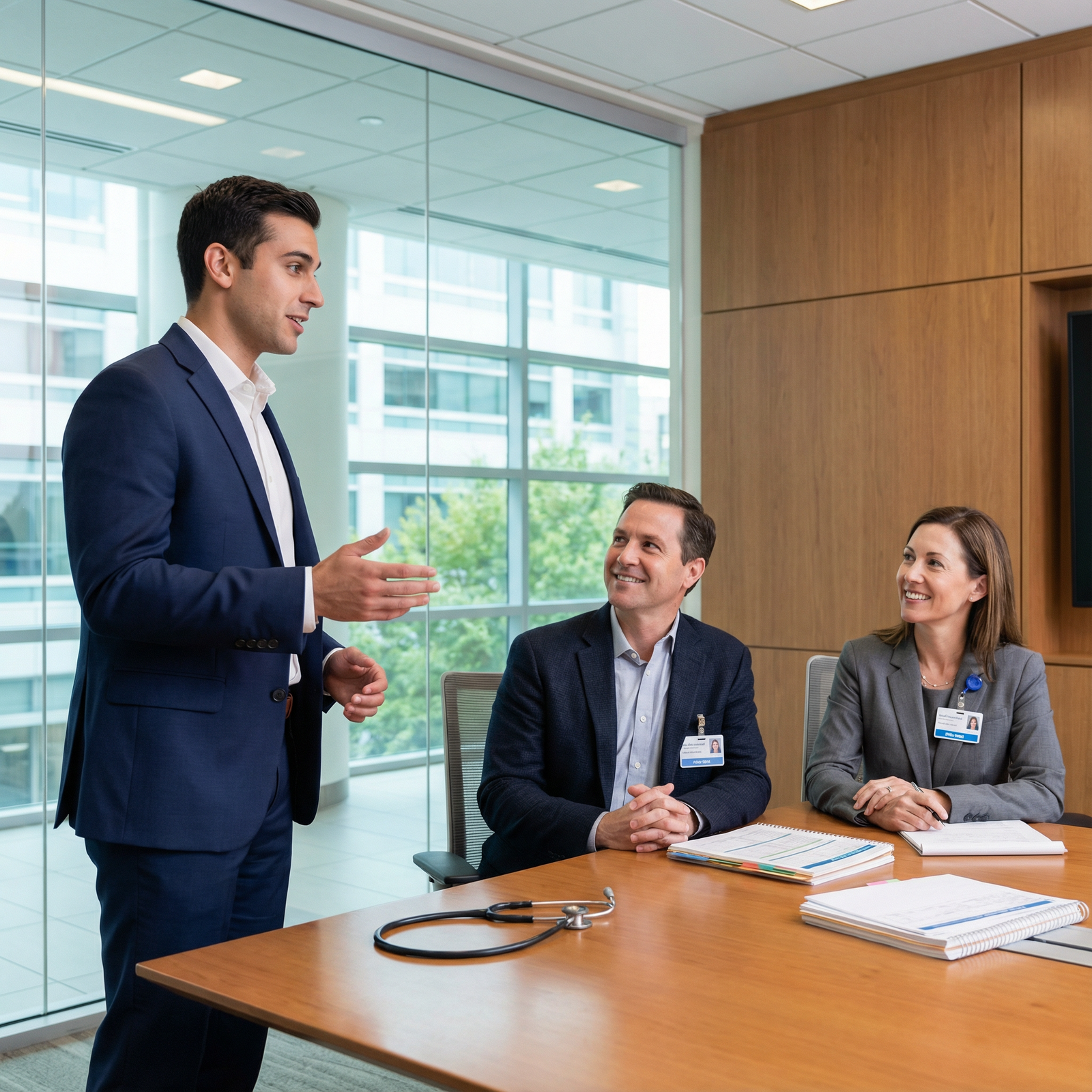
Introduction: Why Residency Interviews Matter for Your Medical Career
Residency interviews are one of the most decisive milestones in your medical career. After years of coursework, clinical rotations, and board exams, the interview is where programs meet you as a future colleague—not just as an application file.
A strong interview can move you from the middle of a rank list to the top. A poorly executed one can sink an otherwise competitive application. Beyond assessing your clinical potential, residency interviews evaluate your professionalism, communication skills, self-awareness, and “fit” with the program’s culture and goals.
This guide offers detailed, evidence-informed interview strategies tailored to residency applicants. You’ll find preparation tips, communication tools, and professional development strategies that help you:
- Present a clear, compelling narrative about who you are
- Demonstrate maturity, insight, and resilience
- Ask smart questions that show you’ve done your homework
- Follow up professionally and leave a lasting impression
Whether you’re a U.S. MD/DO student, an IMG, or a non-traditional applicant changing careers, these residency interview strategies will help you interview like a pro—and move closer to matching into a program that truly fits your goals.
1. Laying the Foundation: Deep-Dive Preparation Strategies
Preparation is where you win or lose most residency interviews. The more targeted your prep, the more relaxed and authentic you will feel on interview day.
Understand Each Program Beyond the Website
General research is not enough; you need program-specific preparation for every interview.
Key areas to investigate:
Curriculum and structure
- Rotation schedule (inpatient, outpatient, electives)
- Call schedule and night float system
- Unique tracks (global health, clinician-educator, research, primary care, rural medicine, etc.)
- Procedural opportunities and autonomy progression
Program culture and values
- Mission statement and core values
- Patient population served (urban, suburban, rural, underserved, academic vs community)
- Emphasis on teaching vs service
- Program size and faculty accessibility
Scholarly environment
- Research expectations and support (protected time, mentorship, funding)
- Fellowship match outcomes
- Opportunities to teach medical students or junior residents
How to gather this information:
- Program website and social media (Twitter/X, Instagram, LinkedIn)
- FREIDA / AAMC / residency explorer tools
- Virtual open houses or pre-interview information sessions
- Talking with:
- Your school’s recent graduates who matched there
- Current residents (via email, LinkedIn, or alumni networks)
- Faculty who may know the program leadership
Action step:
Create a brief one-page “program snapshot” for each interview with:
- 3–5 things you genuinely like about the program
- 1–2 potential concerns or questions
- A few unique features (tracks, patient population, locations)
- Names/roles of program leadership and key faculty
Review this cheat sheet the night before and again the morning of your interview.
Reflect Deeply on Your Experiences and Your Story
Interviewers want to see how you think, grow, and work with others. To convey this, you need to understand your own story.
Build a “personal experience bank”:
List 10–15 meaningful experiences from medical school and before, including:
- Clinical rotations (especially in your chosen specialty)
- Significant patient encounters
- Leadership roles (student groups, committees, quality improvement projects)
- Research and quality improvement projects
- Teaching/mentoring roles
- Volunteer or community work
- Jobs before or during medical school (especially for non-traditional applicants)
- Personal challenges or failures that shaped you
For each entry, jot down:
- What happened (briefly)
- Your specific role
- What you learned
- How it changed your behavior or outlook
- How it connects to residency or your long-term medical career
These become your ready-made stories for behavioral and situational questions (“Tell me about a time…”).
Master the Most Common Residency Interview Questions
While every interview is different, many core questions are predictable. Prepare and practice—but avoid sounding scripted.
Foundational questions to rehearse:
- Tell me about yourself.
- Why did you choose this specialty?
- Why are you interested in our program?
- What are your strengths as a future resident?
- What are your areas for growth or weaknesses?
- Tell me about a challenge or failure and what you learned.
- Tell me about a conflict with a team member and how you handled it.
- Describe a time you made a mistake in clinical care (or almost did).
- How do you handle stress, burnout, or work-life balance?
- Where do you see yourself in 5–10 years?
Use the STAR method (Situation, Task, Action, Result) to keep answers clear and structured:
- Situation: Brief background/context
- Task: Your responsibility or goal
- Action: What you did (focus on your behavior)
- Result: Outcome + what you learned
Example (Conflict with a teammate):
- Situation: “On my internal medicine rotation, a team member and I disagreed about…”
- Task: “I wanted to ensure good patient care and maintain team cohesion…”
- Action: “I scheduled a private conversation, used ‘I’ statements, and asked for their perspective…”
- Result: “We clarified expectations, patient care improved, and now I address conflicts earlier…”
Practice out loud with a friend, advisor, or even recording yourself. Pay attention to:
- Length (1–2 minutes per question is usually ideal)
- Clarity and organization
- Tone (confident but humble, reflective, and professional)

2. Polishing Your Professional Image and Communication
Your application gets you the interview; your professional presence determines how you are remembered.
Dress and Appearance: Signal Professionalism and Respect
Choose attire that communicates professionalism, attention to detail, and respect for the process.
General guidelines:
- Aim for business formal:
- Dark or neutral suit (navy, charcoal, black)
- Conservative shirt or blouse (white or light solid colors)
- Closed-toe shoes, clean and in good condition
- Keep accessories minimal:
- Simple jewelry, professional watch if you wear one
- Limited fragrance (or none) in case of sensitivities
- Pay attention to grooming:
- Hair neat and out of your face
- Nails clean; if polished, neutral colors
- Facial hair trimmed if present
For virtual interviews, also:
- Test lighting (face well-lit, minimal shadows)
- Use a neutral, uncluttered background
- Position your camera at eye level
- Check audio and internet connection in advance
Non-Verbal Communication and Body Language
Much of your impression comes from how you carry yourself, not just what you say.
Key non-verbal strategies:
- Posture: Sit upright, relaxed shoulders, lean slightly forward to show engagement.
- Eye contact: Steady, but not staring. In virtual interviews, look at the camera periodically to simulate eye contact.
- Facial expression: Neutral-to-positive; let your interest and warmth show naturally.
- Hands and gestures: Use natural, small gestures. Avoid fidgeting with pens, jewelry, or hair.
- Arrival: For in-person interviews, arrive 10–15 minutes early. For virtual, log in 10 minutes early to handle any technical issues.
Active Listening and Conversational Flow
Program directors and faculty are evaluating whether they would enjoy working with you for three or more years. That depends heavily on how you communicate.
Demonstrate active listening:
- Pause a second before responding; it shows thoughtfulness.
- Nod or affirm when appropriate (“That makes sense,” “I appreciate that perspective”).
- If you don’t understand a question, ask for clarification:
“Just to make sure I answer your question fully, are you asking about…?”
Turn answers into conversations:
Instead of ending with a hard stop, you can occasionally add a gentle invitation to dialogue:
- “That experience is part of why I’m particularly interested in programs that prioritize resident autonomy. I’d love to hear how that’s approached here.”
- “That’s been especially important in my professional development; I’m curious how your residents get feedback on similar skills.”
This helps transform a rigid Q&A into a more natural, collegial conversation.
Managing Anxiety and Staying Composed
Feeling nervous is normal—and expected. The goal is not to eliminate anxiety, but to function well despite it.
Evidence-based techniques:
- Pre-commit to a routine the night before and morning of:
- Light exercise or a walk
- Brief mindfulness or breathing exercise (e.g., 4-7-8 breathing)
- Review your program snapshot and a few key stories—not every possible question
- Reframe anxiety as excitement:
Tell yourself, “My body is preparing me to perform,” not “I’m falling apart.” - Use “pause and breathe” inside the interview:
Before answering a tough question, take a breath and say, “That’s a great question; let me think for a moment.” This signals thoughtfulness, not weakness.
If you stumble:
- Don’t apologize excessively.
- Correct yourself briefly if needed and move on.
- Remember: interviewers are far more forgiving than you think.
3. Engaging Authentically: Content, Fit, and Asking Insightful Questions
Residency interviews are not only about whether you are good enough for the program—they are also about whether the program is right for you. Demonstrating good “fit” is a two-way process.
Communicating Your “Why” and Long-Term Goals
Programs want to understand:
- Why this specialty?
- Why their program?
- Where are you headed professionally?
When answering “Why this specialty?”:
- Avoid generic answers (“I like working with my hands,” “I enjoy continuity of care”) unless you make them concrete.
- Tie your reasons to specific experiences and patients.
- Show you understand the realities—and still want the field.
Example elements to include:
- A moment when the specialty “clicked” for you
- Aspects of the work you find energizing (patient population, pace, procedures, complexity)
- How your personality and strengths fit the specialty
When answering “Why our program?”:
Tailor your answer for each program using specifics from your research:
- Patient population: “I’m drawn to your strong focus on underserved urban communities…”
- Educational structure: “I value your X+Y schedule and the way it protects continuity clinic…”
- Tracks and opportunities: “Your global health track aligns with my long-term goal of…”
- Culture: “Every resident I’ve spoken to mentioned how supportive the faculty are…”
Avoid copy-paste phrases that could apply anywhere. Show that you see this program as more than a name on a list.
Answering Questions About Weaknesses, Gaps, and Red Flags
Nearly every applicant has something they are worried about: a low step score, a leave of absence, a failed exam, or a gap in training.
Principles for handling difficult topics:
- Be honest, but succinct.
- Take responsibility where appropriate—avoid blaming others.
- Emphasize insight and growth: what you changed and how you improved.
- Connect to how this will make you a stronger resident.
Example framework (failed exam):
- Briefly state what happened.
- Identify what contributed (study strategy, health issue, etc.).
- Explain specific changes you made (study plan, support systems).
- Point to subsequent evidence of improvement (later exam scores, clinical evaluations).
Programs are looking less for perfection and more for resilience and maturity.
Asking Strong, Insightful Questions
The questions you ask signal how you think and what you value. They are a critical part of your interview strategies.
Avoid questions easily answered by a quick Google search or FAQ (“How many residents are in the program?”). Instead focus on:
Culture and support:
- “How would you describe the culture of the residency on a tough rotation month?”
- “How does the program support residents when they’re struggling—whether academically or personally?”
- “Can you share an example of how resident feedback has led to changes in the program?”
Education and autonomy:
- “How do you balance resident autonomy with supervision at different PGY levels?”
- “What opportunities exist for residents to take on teaching roles with students or juniors?”
- “How is feedback delivered, and how often do residents receive structured evaluations?”
Career development and outcomes:
- “What support do residents receive for career planning—whether fellowship, academic medicine, or community practice?”
- “How does the program help residents build their CVs through research, QI, or leadership opportunities?”
Program-specific interests:
Tailor questions to your genuine interests—global health, advocacy, medical education, research, lifestyle, procedural volume, etc.
For current residents, more candid questions are appropriate:
- “What’s something you wish you’d known before joining this program?”
- “How responsive is leadership when concerns are raised?”
- “How does the program handle coverage when someone is sick or has a personal emergency?”
Document answers immediately after the interview while details are fresh. These notes are invaluable when finalizing your rank list.
4. Professional Follow-Up: Thank You Notes and Post-Interview Strategy
What you do after the interview can reinforce (or weaken) the impression you made.

Writing Effective Thank You Messages
While thank you notes rarely make or break an application, they can:
- Reinforce your interest and fit
- Highlight a specific connection or discussion
- Demonstrate professionalism and courtesy
General guidelines:
- Send within 24–48 hours of your interview.
- Email is preferred and standard.
- If you met many people, prioritize:
- Program director
- Associate/assistant program directors you interviewed with
- Key faculty you had substantial conversations with
- Chief residents if they played a major role in your interview day
Content suggestions (brief and specific):
- Express appreciation for their time and insights.
- Reference 1–2 specific aspects of your conversation or something unique about the program.
- Reiterate, honestly, your interest in the program and how you see yourself fitting in.
- Keep it to 1–2 short paragraphs; avoid over-enthusiastic or overly personal language.
Example structure:
- Paragraph 1: Thank them + specific reference
- Paragraph 2: Reinforce fit and interest
Ensure there are no promises or rank statements that violate NRMP rules. Avoid language like “I will rank your program #1” if you’re not absolutely certain—and be mindful of NRMP guidelines on post-interview communication.
Organizing Your Impressions for Rank List Season
Immediately after each interview, take 10–15 minutes to document:
- Pros and cons of the program
- Your gut feeling about fit and culture
- Notable strengths (education, wellness, research, location)
- Any major concerns or dealbreakers
- How it compares to other programs you’ve seen so far
Many applicants create a simple spreadsheet with:
- Columns for various factors (education, camaraderie, location, patient population, call schedule, wellness, etc.)
- A subjective 1–5 rating for each
- Space for free-text comments
This organized reflection helps you make rational, values-based decisions later, when everything starts to blur together.
5. Special Considerations: Virtual Interviews, Non-Traditional Paths, and IMGs
Residency interviews are evolving, and applicants bring increasingly diverse backgrounds.
Optimizing Virtual Residency Interviews
If your residency interviews are virtual (or hybrid), treat your virtual environment as part of your professional presentation.
Technical setup:
- Use a reliable computer, not just a phone.
- Connect via wired internet if possible or be as close to the router as you can.
- Test your platform (Zoom, Webex, Thalamus, etc.) in advance.
- Keep a backup plan (phone hotspot, secondary device).
Environment and presence:
- Quiet, private space with minimal background noise.
- Neutral background (blank wall, bookshelf, or tasteful decor).
- Camera at eye level; frame your head and upper torso, not just your face.
- Keep a water bottle nearby and a printed copy of your CV within reach.
Practice virtual-specific skills:
- Look at the camera periodically to simulate eye contact.
- Avoid talking over others; short pauses help with lag.
- Name use: “Thank you, Dr. Smith, that’s helpful” shows engagement and tracks the conversation.
Non-Traditional Applicants: Framing Your Unique Path
If you had a previous career, took time away from medicine, or followed an unconventional route:
- Own your story confidently.
- Highlight transferable skills: leadership, communication, teamwork, adaptability, problem-solving.
- Connect your previous experiences to why you will be a stronger resident and colleague.
- Be ready for: “Tell me about your path to medicine,” and “Why now?”
International Medical Graduates (IMGs): Anticipating Common Questions
IMGs may be asked about:
- Motivation to train in the U.S.
- Adaptation to U.S. health care systems and culture
- Visa needs and long-term plans
- Gaps between graduation and residency
Address these topics directly:
- Emphasize clinical exposure in the U.S. (observerships, externships, research).
- Highlight language proficiency and cross-cultural communication skills.
- Clarify your understanding of U.S. residency demands and expectations.
FAQ: Residency Interview Strategies and Professional Development
How early should I start preparing for residency interviews?
Begin serious preparation 4–6 weeks before your first interview. Earlier in the year, you can start building your experience bank and refining your personal statement, which will help with storytelling. As interviews approach, focus on:
- Researching each program
- Practicing common questions using the STAR method
- Scheduling mock interviews with advisors, mentors, or peers
- Testing your technology and environment for virtual interviews
What if I’m asked a question I truly don’t know how to answer?
Pause, breathe, and give yourself a moment. You can:
- Ask for clarification: “Just to make sure I understand, are you asking about…?”
- Think out loud if it’s a conceptual or ethical question.
- If you truly don’t know, it’s acceptable to say:
“I don’t have direct experience with that, but here’s how I would approach it…”
Interviewers are evaluating your reasoning process and honesty, not perfection.
How can I show interest in a program without violating NRMP rules?
You can absolutely express strong interest without making explicit rank promises. For example:
- “Based on my interviews and research so far, your program stands out as an excellent fit for my goals.”
- “I would be very excited to train here and think I’d thrive in this environment.”
Avoid sending misleading messages to multiple programs (e.g., implying each is your #1). Always stay within NRMP’s guidelines on post-interview communication.
How should I handle a “bad” or awkward interview?
Every applicant has at least one interview that feels off. If this happens:
- Don’t catastrophize—programs rarely base decisions on a single awkward moment.
- Reflect briefly: Was it nerves, a specific question, or a mismatch in style?
- Identify one or two concrete lessons for future interviews (e.g., practice a certain question more, slow down your speech).
- Still send a professional thank you note; you may have done better than you think.
What are signs that a residency program might not be a good fit?
Red flags vary by person, but potential concerns include:
- Residents appearing consistently exhausted, disengaged, or hesitant to speak openly
- Vague or evasive answers about workload, wellness, or how concerns are handled
- High, unexplained attrition rates
- Lack of clear supervision structure or educational focus
- Leadership dismissing questions about feedback, burnout, or support
Trust both your observations and your instincts. Your residency is a formative period in your medical career; fit and support matter as much as prestige.
By combining intentional preparation, clear communication, and thoughtful follow-up, you’ll be ready to approach your residency interviews as a confident, developing professional—someone programs can easily imagine as a trusted colleague. Use these interview strategies not just to secure a position, but to find the residency environment where you will grow, thrive, and launch the next phase of your medical career.




















