
Understanding Malpractice Risk in Medical Genetics
Medical genetics may feel “cerebral” and less procedurally intense than many other specialties, but your exposure to liability is real and growing. As more diagnoses, reproductive choices, targeted therapies, and even life-planning decisions hinge on your genetic evaluations, the legal stakes rise accordingly.
Before diving into policy types like claims made vs occurrence, it helps to understand where malpractice risk comes from in medical genetics and why residency applicants and trainees need to think about medical liability insurance early.
Why malpractice insurance matters for medical genetics residents
As a medical genetics resident or fellow, you are:
- Interpreting complex test results that can dramatically alter patient decisions
- Counseling patients about reproductive risks, cancer predisposition, and future disease likelihood
- Often working in multidisciplinary teams where miscommunication can easily occur
- Practicing in a rapidly evolving field where standards of care and guidelines are continually updated
Even if you feel “covered by the institution,” residency is exactly when you should start understanding:
- What your program’s malpractice insurance covers (and what it doesn’t)
- How coverage will change as you become a fellow, junior faculty, or enter private practice
- How the genetics-specific risk profile might affect your premiums and policy choices
Common malpractice scenarios in medical genetics
The majority of malpractice cases in medical genetics revolve around information, communication, and documentation rather than hands-on procedural harm. Typical allegations include:
- Failure to diagnose or delayed diagnosis
- Missing a genetic syndrome despite suggestive history or phenotype
- Not ordering appropriate follow-up tests
- Wrongful birth / wrongful life claims
- Inadequate counseling about reproductive risks
- Failure to offer or correctly interpret prenatal testing
- Incorrect or miscommunicated test interpretation
- Misclassifying a variant of uncertain significance (VUS) as benign or pathogenic
- Not updating a patient when variant reclassification changes management
- Lack of informed consent
- Not explaining the implications or limitations of genetic testing
- Not discussing possible psychosocial or insurance implications
- Inadequate family communication or cascade testing
- Failing to recommend or document outreach to at-risk relatives when indicated
These are subtle, documentation-heavy claims. They hinge on what you said, what you wrote, and what a “reasonable genetics professional” would have done at that time. That’s exactly why robust malpractice insurance and good risk-reduction habits are essential.
Core Concepts: Medical Liability Insurance Basics
Before you evaluate policies, you need baseline vocabulary. When you hear your GME office, mentors, or future employers talk about malpractice coverage, they’re almost always referring to professional medical liability insurance.
What malpractice insurance actually covers
Standard medical liability insurance generally includes:
- Defense costs: Attorney fees, expert witnesses, court costs
- Indemnity payments: Settlements or judgments paid to plaintiffs (up to your policy limits)
- Licensing board defense (sometimes): Legal help if you face board or hospital disciplinary action
- Tailored coverage: Specifically written for medical practice, not general business liability
It does not typically cover:
- Criminal acts or intentional harm
- Sexual misconduct
- Practicing outside the scope of your license
- Certain administrative or employment disputes (unless you carry separate employment-practices coverage)
During residency, the institution normally purchases a group policy that covers you while acting within the scope of your training. But the details—especially type of coverage and limitations—matter.
Policy limits: how much coverage?
You’ll see limits written like:
- $1,000,000 / $3,000,000 (“1/3” policy)
- $1 million per claim
- $3 million aggregate per year
During training, your program usually sets these limits for you. Later, as an attending in medical genetics, common limits might be:
- 1/3 or 1/5 in many states
- Higher in more litigious locations or academic centers
For most genetics positions, standard limits are sufficient, but if you take on leadership roles, high-profile consults, or direct a genetics laboratory, you may want to discuss higher limits or additional coverage with a broker or risk manager.
Claims Made vs Occurrence: Policy Types Explained
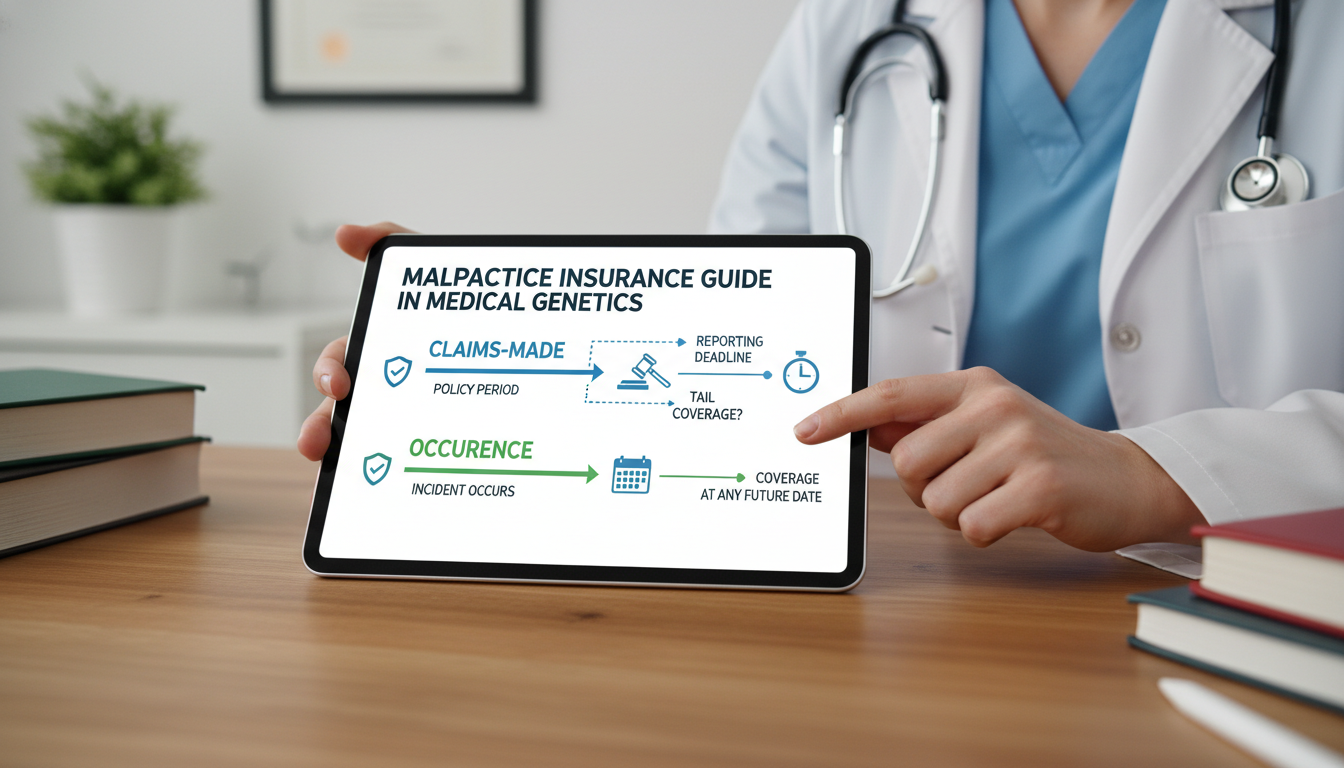
The single most important structural feature of your malpractice policy is whether it is claims-made or occurrence-based. Understanding this distinction early in your career will save you money and major headaches later.
Claims-made policies
A claims-made policy covers you only if:
- The incident (alleged malpractice) happened after your retroactive date, and
- The claim is reported while the policy is active (or during a valid tail coverage period)
In practice:
- Your policy has a retroactive date (often the day you started work under that policy)
- Only claims arising from care after that date and reported while your policy is in force are covered
- Once you leave that job or policy, you typically need tail coverage to protect yourself from late-arriving claims
This type is very common in group practices, hospital-employed positions, and academic settings—likely what you’ll see when you graduate.
Tail coverage (Extended Reporting Endorsement)
If you have a claims-made policy and you leave a job, you may need to buy tail coverage (sometimes called an Extended Reporting Endorsement):
- Covers claims filed after the policy ends
- For services you provided while the policy was active
- Can be expensive—often 150–250% of your annual premium for a one-time purchase
- Usually lasts indefinitely for those prior years of service
In some residency or academic contracts:
- The employer pays for your tail if they terminate you without cause
- You must pay for your own tail if you resign or move to another employer
- Your new employer might offer to cover your previous tail as part of recruitment
For medical genetics, where alleged harms may emerge years later (e.g., a child born with a condition that wasn’t adequately counseled), ensuring continuous coverage via tail is critically important.
Occurrence-based policies
An occurrence policy covers you if the incident occurred while the policy was active, regardless of when the claim is filed.
- No tail coverage is usually needed
- Premiums are higher up front because the insurer is taking on indefinite future risk for that period
- Less common in hospital-employed and large-group settings; more often seen in some private practices or certain regions
For a medical genetics practitioner, occurrence coverage can be attractive because:
- You may see claims long after an encounter (e.g., in prenatal or cancer genetics)
- You avoid worrying about buying tail each time you change positions
However, you may not get to choose policy type in many employed positions; it’s set by the institution.
How this affects you during and after residency
As a medical genetics resident:
- Your GME office usually holds a claims-made group policy
- The institution almost always buys built-in tail coverage for your residency years
- You typically do not need to purchase personal malpractice insurance while training (unless moonlighting—more on this below)
As a new attending:
- Clarify whether your new employer offers claims-made vs occurrence
- If claims-made, confirm who pays for tail when you leave
- Negotiate tail terms in your employment contract, especially for high-risk services (e.g., prenatal, cancer genetics)
Malpractice Insurance During Medical Genetics Residency
During residency and fellowship in medical genetics, your relationship to malpractice insurance is different from that of an independent attending. But decisions you make now—especially around moonlighting and side work—can create long-term risk if you’re not careful.
What your residency program usually covers
Most ACGME-accredited programs in the U.S.:
- Provide professional liability insurance for residents and fellows
- Cover you for activities performed:
- As part of your official training
- Under supervision, following institutional policies
- Set policy limits at or above local standards (often 1/3 or 1/5)
- Maintain coverage (including tail) for claims filed after you graduate for actions taken during residency
You should confirm in writing:
- Whether your program uses claims-made vs occurrence
- Whether the institutional policy includes tail coverage after you complete training
- Any exclusions for telemedicine, volunteer work, or research activities
Ask your program director or GME office for:
- A certificate of insurance (COI) with limits and carrier
- A brief summary of what’s covered and when
Moonlighting: a major gray zone
Moonlighting can be financially attractive, but it’s also one of the most common ways residents unintentionally create coverage gaps.
Questions to clarify before you moonlight:
Is the moonlighting activity internal or external?
- Internal: Within your own institution; often covered by the same policy, but verify.
- External: At another hospital or clinic; almost always requires separate coverage.
Who provides malpractice insurance for moonlighting?
- The moonlighting site may include you on their policy
- You may be required to purchase individual coverage
Is this work clearly separate from your residency role?
- If not, disputes can occur about which policy should respond to a claim
- Always delineate roles, times, and documentation clearly
Does your residency contract permit moonlighting?
- If you moonlight against policy, your program’s insurer may decline coverage for related claims
For genetics-specific moonlighting:
- You might be asked to do genetics consults, newborn screening reviews, or tele-genetics counseling for outside facilities.
- These are high-stakes decisions with long-term consequences; never perform them without clear written malpractice coverage from the site or a personal policy.
Research, genomics projects, and lab work
Many medical genetics trainees engage in research or participate in genomic testing programs. This can blur the line between clinical and research activities.
- Pure research with no clinical decision-making is often covered under institutional research or general liability coverage, not your clinical malpractice policy.
- Clinical implementation projects (e.g., population genomic screening in clinic) generally fall under medical malpractice coverage.
You should clarify:
- Under which policy you’re covered when ordering tests, giving results, or advising based on research protocols
- Whether the study’s sponsor provides additional liability coverage
- Documentation expectations in the EMR vs research records
If unsure, talk to:
- Your program director
- The institution’s risk management or legal department
- The study’s principal investigator
Transitioning to Practice: Malpractice Insurance After Residency
As you approach the medical genetics residency match and then later transition to attending roles, your perspective shifts from “am I covered?” to “what is the best coverage structure for my career?”
Employment models in medical genetics and their impact on insurance
Common early-career roles in medical genetics include:
- Academic hospital-employed geneticist
- Children’s hospital or cancer center staff
- Large multispecialty group practice geneticist
- Tele-genetics or remote counseling services
- Industry roles (e.g., for genetic testing companies; often non-clinical)
Each has different malpractice implications:
Hospital-employed / academic positions
- Usually provide group malpractice coverage as part of your benefits
- Often claims-made; the hospital may or may not pay for tail coverage when you leave
- You rarely purchase personal policies unless doing side consulting outside your employment contract
Group practice or private practice
- Practice may purchase malpractice coverage for all partners/associates
- You may share limits (group policy) or hold individual limits
- Tail obligations at separation should be clearly defined in your partnership or employment agreement
Tele-genetics / remote counseling
- Must comply with licensure and malpractice requirements in every state where patients are located
- Some telehealth companies provide comprehensive coverage; others expect you to carry your own
- Pay careful attention to cross-state liability and jurisdiction issues
Industry non-clinical roles
- If you’re not directly treating or advising individual patients, traditional malpractice insurance may be less central
- You might instead need other forms of professional liability (e.g., errors & omissions)
Contract negotiation and malpractice clauses
When evaluating attending contracts, you should specifically review the malpractice insurance section. Key points:
- Type of policy: claims-made vs occurrence
- Policy limits: are they standard for your region and risk profile?
- Who is the named insured? You individually, or you as part of a group/institution?
- Tail coverage:
- Who pays for it if:
- You resign
- You are terminated without cause
- You are terminated with cause
- Is there a vesting schedule (e.g., employer pays increasing shares the longer you stay)?
- Who pays for it if:
For example, a common academic contract might say:
“The Institution will provide professional liability insurance with limits of $1,000,000 per claim and $3,000,000 aggregate. The policy is claims-made. The Institution will maintain tail coverage for services provided by Physician under this Agreement.”
In contrast, a less favorable private practice offer might state:
“The Practice will provide claims-made professional liability coverage. Upon termination for any reason, Physician shall be solely responsible for procuring and paying for extended reporting (tail) coverage.”
As a medical genetics specialist, where downstream consequences of your decisions may arise many years later, having an employer who covers tail coverage is a significant benefit.

Risk Management Strategies Specific to Medical Genetics
Even the best malpractice insurance is a safety net, not your primary defense. Your everyday clinical behavior is what truly mitigates your malpractice risk.
Documentation: your strongest ally
Because most genetics-related claims center on communication and decision-making, your documentation quality is crucial.
Key elements to always document clearly:
- Reason for referral and relevant history
- Differential diagnosis or risk assessment (even if brief)
- Tests ordered and rationale (including why some options were not chosen)
- Risks, benefits, and limitations of testing discussed with the patient
- Patient’s values and preferences influencing decisions
- Family history details used to guide risk estimates
- Follow-up plans, including what will happen with:
- Pending results
- Potential variant reclassification
- Cascade testing for relatives
For high-risk domains such as prenatal genetics or cancer predisposition:
- Use standardized templates or checklists for counseling sessions
- Include direct quotes when patients decline recommended testing:
- “Patient declined invasive diagnostic testing after thorough discussion of risks, benefits, and alternatives, stating, ‘I would not terminate the pregnancy regardless of results.’”
Informed consent: more than a signature
In genetics, informed consent is not simply signing a lab form; it is a process:
Core topics to address and document:
- Purpose of the test (diagnosis, screening, reproductive planning, targeted therapy)
- Possible results (positive, negative, VUS) and what they would mean
- Test limitations, including:
- Sensitivity and specificity
- Possibility of incidental or secondary findings
- Potential psychosocial impacts
- Confidentiality and data sharing (e.g., with databases, family members)
- Risk of genetic discrimination and relevant protections (e.g., GINA in the U.S.)
If you’re using telehealth, ensure your informed consent approach:
- Meets state requirements for telemedicine
- Is clearly documented in the note
- Addresses limitations of remote assessment for certain physical findings
Communication and follow-up systems
System failures are common bases for malpractice claims in medical genetics:
- Test results not communicated
- Abnormal findings buried in the chart without action
- Family members not offered or informed about cascade testing
Protect yourself by:
- Using EMR alerts or task systems for pending and abnormal results
- Having clear protocols within your genetics team for:
- Who calls patients
- Who manages no-shows
- How reclassification of variants is communicated
- Periodically auditing your own charts for closed-loop documentation of test results
In cancer and prenatal genetics especially, robust follow-up systems are crucial. For example:
- If a BRCA1 pathogenic variant is identified, ensure documentation of:
- Discussion of risk-reducing options
- Referrals to appropriate subspecialists
- Recommendations for family member testing
Staying current with evolving standards
The standard of care in medical genetics evolves quickly. What was acceptable five years ago may now be seen as substandard.
To mitigate risk:
- Maintain board certification and complete CME in relevant areas
- Follow professional guidelines (e.g., ACMG, ACOG, NCCN) and document when your decisions align with or thoughtfully diverge from them
- Participate in genetics case conferences or tumor boards
- Know your institution’s policies around:
- Secondary findings
- Direct-to-consumer test interpretation
- Data sharing and consent
When you deviate from guideline recommendations, clearly explain and document why, based on patient-specific circumstances.
Frequently Asked Questions (FAQ)
1. Do I need my own malpractice insurance as a medical genetics resident?
Often no, but verify. Most medical genetics residents are fully covered by their institution’s group malpractice policy for all activities within the scope of training. However, you might need separate coverage if:
- You moonlight outside your training institution
- You perform independent consulting or tele-genetics work
- Your contract or GME office explicitly says institutional coverage does not extend to certain activities
Always get written confirmation from your program or risk management office before starting outside work.
2. How do claims-made vs occurrence policies affect me long-term as a genetics specialist?
They primarily affect:
- Continuity of coverage: Claims-made requires you to maintain coverage or buy tail coverage for past acts; occurrence locks in coverage for incidents during the policy period without tail.
- Cost timing: Claims-made policies start cheaper and increase over time; occurrence costs more upfront but avoids future tail costs.
- Job changes: With claims-made, each job change raises the question: Who pays for tail? For genetics, where allegations can arise years after a consult or prenatal encounter, consistent protection (whether via tail or occurrence) is critical.
When reviewing job offers, focus on who is responsible for tail coverage and under what circumstances.
3. Does malpractice insurance cover teaching, research, and conference presentations?
It depends on your role and the context:
- Teaching medical students or residents within your clinical duties is usually covered.
- Clinical research where you’re directly making patient-care decisions is generally covered by malpractice insurance, sometimes supplemented by research-specific coverage.
- Non-clinical research or bench work is often under separate institutional liability policies.
- Conference presentations or educational talks are typically not malpractice issues unless you are giving patient-specific medical advice, which you should avoid.
If in doubt, consult your institution’s risk management or legal office.
4. I’m applying to a medical genetics residency. Should malpractice insurance influence my rank list in the genetics match?
Indirectly, yes. Most reputable programs will provide adequate malpractice coverage, but you can ask:
- “Is malpractice insurance provided for residents and fellows?”
- “Does the policy include tail coverage for actions during training?”
- “Are internal moonlighting activities covered under the same policy?”
While malpractice insurance alone shouldn’t dictate your rank order list, programs with transparent, robust coverage and strong risk-management education demonstrate that they take trainee welfare seriously—an important factor in your overall decision-making about the genetics match.
By understanding how medical liability insurance works, the difference between claims made vs occurrence policies, and the unique risk profile of medical genetics, you can protect both your patients and your career. Start these conversations early—during residency and as you move into your first attending role—so that your future in medical genetics is secure, sustainable, and focused on what matters most: high-quality, ethical care.