
Preparing for board exams as a Medicine-Pediatrics (Med-Peds) resident means juggling two specialties, four boards (ABIM, ABP initial certification, and often USMLE/COMLEX step exams early on), and a busy residency schedule. A strategic approach to board exam study resources can make the difference between barely keeping up and confidently walking into your exam.
This guide organizes the landscape of Med-Peds board exam resources, with practical guidance on how to combine internal medicine and pediatrics materials, build an integrated study plan, and use popular tools like Anki and UWorld effectively.
Understanding the Med-Peds Board Exam Landscape
Before choosing resources, you need to be clear on what you’re actually preparing for. As a Med-Peds resident, your study strategy will usually cover:
Licensing Exams (early training)
- USMLE Step 3 or COMLEX Level 3
- Sometimes late Step 2 or Level 2 if there were delays
In-Training Exams (ITE)
- Internal Medicine In-Training Examination
- Pediatrics In-Training Examination
- Used as benchmarks for your medicine pediatrics match cohort and often factor into fellowship applications
Board Certification Exams
- ABIM Internal Medicine Certification Exam
- ABP General Pediatrics Certification Exam
The key challenge: you cannot just double your study time for two specialties. You need shared resources, smart integration, and efficient repetition.
High-Yield Principles for Med-Peds Board Prep
- Integrate, don’t duplicate. Many core concepts (e.g., asthma, diabetes, sepsis, cardiac physiology) overlap; learn them once, then refine the pediatric vs adult nuances.
- Use question banks as your primary resource. Texts and videos are supports; practice questions and spaced repetition drive retention.
- Plan by exam calendar. Back-plan your use of board exam resources from the date of your ITEs and certification exams.
- Build a “Med-Peds core” deck and concept map. Especially using Anki USMLE-style cards that cross-reference adult and pediatric versions of common diseases.
Core Question Banks and How to Use Them Strategically
Question banks (Qbanks) are the backbone of your board exam preparation. For Med-Peds residents, you’ll typically use multiple banks and need to allocate your time carefully.
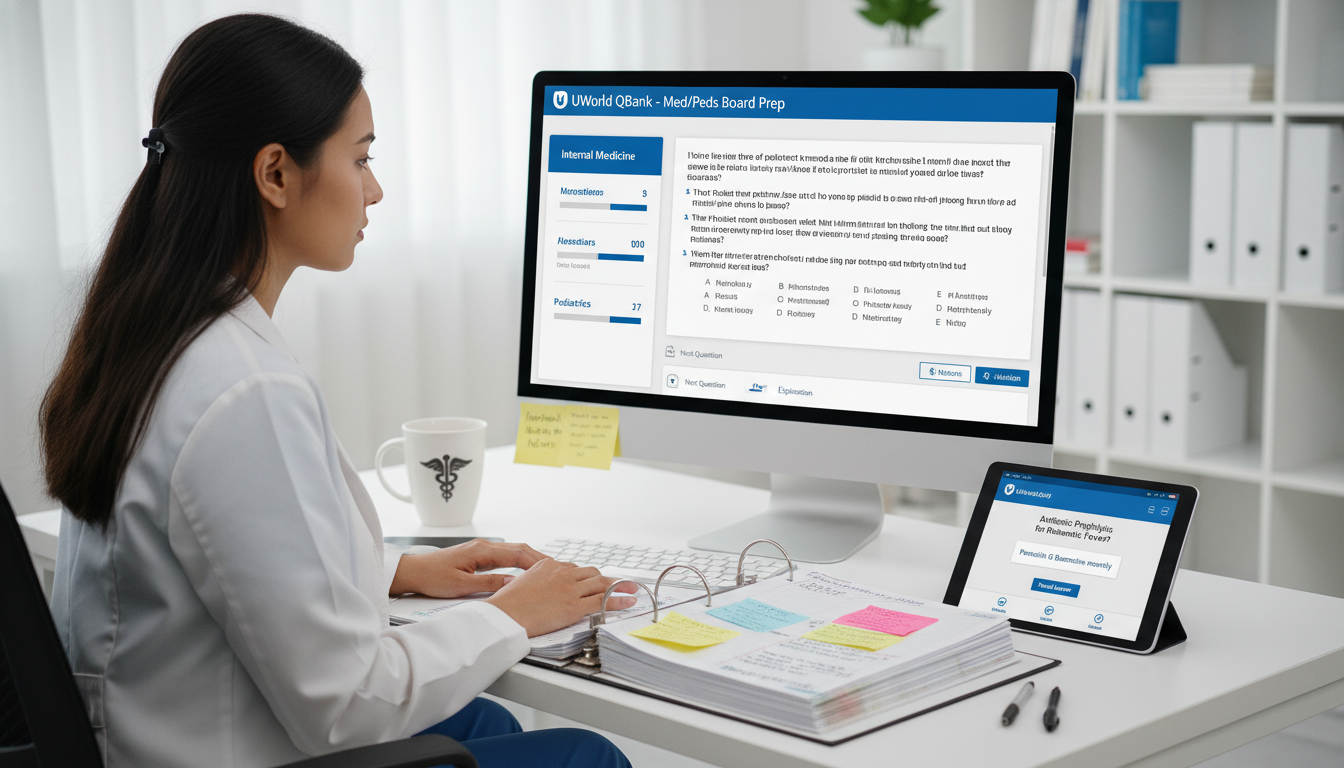
1. UWorld: Foundation for High-Stakes Exams
UWorld is widely considered the gold standard for board-style questions, especially for USMLE and internal medicine content.
Best uses for Med-Peds:
USMLE/COMLEX (early residency)
- Use UWorld Step 3 (and Step 2 if still pending) to solidify general medicine, critical care, and ambulatory topics.
- Focus on systems that are high-yield for both adult and pediatric care: cardiology, pulmonology, ID, rheumatology, endocrinology.
Internal Medicine Boards
- UWorld’s Internal Medicine Qbank is highly aligned with ABIM-style questions.
- Use UWorld tips like:
- Do most questions in timed, random mode after an initial content block strategy phase.
- Aim for 1x full pass (or 1.5x if you start early).
- Keep a running list or flashcards of “frequently missed” topics.
How to make the most of UWorld tips in your workflow:
- Annotate succinctly. Don’t rewrite the explanations; distill to 1–2 key lines or Anki cards per missed concept.
- Tie in pediatric parallels. When you see an adult CHF or asthma case, ask: “What’s different in a 5-year-old?” Note dose differences, diagnostic thresholds, and guideline changes.
- Use tutor mode early; timed mode late. Early: learn features and explanations. Closer to exams: simulate timing and pressure.
2. MedStudy, MKSAP, and Pediatrics-Based Qbanks
You’ll need high-yield content for both medicine and pediatrics certification exams.
Internal Medicine Focused
MKSAP (American College of Physicians)
- Excellent for ABIM-style questions and in-training exam prep.
- Provides both questions and high-yield concise text.
- Strategy:
- Do all MKSAP questions by system, especially for your weaker areas as revealed by ITE.
- Use the text as a reference, not something to read cover-to-cover during internship.
MedStudy Internal Medicine
- Offers flashcards, question banks, and textbooks.
- A bit more “teaching style” and less exam-mimic than UWorld, but strong for conceptual understanding and board prep.
Pediatrics Focused
PREP Questions (AAP)
- The American Academy of Pediatrics’ board-style questions. Considered extremely high-yield for the ABP exam.
- Often used as the primary tool for pediatrics boards and the Pediatrics ITE.
- Strategy:
- Aim to go through at least 3–4 years of PREP questions before the peds boards.
- Keep notes or flashcards of recurring patterns (e.g., vaccine schedules, genetic syndromes, metabolic disorders).
MedStudy Pediatrics
- Structured around the ABP blueprint, with questions and companion text.
- Good as a supplement to PREP with a more didactic style.
BoardVitals Pediatrics Qbank
- Frequently used supplemental pediatrics board exam resource.
- Use selectively if you exhaust PREP and want additional question exposure.
3. Allocating Your Time Across Qbanks
Because you’re preparing for two specialties, overcommitting to every resource is easy—and dangerous.
A pragmatic Med-Peds Qbank priority list:
- Year 1–2 (early residency)
- Primary: UWorld (Step 3/internal medicine), PREP (or a pediatric Qbank) aligned with your pediatric rotations.
- Secondary: Sample MKSAP and MedStudy for content gaps.
- Late PGY-2 – PGY-3
- Shift toward:
- Full MKSAP or MedStudy internal medicine Qbank for ABIM-prep.
- 2–3 years of PREP questions.
- Shift toward:
- PGY-3 – PGY-4 (board-focused)
- Internal Medicine: Ensure a full pass of your primary IM Qbank (MKSAP/UWorld) plus dedicated review.
- Pediatrics: Complete several years of PREP questions methodically, plus focused review of weak areas from ITE.
Textbooks, Review Books, and Video Resources
Text and video resources help you shore up weak areas and build conceptual understanding that question banks alone can’t fully provide.
1. Core Adult Medicine References
Harrison’s Principles of Internal Medicine
- Comprehensive reference, but too dense to read cover-to-cover during residency.
- Use for:
- Complex pathophysiology questions.
- Tough, unusual diagnoses you encounter on wards or in questions.
Outpatient/Internal Medicine Board Review Books
- Examples: MedStudy texts, Mayo Clinic Internal Medicine Board Review.
- Better suited for targeted reading:
- Before rotations (e.g., cardiology, GI).
- For focused weak-system review identified by ITE performance.
2. Core Pediatrics References
Nelson Textbook of Pediatrics
- The Harrison’s equivalent for pediatric care.
- Too long for linear reading during residency; use as a reference for:
- Rare syndromes.
- NICU/PICU pathophysiology that appears in PREP questions.
Pediatric Board Review Texts
- Examples: MedStudy Pediatrics, Laughing Your Way to Passing the Pediatric Boards, Pediatrics Board Review (PBR).
- Many residents pair:
- PREP questions + one systematic review text.
3. Video and Lecture Series
Video resources can be helpful during commutes, call-free evenings, or lighter rotations.
MedStudy Video Lectures (IM and Peds)
- Systematic, board-focused coverage.
- Best used:
- Early for building baseline understanding.
- Later as audio review for weak topics.
Online MedEd, Boards & Beyond, others (early training)
- Especially useful around the medicine pediatrics match period, Step 2/3 prep, and transition to residency.
- While designed for USMLE, many core internal medicine concepts translate well into later board prep.
How to avoid getting lost in content overload:
- Use Qbank performance to drive content selection.
- If you consistently miss pediatric endocrine questions, then go to the peds endocrine chapter or video module.
- Set strict time limits on passive studying.
- Example: “Two 30-minute video sessions per week as reinforcement; otherwise, question-based study only.”
Spaced Repetition and Anki: Making Knowledge Stick
For a dual-specialty path, memory management is as important as resource selection. Spaced repetition—especially using Anki USMLE and board-style decks—is one of the most powerful ways to handle the volume.

1. Choosing and Customizing Anki Decks
Many residents start Anki decks during medical school (USMLE-focused) and adapt them in residency.
Options:
Existing USMLE Decks (e.g., AnKing-based)
- Excellent for foundational pathophysiology and pharmacology.
- Can be selectively unsuspended for internal medicine and pediatrics-relevant cards.
Residency/Board-Specific Decks
- Some communities and programs share IM and pediatrics-specific decks or ITE-aligned cards.
- Use these to supplement, not replace, question-based learning.
Self-Made Decks
- High-yield for Med-Peds: create cards that explicitly highlight:
- Differences between adult and pediatric presentations.
- Dose/age cutoffs, screening intervals, and growth/development milestones.
- Specific board “buzzwords” that appear in PREP or ABIM-style questions.
- High-yield for Med-Peds: create cards that explicitly highlight:
2. Smart Anki Strategies for Med-Peds
- Limit deck sprawl.
- Merge IM and peds cards into major categories (e.g., Cardiology, Pulmonology, ID) with child tags for “adult” vs “peds.”
- Card style: short and focused.
- Use cloze deletions (fill-in-the-blank) or simple Q&A.
- Example:
- “At what age should you start lipid screening in an average-risk child?”
- “What is the first-line controller therapy for moderate persistent asthma in a 5-year-old?”
- Daily cap.
- During busy inpatient months, cap reviews (e.g., 80–150/day) to avoid burnout.
- Make heavy-use during lighter outpatient or elective months.
3. Integrating Anki with Qbanks
For every missed question, ask:
- Did I miss because of a fact or a concept?
- If it’s a stable fact (e.g., vaccine schedule, diagnostic criteria), make 1–2 cards.
- If it’s a concept, add a card that forces you to explain the principle (e.g., “Why is doxycycline avoided in children under 8?”).
Use Anki as your long-term memory insurance:
- PREP and MKSAP build knowledge quickly.
- Anki preserves it from month to month, even while you rotate between NICU, ICU, wards, and clinic.
Building an Integrated Med-Peds Study Plan
Resources alone don’t pass exams; the plan does. You need to weave board exam resources into the reality of Med-Peds residency—rotations, calls, research, and life.
Step 1: Map Your Timeline
Create a high-level 3–4 year map that includes:
- USMLE/COMLEX Step 3 (if not taken before intern year).
- IM and Pediatrics ITEs (usually yearly).
- ABIM and ABP Certification Exams (often during or just after PGY-4).
Back-plan major study pushes:
- 2–3 months before each ITE: ramp up focused Qbank usage.
- 6–12 months before boards: structured, consistent board prep schedule.
Step 2: Assign Primary Resources by Phase
Example integrated strategy:
PGY-1 – Foundations
- Goal: Survive, build clinical reasoning, and pass Step 3 if needed.
- Resources:
- UWorld Step 3 (or IM) Qbank: ~10–15 questions/day.
- Light PREP usage for pediatric heavy rotations.
- Anki USMLE-based foundational review if you have prior decks.
- Focus:
- Establish daily habit: Anki + at least a small Qbank block.
- Don’t aim for aggressive board-style mastery yet.
PGY-2 – Consolidation
- Goal: Improve ITE scores and start board-planning.
- Resources:
- MKSAP or MedStudy IM Qbank: targeted to your weak IM ITE areas.
- PREP: 1–2 years’ worth spread over the year.
- Structured Anki decks for both adult and pediatric topics.
- Focus:
- Use ITE performance to target content (e.g., endocrine, ID, renal).
- Start defining your “core” Med-Peds reference materials.
PGY-3 – IM or Peds-Heavy Focus (depending on exam timing)
- If you plan to take ABIM first:
- Increase UWorld IM and MKSAP usage; aim for full pass.
- Use PREP at maintenance level (e.g., 10–15 questions every other day).
- If ABP will be taken first:
- Prioritize PREP: daily mixed sets of 10–20 questions.
- Use MedStudy Pediatrics or similar for structured review.
PGY-4 – Full Board Prep Year
- Goal: Focused, exam-specific refinement.
- Internal Medicine:
- Do second-pass of weak areas in IM Qbanks.
- Focus on test-taking strategy: flagging, pacing, and reviewing wrongs.
- Pediatrics:
- Complete final PREP years, targeting areas flagged by ITEs.
- Memorize must-know lists: vaccine tables, developmental milestones, metabolic screening, congenital heart lesions.
Step 3: Weekly and Daily Structure
Weekly template (on a moderate rotation):
- 3–4 days/week:
- 20–40 IM Qbank questions.
- 30–60 minutes of focused review (Anki + notes).
- 2–3 days/week:
- 15–25 pediatrics PREP questions.
- Brief reading from pediatric board review text on missed topics.
Daily minimums (even on call-heavy days):
- 20–30 minutes of Anki reviews.
- 5–10 questions (IM or Peds) if possible.
Step 4: Med-Peds Integration Examples
To avoid feeling like you’re studying “two separate residencies,” actively link adult and pediatric topics:
After an adult CHF question:
- Review the pediatric cardiomyopathy list.
- Ask: “What causes of CHF are unique to children (e.g., congenital lesions, Kawasaki cardiomyopathy)?”
After a pediatric asthma case:
- Compare stepwise therapy to adult guidelines:
- Inhaled corticosteroids.
- Use and indication of LABA.
- Role of monoclonal antibodies.
- Compare stepwise therapy to adult guidelines:
Maintain a single document or notebook titled “Adult vs Peds Pearls” where you log these contrasts. This not only strengthens your understanding but improves recall for both ABIM and ABP exams.
Choosing the Right Board Exam Resources for Your Learning Style
Different residents thrive with different tools; the best medicine pediatrics board exam strategy will match your style.
If You’re a “Question-First” Learner
- Focus: UWorld + MKSAP (for IM), PREP (for Peds).
- Add only light text reading, mainly from explanations.
- Use Anki sparingly for high-yield facts you consistently miss.
If You’re a “Structure-First” Learner
- Start with:
- MedStudy or other board review textbooks.
- Outline the content areas by system.
- Then:
- Add Qbanks to test your structured understanding.
- Use Anki to reinforce chapter summaries or tables.
If You’re a “Visual/Audio” Learner
- Leverage:
- Video lecture series (MedStudy, Online MedEd, others).
- Audio versions of board review material during commutes.
- However:
- Always anchor with Qbanks—videos are adjuncts, not substitutes.
Frequently Asked Questions (FAQ)
1. Do I really need separate resources for internal medicine and pediatrics boards?
Yes, but with overlap. The question banks and exam blueprints differ between ABIM and ABP. PREP is uniquely pediatric; MKSAP/MedStudy/UWorld are optimized for adult internal medicine. Use integrated strategies (e.g., comparing adult vs pediatric versions of the same disease), but don’t rely on “just one” resource to cover both.
2. How many questions should I aim to finish before each board exam?
For most Med-Peds residents, reasonable targets are:
- Internal Medicine:
- 1 full run of a robust IM Qbank (e.g., UWorld or MKSAP) = ~2,000+ questions.
- Pediatrics:
- 3–4 years of PREP questions (often 800–1,200+ total), plus any supplemental Qbanks if needed.
Quality and careful review matter more than absolute question count. Rushing through thousands of questions without deep review is less effective than systematic, reflective practice.
3. How should I balance board prep with a demanding call schedule?
- Set minimum daily habits: short Anki reviews plus a small Qbank block when possible.
- Use lighter rotations (outpatient, electives) for heavier study blocks.
- Protect at least one consistent weekly time block (e.g., Sunday morning) for uninterrupted board prep.
- Consider “micro-study” during downtime:
- A few Anki cards between admissions.
- 5-question sets while waiting for radiology calls or labs.
4. Is Anki really necessary if I’m using UWorld and PREP?
Not strictly necessary, but highly recommended—especially in Med-Peds. UWorld tips and PREP explanations teach concepts, but spaced repetition ensures you still remember those fine details six months later. If you’re already compressed for time, even a small, focused Anki deck built from your missed questions can significantly improve long-term retention.
A thoughtful combination of high-yield question banks, targeted board exam resources, and efficient spaced repetition will position you to thrive as a Med-Peds resident and succeed in both the medicine and pediatrics boards. Build a realistic, integrated plan early, adjust it using feedback from your in-training exams, and let your daily habits—not last-minute cramming—carry you to certification.