Preparing for neurology boards—whether the ABPN Neurology Certification Exam, in-training exam (RITE), or USMLE/COMLEX on the way to a neurology residency—requires a strategic mix of high-yield content review, question practice, and spaced repetition. With so many resources advertised as “must-have,” it’s easy to feel overwhelmed and under-focused.
This guide breaks down the most important board exam study resources in neurology, how to use them effectively, and how to adapt your approach from the USMLE era to residency and beyond. You’ll find practical strategies, examples, and UWorld tips that can streamline your studying and improve retention.
Understanding the Neurology Exam Landscape
Before choosing resources, it helps to understand what you’re actually preparing for and how each exam shapes your study plan.
Key exams along the neurology trajectory
USMLE/COMLEX (Pre-residency)
- Purpose: Gain acceptance into neurology residency (neuro match).
- Focus: Foundational neuroscience, neuroanatomy, neurophysiology, neuropharmacology, and neurology clinical vignettes.
- Style: System-based, integrated with other disciplines, heavy on multiple-step reasoning.
RITE (Residency In-Service Exam)
- Purpose: Benchmark your progress during neurology residency; predictive of ABPN board performance.
- Focus: Adult neurology, pediatric neurology, basic neuroscience, clinical neurophysiology, neuropathology, neuroimaging.
- Style: More “pure neurology” than USMLE, with deeper dives into subspecialties.
ABPN Neurology Board Certification Exam
- Purpose: Obtain board certification in neurology.
- Focus: Breadth and depth of clinical neurology, including stroke, epilepsy, neuromuscular, movement disorders, MS, dementia, neuro-oncology, neurocritical care, and more.
- Style: Clinical vignettes, imaging-based questions, EEG/EMG interpretations, localization problems.
How this guide is structured
We’ll move from foundation-building resources (USMLE era and early residency) to advanced neurology board prep, while weaving in:
- How to integrate Anki USMLE-style decks into neurology learning.
- How to apply UWorld tips to neurology-specific question banks.
- How to build a sustainable system that you can maintain alongside residency workload.
Core Neurology Content Resources
You need at least one primary content source for systematic coverage, and a few high-yield supplements. The right choice depends on your level (MS3 vs PGY-3 vs PGY-5 taking epilepsy boards), but the principles are similar.
1. Comprehensive Neurology Texts
These are not “cover to cover two days before boards” books. Instead, they serve as references and structured study backbones.
For residents and ABPN candidates:
- Bradley’s Neurology in Clinical Practice
- Best for: In-depth reference; clarifying difficult topics.
- Use: Read targeted chapters (e.g., “Approach to the Patient with Ataxia”) when your question bank reveals a weakness.
- Adams and Victor’s Principles of Neurology
- Best for: Conceptual understanding and neurology “storytelling.”
- Use: Helpful for localization, clinical reasoning, and pathophysiology.
For focused exam review (more practical for most residents):
- Mitsikostas or Daroff-type concise neurology review books
- Shorter, review-style texts with exam-oriented framing.
- Use: As your primary structured review across 6–9 months before neurology boards; read systematically, one chapter per week.
Actionable tip:
- Create a chapter calendar, e.g., “Week 1: Cerebrovascular; Week 2: Epilepsy; Week 3: Headache; Week 4: Neuromuscular,” and sync this with your question bank blocks.
2. Board-Oriented Neurology Review Books
These are designed explicitly for exam prep and often include embedded questions and tables.
Commonly used:
- Neurology Board Review (e.g., by Biller or similar)
- Pros: High-yield, structured by exam topics, includes tables and mnemonics.
- Cons: Less depth; not a replacement for clinical reading.
- RITE/Board review-specific texts
- Example structure: brief chapters followed by multiple-choice questions.
How to use:
- During PGY-2/PGY-3: Read on a rotation-aligned basis. On stroke service? Read the stroke and vascular neurology chapters.
- During dedicated board prep (6–9 months out): Systematically cover chapters with concurrent question practice and flashcard creation.
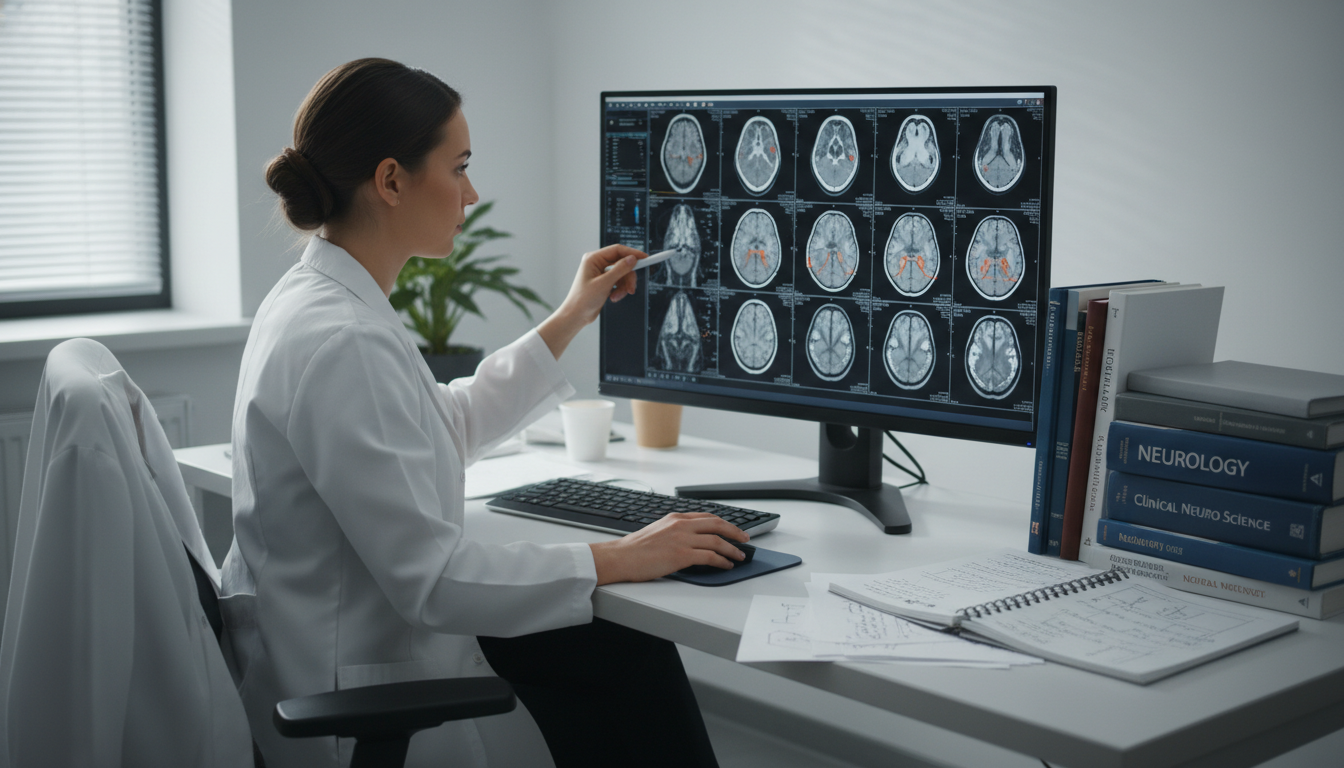
3. High-Yield Atlases and Visual Resources
Neurology is visually heavy. For boards, being able to rapidly recognize imaging and lesion patterns can be score-defining.
Recommended:
- Neuroanatomy atlases for brainstem, spinal cord, and cortical localization.
- Neuroimaging atlases (MRI/CT): Stroke patterns, demyelination, tumors, hemorrhages, hydrocephalus, etc.
- EEG and EMG overview texts with sample tracings:
- Not to become an electrophysiologist, but to confidently recognize “classic” board patterns (e.g., 3 Hz spike-and-wave, PLEDs, periodic sharp wave complexes).
Practical approach:
- Once a week, spend 20–30 minutes on a visual review session:
- Scroll through stroke imaging by vascular territory.
- Practice “name that lesion” with brief self-quizzing.
- Tag any weak patterns into your Anki deck (screenshots + brief concise cards).
Question Banks and UWorld-Style Strategy
Even for neurology-specific boards, the habits you built with USMLE-style question banks like UWorld are still powerful. The key is adapting them to neurology content and to a more senior level of clinical reasoning.
1. Question Banks for Neurology
Depending on what’s available to you (these vary by region and institution), you’ll likely have access to:
Dedicated Neurology Board Qbanks
- Modeled on ABPN style.
- Include imaging, EEG snippets, and more nuanced clinical decision-making.
RITE-style questions / official or unofficial prep sets
- Closely modeled on the AAN RITE exam.
- Strong correlation to ABPN content emphasis.
Residency program question collections
- Internal or regionally shared sets of questions compiled by faculty or prior residents.
How to choose:
- If you have 1 strong, well-known neurology question bank, it’s usually better to master it thoroughly than spread yourself too thin across many half-completed resources.
- Use additional clusters (e.g., free online mini-banks or RITE practice questions) for supplemental exposure once you’ve completed your primary bank.
2. UWorld Tips Applied to Neurology Qbanks
Your approach to neurology question banks should echo best practices from USMLE prep:
A. Active, timed blocks
- Do 10–20 questions at a time in timed, random mode once you’ve covered basic content.
- Start with subject-wise blocks early on (e.g., only epilepsy) if you’re still building foundation, then transition to mixed blocks.
B. Deep review over question volume
- For each missed or guessed question, ask:
- Why was my first instinct wrong?
- What piece of data in the vignette was key but ignored?
- What “classic board phrase” or imaging feature did I miss?
- Document these as:
- Short Anki cards (e.g., “Classic CSF profile for cryptococcal meningitis in HIV on boards?”).
- Notes on a running “Mistakes Log.”
C. Pattern recognition & localization
- Neurology boards test:
- Where is the lesion?
- What is the underlying mechanism?
- With every question:
- Verbalize the localization before reading answer choices.
- Identify 1–2 features that “tie” the presentation to a particular pathology (e.g., vertical gaze palsy → dorsal midbrain; internuclear ophthalmoplegia → MLF).
D. Treat explanations as mini-chapters
- Especially in neurology, question explanations often contain board-level summaries of:
- Stroke syndromes
- Demyelinating diseases
- Movement disorders and their pharmacology
- Highlight or copy the high-yield, generalizable sentences into your notes or flashcards.
Practical schedule example (PGY-3 preparing for boards in 9 months):
- Months 1–3: 10 questions/day (subject-based), deep review, adding 3–5 Anki cards per day.
- Months 4–6: 20 questions/day (mixed), focusing on weak subspecialties.
- Months 7–9: 30–40 questions/day (fully mixed, timed), simulating exam conditions weekly.
Spaced Repetition and Anki for Neurology
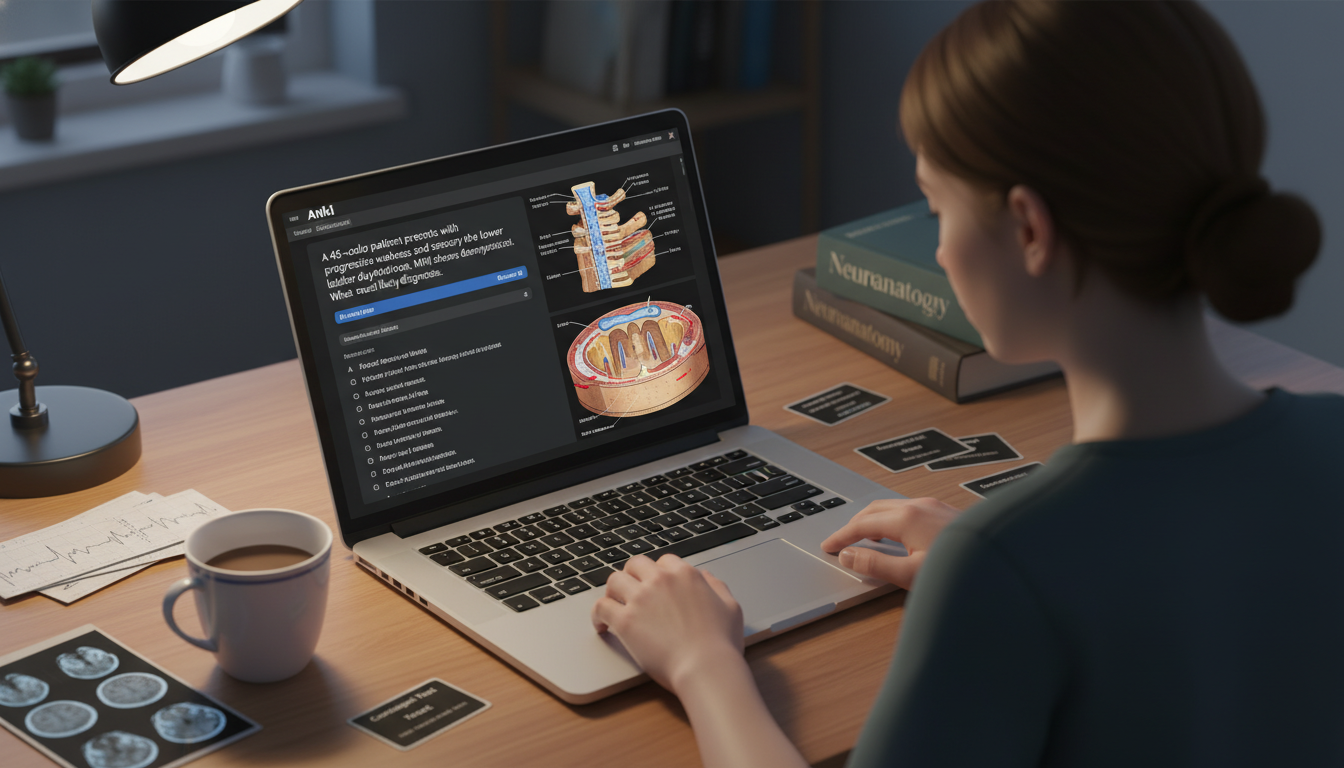
Many neurology residents arrive at residency with experience using Anki USMLE decks (like Zanki/Brosencephalon). Those decks build a strong foundation in neuroanatomy and neurology-related pharmacology, but you’ll need to upgrade your deck for neurology boards.
1. Using Anki USMLE Foundations in Neurology
If you previously used Anki for USMLE:
- Identify and reactivate or tag relevant neuro cards:
- Brainstem lesions and tracts.
- Neurocutaneous disorders.
- Demyelinating diseases.
- CNS tumors.
- Seizure types and antiepileptic drugs.
- Add a tag like
neuro_boardsorneurology_residencyso they appear in a specialized review deck.
This gives you a base to rebuild higher-level neurology knowledge.
2. Building a Neurology-Specific Anki Deck
Aim for fewer, higher-yield cards, not mass card creation. Good board-style neurology cards should:
- Be concise: 1 fact or short cluster of related facts per card.
- Emphasize patterns and “buzz phrases”:
- “Board phrase: stepwise decline + focal neuro deficits between strokes → multi-infarct dementia.”
- Include images when helpful:
- MRI slices with arrows and 1–2-word labels.
- EEG snippets with simple pattern names.
Types of cards to prioritize:
- Localization patterns
- “Lesion causing contralateral loss of vibration/proprioception and ipsilateral tongue deviation?”
- Key diagnostic criteria
- McDonald criteria, NINDS, ILAE, etc. (only the exam-relevant parts).
- Therapeutic hierarchies
- First-line vs second-line agents for epilepsy, MS, migraine, etc.
- Classic board cases
- “Elderly with new-onset headache and visual changes; ESR > 100 → suspicion and next step?”
Daily workflow:
- After each question session, create:
- 2–5 cards from concepts you didn’t know or misunderstood.
- After each consult or clinic case that feels “board-like,” add 1–2 cards based on teaching points.
This ensures your deck grows from real weaknesses and real clinical exposure, not abstract lists.
3. Avoiding Anki Pitfalls as a Resident
With neurology residency workload, Anki can become overwhelming unless managed carefully.
Guidelines:
- Cap daily new cards (e.g., 10–20 new per day max).
- If reviews are backing up:
- Temporarily reduce or pause new cards, but try not to skip reviews entirely.
- Focus on high-yield subspecialties emphasized on boards:
- Stroke, epilepsy, neuromuscular, MS/demyelinating, movement, dementia, headache.
Structured Courses, Videos, and Board Review Programs
Beyond books and banks, many trainees benefit from more guided, structured review—especially in the final 6–12 months before boards.
1. Live and Online Neurology Board Review Courses
Many academic societies and institutions offer intensive courses that:
- Run over a few days to a week.
- Cover all major subspecialties.
- Include practice questions and mock exams.
Benefits:
- Condenses “what’s truly testable” from a faculty perspective.
- Great for identifying last-minute knowledge gaps.
- Forces you to engage with areas you might otherwise procrastinate (e.g., neuro-ophthalmology, pediatric neurology).
How to integrate:
- Do not rely on the course as your only prep.
- Treat it as:
- An exam blueprint.
- A final sweep for gaps.
- Before the course: finish at least 50–70% of your question bank.
- After the course: immediately encode key takeaways into Anki or a written summary.
2. Video Lectures and Online Learning Platforms
Neurology residents commonly use:
- USMLE/Step-style video platforms for foundational neuroanatomy and pathophysiology refreshers.
- Neurology-focused online lecture series covering:
- Stroke basics and advanced management.
- EEG/EMG introductory content.
- Movement disorders and phenomenology.
Effective use:
- Targeted watching: pick videos focused on your weakest modules (e.g., “Approach to Ataxia,” “Neuro-oncology for the boards”).
- Combine with:
- Active note-taking (outlining only the information you’d test yourself on).
- Immediate follow-up with 10–15 questions on the same topic.
3. Local Conferences and Grand Rounds
Your own neurology department can be a powerful resource:
- Grand rounds:
- Often include high-level updates, but can provide testable pearls, especially in areas like neuro-infectious disease and neuroimmunology.
- Didactic series for residents:
- Case-based teaching sessions with faculty.
- Ask for slides, handouts, and reading lists.
- Neurosubspecialty conferences:
- Stroke, epilepsy, neuromuscular, movement, etc., often emphasize diagnostic frameworks that map well to board questions.
Convert what you learn into structured notes and, when appropriate, Anki cards.
Building a Study Strategy and Timeline
The best resources won’t help if your study plan is unrealistic or poorly structured. The challenge for neurology residents is balancing board prep with call schedules, consults, and personal life.
1. Early Residency (PGY-2)
Goals:
- Establish a foundation and good habits.
- Perform reasonably on the RITE and spot major gaps.
Resources focus:
- Neurology review text (steady, low-volume reading).
- Initial neurology question bank use:
- ~10 questions per day, topic-based.
- Reuse/refine Anki USMLE neurology cards, plus a few new cards each week.
Suggested pace:
- 3–4 hours per week of structured board studying (not including routine reading on service).
2. Mid-Residency (PGY-3)
Goals:
- Convert from “patchy knowledge” to “board-ready structure.”
- Start aligning your schedule with the ABPN exam date.
Resources focus:
- Increased neurology board question bank volume.
- Subject-wise to mixed transition in question blocks.
- More systematic reading of neurology board review texts.
- Spaced repetition via Anki for consistent retention.
Suggested pace:
- 5–8 hours/week of structured board prep (often broken into 30–60 minute chunks).
3. Late Residency and Pre-Boards (PGY-4/PGY-5 or Fellowship Year)
Goals:
- Refine, consolidate, and eliminate major blind spots.
- Practice under exam-like conditions.
Resources focus:
- Completing and, if time allows, partially repeating your primary question bank.
- Mixed timed blocks and full-length practice exams.
- Board review course (if available).
- High-yield crash summaries and visual review (imaging, EEG, localizations).
Suggested pace:
- 8–12 hours/week for 3–6 months before your exam.
- One longer simulated test session (2–3 hours) every 1–2 weeks.
4. Integrating Study with Clinical Work
Practical strategies:
- Use short pockets of time:
- One 10–20 question block during a slower call night.
- 5–10 minutes of Anki during commute (if safe and appropriate, e.g., on public transit).
- Align study with rotation:
- On stroke service: emphasize stroke chapter + stroke questions.
- On epilepsy: focus on seizure semiology, EEG basics, antiseizure meds.
- Protect at least one half-day per week as “board time”—treat it like a clinic session in your calendar.
FAQs
1. How early should I start preparing for neurology boards during residency?
Ideally, start building the foundation in PGY-2, with light but consistent studying (a few hours per week). Ramp up during PGY-3 with more systematic question bank use and review text reading. For most residents, serious, structured board preparation begins about 6–9 months before the exam, but your success will depend on how well you’ve built up your knowledge and habits before that.
2. Is it necessary to use Anki for neurology boards, or can I stick to books and question banks?
It’s not mandatory to use Anki, but some form of spaced repetition is extremely helpful, especially with the sheer volume of neurology details (antibody associations, syndromes, imaging patterns). If you don’t like Anki, consider:
- A self-made “rapid review” notebook you review weekly.
- Digital flashcards in another app.
- Regular, scheduled re-reads of your own summarized notes. Anki USMLE decks can be a great starting point, but for neurology boards, custom neurology cards tailored to your weaknesses are far more valuable.
3. How many neurology question bank questions should I aim to complete before boards?
Aim to complete at least one full, reputable neurology question bank (often 800–1500 questions) with careful review. If time allows, a partial second pass of your weakest sections is ideal. Focus on:
- Doing questions in mixed, timed blocks in the final months.
- Spending more time on reviewing explanations and logging errors than chasing sheer question volume.
4. What’s the best way to transition from USMLE-style studying to neurology board-level studying?
Use your USMLE background as a foundation for mechanisms and basic neuroanatomy, then:
- Shift emphasis from broad, multi-system integration to depth within neurology subspecialties.
- Replace some of your preclinical-style memorization with:
- Localization-based reasoning.
- Pattern recognition in imaging, EEG, and clinical syndromes.
- Upgrade your flashcard and note content from “What receptor?” to “What is the most appropriate next step in management for this specific neurology presentation?”
By combining solid content resources, neurology-focused question banks, UWorld-style discipline, and structured spaced repetition (whether through Anki USMLE-based decks or your own), you can approach the neurology boards with confidence, even amid the demands of residency and the neuro match process.