
Understanding the Reality of Ultra-Competitive Specialties as a Non‑US Citizen IMG
Ultra-competitive specialties—dermatology, orthopedic surgery, plastic surgery, neurosurgery, ophthalmology, radiation oncology, and sometimes radiology and ENT—are challenging for all applicants. For a non-US citizen IMG, the bar is even higher, but not impossible.
Before you invest years of effort into matching derm or matching ortho, you need clear-eyed insight into:
Structural disadvantages:
- Many programs do not sponsor visas.
- Some programs have institutional policies against ranking IMGs.
- Program directors often prefer “known quantities” (US MDs, home students, and their own rotators).
- Funding and GME policies may favor US grads.
Typical strengths of successful non-US citizen IMG applicants:
- Exceptional exam performance (often ≥90th percentile).
- Robust US-based research with publications in the specialty.
- Multiple US clinical experiences with strong letters from US faculty.
- A compelling, well-structured story for why this specialty and why the US.
Key strategic questions to answer early:
- Are you willing to extend your timeline (research fellowship, prelim/TY year, or second residency path)?
- What is your visa situation (J‑1 vs H‑1B vs green card)?
- Are you open to alternate routes (e.g., prelim surgery → reapply to ortho, internal medicine → derm via fellowship pathways in some countries, etc.)?
- Are you able to relocate to the US for 1–2 years of research or observership?
Being realistic does not mean giving up; it means crafting a data-driven, risk-aware strategy instead of a wishful one.
Step 1: Clarify Your Specialty Target and Risk Tolerance
The first strategic decision is not “How do I match?” but “Should I apply directly to this specialty, and if so, how?”
Know the Landscape of Ultra-Competitive Specialties
For a foreign national medical graduate, the following are especially challenging:
- Dermatology
- Orthopedic surgery
- Plastic surgery (integrated)
- Neurosurgery
- Ophthalmology (via SF Match)
- ENT (Otolaryngology)
- Some highly sought radiology, radiation oncology, and interventional specialties
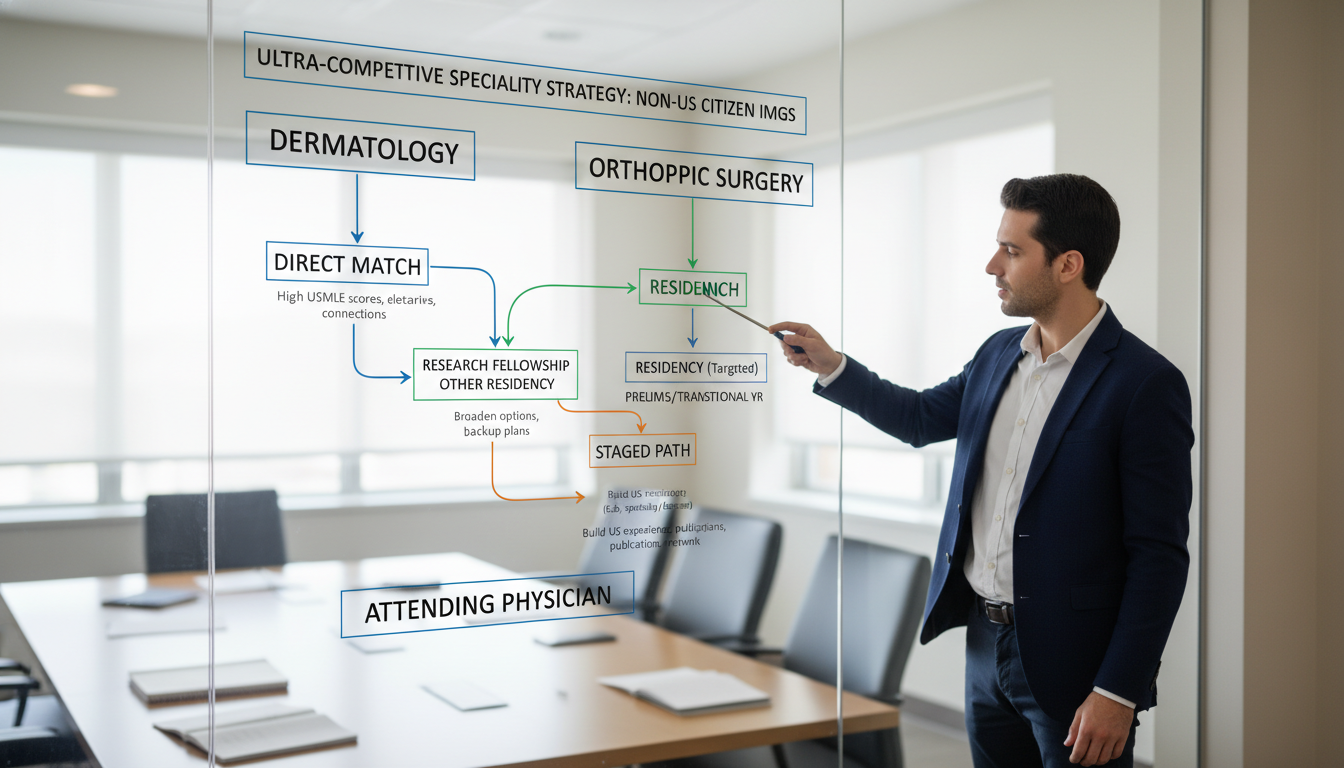
Many successful non-US citizen IMG applicants choose a dual‑path strategy:
- Primary ultra-competitive target (e.g., ortho, derm).
- Parallel viable option with more IMG acceptance (e.g., Internal Medicine, Family Medicine, Pathology, Neurology, Pediatrics, sometimes General Surgery categorical).
Decide Your Strategy Type
Think of three broad strategies:
All‑in Strategy (High Risk, High Reward)
- Target only one ultra-competitive specialty.
- Typically for those with:
- Top‑tier USMLE scores (260+ range for Step 2).
- Strong US research experience in the target specialty.
- US clinical rotations at reputable teaching hospitals.
- Faculty champions willing to call programs on your behalf.
- Requires emotional and financial tolerance for a possible unmatched year.
Focused + Parallel Strategy (Balanced)
- Apply primarily to the ultra-competitive specialty and to a backup specialty where IMGs commonly match.
- Example:
- 60–80 applications in ortho.
- 60–80 applications in internal medicine or prelim surgery.
- You must be genuinely willing to train and build a career in your backup specialty.
Staged Strategy (More Conservative, Longer Timeline)
- Stage 1: Enter a more accessible field (e.g., Internal Medicine, General Surgery prelim).
- Stage 2: Build US credentials (research, mentorship, publications).
- Stage 3: Reapply to the ultra-competitive specialty (or subspecialize in a related field).
- Example: IM residency → Dermatopathology fellowship → Academic derm‑related career.
For most non-US citizen IMGs, the Focused + Parallel or Staged strategies are the safest balance between ambition and reality.
Step 2: Build a Competitiveness Profile Far Above the Minimum
As a non-US citizen IMG aiming at matching derm or matching ortho, “good enough” USMLE scores and “some research” are not sufficient. Your profile must be clearly exceptional.
1. Academic Metrics: USMLE and Medical School Performance
USMLE Step 2 CK (since Step 1 is pass/fail):
- Aim for ≥ 250, with 260+ strongly preferred for derm, ortho, neurosurgery, plastics.
- Lower scores do not make it impossible, but they raise the bar for everything else.
Medical school performance:
- Class rank / distinction / honors.
- Strong evaluations in surgery, medicine, dermatology, neurology, depending on your target.
- If your school has no ranking system, get detailed MSPE language showing your relative performance.
Exams in your home country:
- Gold medals, top‑rank in national exams, or distinction on final MBBS/MD exams help reinforce academic strength.
Actionable tips:
- If your Step 2 score is <245 and you lack substantial research, carefully reassess whether a direct ultra-competitive attempt is wise.
- Use strong performance on Step 3 (if taken early) to partially compensate for a slightly lower Step 2.
2. Research: Depth, Relevance, and US‑Based Work
For ultra-competitive specialties, research is often what distinguishes foreign national medical graduates who match from those who do not.
Ideal research profile (for non-US citizen IMG):
- 1–2 years of US-based research in the target specialty.
- Evidence of sustained productivity:
- Peer‑reviewed papers (especially first‑ or second‑author).
- Conference abstracts, posters, oral presentations (US national meetings preferred).
- Book chapters or review articles.
- A clear narrative: your work aligns with your chosen field (e.g., melanocytic lesions and skin cancer for derm; trauma outcomes, joint replacement, biomechanics for ortho).
How to obtain research positions:
Cold emailing:
- Target academic faculty in your specialty of interest.
- Attach a brief CV and a concise email explaining:
- Who you are.
- Why you are interested in their work.
- Your willingness to work hard (including unpaid or stipend-based positions).
- Start 12–18 months before you hope to apply.
Leverage alumni or diaspora networks:
- Look for alumni from your school in US programs.
- Reach out to physicians from your country or region in your target field.
Research fellowships for IMGs:
- Many major academic centers (e.g., Harvard, Mayo, Cleveland Clinic, NYU, etc.) have specific research positions for IMGs in derm, ortho, neurosurgery, and other specialties.
Key point: Research is not just about lines on a CV. It is a powerful way to:
(a) get US mentors,
(b) obtain strong letters, and
(c) gain internal advocacy at a potential program.
3. US Clinical Experience (USCE) and Rotations
For ultra-competitive specialties, observerships alone usually are not enough. You want experiences where you can show work ethic and clinical reasoning.
Tiered value of experiences:
- Sub‑internships (“Sub‑Is”) / Acting Internships in your target specialty at reputable programs.
- Elective clerkships in the US at teaching hospitals (especially those with residencies in your target specialty).
- Hands‑on externships in the US (where permitted).
- In‑person observerships where you can interact with faculty daily and attend conferences.
Strategic approach:
For derm:
- Seek rotations at academic dermatology departments, even if labeled as research + clinic.
- Try to see a high volume of complex cases, not only cosmetic derm.
For ortho:
- Aim for sub‑Is in high‑volume orthopedic centers.
- Work closely with residents in the OR, clinics, and trauma call.
During these rotations, your goals are to:
- Demonstrate professionalism, humility, and reliability.
- Show clinical curiosity and reasoning.
- Build relationships for strong LORs and possibly program advocacy.
4. Letters of Recommendation (LORs): Quality Over Quantity
For a non-US citizen IMG, strong US letters are essential:
- Aim for 3–4 letters, primarily from:
- US faculty in your target specialty (ideally at known academic institutions).
- Research mentors who know your capabilities well.
- A “template” letter is much less valuable than a detailed, personalized letter.
To earn strong letters:
- Take ownership of tasks (research projects, patient follow-up, presentations).
- Ask for feedback and act on it.
- Near the end of your time with a mentor, ask directly:
- “Do you feel comfortable writing me a strong letter of recommendation for [dermatology/orthopedic surgery]?”
Step 3: Master Visa Strategy and Program Targeting
Your visa status dramatically shapes your options and should guide where and how you apply.
Visa Types and Their Implications
J‑1 Visa (ECFMG‑sponsored)
- Most common for IMGs.
- Widely accepted by programs.
- Requires a two‑year home country requirement after training unless waived.
- For ultra-competitive specialties, J‑1 is usually acceptable, but some programs still prefer H‑1B.
H‑1B Visa
- Less commonly offered due to cost and complexity.
- Some surgical fields and top institutions may still sponsor H‑1B.
- Often requires having Step 3 passed before starting residency.
- Check each program’s policy carefully.
Green Card or US Citizenship
- If you are a non-US citizen IMG but have permanent residency, your competitiveness increases substantially because programs treat you like a domestic graduate regarding visa concerns.
Action items:
- Decide early whether to take Step 3 before applications, especially if you aim for H‑1B–friendly programs.
- Keep a spreadsheet of program visa policies (from FREIDA, program websites, and direct emails).
Targeting Programs Strategically
As a foreign national medical graduate, your program list should be highly strategic, not random.
Research each program on:
- Visa sponsorship (J‑1 only, J‑1/H‑1B, or none).
- History of matching IMGs—especially non‑US citizen IMGs.
- Academic vs community profile.
- Presence of research tracks and strong research productivity.
- Program size and number of positions.
- Culture around diversity and inclusion.
How to prioritize:
- Tier 1: Programs known to sponsor visas, with at least some history of IMGs in your target specialty.
- Tier 2: Programs that sponsor visas but have minimal IMG representation; apply if you have strong connections (e.g., research).
- Tier 3: Programs with no clear visa info or clear bias against IMGs—apply only if you have direct, strong connections.
For matching derm or matching ortho as a non-US citizen IMG, consider:
- Large academic centers with robust research (where your research/mentors can advocate).
- Programs known to be more open to IMGs (look at current residents’ backgrounds).
- Avoid spending too many applications on “IMG‑invisible” programs with 0 track record and no visa sponsorship.

Step 4: Application, Interview, and Backup Strategy
Crafting a Convincing ERAS Application
Your application must clearly answer:
- Why this specialty? (not generic; must show deep exposure and reflection).
- Why you, despite being an IMG and foreign national?
- What is unique about your path and contributions?
Personal Statement Tips:
For derm:
- Highlight long‑term engagement with skin disease (research, clinics, underserved care).
- Connect your interest to visual diagnostics, chronic disease continuity, and patient relationships.
For ortho:
- Emphasize love of procedures, biomechanics, teamwork, and patient functional recovery.
- Include concrete surgical exposures and what you learned from them.
Avoid clichés like “I love helping people” or “I am passionate about surgery.” Use specific cases, projects, or turning points.
CV Optimization:
- Group research under clear headings (Dermatology Research, Orthopedic Trauma Research).
- Highlight leadership roles, teaching, and any national awards.
- For each experience, quantify scope and impact (e.g., “Co‑authored 3 manuscripts, presented at 2 national meetings”).
Interview Skills Tailored to Non-US Citizen IMGs
When you reach the interview stage, the playing field is more level. However, you will often be asked:
- “Why should we choose you over a US grad?”
- “How will you handle the cultural and system differences?”
- “What are your visa needs?”
Prepare to demonstrate:
- Excellent English communication (clear, concise, not overly formal or vague).
- Understanding of US healthcare system basics (insurance, team structure, EMR, duty hours).
- Humility and adaptability—acknowledge that adjusting from your home system took effort, and show what you did to adapt.
Practice common questions:
- Tell me about yourself.
- Why this specialty?
- Why our program?
- Describe a challenging clinical situation.
- How do you handle heavy workloads / call?
Have specific US-based examples, not only from your home country. Programs want to see that you’ve already started adapting.
Constructing a Backup Plan that Doesn’t Undermine You
Your backup strategy should be deliberate, not accidental.
Options for backup:
Parallel specialty ERAS application in the same cycle
- E.g., Primary: Dermatology / Ortho. Backup: Internal Medicine, Prelim Surgery, Transitional Year.
- Maintain separate personal statements for each specialty.
- Do not mention your backup specialty in interviews for your primary choice.
Research year if unmatched
- If you go unmatched, you can often:
- Begin/extend a full-time research position.
- Improve your publications and network.
- Reapply stronger the following year.
- If you go unmatched, you can often:
Alternate specialty leading to related subspecialty
- If derm seems out of reach, consider:
- Internal Medicine → Rheumatology with strong skin focus.
- Pathology → Dermatopathology.
- For ortho:
- General Surgery → Hand Surgery, Trauma Surgery.
- PM&R → Interventional spine, sports medicine.
- If derm seems out of reach, consider:
Your backup is successful if you can honestly say, “I will still have a fulfilling, respected career even if I end up here.”
Step 5: Timeframes, Decision Points, and Burnout Prevention
Realistic Timeline for a Non-US Citizen IMG
A common high‑intensity but realistic timeline:
Year 0 (final year of med school / early postgrad):
- Decide specialty target and strategy.
- Prepare for Step 2 CK; aim for a top score.
- Start serious email outreach for US research positions.
Year 1:
- Move to the US for a research position in your specialty.
- Begin building publications and networking.
- Take Step 2 CK (and possibly Step 3).
- Attend conferences, present posters.
Year 2:
- Continue research, now with stronger productivity.
- Arrange US clinical rotations (sub‑Is, electives).
- Secure strong LORs.
- Submit ERAS with well-rounded academic, research, and clinical profile.
Some applicants compress this into a shorter period, but for ultra-competitive specialties, a 1–2 year dedicated preparation phase in the US is common among successful non-US citizen IMGs.
Key Decision Points
Throughout this journey, periodically reassess:
- Has my Step 2 CK score changed my realistic prospects?
- Is my research output sufficient for top‑tier programs, or do I need another year?
- Do I have at least two strong US specialty letters?
- Does my visa situation limit my options excessively?
If the answer is “no” at multiple points near ERAS opening, it may be wiser to:
- Postpone application by one year, or
- Modify your strategy (e.g., focus on a more accessible specialty this year, keep the ultra-competitive specialty as a long-term dream via subspecialization).
Preventing Burnout and Maintaining Perspective
Pursuing ultra-competitive specialties as a non-US citizen IMG is emotionally and financially demanding. To avoid burnout:
- Set measurable quarterly goals (papers submitted, rotations completed, mentors contacted).
- Maintain support from:
- Peers on similar paths.
- Mentors who give honest feedback.
- Family who understand that this is a multi‑year journey.
- Remember: Every step increases your options, even if the exact specialty outcome remains uncertain.
Your USMLE prep, research, and clinical exposure are never wasted—they build a foundation for many career directions, not just matching derm or matching ortho.
Frequently Asked Questions (FAQ)
1. Is it realistic for a non-US citizen IMG to match dermatology or orthopedic surgery?
Yes, but it is rare and demanding. You must generally be stronger than the average US MD applicant in metrics that are visible to programs:
- High Step 2 CK (often ≥260 for true competitiveness).
- 1–2 years of relevant US research with publications.
- Solid US clinical exposure and top-tier LORs.
- A clear, well-supported specialty narrative.
Many highly qualified non-US citizen IMGs still do not match on the first attempt, so you must be prepared for multiple cycles or a staged pathway via another specialty.
2. Should I apply directly to derm/ortho or first complete another residency like Internal Medicine or Surgery?
It depends on your current profile:
- If you already have top scores, US research, strong US letters, and rotations, applying directly can be justified (often with a backup specialty in the same cycle).
- If you lack one or more of those pillars, a staged strategy may be wiser:
- Start in a more accessible field (like Internal Medicine or a Surgical prelim).
- Build US credentials.
- Reapply or pursue a related subspecialty (e.g., dermatopathology, rheumatology with derm focus, hand/trauma surgery).
Discuss your specific situation with mentors who know your file and the current match landscape.
3. How important is it to be physically in the US for research or observerships?
Being physically in the US is extremely valuable, especially for ultra-competitive specialties:
- It allows you to build relationships with faculty.
- You can show your work ethic and communication skills in person.
- Faculty are more likely to advocate for you within their program or with colleagues.
Remote research can be helpful but is usually not enough by itself. If at all possible, plan for at least 6–12 months in the US doing research and/or rotations in your specialty.
4. If I go unmatched in an ultra-competitive specialty, what is the best way to use my “gap year”?
The optimal use of an unmatched year often includes:
- Full-time US-based research in your target specialty.
- Strengthening your publications and presentations.
- Additional US clinical exposure (if possible) to secure better letters.
- Retaking missing steps (e.g., Step 3) or improving English communication skills.
At the same time, reassess whether reapplying is appropriate or whether you should pivot to a different but fulfilling specialty. Use the extra year to become objectively more competitive, not just older.
Pursuing an ultra-competitive specialty as a non-US citizen IMG is one of the toughest paths in medical training—but with a strategic plan, realistic self-assessment, and sustained effort, you can maximize your chances and avoid blind risk. Even if your path ultimately diverges from matching derm or matching ortho, the skills and relationships you build along the way will support a meaningful, successful career in US medicine.