


Preparing for nuclear medicine board exams is a unique challenge: you need solid physics, radiobiology, radiopharmacy, and imaging interpretation skills—plus a strong command of clinical applications from cardiology to oncology. Whether you are coming from diagnostic radiology, internal medicine, or a dedicated nuclear medicine residency, your study strategy and resource selection will make a major difference in both the nuclear medicine match and in your long-term practice.
This guide walks through the most valuable board exam study resources in nuclear medicine, how to integrate them into a coherent plan, and how to avoid common pitfalls. It is written with U.S. candidates in mind (ABNM, ABR-NM), but the principles are broadly applicable to international boards.
Core Domains of Nuclear Medicine Board Preparation
Before you pick resources, clarify what you are studying for. Most nuclear medicine board exams assess:
Clinical Nuclear Medicine
- Oncologic imaging (PET/CT, SPECT/CT)
- Cardiac nuclear medicine and stress testing
- Endocrine, renal, GI, pulmonary, musculoskeletal, infection/inflammation imaging
- Therapy: thyroid, radioembolization, Lu-177 therapies, etc.
Physics and Instrumentation
- Radiation physics basics
- Gamma cameras, PET detectors, collimators
- Image formation, SPECT/CT, PET/CT, PET/MR
- Image quality, artifacts, resolution, sensitivity, noise
Radiation Biology and Protection
- Cellular effects of radiation
- Stochastic vs deterministic effects
- Dosimetry concepts
- Shielding, ALARA, pregnant workers/patients, regulatory limits
Radiopharmacy and Radiochemistry
- Radiopharmaceutical production and QC
- Common tracers (FDG, MDP, Tc-based agents, I-123, I-131, Ga-68, F-18 compounds, Lu-177, Y-90)
- Biodistribution, indications, contraindications, pitfalls
Regulations and Practice Management
- NRC and state regulations
- Licensing, record keeping
- Radioactive material handling and waste
- Quality assurance (QA/QC) procedures
Each of these domains maps to different types of resources—textbooks, question banks, flashcards, and guidelines. Effective prep means layering these resources strategically rather than trying to “read everything.”
Essential Textbooks and Reference Materials
Textbooks remain the backbone of nuclear medicine board exam preparation. The goal is not to memorize every page, but to build a conceptual lattice you will reinforce with questions and active recall.
1. Core Clinical and Physics Texts
a. Nuclear Medicine: The Requisites (G. Elgazzar or similar editions)
- Why it’s valuable: Concise, board-oriented overview of clinical nuclear medicine, imaging techniques, and radiopharmaceuticals.
- How to use:
- Read systematically during the first half of your study timeline.
- Highlight classic patterns: e.g. FDG PET patterns of lymphoma vs infection, typical thyroid scintigraphy findings.
- Create questions or flashcards for classic “pearls” and tables.
b. Essentials of Nuclear Medicine Imaging (Mettler & Guiberteau)
- Why it’s valuable: More detailed imaging text with excellent image examples and clinically relevant discussions.
- How to use:
- Focus on chapters that historically yield many exam questions: PET/CT, cardiac, bone, thyroid, renal, infection, and pediatric nuclear medicine.
- For images, practice describing them out loud as if dictating a report—this mimics exam interpretation.
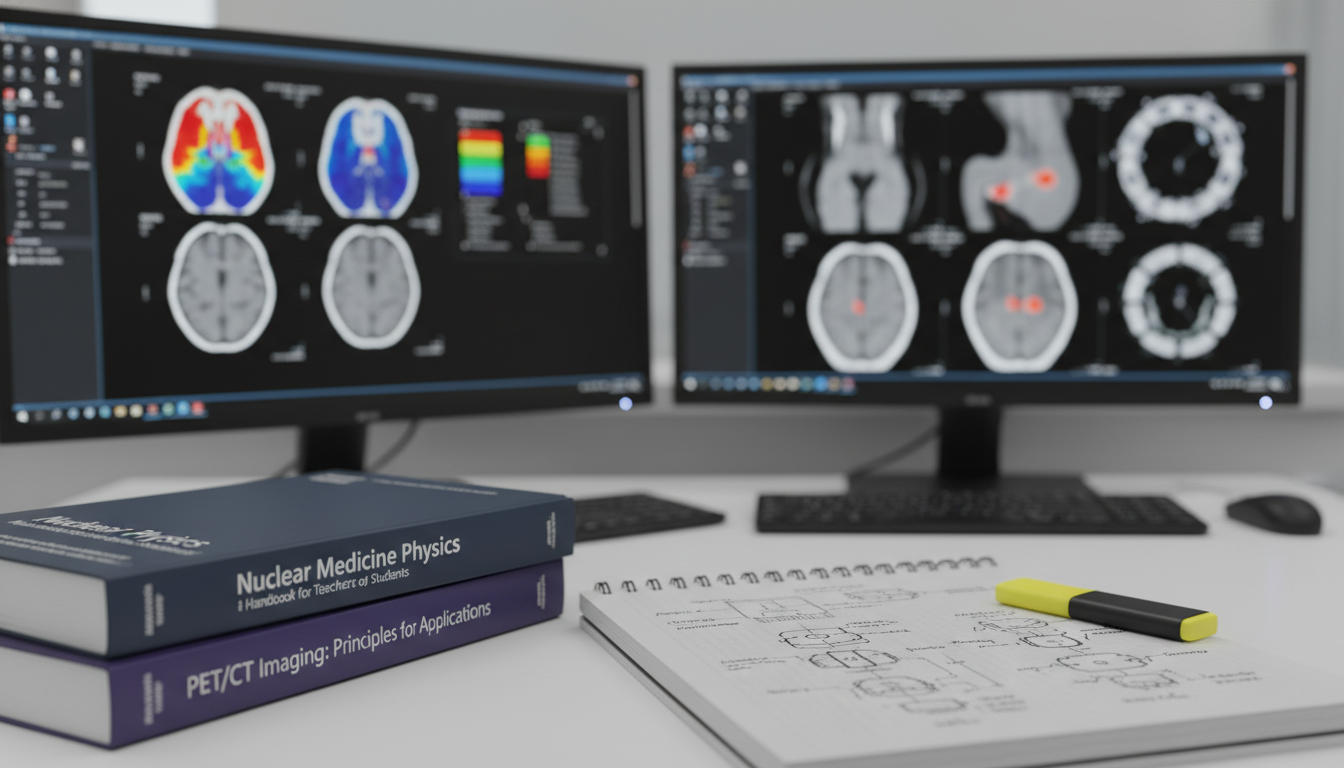
c. Nuclear Medicine Physics: The Basics (Harold Elgazzar or equivalent)
- Why it’s valuable: Clear introduction to radiation physics and instrumentation designed for clinicians.
- How to use:
- Read early in prep to orient yourself to concepts like attenuation, scatter, resolution, detector efficiency, and QC tests.
- Draw diagrams (e.g., collimator types, PET coincidence detection) and label them—this helps for image-based physics questions.
2. Therapy and Advanced PET Resources
a. Theranostics and Radionuclide Therapy Texts
Depending on your board, therapy content is increasingly emphasized:
- Look for chapters on:
- I-131 for differentiated thyroid cancer and hyperthyroidism
- Lu-177 DOTATATE, Lu-177 PSMA
- Y-90 radioembolization
- Radiation safety for high-activity therapies
- How to use:
- Create a comparison chart: indications, contraindications, preparation, dosimetry principles, side effects, follow-up.
b. PET/CT and PET/MR Focused Texts (optional but helpful)
- Helpful for ABNM-style questions emphasizing oncology imaging (lung, lymphoma, melanoma, colorectal, head and neck).
- Focus on:
- Normal variants vs pathologic uptake
- Therapy response assessment criteria (e.g., PERCIST basics)
- Common artifacts (e.g., misregistration, brown fat, muscle uptake)
3. Guidelines and Official Documents
Board exams frequently reflect guideline-based practice. Key sources:
SNMMI Procedure Standards
- Stress, thyroid, renal, infection, bone, pediatric, and PET protocols.
- Focus on dosing ranges, imaging time points, major indications, and critical contraindications.
NRC or Local Regulatory Guidance
- Especially for radiation protection and therapy questions.
- Study trigger limits, reporting thresholds, and basic licensing structures.
Practical tip:
Create a 5–10 page “guideline digest” summarizing key parameters: doses, wait times, contraindications, precautions for breastfeeding and pregnancy, and common pitfalls.
Question Banks, Q‑Books, and Online Platforms
Your performance on nuclear medicine board exams will depend heavily on how much question-based practice you do, not just what you read. Questions force you to retrieve information, recognize patterns, and apply concepts under time pressure.
1. Specialty Question Banks
While nuclear medicine is a smaller field (and commercial Q-banks are less abundant than for USMLE), several high-yield options exist:
a. Board-Style Nuclear Medicine Question Books
Look for titles explicitly labeled as board review or case review. Typical formats:
- Multiple-choice question (MCQ) books
- Physics and instrumentation sections
- Clinical cases with images and vignettes
- Radiopharmacy/regulatory chapters
- Case-based review books
- PET/CT case collections
- SPECT/CT and planar imaging cases
How to use:
- Do one or two blocks (20–40 questions) daily during intensive prep.
- Track every missed question in a log:
- Topic: e.g., “cardiac SPECT artifacts,” “thyroid therapy radiation safety.”
- Why you missed it: content gap vs misreading vs guessing.
- Action: “Review Mettler chapter 7” or “Add Anki card.”
b. Online Nuclear Medicine Question Platforms
Institutions, societies, or exam prep companies sometimes offer:
- Timed board-style exams
- Subspecialty modules (physics, therapy, cardiac, PET)
- Performance dashboards by topic
If you have access through your nuclear medicine residency, use it aggressively in the last 3–4 months before the exam.
2. Leveraging General Radiology Q‑Banks
Some radiology question banks include a nuclear medicine section that is quite robust:
- These may not cover regulatory or detailed therapy content, but can:
- Sharpen your image interpretation skills
- Reinforce cardiac, bone, and oncologic imaging patterns
- Highlight cross-sectional anatomy relevant to SPECT/CT and PET/CT
Integrate them as supplemental practice, not primary nuclear medicine content.
3. Question Strategy and UWorld-Style Tactics
Many residents preparing for nuclear medicine boards draw on skills developed for the USMLE, particularly from UWorld tips:
- Read the last line of the stem first to know what you’re looking for.
- Annotate key findings in the vignette (age, clinical setting, risk factors).
- Commit to an answer before reading options; then compare.
- Avoid overthinking rare zebra diagnoses when a common explanation fits.
Even if there is no “UWorld for nuclear medicine,” you can apply UWorld-style discipline:
- Use timed blocks to simulate exam conditions.
- Review every explanation, not just wrong answers.
- Build a topic list of high-yield deficiencies to target in reading and flashcards.
Active Recall and Spaced Repetition: Anki and Beyond
Nuclear medicine exams require retention of numerous facts, numbers, and patterns: half-lives, photon energies, QC parameters, dosing ranges, radiopharmaceutical biodistributions, and regulatory thresholds. Passive rereading is not enough—you need active recall and spaced repetition.
1. Anki for Nuclear Medicine Boards
Even if you used Anki USMLE decks previously, you should build or adapt a deck specifically for nuclear medicine:
What to put in your Anki deck:
Radiopharmaceuticals
- Half-life, emission type, primary energy (if clinically relevant)
- Target organ and mechanism (e.g., Na/I symporter, bone turnover, perfusion)
- Common clinical indications and contraindications
- Normal biodistribution and major pitfalls (physiologic variants)
Physics and Instrumentation
- Definitions: resolution, sensitivity, scatter, attenuation, dead time
- QC tests: daily uniformity, weekly bar phantom, energy peaking
- PET vs SPECT differences, CT dose basics
- Common artifacts and their causes
Dosimetry and Safety
- Typical effective doses for common studies
- Occupational dose limits
- Therapy-specific safety instructions
Guideline Nuggets
- Stress testing contraindications and stopping criteria
- Renal scan interpretations (e.g., obstruction vs nonobstructive patterns)
- Thyroid cancer management flow (e.g., when to ablate, surveillance)
How to use Anki effectively:
- Aim for short, focused cards—1 fact per card.
- Use image occlusion for labeling diagrams (e.g., gamma camera components).
- Do a daily review, even during busy rotations (15–30 minutes).
- Ramp up new cards during the early and middle phases of prep; taper toward exam as you consolidate.
2. Other Active Recall Tools
If Anki does not fit your style, you can still use active recall:
Self-written One-Pagers
- Each topic on one page: “Cardiac Nuclear Medicine”, “Thyroid Scintigraphy”, “Lu-177 DOTATATE.”
- Regularly cover answers with a blank sheet and recite from memory.
Whiteboard Sessions
- Once weekly, take 30 minutes to draw systems from scratch:
- PET scanner schematic
- Radiopharmaceutical biodistribution map
- Algorithm for thyroid nodule evaluation and treatment
- Once weekly, take 30 minutes to draw systems from scratch:
Teaching Others
- Present 10-minute “micro-lectures” to junior residents or technologists.
- Explaining radiopharmacy, physics, and protocols cements your own understanding.
Integrating USMLE-Style Resources into Nuclear Medicine Prep
Many nuclear medicine residents are physicians who have already completed or are completing other residencies (radiology, internal medicine, etc.) and are familiar with USMLE-style resources like UWorld and Anki. You can leverage those experiences thoughtfully.
1. When USMLE-Level Material Helps
Radiation Biology and Basic Physics:
- USMLE Step 1/2 resources cover:
- DNA damage mechanisms
- Cell cycle sensitivity to radiation
- Radiation risk and cancer induction
- These can serve as a conceptual base, but board exams in nuclear medicine go much deeper into instrumentation and imaging.
- USMLE Step 1/2 resources cover:
Internal Medicine Concepts:
- For nuclear cardiology: prior cardiology and pharmacology knowledge strengthen understanding of stress agents and ischemia patterns.
- For oncologic PET: understanding staging systems and treatment regimens helps interpret exam-style clinical vignettes.
2. Adapting UWorld Tips and Study Habits
Even though UWorld is not tailored to nuclear medicine, the process that helped you succeed on USMLE can and should carry over:
Block and Review Structure:
- Nuclear medicine question blocks in the morning
- Dedicated review session in the evening:
- Re-do missed questions
- Update Anki or notes with new information
Data-Driven Focus:
- Track which topics consistently cause errors
- Adjust your reading and practice schedule to attack weak spots
High‑Yield First, Then Depth:
- Start with commonly tested studies: cardiac, bone, thyroid, PET/CT for major cancers.
- Then tackle niche areas: neuroendocrine tumors, pediatric protocols, complex dosimetry.
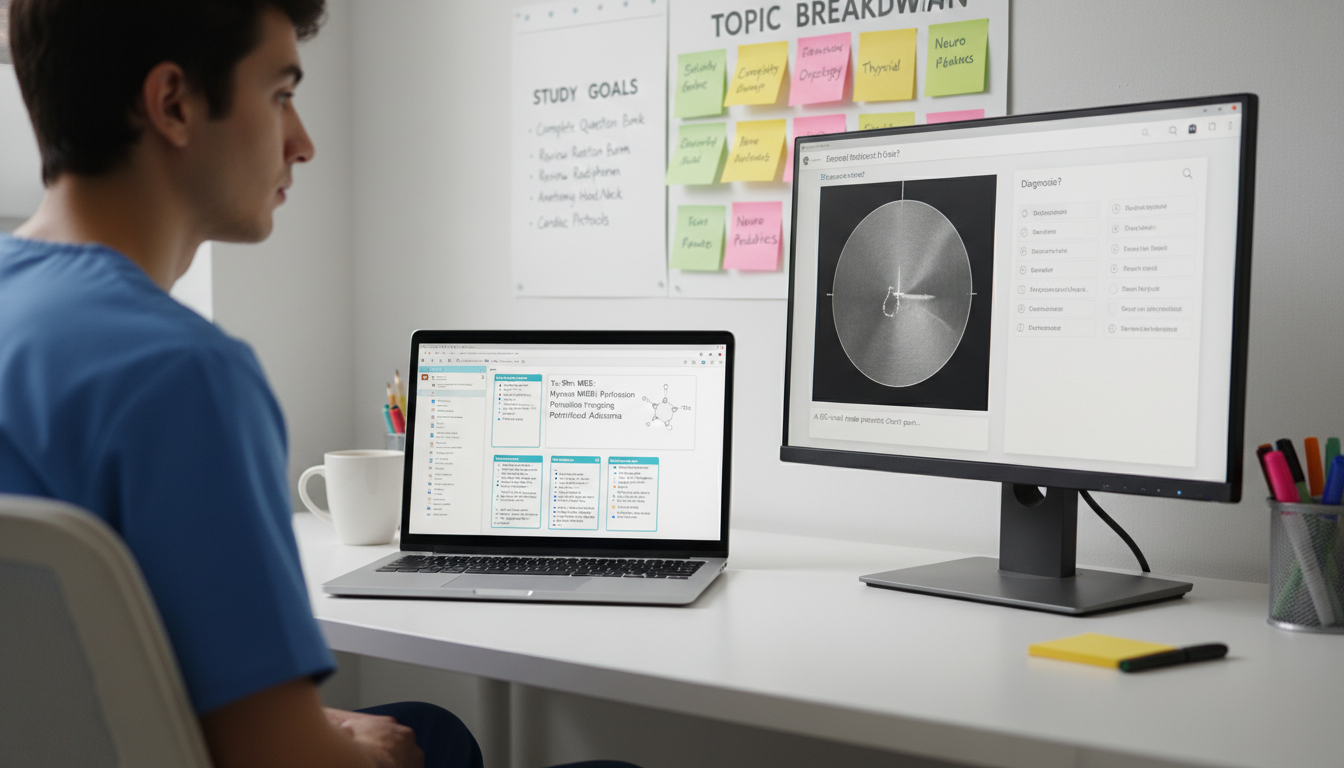
Building a Comprehensive Study Plan
Resources only work if you integrate them into a coherent schedule. Below is a sample 4–6 month structure you can adapt based on your exam date and clinical workload.
Phase 1 (Months 1–2): Foundation Building
Goals:
- Cover core textbook material once.
- Set up Anki or other active recall system.
- Familiarize yourself with exam blueprint.
Resources:
- Nuclear Medicine: The Requisites (or equivalent clinical book)
- Nuclear medicine physics basics text
- SNMMI procedure standards for highest-yield studies
Weekly structure (example):
- 4 days/week: 1–2 textbook chapters + 20–30 related questions
- Daily: 15–20 minutes Anki
- Weekend: 1–2 hours guideline-based review (dosing, protocols)
Phase 2 (Months 3–4): Question-Heavy Consolidation
Goals:
- Systematically work through board-style Q‑books and online question banks.
- Identify and aggressively remediate weak areas.
- Build integrated understanding (link physics ↔ clinical ↔ radiopharmacy).
Resources:
- Q-books and any online nuclear medicine question platforms
- PET/CT and therapy-focused chapters
- Radiopharmacy chapters/guides
Weekly structure (example):
- 4–5 days/week: 40–80 questions/day (mix of topics)
- Daily: 20–30 minutes Anki, focusing on errors and persistently weak facts
- 1–2 days/week: focused reading on weak areas (e.g., radiation regulations, therapy dosimetry)
Phase 3 (Month 5–6): Final Review and Simulation
Goals:
- Simulate exam conditions.
- Rapidly refresh high-yield facts and patterns.
- Reduce cognitive load by organizing memorized content.
Resources:
- Full-length practice exams or multi-block simulations
- Personal notes, one-pagers, and condensed Anki cards
- Select textbook/image review of high-yield cases
Weekly structure (example):
- 1–2 full exam simulations (timed, with breaks comparable to real exam)
- Remaining days: mix of:
- Targeted question blocks in weakest domains
- Rapid Anki review
- Image-heavy review sessions (cardiac, PET/CT, bone, thyroid, renal)
Practical exam-week adjustments:
- Focus heavily on:
- Radiopharmaceuticals (tables, biodistribution, pitfalls)
- Radiation safety and regulations
- Classic image patterns and common artifacts
- Avoid starting brand-new dense chapters; instead, consolidate.
Common Pitfalls and How to Avoid Them
Overemphasis on Reading, Underemphasis on Questions
- Solution: Set a minimum question quota per week from the start.
Neglecting Physics and QC
- Physics and instrumentation often feel abstract, but they are high-yield.
- Solution: Integrate small doses weekly, not just at the end.
Ignoring Guidelines
- Boards test standard-of-care, not just textbook content.
- Solution: Build concise guideline summaries and actively quiz yourself.
Weak Time Management
- Going too slowly through questions or obsessively rereading explanations.
- Solution: Use timed blocks and accept some uncertainty; focus on learning patterns, not perfection.
Burnout Near Exam Time
- Pacing is crucial. Cramming the final month without a foundation rarely works.
- Solution: Follow phased preparation, maintain some time for rest and exercise.
FAQ: Nuclear Medicine Board Exam Resources
1. If I can only buy one major textbook for nuclear medicine boards, which should I choose?
If you must pick a single core text, a comprehensive clinical book such as Nuclear Medicine: The Requisites or Essentials of Nuclear Medicine Imaging is usually the most efficient choice. It offers broad coverage of clinical topics, imaging patterns, and radiopharmaceuticals. You can then supplement physics and regulatory knowledge with shorter dedicated resources or review chapters.
2. How many questions should I aim to complete before the exam?
A reasonable target is 1,500–2,500 board-style nuclear medicine questions over your whole prep period. If formal nuclear medicine Q‑banks are limited, combine:
- Multiple question books
- Institutional or society practice sets
- Radiology Q‑banks with strong nuclear medicine sections
The key is not just quantity, but thorough review of explanations and converting errors into flashcards or notes.
3. Do I really need Anki or can I pass the exam with just reading and questions?
Many people pass without Anki, but spaced repetition is especially helpful in nuclear medicine, given the volume of discrete facts (half-lives, energies, dosing, regulatory thresholds). If you dislike Anki specifically, consider alternate active recall formats (short quizzes, flashcards, self-testing sheets). Passing is possible without it, but your retention and confidence are often better with a structured recall system.
4. What’s the best way to prepare for the physics and radiation safety components?
Use a three-layer approach:
- A concise nuclear medicine physics text for conceptual understanding.
- Targeted question practice focusing on instrumentation, QC, dosimetry, and artifacts.
- Summaries of key regulatory and safety values (dose limits, reporting thresholds, therapy precautions) that you actively recall weekly (e.g., via Anki).
Do not leave physics and safety to the final weeks—integrate them throughout your study plan.
Mastering nuclear medicine boards is a cumulative process: building a conceptual framework, practicing with board-level questions, and reinforcing details through active recall. With the right combination of textbooks, question banks, Anki or similar tools, and guideline-based review, you can approach exam day with confidence—and translate that knowledge into safer, more effective patient care in your nuclear medicine residency and beyond.




















