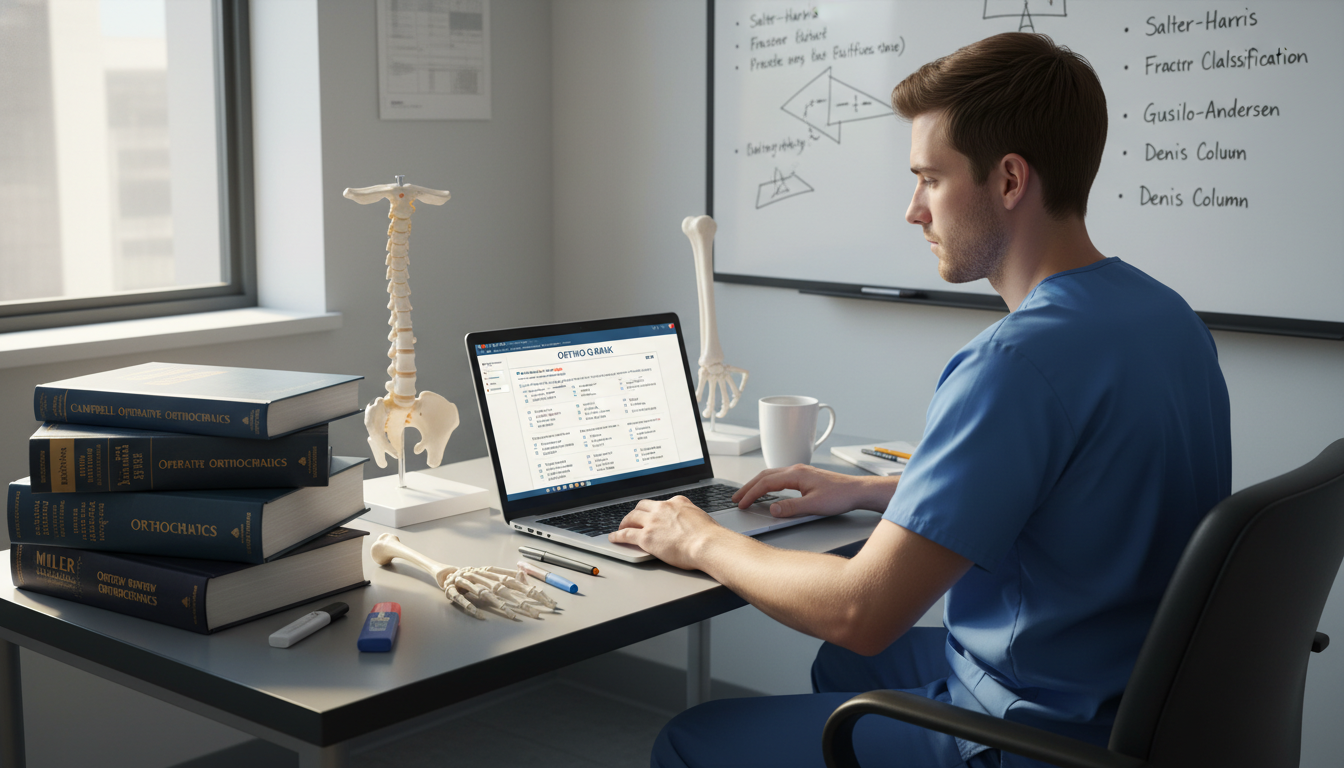
Preparing for orthopedic surgery board exams—whether the ABOS Part I, ABOS Part II, or the Orthopaedic In-Training Examination (OITE)—requires a clear plan, the right materials, and disciplined execution. This guide breaks down the most effective board exam resources in orthopedic surgery, how to combine them strategically, and how to adapt your approach based on where you are in training.
Understanding the Orthopedic Surgery Board Exam Landscape
Before choosing board exam resources, you need to understand what you’re aiming for and where the exams overlap.
Key Exams in Orthopedic Surgery
1. OITE (Orthopaedic In-Training Examination)
- Taken annually during residency
- Content closely mirrors ABOS Part I in scope and style
- Best used as a formative exam to benchmark your knowledge and identify weak areas
- Strong OITE performance is correlated with success on ABOS Part I
2. ABOS Part I (Written Exam)
- Computer-based multiple-choice exam
- Focused on breadth of knowledge across orthopedic subspecialties
- Heavy emphasis on:
- Fracture classification and management
- Basic science (biomechanics, pathology, biomaterials, physiology)
- Common clinical scenarios and complications
- Your primary target during late residency (PGY-4/5 for most)
3. ABOS Part II (Oral Exam)
- Case-based oral exam after residency and early practice
- Requires submission of a case list and oral defense of selected cases
- Study resources focus more on:
- Guidelines and evidence-based management
- Complication recognition and prevention
- Clear communication and documentation
This article focuses primarily on written-exam style board resources, but you’ll also find recommendations relevant to OITE and Part II exam preparation.
Core Question Banks and How to Use Them
For orthopedic surgery board exam preparation, question banks are your primary tool. They mimic the testing style, reinforce high-yield facts, and teach you how to think through cases.
1. AAOS OITE/Board Review Question Banks
Multiple organizations and publishers create orthopedic exam-style questions, but the most widely used include:
- AAOS or Academy-sponsored question banks
- OITE past questions (via official sources and commercial platforms)
- Various comprehensive review platforms structured like the OITE and ABOS Part I
Why they work:
- Closely aligned with the real exam’s style and structure
- Frequently updated with current guidelines and contemporary practice
- Explanations often reference AAOS Clinical Practice Guidelines and classic literature
How to use them:
- PGY-1/2: Aim for coverage over completion. Do small sets (10–15 questions/day) focusing on reading explanations thoroughly.
- PGY-3/4: Shift to performance plus remediation. Do blocks of 20–40 timed questions and track your percentage and weak topics.
- PGY-5 / Early Fellow: Use them as refinement and simulation. Full-length timed blocks under exam conditions.
Practical schedule example (PGY-3, pre-OITE season):
- July–September: 10–20 questions/day, untimed, mixed topics
- October–November: 40–60 questions/day, timed blocks simulating exam conditions
- December–January: Review missed questions and explanations; reinforce high-yield summaries
2. UWorld-Style Tips for Ortho Question Banks
While UWorld itself is not an orthopedic surgery-specific question bank, residents often refer to “UWorld tips” as a shorthand for deep, explanation-focused studying of Qbanks. Apply the UWorld mindset to your orthopedic question banks:
Use these UWorld tips with ortho question banks:
- Always read the full explanation, even when you’re correct. Many board-level distinctions are subtle (e.g., choice of fixation method, implant design, imaging workup).
- Annotate or capture pearls, not paragraphs. Summarize each explanation into:
- One main “teaching point”
- One key classification or numerical threshold (e.g., Cobb angle, correction limits, alignment parameters)
- Flag questions strategically:
- Flag “high-yield” and “I guessed but got right” questions
- Re-do flagged questions 1–2 weeks later
- Simulate test conditions:
- At least once weekly (closer to exams), do a 50–100 question block in one sitting, timed, with no interruptions.
3. Specialty-Specific Question Sets
For stronger performance in subspecialty-heavy sections, consider dedicated resources:
- Trauma: AO Trauma, institutional trauma review lectures, trauma-focused question sets
- Sports: Resources aligned with AOSSM or sports review courses
- Pediatrics: Pediatric-specific question banks and POSNA educational materials
- Spine, Hand, Foot & Ankle, Oncology, Adult Reconstruction: Many commercial board review series include subspecialty-specific chapters and question pools.
Strategy:
Use broad question banks as your foundation; then, in the last 6–8 weeks before the exam, do focused subspecialty blocks to patch gaps revealed by practice tests.

Textbooks, Review Books, and High-Yield Summaries
Question banks alone are not enough. You need a conceptual framework, and textbooks and review books provide that structure.
1. Comprehensive Orthopedic Textbooks
The classic orthopedic textbooks include:
- Campbell’s Operative Orthopaedics
- Lovell & Winter’s Pediatric Orthopaedics
- Rockwood and Green’s Fractures in Adults and Children
- Miller’s Review of Orthopaedics (bridges textbook and review style)
These are not books you read cover-to-cover in the months before the exam, but they are essential reference texts.
How to use them effectively:
- Use your OITE reports and practice exam results to identify weak areas, then read targeted sections (e.g., “Periprosthetic fractures,” “Scaphoid fractures,” “DDH”).
- Focus on:
- Fracture classification systems (e.g., AO, Schatzker, Garden, Neer)
- Standard operative indications and techniques
- Classic complications and their management
- Key biomechanical and biomaterials principles
Keep a list of “persistent weak areas” and schedule 30–60 minutes of textbook reading per week to address them.
2. High-Yield Review Books
For residents targeting the ortho match and future board success, high-yield review books are indispensable during the latter part of residency:
- Miller’s Review of Orthopaedics
- AAOS Orthopaedic Knowledge Update (OKU) series
- Various “board review” manuals designed specifically for OITE and ABOS Part I
Why they’re high-value:
- Distill large textbooks into exam-relevant summaries
- Include high-yield facts, classic exam images, and references
- Often organized by subspecialty, mirroring the exam structure
Suggested approach:
- PGY-2/3: Read selective high-yield chapters before each rotation (e.g., sports chapter before sports rotation).
- PGY-4/5: Systematic second pass of the entire review book over 3–4 months, synchronized with your question bank cycles.
Example schedule (3-month board review plan):
- Month 1: Trauma, adult reconstruction, basic science
- Month 2: Hand, sports, pediatrics, foot & ankle
- Month 3: Spine, oncology, shoulder & elbow, infections, misc./review
3. Quick-Reference Outlines and Mnemonics
Many residents build personal “board notes” or cheat sheets, often derived from:
- Morning conference handouts
- Faculty review sessions
- Recorded course notes
- Prior OITE review packets
Consider organizing your notes as:
- One-page summaries of each major topic:
- Epidemiology and risk factors
- Key anatomy
- Diagnostic workup
- Nonoperative vs operative indications
- Preferred procedures
- Classic complications and numbers (angles, thresholds, time windows)
- Mnemonic lists for:
- Nerve injuries
- Classic associations (e.g., systemic diseases and ortho manifestations)
- Imaging findings and eponymous signs
This style of condensed material is especially useful in the final 1–2 weeks before your exam for rapid review.
Digital Tools: Anki, USMLE Habits, and Structured Recall
Orthopedic board content is fact-dense: classifications, angles, radiographic thresholds, implant choices, grading scales, and disease associations. Spaced repetition tools like Anki can help transform that into long-term recall.
1. Using Anki for Orthopedic Boards
Even if you primarily used Anki USMLE decks as a medical student, the same principles work extremely well for orthopedic surgery content.
What to put into your Anki deck:
- Fracture classifications with imaging examples
- Key operative indications and contraindications
- Numeric values: alignment parameters, Cobb angles, biomechanical forces, lab cutoffs
- Named tests and signs (e.g., provocative tests, physical exam maneuvers, radiographic signs)
- High-yield associations from question explanations
Card style recommendations:
- Cloze deletions within short statements (e.g., “The Garden classification describes ______ fractures of the ______.”)
- Image occlusion of x-rays and schematics for:
- Fracture classification
- Osteotomies
- Implant recognition
Daily practice:
- 20–40 new cards/day during early prep
- 100–200 reviews/day as your deck matures
- Integrate Anki sessions into:
- Post-call mornings (short sessions)
- Evening study blocks
- Commutes (if safe and feasible with audio/flashcard apps)
2. Integrating Anki with Question Banks
To fully exploit spaced repetition:
After each question block, create Anki cards only for:
- Facts you missed
- Facts you got right by guessing
- Concepts you want to cement for the exam
Example workflow:
- Do a 20-question block
- Review explanations and mark 5–10 “card-worthy” points
- Spend 10–15 minutes creating cards immediately (or at least the same day)
Tag cards by subspecialty (e.g., “trauma,” “peds,” “arthroplasty”). Before the exam, you can filter/review particularly weak areas.
This approach turns every practice question into a long-term learning opportunity rather than a one-time event.
3. Leveraging USMLE Study Habits
Many of the strategies that worked for Step 1/2 will still work for orthopedic boards:
- Active recall > passive reading: Qbanks + flashcards beat simply reading Campbell’s.
- Interleaved practice: Mix subspecialties in question blocks; don’t study just trauma for two weeks straight.
- Spaced repetition: Revisit topics multiple times over months, not days.
The main difference: the content is more specialized and image-heavy, and the clinical reasoning is more procedure-focused.
Courses, Lectures, and Group Study: When and How to Use Them
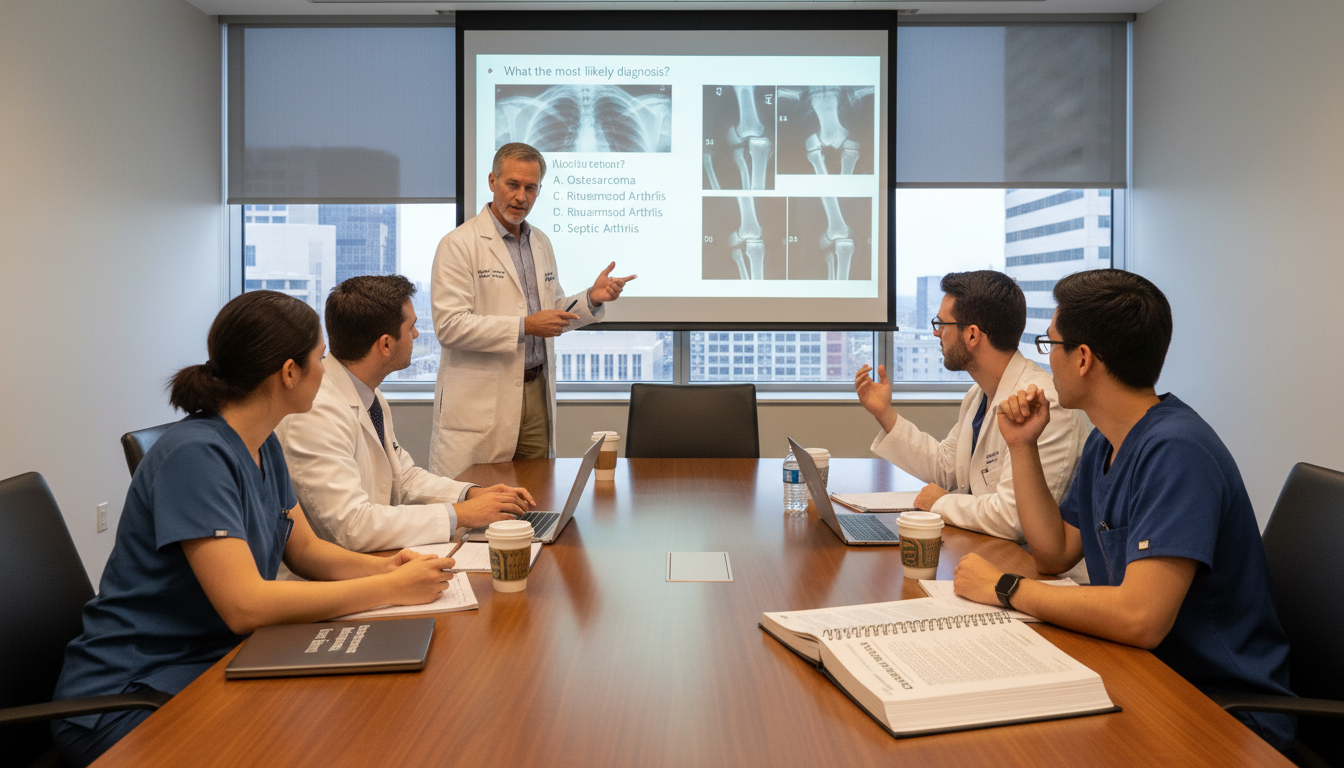
Structured teaching and live courses can accelerate your preparation and fill content gaps that self-study may miss.
1. Formal Board Review Courses
Several organizations and institutions offer live or virtual orthopedic board review courses. Key features often include:
- High-yield lectures organized by subspecialty
- Practice questions with real-time discussion
- Case-based teaching emphasizing exam-style reasoning
- Access to recorded content for later review
Are they necessary?
Not mandatory, but highly beneficial for residents who:
- Struggle with self-structuring their study
- Prefer lecture-based learning
- Are taking ABOS Part I for the first time and want comprehensive coverage
How to maximize a course:
- Preview the topic outline and identify your weak sections beforehand
- Take concise notes with an eye toward making Anki cards or summaries
- Rewatch high-yield topics in the final month, focusing on areas you performed poorly in on the OITE
2. Departmental Conferences and OITE Review Sessions
Many residency programs build exam prep into their academic schedule:
- Weekly fracture conference
- Indications conferences
- OITE review series during fall/winter
- Journal clubs focusing on landmark studies and classic trials
Use these strategically:
- Treat conferences as “live board review” opportunities.
- When a case is presented, mentally answer:
- “What is the diagnosis?”
- “What are the operative indications?”
- “What are the options and pros/cons?”
- “What would the board answer be?”
Then compare your thinking with faculty. Note discrepancies and turn them into flashcards or reading assignments.
3. Study Groups: Pros and Cons
Benefits:
- Accountability and structure
- Explaining concepts to peers deepens understanding
- Exposure to different ways of thinking and solving questions
Risks:
- Can devolve into unfocused chat or venting
- May not match your pace or learning style
Best practices:
- Form a small group (2–4 residents).
- Meet weekly or biweekly with a defined agenda:
- 20–40 pre-assigned questions to discuss
- 1–2 subspecialty topics per session
- Focus on why each answer is correct or incorrect; link questions to guidelines and surgical principles.
Tailoring a Study Plan to Your Level and Timeline
Your optimal study plan depends on your PGY year, your baseline knowledge, and the time until your next exam.
1. Early Residency (PGY-1/2): Building Foundations
Primary goals:
- Get familiar with exam style and core orthopedic vocabulary
- Learn from day-to-day cases and correlate them with reading
Resources:
- 10–15 exam-style questions/day
- Early exposure to Miller’s or OKU chapters (linked to rotations)
- Basic Anki decks for fracture patterns, anatomy, and simple classifications
Focus:
- Breadth rather than depth
- Building habits: daily questions and regular reading
- Learning from your first OITE performance to guide future study
2. Mid-Residency (PGY-3/4): From OITE to Board-Level Thinking
Primary goals:
- Elevate OITE scores
- Begin to think like a board examinee rather than just a trainee
Resources:
- 20–40 questions/day, with increasing emphasis on timed blocks
- Systematic pass through a review book (e.g., Miller’s Review)
- Expanding and reinforcing Anki decks
Focus:
- Identify persistent weak areas (e.g., pediatrics, spine) and attack them with a mix of Qbank + focused reading
- Incorporate trauma conference and subspecialty conferences into your mental “exam prep” framework
3. Senior Residency (PGY-5) and ABOS Part I Prep
Primary goals:
- Comprehensive coverage
- Exam performance optimization
12–16 week structured plan example:
Weeks 1–4:
- Daily: 40–60 mixed Qbank questions
- Review: Trauma, Adult Reconstruction, Basic Science chapters
- Anki: 150–200 reviews/day
Weeks 5–8:
- Daily: 60–80 questions (mix of timed and tutor modes)
- Review: Pediatrics, Sports, Foot & Ankle, Hand
- Start doing 100–150 question “mock exam days” on weekends
Weeks 9–12:
- Daily: 80–100 questions, mostly timed, full-length blocks
- Review: Spine, Oncology, Shoulder & Elbow, Infections, Misc.
- Re-do all incorrectly answered or flagged questions from prior weeks
- Intensify quick-reference and Anki review of high-yield facts
Final week:
- Light question review (30–50/day)
- High-yield summary reading and visual review (x-rays, implants, classic cases)
- Prioritize sleep and mental readiness
4. Early Practice and ABOS Part II
Though ABOS Part II is oral and case-based, your Part I preparation is still relevant:
- Review guidelines, indications, and complication management from board review resources.
- Practice case presentations using your own cases:
- Clear, concise history and physical
- Justification of workup and treatment choice
- Anticipation and discussion of complications, including how you managed or would manage them
Consider Part II-specific courses that offer mock oral exam sessions and structured feedback.
Frequently Asked Questions (FAQ)
1. How early should I start using board exam resources in orthopedic surgery residency?
Start in PGY-1 with light exposure: 10–15 questions/day and reading tied to your rotations. The OITE provides an early benchmark. By PGY-3, transition to more structured, board-focused studying with question banks and review books.
2. Which is more important: question banks or textbooks?
For board exam performance, question banks are usually higher yield per hour, because they mirror the exam format and highlight high-yield concepts. Textbooks are critical references for deeper understanding and filling gaps. A balanced approach is best: 60–80% of your dedicated study time on questions, 20–40% on targeted reading and notes.
3. Is Anki really necessary if I’m already doing a lot of questions?
Not mandatory, but very powerful for remembering the vast amount of factual material in orthopedic surgery (classifications, angles, indications, etc.). Using Anki (or similar spaced repetition) converts each practice question into long-term memory rather than short-term recognition, especially for the hardest-to-remember details.
4. How can I avoid burnout while studying for orthopedic boards during residency?
- Build small, consistent habits (e.g., 30–60 minutes/day) rather than cramming.
- Combine studying with clinical work: read about the cases you scrubbed or admitted.
- Use weekends for one longer session, but protect time for sleep and recovery.
- Rotate study modes: questions, reading, flashcards, group discussion, images, and practice exams to maintain variety.
- Monitor performance trends rather than obsessing over every test day; focus on progress over months, not days.
With a well-chosen mix of question banks, high-yield review books, spaced repetition tools like Anki, and structured teaching (courses and conferences), you can build a strong, exam-ready knowledge base. Thoughtful planning and consistent execution—not last-minute cramming—are what will carry you to success on the OITE, ABOS Part I, and beyond in your orthopedic surgery residency and career.