
Understanding the Landscape: Pediatrics-Psychiatry Training Pathways
For applicants interested in the intersection of child health and mental health, the training landscape can be confusing. You will see terms like peds psych residency, triple board, combined residency, med peds program, and categorical vs combined in program descriptions and on interview days. Yet many students are not sure how these pathways differ—or which one best fits their career goals.
This guide walks through:
- What “categorical” vs “combined” really means
- How pediatrics-psychiatry training is structured in each model
- Pros, cons, and career outcomes of each pathway
- How to decide which type of program to rank higher on your list
- Practical application tips and common FAQs
Although the focus is on Pediatrics–Psychiatry, we’ll also compare briefly with other combined paths (like med-peds and adult psych/child psych) to give you context.
Key Definitions: Categorical vs Combined Programs
Before diving into the nuances of pediatrics-psychiatry, it helps to clarify core terminology you’ll see in ERAS and program websites.
What Is a Categorical Program?
A categorical residency is a traditional, single-specialty training program that takes you from intern year through eligibility for that specialty’s board certification.
In this context, “categorical” usually refers to:
- Categorical Pediatrics Residency (3 years)
- Categorical Psychiatry Residency (4 years)
You match into one specialty and complete that program. If you later want to subspecialize (e.g., child and adolescent psychiatry), you apply separately during residency to a fellowship or fast-track option.
Examples relevant to pediatrics-psychiatry:
- Categorical Pediatrics → Child Abuse Pediatrics, Developmental-Behavioral Pediatrics, or other pediatric subspecialties.
- Categorical Psychiatry → Child and Adolescent Psychiatry (CAP) fellowship after 3–4 years of general psychiatry.
What Is a Combined Residency Program?
A combined residency formally integrates the requirements of two (or more) board specialties into a single, pre-approved training track. You match into one ACGME-accredited combined program and graduate eligible for multiple boards.
Key features:
- Single match entry (one NRMP program code)
- Integrated didactics and rotations
- Clear, pre-approved board eligibility pathway
- Specific duration (usually longer than categorical training in either specialty alone)
In pediatrics-psychiatry, the main combined structure you’ll encounter is:
- Triple Board: Pediatrics – General Psychiatry – Child & Adolescent Psychiatry
This is distinct from:
- Med-peds program: a 4-year combined Internal Medicine–Pediatrics residency (not psych-related but often mentioned in the same breath as other combined residencies).
Where Does “Peds Psych Residency” Fit In?
When people say “peds psych residency,” they may mean:
- Triple Board (pediatrics + general psych + child psych; truly combined), or
- Categorical psychiatry with intent to pursue child & adolescent psychiatry, or
- Less commonly, categorical pediatrics with heavy focus on mental health, behavior, and neurodevelopment.
Clarify which pathway someone is referring to—“peds psych” is used loosely.
Major Training Pathways in Pediatrics–Psychiatry
There are two main structural paths to a career focused on pediatric mental health:
- Combined (Triple Board) training
- Categorical + Fellowship routes (pediatrics or psychiatry first)
Let’s break them down.
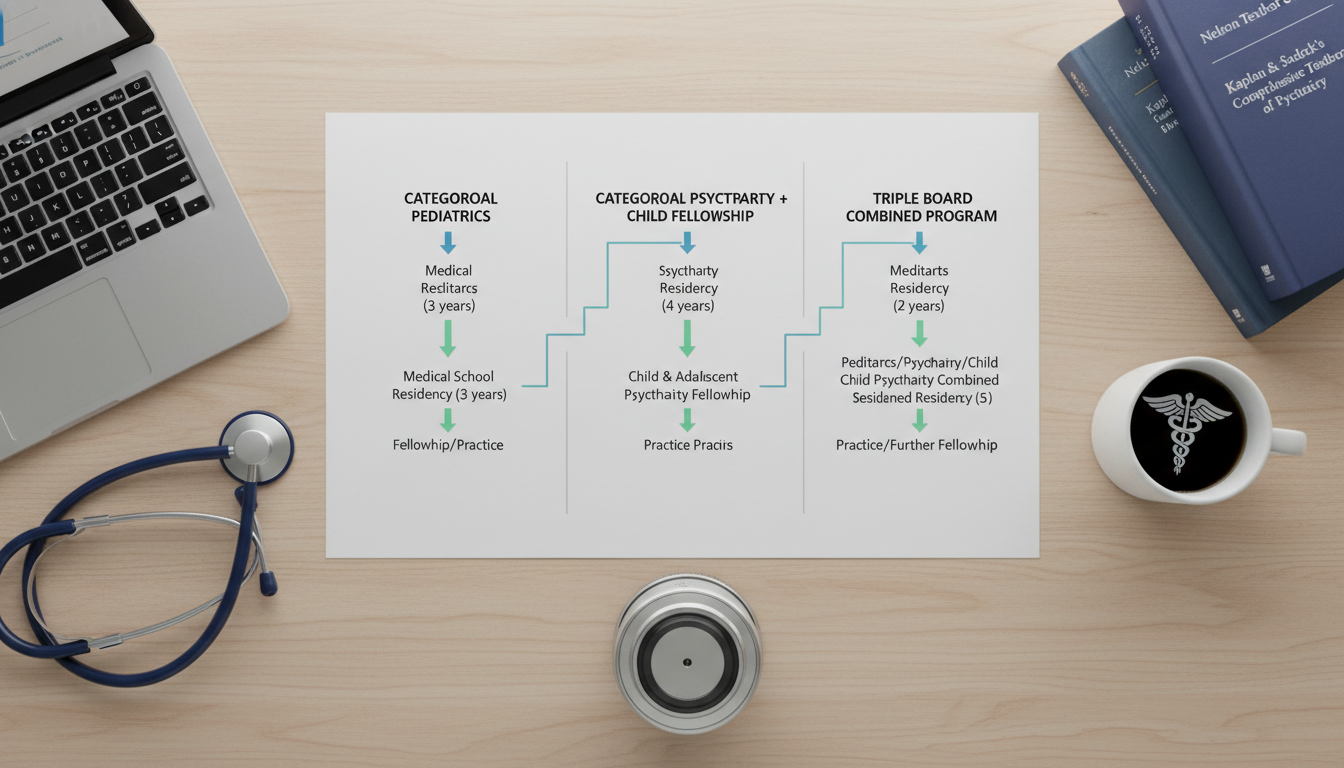
1. Triple Board: Pediatrics – Psychiatry – Child & Adolescent Psychiatry
Duration: 5 years
Board Eligibility:
- Pediatrics
- General Psychiatry
- Child & Adolescent Psychiatry
Triple board is the flagship combined residency route in pediatrics-psychiatry. It is designed for physicians who want deep, integrated training in:
- Physical health of children
- Mental health across the life span
- Specialized child & adolescent mental health
Rotation structure (general pattern, varies by site):
- Around 24 months pediatrics
- Around 18 months general psychiatry
- Around 18 months child and adolescent psychiatry
- Integrated continuity clinics and cross-disciplinary experiences
Typical clinical experiences:
- Inpatient and outpatient pediatrics
- NICU/PICU exposures (or at least some critical care)
- Adult inpatient psychiatry, consult liaison, emergency psychiatry
- Child psychiatry inpatient, intensive outpatient, and outpatient clinics
- Neurodevelopmental clinics, integrated behavioral pediatrics, autism and ADHD assessments
- Collaborative care, integrated primary care-mental health settings
Who tends to choose triple board?
- Students who are equally drawn to pediatrics and psychiatry
- Those envisioning careers in:
- Pediatric consultation-liaison psychiatry
- Integrated pediatric-behavioral health models
- Complex developmental/behavioral pediatrics with strong mental health emphasis
- Academic leaders at the intersection of child health systems and mental health policy
2. Categorical Pediatrics → Subspecialty with Behavioral Focus
Duration:
- Categorical Pediatrics: 3 years
- Fellowship: 3 years (most pediatric subspecialties)
Possible fellowships for a mental-health-focused pediatrician:
- Developmental-Behavioral Pediatrics
- Child Abuse Pediatrics
- Adolescent Medicine
- Pediatric Palliative Care (not purely psych-focused but often heavy on communication and behavioral issues)
Strengths of this route:
- Deep expertise in pediatric medicine, chronic disease, and systems of pediatric care
- Highly respected route within children’s hospitals and pediatric departments
- Clear mentoring from pediatric faculty; many more peds positions than triple board spots
You can become a pediatrician who is especially skilled in mental/behavioral health, but you will not be a boarded psychiatrist.
3. Categorical Psychiatry → Child & Adolescent Psychiatry (CAP) Fellowship
Duration:
- Categorical Psychiatry: 4 years (with the option to apply to CAP early after PGY-2)
- CAP Fellowship: 2 years
- Many programs allow “fast-track” after 3 years of general psychiatry (3 + 2 = 5 years total)
This is the most common route in the U.S. to become a child & adolescent psychiatrist.
Strengths:
- Designed primarily for people whose long-term identity is “psychiatrist”
- Heavy focus on psychopharmacology, psychotherapy, and systems of care
- More training time in adult psychiatry than triple board, which can be helpful if you want to treat transitional-age youth or adults as well
You get strong pediatrics exposure during CAP, but you are not a pediatrician and won’t be board-certified in pediatrics.
Where Do Med-Peds and Other Combined Programs Fit?
Because you will see med peds program discussions in the same circles as triple board and other combined tracks, it helps to situate them:
Med-Peds (Internal Medicine–Pediatrics): 4-year combined residency; board-eligible in both Internal Medicine and Pediatrics. No psychiatry component, but often includes exposure to chronic complex care, adolescent transitions, and sometimes collaborative mental health.
Combined Psychiatry–Family Medicine or Psychiatry–Internal Medicine: These are combined residencies in adult medicine and psychiatry—not pediatric-psychiatry-focused, but they share similar combined-program principles.
Understanding these helps you think clearly about categorical vs combined models in general: what you gain, what you trade off, and what kind of professional identity each fosters.
Categorical vs Combined: Comparing Training Structures and Experiences
Now that the main pathways are clear, let’s directly compare categorical vs combined in the specific context of pediatrics-psychiatry interests.
1. Breadth vs Depth
Combined (Triple Board):
- Breadth: You train broadly across pediatrics, adult psychiatry, and child psychiatry.
- Depth: Each area is somewhat compressed compared with its stand‑alone categorical counterpart. You meet all board requirements, but you may have fewer elective months in any single field.
Categorical + Fellowship (Peds → subspecialty OR Psych → CAP):
- Depth in one discipline:
- Peds-first route → deeply grounded pediatrician
- Psych-first route → deeply grounded psychiatrist
- Less formal training in the other field: You’ll gain cross-disciplinary skills, but not to the level of dual board eligibility.
2. Continuity and Identity Formation
Combined:
- Identity can feel blended—and at times, pulled in multiple directions.
- You might change services every few months (peds → psych → child psych → back to peds).
- Continuity with mentors requires intentional effort across multiple departments.
Categorical:
- More linear identity development:
- You are a pediatrician in training, then a subspecialist.
- Or you are a psychiatrist in training, then a CAP fellow.
- Departmental mentorship and culture are more cohesive and consistent.
3. Lifestyle and Call Schedules
Combined (Triple Board):
You experience call structures of multiple departments:
- Pediatric inpatient/NICU/PICU calls (often more intense and shift-based).
- Adult psychiatry calls (ED consults, inpatient coverage).
- Child psychiatry calls (variable, often less intense nights but depends on site).
Pros:
- You may avoid burnout from a single type of call or rotation.
- Rotating between different types of work can be stimulating.
Cons:
- You must continually adapt to new teams, workflows, and expectations.
- Vacation policies and scheduling can be tricky when split across departments.
Categorical:
- More predictable call culture within one specialty.
- Easier to understand long-term lifestyle implications early on.
4. Career Flexibility and Board Certification
Combined (Triple Board):
Board-eligible in three areas: Pediatrics, General Psychiatry, Child & Adolescent Psychiatry.
Career flexibility:
- Can practice primarily as a pediatrician, a child psychiatrist, or a mixed-role clinician.
- Particularly well-suited to integrated care and complex developmental/medical-psychiatric roles.
But:
- Each additional board means maintenance-of-certification requirements, CME, and potential credentialing complexity.
Categorical:
- Clear identity as either a pediatrician (plus subspecialty) or a psychiatrist (plus CAP).
- Often easier to market yourself and negotiate roles that fit standard departmental structures.
- Less administrative complexity with fewer boards.
5. Marketability and Job Prospects
Across all pathways, demand for child mental health expertise is high. However, how you are perceived can differ.
Triple Board:
Standout candidate for:
- Pediatric consultation-liaison psychiatry
- Multidisciplinary behavioral/developmental clinics
- Leadership roles in hospital systems, quality improvement, and integrated care
Some employers may be unfamiliar with triple board and need education about your skill set. This can be an opportunity, but also an extra step.
Peds + Behavioral/Developmental Subspecialty:
- Natural fit in children’s hospitals, academic pediatrics, or specialty clinics.
- Seen clearly as “a pediatric subspecialist with behavioral expertise.”
Psych + CAP:
- Standard pathway to child and adolescent psychiatry.
- Highly needed in outpatient clinics, school-based programs, juvenile justice, and community mental health.
In most markets, job availability is robust across all three paths if you want to work with children and adolescents.
How to Decide: Which Pathway Fits Your Goals?
Choosing between combined vs categorical is less about prestige and more about self-knowledge. Consider these questions.

1. How Strong Is Your Interest in Pediatrics vs Psychiatry?
Ask yourself:
- If I could only practice pediatrics, with limited formal psych training, would I be satisfied?
- If I could only practice psychiatry/child psychiatry, with limited medical pediatrics, would I be satisfied?
- Do I feel distressed at the idea of letting go of either side?
You might lean toward:
Triple Board (combined) if:
- It feels genuinely painful to imagine giving up either pediatrics or psychiatry.
- You are energized by the idea of bridging systems and practicing at interfaces.
Categorical Pediatrics if:
- You enjoy mental health issues but ultimately see yourself as a pediatrician, grounded in physical health, chronic disease management, and primary prevention.
Categorical Psychiatry → CAP if:
- You are most excited by psychotherapy, psychopharmacology, and systems of mental health care, and you see pediatric medical issues as interesting but secondary.
2. What Type of Patients and Problems Do You Want to Focus On?
Reflect on the clinical scenarios that most energize you:
- Medically complex children with psychiatric overlay (e.g., chronic illness, transplant, oncology, functional somatic symptoms)?
- Primary psychiatric disorders (e.g., mood, anxiety, psychosis, trauma, OCD)?
- Neurodevelopmental conditions (e.g., autism, intellectual disability, ADHD) with strong behavioral and educational components?
Some patterns:
- Strong pull toward inpatient pediatrics + psychiatric comorbidity → Triple board or categorical peds with a behavioral/developmental emphasis.
- Strong pull toward mood disorders, trauma, and psychotherapy → Categorical psychiatry + CAP.
- Deep interest in neurodevelopmental disorders and early-childhood systems → Could fit any path, but triple board and developmental-behavioral pediatrics are especially well-aligned.
3. How Many Years of Training Are You Comfortable With?
Approximate timelines:
- Triple Board: 5 years
- Psych + CAP (fast track): 5 years (3 general + 2 CAP)
- Full psych (4) + CAP (2): 6 years
- Peds (3) + subspecialty (3): 6 years
So in terms of length, triple board and fast-tracked psych+CAP are similar. The question becomes less “how many years?” and more “what balance of pediatrics vs psychiatry in those years?”
4. Do You Want a Clear, Single Professional Identity or a Hybrid One?
Some physicians thrive as boundary-spanners; others prefer focused depth.
If you like saying:
“I’m a pediatrician who specializes in behavioral and developmental issues”
or
“I’m a child and adolescent psychiatrist”…a categorical pathway may feel more straightforward.
If you like saying:
“I’m board-certified in pediatrics, psychiatry, and child psychiatry, and I work wherever children’s physical and mental health intersect”
…a triple board, combined residency track may be ideal.
5. How Comfortable Are You With Administrative Complexity?
Combined programs can involve:
- Navigating two or three departments
- Coordinating vacation, evaluations, and mentorship across multiple chairs and program directors
- Explaining your training path to credentialing bodies and future employers
Most triple board programs are experienced at guiding residents through this, but personal tolerance for complexity matters.
Categorical paths tend to have more standardized structures and expectations.
Application Strategy: Positioning Yourself for Categorical vs Combined Programs
Once you have a sense of your preferred path, you need an application strategy.
1. Should You Apply to Both Categorical and Combined Programs?
Many applicants with pediatrics-psychiatry interests do:
- Apply to triple board programs
- Apply to categorical psychiatry programs (especially those with strong CAP or pediatric psychiatry exposure)
- Sometimes also apply to categorical pediatrics (particularly if they could genuinely see themselves happy in pediatrics alone)
This gives you flexibility in the Match. However, be ready to clearly articulate your reasoning in each interview setting.
2. Tailoring Your Personal Statement(s)
If you apply to both combined and categorical programs, consider separate personal statements:
Triple Board / Combined Residency Statement:
- Emphasize your passion for integrating medical and psychiatric care.
- Share experiences where you saw the limitations of siloed care (e.g., a medically complex child cycling between inpatient wards and psych units).
- Discuss long-term goals around systems integration, policy, or multi-disciplinary leadership.
Categorical Pediatrics Statement:
- Focus on your identity as a pediatrician-in-training.
- Highlight your interest in mental health as one component of holistic pediatric care.
Categorical Psychiatry Statement:
- Emphasize commitment to psychiatry as your primary discipline.
- Explain your interest in working with children, families, and developmental trajectories within psychiatric training.
3. Letters of Recommendation
For pediatrics-psychiatry–oriented applications:
- Try to secure at least:
- One strong letter from pediatrics faculty
- One strong letter from psychiatry faculty
- For triple board:
- A blend of both fields is usually ideal.
- Letters should describe your ability to think biopsychosocially and function across systems.
4. Program Signaling and Interview Conversations
During interviews:
For triple board:
- Be explicit about why you need combined training rather than doing a categorical plus fellowship path.
- Provide concrete examples of clinical situations where dual-skills would change outcomes.
For categorical:
- Reassure programs you are genuinely enthusiastic about their pathway, not treating it as a “backup.”
- Emphasize aspects of their specific training (e.g., strong CAP faculty, integrated behavioral pediatrics clinics) that align with your interests.
FAQs: Combined vs Categorical in Pediatrics-Psychiatry
1. If I’m interested in pediatrics-psychiatry, is triple board “better” than psych + CAP?
Neither pathway is universally “better.” They are optimized for different career identities:
Triple Board is best if you want ongoing, substantial involvement in both pediatrics and psychiatry and foresee roles that specifically require dual training (e.g., pediatric C‑L psychiatry embedded in a children’s hospital, high-level systems leadership at the peds-psych interface).
Psych + CAP is best if your primary identity is as a psychiatrist, and you want the depth and flexibility that the standard psychiatry-to-CAP route offers (particularly if you also want substantial adult practice or leadership within psychiatry departments).
2. Can a triple board graduate work as a general pediatrician, or only as a psychiatrist?
Triple board graduates are eligible for board certification in pediatrics and can absolutely work as:
- General pediatricians
- Pediatric hospitalists (depending on local credentialing expectations)
- Pediatric subspecialist trainees if they do additional fellowship
However, many triple board graduates choose roles that combine pediatrics and psychiatry rather than practicing pure general pediatrics.
3. Is a med-peds program a good alternative to triple board if I like both medicine and mental health?
A med peds program offers combined training in internal medicine and pediatrics, not psychiatry. It’s a great choice if you:
- Love complex chronic disease in adults and children
- Enjoy transitions-of-care work (peds to adult care)
- Want to practice across the lifespan in primary care or hospital medicine
But it does not substitute for formal psychiatric training. If your core interest is mental health, you will likely want a psychiatry-based pathway (triple board, psych + CAP, or psych-family medicine, etc.).
4. How competitive are triple board programs compared with categorical pediatrics or psychiatry?
Triple board programs are:
- Small in number and small in class size, which can make them numerically competitive.
- Often seek applicants with clear, sustained interest in both pediatrics and psychiatry, strong letters in both fields, and thoughtful articulation of why combined training is necessary for their goals.
Categorical psychiatry has become more competitive in recent years but generally has more available spots than triple board. Categorical pediatrics typically has a broad range of programs with varying competitiveness.
Applying broadly and aligning your story with each program type’s mission is more important than perceived “prestige.”
Choosing between combined vs categorical programs in pediatrics-psychiatry is ultimately about where you want your professional center of gravity to be. Take inventory of your experiences, the clinical scenarios that have stayed with you, and the mentors whose careers you most admire. Then use those insights to decide whether a peds psych residency in the form of triple board, or a more traditional categorical path with targeted fellowship training, will best support the career you envision.