
Understanding Physician Salary by Specialty in Medicine-Pediatrics
Medicine-Pediatrics (Med-Peds) sits at a unique crossroads in the physician salary landscape. As a dual-trained specialty in both Internal Medicine and Pediatrics, Med-Peds offers unusual flexibility: you can build a career that looks like traditional primary care, hospitalist work, subspecialty practice, or a mix of all three. That flexibility also means your income can vary widely depending on how you structure your practice.
This guide walks you through how physician salary by specialty works for Med-Peds physicians, how Med-Peds compares with other fields, and how to think strategically about compensation as you approach the medicine pediatrics match and your future career.
Throughout, keep in mind: numbers change year to year and vary by region, employer, and contract details. The emphasis here is less on exact dollar amounts and more on understanding the patterns, drivers, and choices that influence your earning potential.
Where Med-Peds Fits in the Physician Salary Landscape
When you think about physician salary by specialty, Med-Peds is unusual because it’s a training pathway, not a single narrow clinical niche. A Med-Peds attending can:
- Practice combined primary care across the lifespan
- Work exclusively with adults (general internal medicine or hospitalist)
- Work exclusively with children (general pediatrics or pediatric hospitalist)
- Pursue any Internal Medicine subspecialty
- Pursue any Pediatric subspecialty
- Split time between general and subspecialty roles
This means you effectively have access to a wide physician salary spectrum—from some of the lower-paying primary care tracks to some of the highest paid specialties.
General Position of Med-Peds on the Salary Spectrum
Using recent trends from major compensation surveys (MGMA, Medscape, Doximity):
- General Internal Medicine and General Pediatrics sit in the lower-to-mid range of physician income.
- Hospitalist work (adult or pediatric) is usually higher than office-based primary care but lower than procedural subspecialties.
- Internal Medicine subspecialties—particularly cardiology, gastroenterology, hematology/oncology, and critical care—often fall among the highest paid specialties.
- Pediatric subspecialties typically pay less than their adult counterparts, though there is wide variation.
Because Med-Peds makes you eligible for both adult and pediatric subspecialties, your potential earning range is extremely wide. You can choose a career track closer to the center of the spectrum (e.g., combined primary care) or toward the top of the physician salary by specialty hierarchy (e.g., interventional cardiology).
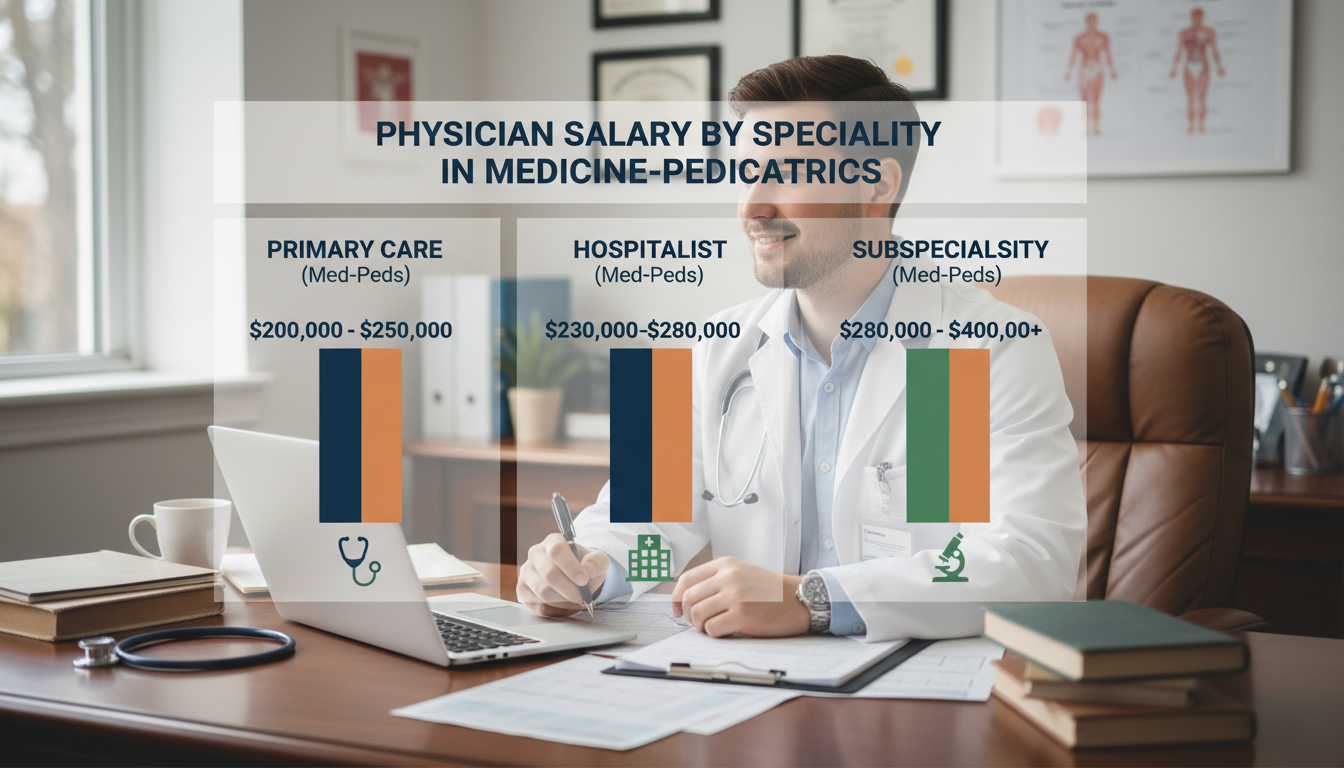
Core Med-Peds Career Paths and Salary Ranges
Below are the most common career trajectories for Med-Peds graduates, with typical salary positioning and trade-offs. Exact figures vary, but the patterns are consistent.
1. Combined Med-Peds Primary Care
Profile:
- Outpatient clinic seeing both adults and children
- Continuity practice, often with a panel-heavy model
- Many Med-Peds physicians in community and academic settings choose this
Salary positioning:
- Typically aligned with Internal Medicine or Pediatrics primary care pay scales
- Income often similar to or slightly above pediatric-only primary care, and sometimes slightly below general internal medicine, depending on payer mix and region
Influencing factors:
- Payer mix: More pediatric patients often means more Medicaid, which tends to reimburse less than Medicare or commercial insurance; this can drag down average revenue per visit.
- RVU targets: Many primary care compensation plans use RVU-based incentives. A balanced adult/peds panel can influence visit complexity, procedure codes, and RVU generation.
- Value-based bonuses: Shared savings programs, quality metrics (vaccination rates, A1c control, readmission rates) can add meaningful bonuses in some systems.
Who this suits:
- Applicants to the medicine pediatrics match who love longitudinal care, complex chronic disease, and family-centered practice.
- Those prioritizing lifestyle, continuity, and scope of practice over chasing the highest paid specialties.
Actionable advice:
- During residency, track your clinic panel complexity and RVUs to understand how your practice style may translate into future earnings.
- Ask potential employers how they value “complexity” for Med-Peds (e.g., adults with congenital heart disease, transition-age diabetes) and whether this is recognized in your compensation model.
2. Adult Hospitalist, Pediatric Hospitalist, or Combined Hospitalist
Profile:
- Inpatient-only work, often 7-on/7-off models
- Adult hospitalist (IM-based), pediatric hospitalist (Peds-based), or a hybrid role (less common but attractive for some Med-Peds grads)
Salary positioning:
- Adult hospitalists generally earn more than outpatient primary care internists.
- Pediatric hospitalists usually earn slightly less than adult hospitalists but more than general outpatient pediatrics.
- Night shifts, ICU coverage, and procedural work can significantly increase pay.
Influencing factors:
- Shift structure: Block schedules, number of shifts per year, and nocturnist differential can markedly change total compensation.
- Location: Rural and underserved areas often pay more for hospitalists due to recruitment challenges.
- Academic vs community: Academic hospitalist salaries are frequently lower than community roles but may be balanced by other benefits (protected time, loan repayment, benefits, prestige).
Who this suits:
- Med-Peds residents who enjoy acute care, procedures, and team-based inpatient work.
- Those who prefer predictable time off and are comfortable with intensity during work weeks.
Actionable advice:
- While interviewing, ask specifically about:
- Expected census
- Number of annual shifts
- Night coverage responsibilities
- Productivity or quality incentives
- Clarify whether you can maintain Med-Peds breadth (e.g., occasional peds shifts in an adult-heavy job or vice versa) and if this changes your compensation.
3. Internal Medicine Subspecialties: Access to Some of the Highest Paid Specialties
One major salary advantage for Med-Peds is full eligibility for all Internal Medicine subspecialties. Many of these are in the top tier of doctor salary by specialty.
Common IM subspecialties for Med-Peds graduates:
- Cardiology (including interventional and electrophysiology)
- Gastroenterology
- Hematology/Oncology
- Pulmonary and Critical Care Medicine
- Infectious Disease
- Rheumatology
- Endocrinology
- Nephrology
- Geriatrics
Where these fall on the salary spectrum:
Highest paid specialties (IM-based):
- Interventional cardiology
- EP cardiology
- Gastroenterology
- Hematology/Oncology
- Pulm/CCM (critical-care heavy practices, especially with procedures)
Mid-range IM subspecialties:
- Nephrology
- Rheumatology
- Infectious disease (traditionally lower, though improving in some markets)
- Endocrinology
Primary drivers of higher income here:
- Procedural revenue: E.g., cath lab procedures, endoscopy, bronchoscopies, central lines, etc.
- Consult volume: ICU and oncology settings can generate high RVUs.
- Call burden and intensity: Nights, weekends, and emergent procedures increase compensation.
How Med-Peds adds unique value:
- Cardiology or GI for adults with congenital heart disease or childhood-onset conditions.
- Hem-Onc with a focus on AYA (adolescent and young adult) oncology.
- Pulm/CCM bridging pediatric and adult CF or chronic ventilatory support.
Actionable advice for residents:
- If you’re considering a high-paying IM subspecialty, start early:
- Seek strong mentors in both adult and pediatric departments.
- Build a research/quality improvement portfolio that showcases your dual-systems expertise.
- During fellowship interviews, explicitly discuss your Med-Peds skill set and how you’d like to apply it.
This route often places you squarely among high-earning physicians, but with notable trade-offs: longer training (residency + 3–4 years fellowship) and higher intensity, especially in procedural fields.
4. Pediatric Subspecialties: Dual-Training Leverage with Different Pay Patterns
Med-Peds also allows entry into all pediatric subspecialties, including:
- Pediatric cardiology
- Pediatric GI
- Pediatric critical care
- Pediatric endocrinology
- Pediatric nephrology
- Pediatric infectious disease
- Pediatric pulmonology
- Adolescent medicine
- Neonatal-perinatal medicine (with some pathways requiring peds-only training—check specifics early)
Salary positioning:
- Generally lower than adult counterparts, even in the same organ system.
- NICU and PICU roles can be relatively better-compensated within pediatrics, though still often below adult ICU or high-intensity IM subspecialties.
- Academic pediatric subspecialties may be markedly lower than community-based adult subspecialties.
Why the difference?
- Payer mix: Pediatrics has a higher proportion of Medicaid, lower reimbursement.
- Volume and procedure mix: Fewer high-revenue procedures compared to adult counterparts in many fields.
- Market structure: Fewer pediatric subspecialists, often concentrated in academic centers with different financial models.
Unique value of Med-Peds:
- Seamless care for patients with childhood-onset diseases transitioning into adulthood.
- Ability to consult across adult and pediatric services in complex cases, which can be a career niche that’s highly valued, even if not always reflected in the highest salaries.
Actionable advice:
- If drawn to pediatric subspecialties, think deliberately about:
- Long-term financial goals (loan repayment, cost of living, family plans).
- Academic vs community employment models.
- Opportunities to monetize niche expertise (transition clinics, joint adult-peds programs) via program-building stipends, protected time, or leadership roles.

Physician Salary Drivers: What Really Affects Med-Peds Income
Beyond specialty choice, several key variables determine your actual physician salary by specialty within Med-Peds.
1. Practice Setting: Academic vs Community vs Employed vs Private
Academic centers:
- Often pay less than community or private practices for the same clinical work.
- Compensation can be offset by:
- Loan repayment
- Robust benefits and retirement contributions
- Protected time for teaching/research
- Prestige, career growth, leadership potential
Community hospital or large health system employment:
- Frequently uses salary + RVU bonuses or salary + quality bonuses.
- Predictable structure, stable income, less direct overhead risk than private practice.
Private practice or partner-track models:
- Potentially higher incomes, especially in procedural subspecialties and high-demand markets.
- More business risk, overhead responsibility, variable income early in your career.
Implication for Med-Peds:
- A Med-Peds primary care physician in private practice with a strong commercial payer base could out-earn an academic hospitalist in a major city.
- A Med-Peds-trained cardiologist in a busy private group may be near the top of doctor salary by specialty nationally.
2. Geography and Cost of Living
High-cost urban centers (e.g., NYC, Boston, SF):
- Often have lower nominal salaries but higher prestige and density of academic centers.
- Effective take-home pay may feel constrained by housing and living costs.
Mid-size cities and suburban markets:
- Competitive salaries with moderate cost of living; often a sweet spot for lifestyle and finances.
Rural and underserved areas:
- Some of the strongest financial packages:
- Sign-on bonuses
- Loan repayment
- Higher base salaries for hospitalists or primary care
- Fewer subspecialty positions, but strong leverage for those willing to practice broad-scope Med-Peds.
Actionable advice:
- When comparing offers, adjust for:
- State income tax
- Cost of housing
- Childcare and education costs
- Spousal job opportunities
- A slightly lower physician salary in a low-cost area may yield more real disposable income than a higher salary in an expensive coastal city.
3. Workload, RVUs, and Clinical Volume
Most contemporary compensation models for employed physicians incorporate RVUs (Relative Value Units) or some measure of productivity.
- Higher RVUs usually mean higher pay, whether as:
- Pure productivity (paid per RVU)
- Hybrid (base salary + RVU bonus)
- Med-Peds physicians can sometimes boost RVUs by:
- Managing high-complexity adult and pediatric patients in a single clinic
- Performing office procedures (joint injections, skin biopsies, point-of-care ultrasound, etc.)
- Running busy transition or complex-care clinics
However, there are trade-offs:
- More volume can mean less time per patient, potential burnout, and decreased satisfaction.
- For some, a slightly lower doctor salary by specialty is acceptable in exchange for a more sustainable pace.
4. Non-Clinical Income Streams
Med-Peds physicians can also augment income beyond direct patient care:
- Medical directorships: overseeing clinics, quality programs, or service lines (transition-of-care programs, complex-care centers).
- Administrative roles: associate program director, medical school leadership, chief quality officer roles.
- Consulting and speaking: especially for those with expertise in transition care, chronic disease management, or quality improvement.
- Research grants: while not salary in the traditional sense, protected time funded by grants can be financially meaningful.
While these may not vault you into the very highest paid specialties, they can significantly boost total compensation and career satisfaction.
Med-Peds, the Match, and Long-Term Financial Strategy
Prospective residents often ask how the medicine pediatrics match affects long-term earnings and whether dual training is “worth it” financially compared with going purely Internal Medicine or Pediatrics.
1. Training Duration and Opportunity Cost
- Med-Peds residency is 4 years, compared with 3 years for IM or Pediatrics alone.
- This means one extra year of resident salary (low) and one fewer year at attending pay (high) if you stop at general practice.
- Over a 30-year career, this additional year generally has modest impact if you move into higher-paying roles or subspecialties.
For those planning IM subspecialty fellowship regardless, the added year is often offset by the career flexibility and niche opportunities Med-Peds provides.
2. Flexibility as a Hedge
Med-Peds acts as a hedge against changes in the physician salary landscape:
- If one market becomes saturated (e.g., general internal medicine in your city), you can more easily pivot:
- To pediatrics-heavy roles
- To hospitalist mixed-practice positions
- Or into fellowship in a high-demand subspecialty
- Dual board eligibility can make you more competitive for certain academic or leadership roles that span both departments, offering additional financial and career security.
3. Strategic Use of Loan Repayment and Incentives
For Med-Peds physicians with significant educational debt:
- Consider NHSC, state-based loan repayment, or hospital-based programs that favor primary care and underserved work.
- A Med-Peds primary care physician with loan repayment incentives may net more effective long-term wealth than a higher-salaried subspecialist with no loan support and higher living costs.
4. Long-Term Wealth vs. Annual Salary
Finally, remember:
- Long-term financial security depends on how you use your salary, not just the numerical size.
- A Med-Peds physician making a solid, mid-range income but living below their means, investing steadily, and avoiding major lifestyle inflation can outpace a high-earning specialist who overspends.
Frequently Asked Questions (FAQ)
1. Do Med-Peds physicians earn less than Internal Medicine doctors because they see kids too?
Not inherently. Your physician salary by specialty is determined more by how you practice than by your training label. A Med-Peds physician doing adult hospitalist work will typically be paid similarly to an Internal Medicine-trained hospitalist in the same role. Where income can diverge is in outpatient primary care with a heavier pediatric panel, which may generate lower reimbursements due to payer mix. In many systems, though, Med-Peds attendings are placed on the same salary scale as IM or Peds colleagues doing equivalent work.
2. Can a Med-Peds doctor enter the highest paid specialties like cardiology or GI?
Yes. Med-Peds graduates can pursue all Internal Medicine subspecialties, including fields that rank among the highest paid specialties, such as interventional cardiology and gastroenterology. Your board eligibility will usually be in Internal Medicine plus your subspecialty, with your Med-Peds background giving you added value for adult survivors of childhood disease or transition-of-care niches. Pediatric versions of these subspecialties tend to pay less than the adult versions, but are still very rewarding and can be excellent career fits.
3. How does Med-Peds compare financially to doing just Internal Medicine?
If you stop at general practice, a Med-Peds physician’s salary is often comparable to an Internal Medicine physician in similar roles, with the caveat that you completed one extra year of residency. That extra year is an “opportunity cost” but usually modest over a full career. The real financial advantage of Med-Peds is flexibility: you can shift between adult and pediatric-focused roles as markets, interests, and life circumstances change, and you retain full access to all IM and Peds subspecialties.
4. What should I ask about compensation when interviewing for Med-Peds jobs?
Focus on these points:
- Base salary and how it compares to IM/Peds colleagues.
- Bonus structure: RVU thresholds, quality metrics, and how realistic they are.
- Expected workload: clinic sessions or shifts, panel size, call responsibilities.
- Payer mix and how it might affect revenue for a Med-Peds-heavy panel.
- Loan repayment, sign-on bonuses, and relocation support.
- Non-clinical opportunities: leadership stipends, medical directorships, teaching pay.
Comparing offers requires more than just looking at the top-line doctor salary by specialty; consider total compensation, time demands, and long-term growth.
Med-Peds gives you uncommon freedom to design your career across the full age spectrum—and that flexibility carries substantial implications for your earning potential. By understanding the physician salary landscape, being intentional about your practice setting and specialty choices, and negotiating thoughtfully, you can align your Med-Peds career with both your professional passions and your financial goals.