
Understanding the Preliminary Medicine Year
For many residency applicants, the preliminary medicine year is both a bridge and a bottleneck. Whether you are aiming for neurology, anesthesiology, dermatology, radiation oncology, radiology, PM&R, or another advanced specialty, your preliminary year selection can heavily influence your training experience, clinical confidence, and overall well-being.
In this guide, “preliminary medicine” refers to:
- Preliminary internal medicine (prelim IM) – a 1‑year, non-categorical internal medicine position
- Occasionally compared with prelim surgery or transitional year tracks when applicants are deciding how to fulfill their PGY‑1 requirement.
This article will walk through how to think strategically about preliminary year selection, how to evaluate prelim medicine programs, and how to align this choice with your target advanced specialty.
What Exactly Is a Preliminary Medicine Year?
Definitions and Key Terms
Preliminary Medicine Year / Prelim IM
- A one-year internal medicine position (PGY‑1 only)
- Often paired with an advanced program (PGY‑2+), such as neurology, radiology, anesthesiology, ophthalmology, radiation oncology, or PM&R
- Designed for applicants who need a clinical base year but will complete core residency training in another specialty
Categorical Internal Medicine
- A three-year IM program (PGY‑1 to PGY‑3)
- Leads to board eligibility in internal medicine
- Not the same as a prelim year; categorical is a full training pathway
Transitional Year
- A flexible, broad-based PGY‑1 with mixed rotations (IM, surgery, electives, etc.)
- Often perceived as lighter than many prelim medicine or prelim surgery programs (though this varies considerably)
Prelim Surgery
- A surgery-focused 1‑year PGY‑1
- More operative and surgical ward exposure
- Sometimes used as an alternative base year for fields like radiology or anesthesiology, though many advanced specialties explicitly prefer prelim medicine
Why Preliminary Medicine Instead of Other Options?
You might choose prelim medicine over a transitional year or prelim surgery because:
- Your advanced specialty requires or strongly prefers internal medicine exposure (e.g., neurology, oncology-related fields, some radiology programs)
- You want robust inpatient medicine training to boost your clinical confidence for any specialty
- You aim to strengthen your medicine letters of recommendation or reapply to categorical internal medicine if needed
- Your paired advanced program mandates a specific prelim IM program (“linked” position)
By contrast:
- Transitional year may be attractive if you want more electives and potentially more lifestyle flexibility.
- Prelim surgery may be chosen if you are very surgically oriented or your advanced program is comfortable with a surgical base year (e.g., some IR, anesthesiology, or radiology positions).
Understanding where prelim medicine sits among these options is the foundation for deliberate preliminary year selection.
Strategic Considerations in Preliminary Year Selection
1. Clarify Your Advanced Specialty’s Requirements
Before comparing prelim programs, understand what your future specialty expects from your preliminary year.
- Check ACGME and specialty board requirements
- For example, neurology often requires at least a certain number of months of inpatient internal medicine or related rotations.
- Read program websites carefully
- Many advanced programs specify “must complete a preliminary year in internal medicine or transitional year”; some restrict to prelim IM only.
- Ask directly during interviews
- “What types of preliminary year programs do your current residents typically come from?”
- “Does your program have a preference between prelim medicine, prelim surgery, or transitional year?”
If your advanced specialty or specific advanced program requires prelim IM, that decision is made for you. Your task then becomes choosing which preliminary medicine programs to prioritize and how to rank them relative to your advanced positions.
2. Decide Your Primary Goal for PGY‑1
Different applicants want different things from a preliminary year. Your priorities shape how you evaluate programs.
Common goals:
Clinical Depth and Skill-Building
- You want rigorous internal medicine training
- You’re comfortable with heavy inpatient exposure and possibly higher workload
- You want to feel ready for any acutely ill patient in your target specialty
Lifestyle and Burnout Mitigation
- You want a survivable year that allows for sleep, relationships, and personal time
- You prefer manageable call schedules and supportive residency culture
Networking and Academic Opportunities
- You’re aiming for fellowship or want to strengthen your academic CV
- You value research, mentorship, and letters from academic faculty
Geographic Stability and Family Considerations
- You need to live in a certain city/region for a partner, children, or visa reasons
- You prefer (or need) to have your prelim medicine year and advanced residency in the same location
No program perfectly maximizes all of these; understanding your top two priorities helps you make trade-offs intentionally.
How to Evaluate Preliminary Medicine Programs
Once you know why you want a prelim medicine year, the next step is systematically comparing programs. Treat this as seriously as you treat evaluating categorical or advanced programs—your PGY‑1 experience shapes your early professional identity and resilience.
Key Domains to Assess
1. Workload, Schedule, and Call Structure
Questions to ask or research:
- What is the average number of inpatient months during the prelim year?
- How many ICU months do prelims do?
- What is the night float system like?
- Night float vs 24‑hour call
- Frequency of nights per month
- Are there caps on patient census for interns?
- How often do prelims take “short call” or admitting shifts?
You are trying to understand the true lived experience, not just what’s written in promotional materials. Ask current residents:
- “On a typical ward month, how many hours do you actually work per week?”
- “How often do you leave on time post‑call?”
- “What rotation is considered the most challenging, and why?”
2. Role and Value of Prelims in the Program
At some institutions, preliminary medicine residents are fully integrated and valued; at others, they may feel peripheral.
Consider:
- Are prelims included in all conferences, retreats, and wellness events?
- Do prelims receive formal mentorship?
- Are prelims allowed to:
- Participate in quality improvement projects?
- Take electives of their choosing?
- Give presentations at noon conference or M&M?
Ask current or former prelims:
- “Do you feel treated as ‘just here for a year,’ or as a full member of the residency?”
- “Would you choose this prelim medicine year again, knowing what you know now?”
3. Curriculum and Rotation Balance
Look at the sample PGY‑1 schedule for prelim medicine residents:
- Inpatient ward months (general medicine vs subspecialty)
- ICU/CCU months
- ED time
- Required subspecialty rotations (cards, GI, ID, etc.)
- Elective time (and how much is genuinely flexible vs pre‑assigned)
If you are heading into a specific advanced field, align rotations accordingly. For example:
- Neurology-bound:
- Value: stroke/neurology ward exposure, MICU, complex inpatient medicine
- Radiology or Radiation Oncology-bound:
- Value: broad inpatient medicine, ED, oncology, ICU exposure to various imaging and procedural indications
- Anesthesiology-bound:
- Value: MICU, cardiac/CCU, perioperative medicine, consult services
Programs that allow you to customize at least 1–2 elective months can greatly enrich your year.
4. Culture, Wellness, and Support
Even in a demanding prelim medicine year, culture can be the difference between “hard but formative” and “demoralizing.”
Indicators of a healthy environment:
- Leadership that acknowledges prelims’ unique needs (e.g., timing of moving for PGY‑2)
- Access to mental health resources
- Reasonable expectations around non-clinical tasks (notes, prior authorizations, endless scut)
Ask:
- “How responsive is leadership to feedback?”
- “Have there been recent changes based on resident input?”
- “How do attendings respond when you’re overwhelmed?”
5. Location, Logistics, and Life Outside the Hospital
A preliminary year is still a full year of your life:
- Commute time and housing affordability
- Proximity to your advanced program if they’re in different institutions or cities
- Support for visas, if applicable
- Childcare, partner job opportunities, and overall cost of living
Even if your primary focus is clinical training, a year in an environment that aligns with your personal life goals can significantly affect your happiness and performance.
Crafting Your Application Strategy for Preliminary Medicine
How Many Preliminary Programs Should You Apply To?
The number depends on:
- How competitive your advanced specialty is
- How geographically restricted you are
- Your overall application strength (scores, grades, letters)
Typical ranges (not absolute rules):
- Highly competitive advanced specialties (e.g., derm, rad onc, some radiology and anesthesia tracks):
- 10–15+ prelim medicine programs, often across multiple regions
- Moderately competitive advanced specialties:
- 6–12 prelim IM programs, depending on geography and flexibility
- If you are geographically constrained:
- Apply more broadly within your region (including prelim surgery or transitional year options if your advanced program allows)
When you include prelim surgery and transitional year programs in your strategy, be sure each is acceptable to your future advanced program. Do not assume interchangeability.
Coordinating Prelim Medicine and Advanced Program Applications
There are three common scenarios:
Linked Prelim + Advanced Positions
- Some specialties (e.g., neurology, radiology) offer positions where the advanced program comes with a guaranteed preliminary medicine year at a partner institution.
- Pros:
- Simplifies logistics
- Removes stress of matching separately
- Cons:
- Less flexibility in choosing the type of preliminary year you want
Same Institution, Separate Matches
- The hospital offers both an advanced program and a prelim IM program, but they are matched separately.
- This allows for:
- Some flexibility in ranking
- The possibility of matching at the advanced program but not its associated prelim (or vice versa), which you should plan for.
Totally Separate Institutions
- You match your advanced residency at one hospital and your prelim medicine year at another.
- Requires:
- Careful planning for moving between PGY‑1 and PGY‑2
- Early communication between institutions for onboarding, credentialing, and orientation scheduling
In all cases, use the NRMP rank list strategically:
- Rank your ideal combinations (e.g., specific advanced program + preferred prelim medicine program) higher.
- Then rank acceptable “backup combinations,” including transitional year or prelim surgery options if your advanced specialty allows, and if they truly meet your needs.

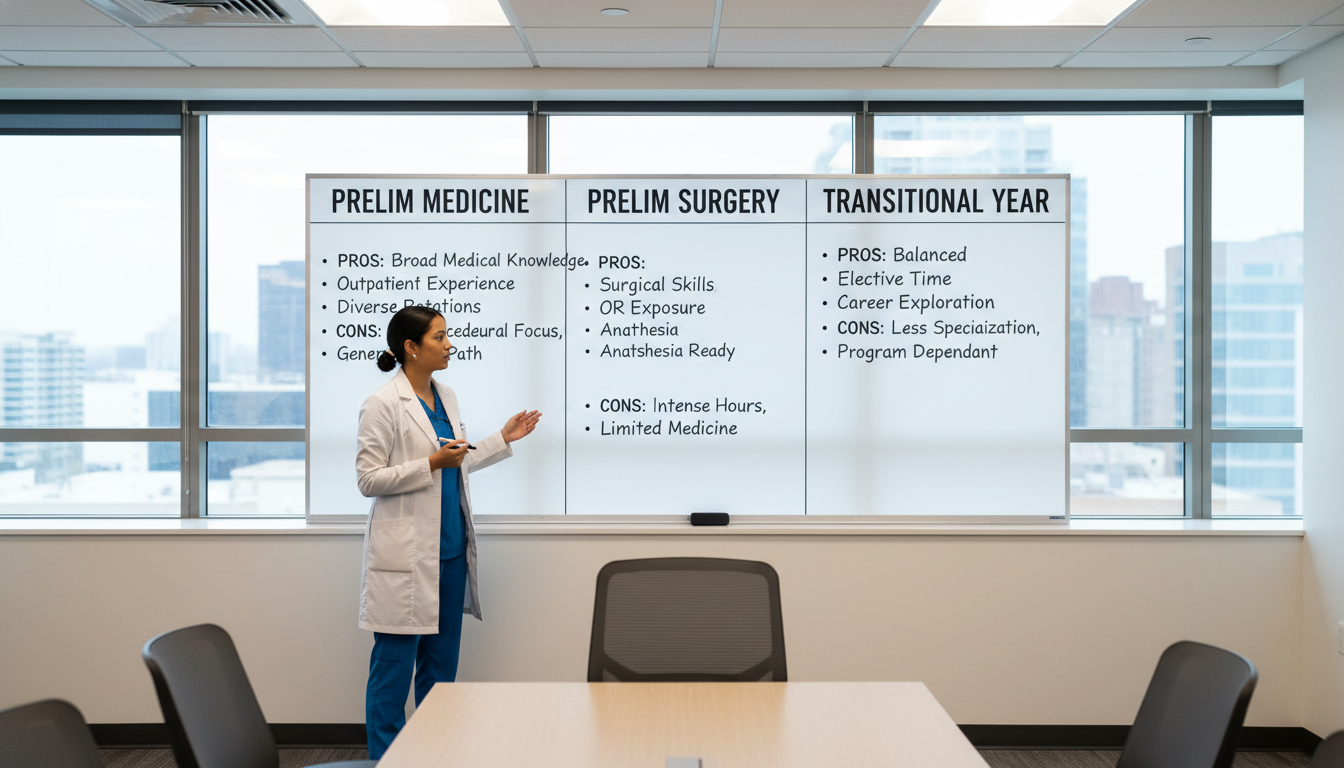
Prelim Medicine vs Transitional Year vs Prelim Surgery
Many applicants struggle with this decision. While your future specialty’s requirements should guide you, there are common patterns.
When Preliminary Medicine Is Usually the Best Fit
Consider prioritizing a prelim medicine year if:
- Your advanced specialty explicitly prefers or requires internal medicine (e.g., neurology, some radiology and oncology subspecialties)
- You want strong inpatient medicine skills that translate broadly across specialties
- You might re-apply later to categorical internal medicine if your first match doesn’t work out
- You value having more IM‑focused letters and experience
When a Transitional Year Might Make More Sense
Transitional year may be preferred if:
- Your advanced specialty is procedure-heavy and doesn’t require deep general medicine training (e.g., diagnostic radiology, radiation oncology, some anesthesia programs that accept a mix)
- You want more electives, potentially including rotations in your future field
- You are highly concerned about burnout and want a year with more diversity in schedule and workload
Still, not all transitional years are “light.” Some can be as intense as a prelim IM year; look closely at rotation structures and night coverage.
When Prelim Surgery Could Be Reasonable
Prelim surgery is less commonly chosen except in specific contexts:
- Your advanced program or specialty is surgical or perioperative in nature and is open to (or prefers) surgical base years (e.g., some IR pathways, anesthesiology in select settings)
- You’re genuinely interested in surgery and operative exposure
- You might use the prelim surgery year as a bridge to categorical surgery if needed
However, be cautious:
- Prelim surgery positions are often high-intensity with long hours and heavy workloads
- You may have fewer medicine-based rotations, which could be a disadvantage for some advanced fields that expect comfort with general internal medicine
Ultimately, there is no one-size-fits-all answer. The right choice balances:
- Specialty requirements
- Training needs
- Lifestyle tolerance
- Long-term career goals
Making the Most of Your Preliminary Medicine Year
Once you’ve selected a prelim medicine year and matched, your focus shifts to maximizing the value of this intense but brief period.
1. Enter with Clear Learning Goals
Before PGY‑1 starts, outline 3–5 concrete goals:
Examples:
- “Become independently comfortable managing common inpatient conditions (CHF exacerbation, COPD exacerbation, sepsis, DKA, delirium).”
- “Develop strong cross-cover triage skills and handoff habits.”
- “Complete one quality improvement project or case report relevant to my advanced specialty.”
- “Build at least two strong relationships with faculty mentors who can provide advice and future letters.”
Revisit these goals quarterly and adjust as you gain experience.
2. Protect Your Future Specialty Identity
During a prelim IM year, you are immersed in internal medicine, but your destination lies elsewhere. To keep your advanced specialty trajectory on track:
- Use elective time strategically:
- Rotate on services overlapping with your future field (e.g., neurology consults for neurology, cardiology or ICU for anesthesia, oncology for radiation oncology).
- Seek mentors who understand your advanced pathway, not just categorical IM.
- Attend relevant conferences or journal clubs when feasible in your future department, especially if your advanced and prelim programs share an institution.
3. Learn Transferable Skills Deliberately
Your advanced specialty will benefit from core IM skills:
- Rapid assessment and stabilization of acutely ill patients
- Risk stratification and disposition decisions
- Communication with patients and families during high-stakes moments
- Understanding the “medicine side” of your patients’ comorbidities
When on call or cross-cover, consciously practice:
- Structured approaches to overnight pages (“What is the vital sign trend? What changed since last assessment?”)
- Brief, efficient SOAP notes under time pressure
- SBAR handoffs at transitions of care
4. Manage Burnout and Set Boundaries
The preliminary year, especially in busy prelim medicine programs, is intense. Protect your well-being:
- Build micro‑recovery habits:
- Short walks after long admissions
- Scheduled meals rather than perpetual grazing at the computer
- 5‑minute decompression routines pre‑ and post‑shift
- Use vacation time strategically:
- Space out blocks to prevent long stretches without rest
- Maintain non-medical relationships and hobbies, even in small doses
If you are struggling:
- Use institutional wellness and mental health resources
- Talk with trusted senior residents or chief residents
- Remember that this is one year, not your entire career; ask for help early.
5. Plan the Transition to PGY‑2 Early
If your advanced residency is at a different institution:
- Confirm start dates and orientation schedules for PGY‑2 around midyear.
- Coordinate with GME offices for:
- Credentialing
- Medical licenses
- Relocation logistics
- Use your last few months of the prelim medicine year to:
- Review core knowledge for your advanced field
- Arrange shadowing or short rotations in that specialty if possible
You want to finish the prelim year feeling clinically strong in medicine while also mentally ready to shift back into your advanced specialty focus.
Frequently Asked Questions (FAQ)
1. Do program directors in advanced specialties care which prelim medicine program I attend?
They care more about what you learn and how you perform than the brand name alone. That said:
- Advanced PDs prefer that you complete a solid, reputable prelim IM year rather than a poorly structured program with limited supervision.
- For highly competitive fields, letters from strong academic internal medicine faculty can still carry weight.
- If your advanced program suggests preferred partner prelim medicine programs, take that input seriously.
Ultimately, a well-chosen prelim medicine year where you excel clinically and professionally is more important than prestige alone.
2. Can I switch from a preliminary medicine track into categorical internal medicine at the same institution?
Sometimes, but it is never guaranteed:
- Some programs informally allow strong prelim residents to convert to categorical positions if:
- A categorical resident leaves
- Funding and accreditation permit
- Others have strict caps and do not convert prelims under any circumstances.
If this is part of your long-term plan:
- Ask discreetly and respectfully during interviews:
- “Have prelim medicine residents ever transitioned into categorical positions here?”
- Do not rely on this as your only pathway to a categorical spot; treat any conversion opportunity as a bonus, not a plan.
3. Is a transitional year always easier than a prelim medicine year?
No. While transitional years are often perceived as lighter, the reality varies:
- Some transitional years are call-heavy, ICU-heavy, or have demanding EM blocks.
- Some prelim medicine programs are very humane, with strong support and reasonable work hours.
You must review the rotation schedule, call structure, and culture for each individual program instead of relying on the label “transitional” vs “prelim medicine.”
4. How should I rank my preliminary year relative to my advanced residency on the NRMP rank list?
In the NRMP system, you rank combinations of advanced and preliminary positions (and standalone options). Practical tips:
- Put your ideal combinations (e.g., Dream Advanced Program A + Prelim Medicine Program X) at the very top.
- Then list:
- The same advanced program with alternative acceptable prelim options (prelim medicine, transitional, or prelim surgery as appropriate).
- Other advanced programs with their acceptable prelim combinations.
- Finally, consider “backup” options, such as strong preliminary medicine or transitional year positions alone, if you would accept a single-year position while reapplying.
Your goal is to honestly reflect your true preferences, knowing that the algorithm is applicant-favorable. Make sure any combination you rank is something you would actually be willing to complete.
Choosing and using your preliminary medicine year wisely is a powerful way to set up the rest of your residency and career. By deliberately weighing prelim IM against prelim surgery and transitional year options, evaluating programs systematically, and approaching PGY‑1 with clear goals, you can transform a challenging year into a formative, confidence-building foundation for your advanced specialty.