
Understanding the Preliminary Year in Ophthalmology
Matching into an ophthalmology residency is unusual compared with most other specialties. The American Urological Association (AUA) match timeline is earlier than the NRMP Main Match, and most ophthalmology programs are advanced positions, meaning they begin at the PGY‑2 level. As a result, applicants must secure a separate PGY‑1 position, commonly called the preliminary year or intern year.
For many applicants, choosing and strategizing around the preliminary year is almost as stressful as the ophtho match itself. Yet the PGY‑1 year significantly shapes your readiness for ophthalmology, your wellness, and even your performance in residency. Done well, it becomes a strong foundation rather than a hurdle.
This guide walks through:
- What a preliminary year is and how it fits into ophthalmology training
- Key differences between prelim medicine, prelim surgery, transitional year, and other options
- How to choose the right type of intern year for your goals and learning style
- How programs view different prelim choices in the ophtho match
- Practical strategies for applying, ranking, and planning your PGY‑1 year
The goal is to help you make an informed, strategic decision about your preliminary year that supports both your match chances and your long‑term success as an ophthalmologist.
1. The Role of the Preliminary Year in Ophthalmology Training
1.1 What is a preliminary year?
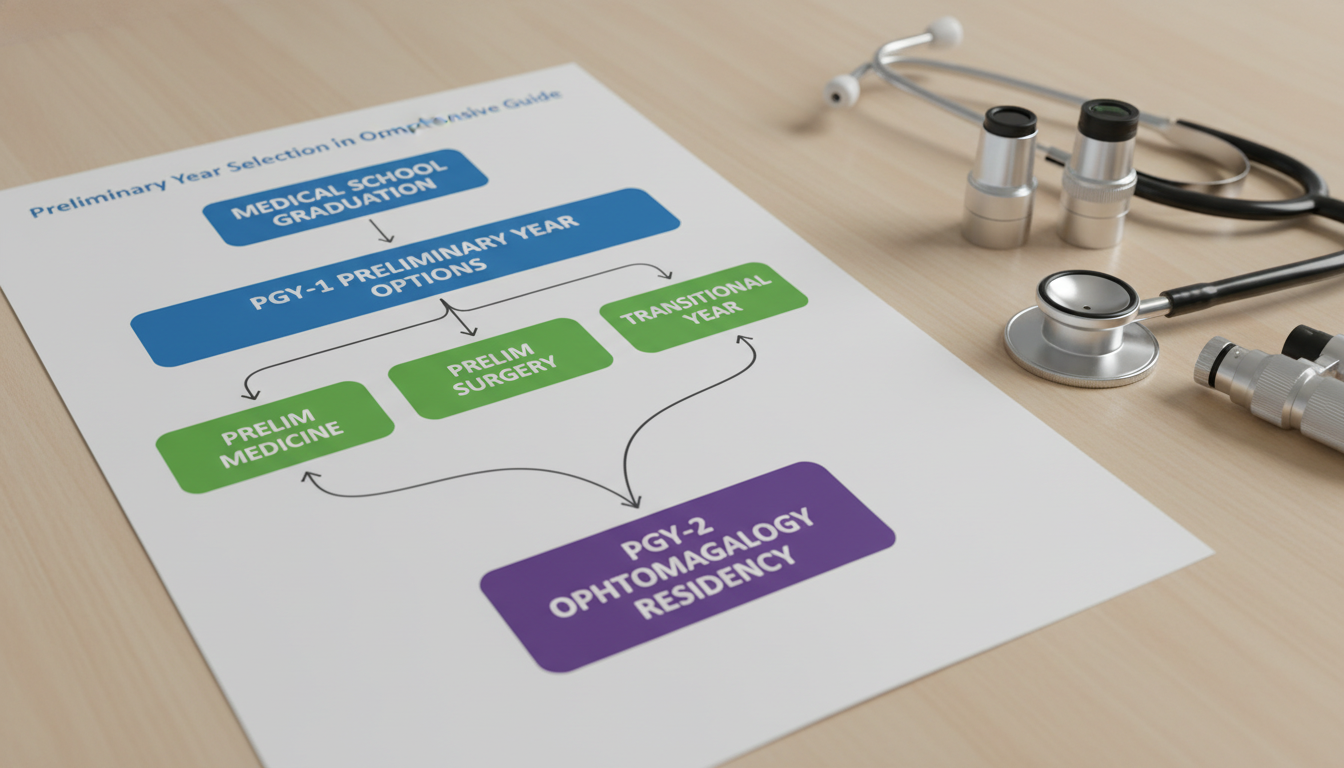
Ophthalmology residency in the U.S. is structured as:
- PGY‑1 (intern year): Often a separate program in medicine, surgery, or a transitional year
- PGY‑2–PGY‑4: Ophthalmology residency (advanced position)
A preliminary year is a one-year, mostly non-continuing position in a core specialty (usually internal medicine or surgery). It differs from:
- Categorical positions (e.g., categorical internal medicine): 3+ year programs designed to lead to full specialty training.
- Transitional year (TY): A broad-based internship with rotations in multiple disciplines (e.g., medicine, surgery, emergency medicine, electives).
In ophthalmology, your prelim year must meet ACGME and American Board of Ophthalmology requirements for a clinical PGY‑1. Programs typically accept:
- Transitional year (TY)
- Preliminary medicine year
- Preliminary surgery year
- Occasionally, other approved preliminary clinical years (e.g., pediatrics) if requirements are met—but this is less common and should be confirmed with your matched program.
1.2 Why the PGY‑1 year matters
Many students underestimate the importance of intern year, assuming the “real learning” starts with ophtho. In reality, a solid PGY‑1 year:
- Builds clinical judgment, especially in acute care and systemic disease
- Improves your ability to recognize systemic conditions that affect the eye (e.g., diabetes, hypertension, autoimmune disease, vasculitis, malignancy)
- Develops crucial communication skills with patients and consultants
- Teaches you how to manage inpatient issues, which helps in complex ophthalmic patients (e.g., neuro-ophthalmic emergencies, trauma)
- Strengthens resilience, time management, and situational awareness, key for call during PGY‑2–PGY‑4
Ophthalmology program directors often say they want residents who arrive at PGY‑2 as competent physicians, not just future eye specialists. Your choice of preliminary year—and how you use it—can strongly influence that.
1.3 Advanced vs. integrated ophthalmology programs
Historically, almost all ophthalmology positions were advanced, requiring a separate NRMP application for PGY‑1. Over the last decade, some programs have developed integrated or joint PGY‑1/PGY‑2 structures:
- Integrated ophthalmology programs: You match into a combined PGY‑1 + ophtho track with a guaranteed intern year, often with ophthalmology rotations included.
- Joint or “linked” prelims: The ophtho program works closely with a specific prelim medicine or prelim surgery program. If you match into ophtho, they expect or require you to match at their affiliated PGY‑1.
However, many programs remain advanced only, so you’ll need to apply to the ophtho match (through SF Match) and separately to prelim/TY positions (through NRMP). Understanding what your target ophtho programs require is the first step in planning.
2. Types of Preliminary Years: Medicine, Surgery, and Transitional Year
2.1 Transitional Year (TY)
What it is:
A transitional year is a flexible, broad-based intern year with rotations across different fields. Typical schedule:
- 4–6 months of internal medicine (inpatient and outpatient)
- 1–2 months of general surgery or surgical subspecialties
- 1 month of emergency medicine
- Several months of electives (sometimes including ophthalmology, neurology, radiology, ICU, or other specialties)
Pros for ophthalmology applicants:
- Often perceived as less grueling than prelim medicine or prelim surgery (though this varies widely by program)
- Substantial elective time allows:
- Ophthalmology rotations
- Research time
- Dedicated study time for OKAPs or board exams
- Broad exposure can help you recognize systemic manifestations of disease across disciplines
- Often associated with higher reported wellness, better work‑life balance, and more predictable schedules, especially in community TYs
Potential cons:
- Less inpatient volume than a rigorous prelim medicine year—some residents feel slightly less comfortable with complex medical management at the start of ophtho
- Some TYs are still very demanding (especially those attached to competitive specialties like radiology or dermatology)
- Limited ICU exposure in some TY programs
- Not all locations have TYs, limiting geographic flexibility
Bottom line:
For many ophthalmology-bound students, a well-structured, balanced transitional year is highly attractive—especially if it allows some ophtho exposure and preservation of wellness before an intense PGY‑2 year.
2.2 Preliminary Medicine (Prelim Medicine)
What it is:
A prelim medicine year is a one-year position within an internal medicine residency. The curriculum is typically identical to that of categorical interns, except that you do not continue beyond PGY‑1.
Typical distribution:
- Heavy inpatient internal medicine
- Night float rotations
- ICU rotations (at many programs)
- Some outpatient clinic
- Few electives
Pros for ophthalmology applicants:
- Provides excellent grounding in systemic disease, which is highly relevant to ophthalmology (e.g., diabetes, hypertension, autoimmune disease, vasculitis, thyroid disease, infectious disease)
- Builds comfort managing acutely ill patients, reading EKGs, interpreting imaging, and coordinating care
- Helps you become an excellent consulting physician and collaborator—critical when managing complex eye patients in the hospital
- Often viewed favorably by ophtho program directors who value strong general medicine training
Potential cons:
- Schedules can be intense: long hours, frequent call, and night float
- Less flexibility and fewer electives; limited chance to do ophthalmology rotations
- Burnout risk if program culture and support are poor
- Can be logistically challenging to maintain ophtho skills or research involvement
Bottom line:
Prelim medicine is ideal if you want to be especially strong at medical management and are comfortable with a rigorous intern year. It is often considered the “safest” pick from an educational standpoint and may subtly reassure programs that you’ll be clinically solid.
2.3 Preliminary Surgery (Prelim Surgery)
What it is:
A prelim surgery year takes place within a general surgery residency. Some residents in these slots aim to switch into categorical surgery; many others are headed for advanced specialties (e.g., radiology, anesthesiology, ophthalmology).
Typical schedule:
- General surgery floor and OR
- Surgical subspecialties (e.g., vascular, colorectal)
- ICU
- Trauma surgery and night float
Pros for ophthalmology applicants:
- High exposure to the OR environment:
- Sterile technique
- Handling instruments and microscope (in some programs)
- OR workflow, communication with nurses and anesthesiologists
- Builds procedural confidence and comfort with acute care
- Can develop excellent crisis management and teamwork skills
- Particularly appealing if you enjoy hands-on, procedural work and want to sharpen those skills before ophtho
Potential cons:
- Surgery prelims can be among the most demanding intern years in terms of hours and overnight call
- Limited outpatient medicine exposure
- Less directly relevant to the systemic disease side of ophthalmology than prelim medicine
- Lower wellness and sleep, depending on local duty culture
- Some positions are unstable (e.g., “orphan” prelim spots with minimal educational support)
Bottom line:
Prelim surgery can be a strong option for applicants who love the OR, learn best from high-intensity environments, and feel confident they can handle long hours without burning out. It’s less common than prelim medicine or TY among ophthalmology residents, but still entirely acceptable.
2.4 Other PGY‑1 Options
On occasion, applicants ask about:
- Prelim pediatrics
- Prelim emergency medicine (rare)
- Family medicine PGY‑1 only (not standard)
These are generally less common and not universally accepted by ophthalmology programs. If you are considering something outside TY, prelim medicine, or prelim surgery, you must:
- Confirm with the ophthalmology program(s) you are targeting that your choice meets their requirements.
- Confirm that the year is ACGME-accredited and fulfills ABO requirements.
For most applicants, it is safer and simpler to choose among transitional year, prelim medicine, or prelim surgery.

3. How Ophthalmology Programs View Different Preliminary Years
3.1 Is there a “best” preliminary year for ophtho match success?
There is no universally “correct” choice, and program directors rarely reject strong applicants based on which acceptable prelim type they choose. Much more important are:
- Your ophtho letters of recommendation
- Clinical performance, especially in ophthalmology rotations
- Research and commitment to the field
- Board scores (where still used), transcripts, and overall professionalism
That said, different programs and faculty may hold preferences:
- Many academic programs quietly favor prelim medicine or a robust transitional year that provides sufficient internal medicine exposure.
- Surgical prelims may be viewed favorably if the institution values surgical and OR skills, though this is less commonly voiced as a preference.
- Some program directors explicitly say they are happy with any accredited TY or prelim medicine and are neutral among them.
When in doubt, ask directly during interviews:
“For your program, is there any preference regarding the type of PGY‑1 training your residents complete (transitional year, prelim medicine, prelim surgery)?”
3.2 Integrated and joint programs: special considerations
If you match into an integrated ophthalmology program, your PGY‑1 is usually predetermined. These programs often structure the intern year to include:
- Several months of internal medicine
- A mix of ICU, emergency medicine, and possibly neurology
- A limited number of ophthalmology rotations, so you hit PGY‑2 with some familiarity
If you match into a program with a linked or joint prelim, you may be:
- Expected or required to rank the affiliated prelim medicine or TY program highly
- Given an internal list or instructions on specific prelim programs to apply to
In some cases, integrated or joint positions may influence how many additional prelim programs you need to apply to, but most applicants still apply to a backup set of PGY‑1 programs through the NRMP in case plans change.
3.3 Does a rigorous prelim year improve future performance?
Program directors commonly report that residents who completed a strong clinical intern year (especially in medicine or a well-structured TY) tend to:
- Be more comfortable managing complex or unstable patients
- Communicate more confidently with primary teams, hospitalists, and consultants
- Recognize which systemic findings are urgent vs. outpatient issues
- Take better overall care of patients, particularly in call and emergency settings
However, there is a tradeoff: a particularly grueling prelim surgery or prelim medicine year at a high-volume hospital can leave you exhausted heading into PGY‑2. Burnout entering ophthalmology can undercut potential benefits.
Ideally, you want a program that:
- Provides strong core training
- Supports resident wellness
- Offers a learning environment rather than purely a service-intensive one
4. How to Choose the Right Preliminary Year for You
4.1 Clarify your priorities
Before you build your rank list or even apply, define what matters most to you. Common priorities include:
- Clinical breadth vs. intensity
- Do you want a broad base with electives (TY), or deep immersion in medicine (prelim medicine)?
- Workload and wellness
- Are you comfortable with a highly demanding schedule, or do you want a more balanced year before ophthalmology?
- Geography
- Do you need to be near family, your significant other, or your future ophtho program?
- Educational culture
- Do residents feel supported? Is there constructive feedback, protected didactics, and mentorship?
- Alignment with future ophtho practice
- For academic careers, strong internal medicine background is often particularly valuable. For surgically oriented practices, OR comfort may help.
Ranking your own priorities will help you see whether you lean naturally toward transitional year vs prelim medicine vs prelim surgery.
4.2 Evaluating specific programs
Once you’ve narrowed your preferred type of intern year, dig into details. During interviews and program research, ask targeted questions:
Workload and schedule
- How many inpatient months and ICU months do interns have?
- What is the call structure (q4, night float, 24-hour call)?
- Are duty hour violations common?
- Are there capped services or historically over-capacity teams?
Education and support
- How frequent and protected are didactics?
- Is there structured mentorship and evaluation?
- How approachable are faculty and senior residents?
- What kind of orientation and onboarding do interns receive?
Relevance to ophthalmology
- Does the program regularly host interns headed to ophthalmology or other advanced specialties?
- Are there ophtho electives or opportunities to work with the eye service?
- Are there rotations in neurology, rheumatology, endocrinology, or other fields relevant to eye disease?
Resident culture and wellness
- How do residents describe their day-to-day experience?
- What is the vacation and sick time policy?
- Are there meaningful wellness initiatives, or are they superficial?
Gather information from:
- Official websites (for structure)
- Current residents, especially those in a similar path (student → intern → ophthalmology)
- Alumni from your medical school
4.3 Examples of “good fit” scenarios
Example 1: Research-oriented future academic ophthalmologist
- Values internal medicine knowledge and complex systemic disease management
- Comfortable with high-intensity clinical work
- Prefers prelim medicine at a teaching hospital with strong subspecialty exposure and robust didactics.
Example 2: Student prioritizing wellness and flexibility
- Wants time for reading, reflection, and possibly some ophtho research
- Concerned about burnout before a demanding ophtho residency
- Thrives with variety instead of repetitive inpatient blocks
- Likely best served by a transitional year with protected electives and a supportive culture.
Example 3: Surgically inclined, loves the OR
- Very excited about hands-on procedural work
- Wants to be maximally comfortable in the OR and with acute postoperative management
- Could choose a prelim surgery year with a reputation for good teaching and a manageable culture (not just raw volume).
In reality, many applicants could thrive in more than one type of PGY‑1. The key is choosing an environment that will help you grow while preserving your ability to show up fully for ophthalmology.
5. Application Strategy: Coordinating Ophtho Match and Prelim Year
5.1 Timeline overview
Ophthalmology uses the SF Match, while most prelim and transitional year programs participate in the NRMP Main Match. A typical sequence:
Early fall (MS4)
- Submit SF Match application for ophthalmology.
- Begin compiling and submitting ERAS applications for prelim/TY programs.
Fall–early winter
- Interview for ophthalmology programs.
- Interview for prelim/TY programs (these often extend later into winter).
January
- Submit rank list for the ophthalmology match (SF Match results released typically in January).
February–March
- Submit rank list for NRMP (prelim/TY).
- Ophthalmology match result can inform how you rank prelim programs (e.g., geographically).
March
- NRMP Match Day: you learn your preliminary year program.
5.2 How many prelim/TY programs should you apply to?
There’s no universal number, but considerations include:
- Competitiveness of your overall application
- Type of PGY‑1 (transitional year programs can be very competitive in attractive locations)
- Geographic flexibility
Common ranges:
- Many ophtho applicants apply to 10–20 prelim/TY programs.
- Those with strong applications and geographic flexibility may apply to slightly fewer.
- Those aiming only for very specific or desirable cities often apply to more, as some TYs are as competitive as categorical residencies.
Speak with your dean’s office and recent alumni who matched in ophthalmology to calibrate your strategy.
5.3 Aligning prelim with your matched ophtho program
Once you receive your ophtho match result (SF Match), you can refine your NRMP rank list:
- If you’ve matched in a specific city or region, you may choose to rank prelim programs closer to that location more highly.
- If your matched program has a preferred or affiliated prelim (or a strong recommendation), adjust your list accordingly.
- If you did not match in ophthalmology on the first attempt, you may adjust your prelim rank strategy to optimize for potential reapplication or explore preliminary years that provide strong mentorship and opportunities.
Communication is key: some ophtho programs will advise you on compatible prelims nearby, and some prelim programs appreciate knowing you are heading to a reputable ophtho residency.
5.4 What if your ophtho and prelim locations are far apart?
This can happen. It is not ideal, but many residents have:
- Completed a PGY‑1 in one state, then
- Moved across the country for PGY‑2 ophthalmology.
Key considerations:
- Licensing and credentialing timelines (ensure you start paperwork early for your PGY‑2 state)
- Need for short-term housing twice in quick succession
- Impact on relationships or family logistics
If you have a strong geographic preference for your intern year, plan your prelim/TY application list accordingly.
6. Making the Most of Your Preliminary Year
Regardless of whether you choose prelim medicine, prelim surgery, or a transitional year, the way you use your intern year is as important as the choice itself.
6.1 Core goals for the PGY‑1 year
During your preliminary year, aim to:
- Become competent in acute care:
- Recognize sick vs. stable patients
- Manage common emergencies and escalate appropriately
- Build strong skills in communication and teamwork:
- Present cases succinctly
- Write clear notes
- Hand off safely
- Understand systemic disease that affects the eye:
- Diabetes, hypertension, hyperlipidemia
- Autoimmune and inflammatory diseases
- Infectious diseases with ocular manifestations
- Maintain or build your interest in ophthalmology:
- Seek out ophtho consultations or electives if available
- Keep reading ophthalmology basics periodically
6.2 Practical strategies
Seek feedback early and often
Ask attendings and senior residents: “What is one thing I could improve for tomorrow?” Implement changes quickly.Keep an ophtho lens on your patients
When caring for patients with diabetes, stroke, or autoimmune disease, think about potential eye manifestations. Ask ophtho residents questions during consults.Prioritize wellness
Even in demanding prelim medicine or prelim surgery years, intentionally protect:- Sleep as much as your schedule allows
- Basic exercise when feasible
- Nutrition (pack snacks/meals on call days)
- Relationships and support systems
Document experiences and cases
Interesting cases from your intern year often become:- Future teaching points with ophtho co-residents
- Case reports or conference presentations
- Foundations for complex patient care later in training
Take advantage of electives (especially in TYs)
Use elective time for:- Rotations with ophthalmology or neurology
- Research or quality improvement projects
- Longitudinal clinics that deepen your understanding of systemic disease
6.3 Red flags and when to seek help
If during your preliminary year you notice:
- Persistent burnout or depressive symptoms
- Severe anxiety about clinical responsibilities
- Frequent conflict with team members or attendings
- Difficulty keeping up with basic tasks or knowledge
Reach out early to:
- Program leadership (PD or APD)
- Chief residents or mentors
- Wellness and confidential counseling resources
You are building the foundation for years of practice; protecting your mental health and ability to learn is as important as your clinical performance.
FAQ: Preliminary Year Selection in Ophthalmology
1. Is a transitional year looked down upon compared with prelim medicine for ophthalmology?
No. Most ophthalmology programs accept both transitional year and prelim medicine without prejudice, as long as the program is accredited and provides adequate internal medicine exposure. Some academic programs may slightly favor strong prelim medicine training, but a robust, well-structured transitional year with good medicine rotations is typically viewed very positively—especially if it supports your wellness and performance.
2. Should I avoid prelim surgery if I want to do ophthalmology?
Not necessarily. Prelim surgery can be an excellent path if you enjoy the OR and procedural work and can tolerate a high-intensity schedule. However, it is less common among ophtho residents and may provide less exposure to outpatient and general internal medicine. If you choose prelim surgery, make sure the program has good educational support and that you’re prepared for potentially long hours.
3. If I match an integrated ophthalmology position, do I still need to apply to prelim or TY programs separately?
Usually not. Integrated positions include the PGY‑1 within the same match package, so your clinical intern year is guaranteed and planned by the institution. Always confirm with the specific program, though—some “joint” arrangements still require a separate NRMP rank list, even if they are functionally linked.
4. How many prelim or transitional year programs should I rank if I’ve already matched in ophthalmology?
Once you know your ophthalmology match result (from SF Match), you should rank enough prelim/TY programs in the NRMP to give yourself a comfortable probability of matching, focusing on programs and locations that are compatible with your PGY‑2 site. Many applicants aim for 10–15 realistic programs on their rank list, but the right number depends on your competitiveness and geographic flexibility. Your dean’s office and recent alumni are excellent resources to fine-tune this decision.
By understanding how the preliminary year fits into ophthalmology training, the differences between prelim medicine, prelim surgery, and transitional year, and how to evaluate and apply to specific programs, you can turn your PGY‑1 into a genuine strength—academically, clinically, and personally—as you enter your ophthalmology residency.