



Understanding EM-IM Combined: Why It Matters Even as a Pre-Med
If you’re a pre-med student interested in acute care, complex diagnosis, and long-term patient relationships, the Emergency Medicine–Internal Medicine (EM IM combined) pathway is one of the most versatile training routes you can pursue later on. Even though combined emergency medicine internal medicine programs begin at residency, the preparation for a competitive application starts long before you submit ERAS—in fact, it starts now, during your pre-med years.
What is EM-IM combined?
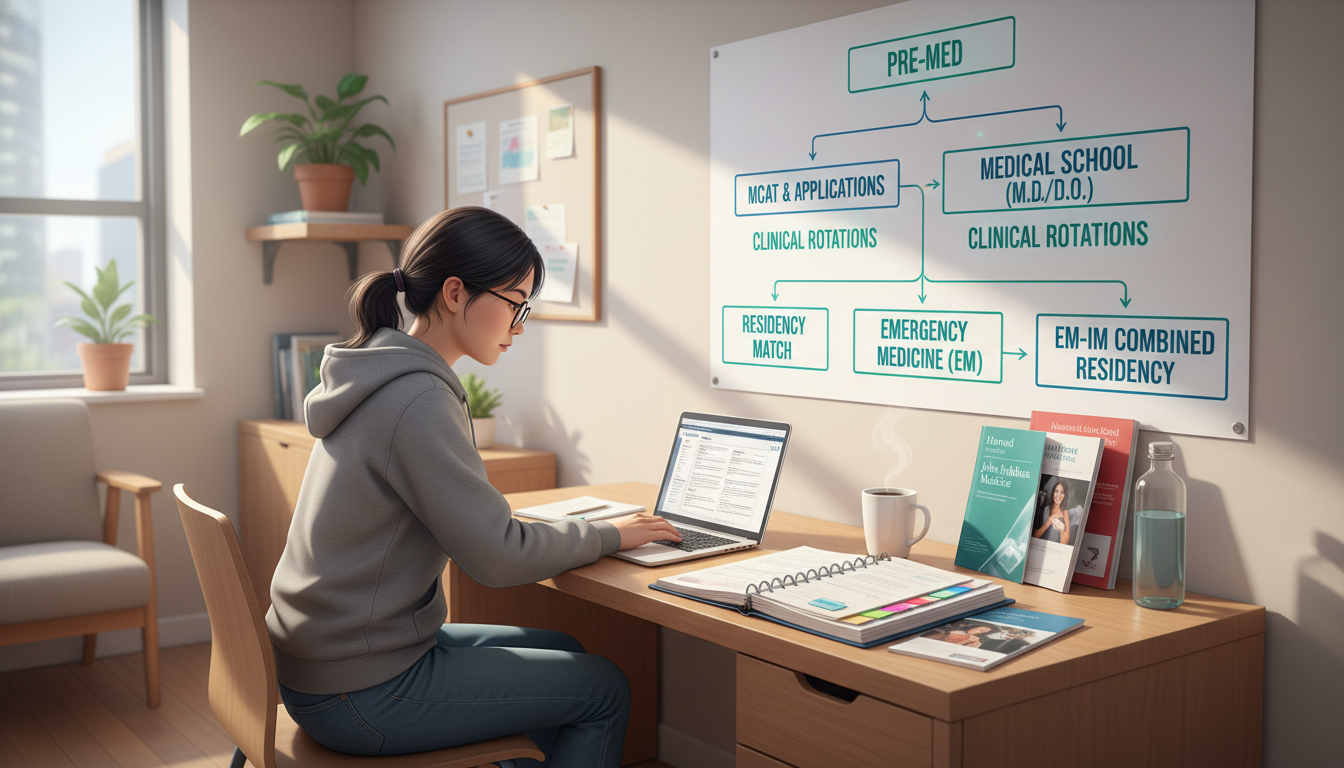
Emergency Medicine–Internal Medicine is a 5-year combined residency that leads to board eligibility in both Emergency Medicine (EM) and Internal Medicine (IM). Graduates can:
- Practice in the emergency department, inpatient wards, outpatient clinics—or a mix of all three
- Pursue fellowships (e.g., critical care, cardiology, ultrasound, palliative care, administration)
- Work in academic centers, community hospitals, or hybrid roles (e.g., ED + hospitalist)
As a pre-med, you do not apply directly to EM-IM programs yet—but if you already know you like both emergency care and complex medical problem-solving, your early choices can lay a powerful foundation. This guide focuses on how to become a doctor specifically with this dual-interest pathway in mind, and what premed requirements, experiences, and strategies can set you up for success.
We’ll cover:
- Core academic expectations and how to build a strong science foundation
- Strategic extracurriculars tailored to EM and IM interests
- Clinical exposure and shadowing ideas that highlight dual training
- Skills and mindsets to cultivate now for long-term success
- How to use premed years to clarify whether EM-IM is truly right for you
Academic Foundations: Premed Requirements With EM-IM in Mind
You can’t match into an EM-IM program if you never get into medical school. Your first objective is to become a strong applicant to MD or DO programs, while subtly aligning your preparation with future EM-IM interests.
Core Premed Requirements
Most U.S. medical schools have similar baseline course expectations. Always verify each school’s list, but common requirements include:
- Biology with lab (2 semesters)
- General chemistry with lab (2 semesters)
- Organic chemistry with lab (2 semesters)
- Physics with lab (2 semesters)
- Biochemistry (increasingly required, almost always recommended)
- English / writing-intensive courses (1–2 semesters)
- Math (often statistics and/or calculus)
- Social/behavioral sciences (psychology, sociology, sometimes recommended rather than required)
From an EM-IM perspective, some areas deserve particular attention.
Courses Especially Valuable for Future EM-IM Physicians
You don’t need a special “EM-IM major,” but you can choose coursework that builds skills used daily in emergency medicine internal medicine practice:
Physiology and Pathophysiology
- Deep understanding of cardiac, respiratory, renal, and neurophysiology is foundational for interpreting acute presentations in the ED and complex inpatient illnesses.
- If offered, take advanced physiology or pathophysiology electives.
Microbiology and Immunology
- Infectious disease is central to both EM and IM (sepsis, pneumonia, meningitis, complicated UTIs).
- These courses help you think through source, host response, and appropriate antimicrobials.
Statistics and Epidemiology
- Internal medicine and EM both rely heavily on evidence-based medicine: understanding risk, test characteristics (sensitivity, specificity), and clinical prediction rules.
- A strong statistics class will directly help you read the literature and later interpret clinical research.
Psychology and Sociology
- You’ll see patients in crisis in the ED and in chronic distress in clinics/hospital wards.
- These classes sharpen your insight into behavior, adherence, substance use, social determinants of health—vital for both specialties.
Ethics, Health Policy, or Public Health
- EM often serves as the safety net for vulnerable populations, while IM sees long-term effects of systemic inequities.
- A course in medical ethics or health policy can deepen your understanding of the systems context of acute and chronic care.
GPA Targets and Academic Strategy
Competitive EM-IM applicants later are typically strong across the board. While specific cutoffs vary by school, as a pre-med you should aim for:
- Overall GPA: 3.6+
- Science GPA (BCPM): 3.5+
You can match into medicine with lower numbers, but combined programs are relatively small and competitive—so think in terms of building the strongest possible academic profile.
Practical academic advice:
- Front-load learning skills, not just grades.
- Practice spaced repetition, active recall, and question-based learning now. These methods are the same ones you’ll need in med school and residency.
- Be realistic in course stacking.
- Don’t take five heavy lab sciences in one term just to “prove” something. Sustained performance matters more than a single brutal semester.
- Fix weaknesses early.
- If general chemistry is a struggle, consider tutoring, office hours, or a lighter course load temporarily. Learning to remediate weakness is part of how to become a doctor capable of lifelong learning.
MCAT Preparation With EM-IM in Mind
The MCAT does not test specialty interests, but there are indirect connections to EM-IM:
- Rapid analytical reasoning: EM physicians must quickly synthesize information under pressure; MCAT CARS trains your ability to read, interpret, and decide efficiently.
- Integrated systems thinking: EM-IM requires seeing pathophysiology across systems; the MCAT’s integrated biology/biochemistry reflects that.
Actionable MCAT tips:
- Start content review 6–9 months in advance if possible.
- Add timed full-length exams early; your specialty interests will eventually demand comfort with performance under time pressure.
- Reflect on your process: How do you handle stress? Do you freeze, rush, or adapt? These are the same patterns you’ll bring to the ED or inpatient wards later.

Clinical Exposure: Designing Experiences for Dual EM and IM Interests
You won’t be doing procedures or managing codes as a pre-med, but you can start understanding what day-to-day life looks like for EM and IM physicians—and especially what it might be like to combine them.
Shadowing: How to Explore EM and IM Early
Try to arrange shadowing experiences in both settings:
Emergency Medicine Shadowing
- Look for shifts where you can see:
- Triage and initial assessment of undifferentiated complaints
- Trauma activations (if allowed)
- Medical resuscitations (e.g., sepsis, heart failure, COPD exacerbations)
- Pay attention to:
- How EM attendings rapidly prioritize life threats
- Communication with consultants (often internists/hospitalists)
- Team dynamics with nurses, techs, EMS, and residents
- Look for shifts where you can see:
Internal Medicine Shadowing
- Seek a mix of:
- Inpatient general medicine/hospitalist services
- Outpatient primary care or subspecialty clinics (cardiology, endocrinology, pulmonary, etc.)
- Observe:
- Longitudinal patient relationships, chronic disease management
- Diagnostic reasoning with complex, multi-problem patients
- How internists coordinate care across specialties and care settings
- Seek a mix of:
If You Can, Shadow an EM-IM Trained Physician
- Combined-trained physicians may:
- Split time between ED and wards
- Work in observation units or intermediate care
- Lead critical care or complex care teams
- Ask them:
- Why they chose EM-IM combined instead of a single specialty
- What personality traits fit well with this path
- What they wish they’d known as pre-meds or medical students
- Combined-trained physicians may:
Shadowing tip: Keep a reflection journal. After each experience, write:
- 1–2 clinical situations that stood out
- Skills you saw that impressed you (communication, composure, diagnostic logic)
- What aspects of the work energized vs. drained you
These reflections later inform your personal statement or interview answers when you explain why you’re drawn to emergency medicine internal medicine training.
Clinical Volunteering: Seeing Patients Up Close
Medical schools expect hands-on patient exposure, and for future EM-IM applicants, some settings are particularly insightful:
Emergency Department Volunteer
- Transporting patients, delivering blankets, stocking supplies
- Observing how high-acuity and low-acuity cases coexist
- Appreciating the ED as a safety net for those without access to primary care
Hospital Inpatient Volunteer
- Working on medical/surgical floors or step-down units
- Seeing how internal medicine teams manage chronic diseases, decompensations, and discharge planning
Free Clinics or Community Health Centers
- Excellent exposure to the outpatient side of internal medicine
- Learn about social determinants of health, adherence barriers, and resource limitations
EMS Ride-Alongs (If Available)
- Though not required, these experiences highlight pre-hospital care and how patients arrive in the ED
- You’ll see triage decisions and time-sensitive interventions that shape ED priorities
When you describe these experiences to medical schools (and later residency programs), emphasize:
- How exposure to both acute episodic care (EM) and longitudinal, comprehensive care (IM) shaped your understanding of patient needs.
- How you began to see that some patients need both: stabilization in the ED and careful chronic management afterward.
Non-Clinical Experiences That Still Matter
EM-IM physicians rely on more than medical knowledge. As a pre-med, you can develop relevant skills through non-clinical roles:
Crisis hotlines / Peer counseling
- Builds communication under emotional pressure, de-escalation skills, and active listening.
- Highly transferable to suicidal patients in the ED, or anxious patients with chronic diseases.
Leadership roles in student organizations
- EM-IM physicians often coordinate teams and systems.
- Running a club, organizing a health fair, or managing volunteers demonstrates initiative and organization.
Teaching/tutoring
- Medicine, and particularly internal medicine, involves constant patient and trainee education.
- Tutoring biology, chemistry, or even non-science subjects can show your ability to explain complex concepts.
Research, Service, and Professional Development Tailored to EM-IM
You don’t need extensive research to match EM or IM alone, but combined programs—often at academic centers—value applicants comfortable in scholarly environments.
Research: What Helps Future EM-IM Applicants?
You can pursue any good research opportunity and still be competitive, but certain themes align well with EM-IM:
Acute care or critical care research
- E.g., sepsis protocols, stroke pathways, trauma outcomes, ED crowding and flow.
- These topics resonate strongly with EM programs.
Quality improvement (QI) projects
- E.g., reducing readmissions for heart failure, improving diabetes control, streamlining ED-to-inpatient handoffs.
- QI is directly relevant to both EM and IM and often more accessible than bench research.
Health services or disparities research
- E.g., access to emergency care, ED use by uninsured populations, language barriers in chronic disease follow-up.
- Shows awareness of system-level issues that EM-IM physicians frequently confront.
Example pathway:
- Volunteer in the ED → notice frequent delays transferring admitted patients to the medicine floor → assist with a QI project analyzing bottlenecks → present at a local or regional conference.
Later, you can connect this experience to your interest in bridging ED and inpatient medicine through EM-IM training.
Service: Showing Commitment to Vulnerable Populations
Both EM and IM have strong service-oriented cultures. EM-IM physicians often:
- Care for patients with limited resources
- Manage chronic conditions complicated by social challenges
- Serve in safety-net hospitals or public systems
Service activities that align with this ethos include:
- Homeless outreach programs
- Free clinics for uninsured patients
- Substance use recovery support groups
- Refugee/immigrant health or language interpretation roles
When reflecting on these experiences, focus less on “I helped” and more on:
- What you learned about barriers to care
- How they shaped your understanding of responsibility and advocacy
- How they inform your desire to train at the interface of crisis care (EM) and chronic management (IM)
Professionalism and Early Networking
Learn early how to communicate and behave professionally in clinical and academic spaces:
- Be reliable: show up on time, follow through on commitments.
- Be teachable: welcome feedback, avoid defensiveness.
- Be respectful: to patients, staff, and peers.
If you encounter EM or IM physicians who inspire you, stay in touch:
- Ask for occasional career advice via email.
- Share updates on your progress.
- Consider asking for letters of recommendation when you apply to medical school.
These mentors may later advise you on whether EM-IM fits your evolving interests, and how to position yourself when it’s time to apply for residency.
Building the EM-IM Mindset: Skills and Traits to Cultivate Now
Long before you’re managing codes or complex ICU patients, you can start building the cognitive and emotional habits that EM-IM physicians rely on.
Tolerance of Uncertainty and Rapid Decision-Making
Emergency medicine often deals with incomplete information; internal medicine excels at filling in the gaps over time.
As a pre-med, you can practice this skill by:
- Working through clinical case books for lay readers, or medical student-level cases if you’re comfortable.
- During shadowing, ask physicians to “walk you through their thinking”—especially when the diagnosis isn’t obvious.
- Reflect on decisions you make daily under uncertain conditions: How do you gather information, weigh risks, and choose a path?
Systems Thinking and Continuity of Care
EM-IM physicians frequently operate at junctions:
- ED to inpatient admission
- Inpatient to outpatient follow-up
- Emergency stabilization to long-term disease management
As a pre-med, think in systems:
- When volunteering in the ED, ask: What happens to this patient after they leave here?
- In a clinic, think: What might bring this patient to the ED unexpectedly?
- Read about healthcare delivery (e.g., books on hospital systems, safety, or quality improvement).
Communication Under Stress
You can’t simulate an ED resuscitation in college, but you can place yourself in challenging communication environments:
- Crisis hotlines
- Leadership during high-stakes events (e.g., organizing conferences, leading large projects)
- Debates or mock trial teams that require quick, clear speaking
Reflect afterward:
- How did you manage your own anxiety?
- Did you listen carefully, or just wait to speak?
- How did you adapt your tone to different audiences?
These reflections will serve you well in patient encounters, interprofessional teamwork, and later on, residency interviews.
Resilience and Self-Care Habits
Combined training is long (5 years) and demanding. Building healthy habits now is part of how to become a doctor who can sustain a meaningful career:
- Establish consistent sleep routines even during busy semesters.
- Develop exercise habits you can maintain in shorter, flexible blocks.
- Practice setting boundaries around work and rest.
- Consider learning basic mindfulness or stress management techniques.
Admissions committees increasingly recognize that resilience and self-awareness are critical physician qualities—especially in high-intensity fields like EM and IM.
Strategically Positioning Yourself for EM-IM While Staying Flexible
You’re still far from choosing a residency, and interests can change. The best premed advice for someone intrigued by EM-IM is to build a broad, strong foundation that keeps many doors open.
In Your Personal Narrative (For Medical School Applications)
When you apply to medical school, you don’t need to commit to EM-IM—but you can naturally weave in:
- A fascination with both acute, undifferentiated presentations and complex longitudinal care
- Experiences in both ED and internal medicine-clinic/hospital settings
- Reflection on how different care environments address different patient needs
Avoid overly rigid statements like:
“I am certain I will become an EM-IM physician.”
Instead, try:
“My exposure to both emergency departments and internal medicine clinics has shown me the value of acute stabilization paired with thoughtful ongoing management. While I remain open to where medical training will lead me, I’m particularly drawn to careers that bridge these domains.”
This conveys direction without inflexibility.
Staying Open to Change
You may discover during medical school that you prefer:
- Pure EM (ED-focused)
- Pure IM (clinic and wards with subspecialty options)
- Another specialty altogether (surgery, pediatrics, psychiatry, etc.)
Everything you’re doing now—strong academics, clinical experiences, service, research—will still serve you regardless. EM-IM combined is one of several attractive pathways, not the only destination.
Early Long-Term Planning Timeline
Freshman / Sophomore Years:
- Complete foundational sciences and start fulfilling premed requirements
- Join 1–2 meaningful extracurriculars (not 10 superficial ones)
- Begin low-intensity clinical or service volunteering
Sophomore / Junior Years:
- Increase clinical exposure; add ED and IM-shadowing if possible
- Consider starting a small research or QI project
- Prepare and take the MCAT
Junior / Senior Years:
- Take upper-level electives (physiology, pathophysiology, stats)
- Solidify leadership roles, deepen service commitments
- Apply to medical school with a narrative reflecting your evolving interest in acute + chronic care
Gap Years (if applicable):
- Work as a scribe (ED or inpatient medicine), EMT, MA, or research assistant
- These roles are particularly powerful steppingstones for future EM-IM applicants
By the time you reach clinical rotations in med school, you’ll be exceptionally prepared to evaluate whether EM, IM, or EM-IM combined best fits your skills and passions.
FAQs: Pre-Med Preparation for Emergency Medicine–Internal Medicine
1. Do I need to know now that I want EM-IM combined, or can I decide later?
No, you don’t need to decide now. Think of yourself as someone exploring interests in both emergency medicine and internal medicine. Your main goal as a pre-med is to get into medical school with a strong, well-rounded application. Most students decide about EM-IM during or after their core clinical rotations. Your current exploration simply helps you make a more informed decision later.
2. Are there specific premed requirements unique to future EM-IM applicants?
There are no special formal course requirements for future EM-IM physicians beyond standard medical school prerequisites. However, courses in physiology, statistics, microbiology, and ethics/public health are especially useful. What differentiates you is not a special checklist, but the depth and intentionality of your experiences in acute and chronic care environments and your ability to reflect on them.
3. Is research mandatory if I think I might want EM-IM?
Research is not strictly mandatory, but it’s advantageous—especially for combined programs often housed in academic centers. You don’t need a first-author paper; sustained involvement in a project (clinical, QI, or health services) with clear learning and some tangible output (poster, presentation) is often sufficient. Focus on quality and your role in the project, not just checking a box.
4. What’s the single most important experience I should get as a pre-med interested in EM-IM?
There isn’t a single magic experience. Ideally, aim for meaningful, sustained clinical exposure in both an emergency department and an internal medicine setting (inpatient or outpatient), paired with service to vulnerable communities. Combined, these give you a realistic view of what EM and IM work looks like, the patient populations you’ll serve, and whether a career bridging these environments appeals to you.
By aligning your academics, experiences, and personal growth with the realities of both emergency and internal medicine, you’ll not only become a stronger medical school applicant—you’ll also start building the mindset of a future EM-IM physician, long before you ever put on a residency badge.




















