If you’re thinking seriously about medicine, the idea of “pre-med preparation” can feel overwhelming—especially when people start talking about things like the preliminary medicine year (prelim IM) before you’ve even finished college. This guide connects the dots from premed requirements in college, through medical school, all the way to the preliminary medicine year, so you can see clearly how early preparation shapes your later residency options.
Understanding the Path: From Premed to Preliminary Medicine
Before you can plan effectively, you need a clear view of the entire path from college to residency.
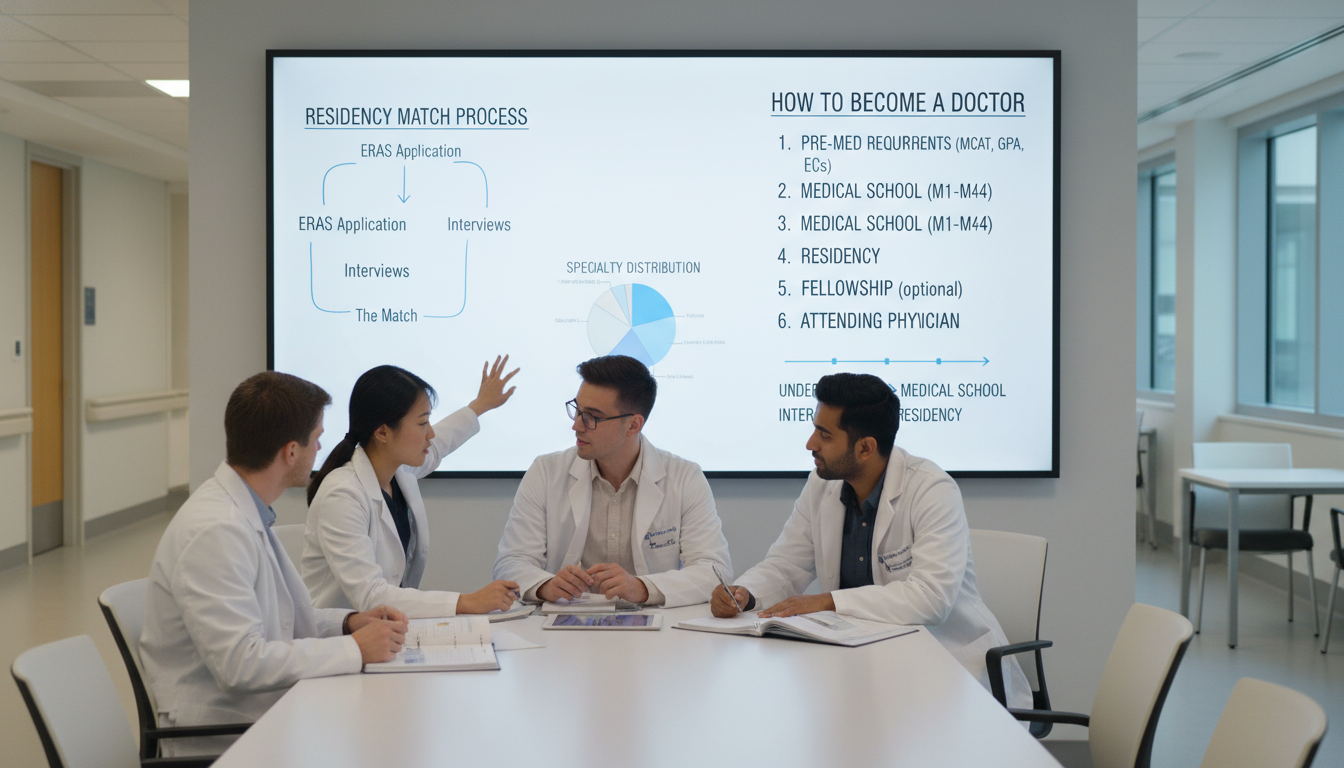
The Big Picture: How to Become a Doctor
The broad sequence in the United States looks like this:
Undergraduate (Premed Years)
- Complete a bachelor’s degree (any major).
- Fulfill core premed requirements (science and non-science).
- Take the MCAT.
- Apply to medical school (AMCAS/AACOMAS/TMDSAS).
Medical School (4 years)
- Pre-clinical: foundational sciences, basic clinical skills.
- Clinical: core clerkships (internal medicine, surgery, pediatrics, etc.).
- Take USMLE Step 1, Step 2 CK (or COMLEX for DO students).
- Decide on specialty and apply to residency through ERAS.
Residency
- Categorical programs: Full training in one specialty (e.g., Internal Medicine, Pediatrics, General Surgery).
- Transitional/Preliminary year: One-year positions, especially for specialties that require one year of internal medicine or surgery before advanced training (e.g., Neurology, Anesthesiology, Radiology, PM&R, sometimes Dermatology).
Fellowship and Practice
- Optional advanced sub-specialization.
- Independent practice as an attending.
Where the Preliminary Medicine Year Fits
A preliminary medicine year (prelim IM) is a one-year internal medicine residency meant to provide a solid foundation in inpatient and outpatient adult medicine. You typically do a prelim IM year when:
- You matched into an advanced specialty (e.g., Neurology, Anesthesiology, Radiology, PM&R, Radiation Oncology) that does not include an integrated intern year.
- You are reapplying to residency and need a clinical year.
- You want a strong medicine foundation while deciding on a final specialty.
From a pre-med perspective, you don’t need to choose a prelim year now—but the quality of your pre-med preparation impacts how well you’ll later compete for both advanced specialties and their associated preliminary medicine positions.
Core Premed Requirements: Building a Foundation for Preliminary Medicine
Your premed years are where you quietly set yourself up to be a strong internal medicine intern many years later. Good preparation now translates into clinical reasoning skills, resilience, and competitiveness down the line.
Academic Coursework: More Than Box-Checking
Most medical schools have similar premed requirements, though details vary by institution. Common required or strongly recommended courses include:
- Biology (with labs) – 2 semesters
- General Chemistry (with labs) – 2 semesters
- Organic Chemistry (with labs) – 2 semesters
- Physics (with labs) – 2 semesters
- Biochemistry – 1 semester
- English / Writing-intensive courses – 2 semesters
- Statistics and/or Calculus – 1–2 semesters
- Psychology and Sociology – 1–2 courses (helpful for MCAT and clinical practice)
- Humanities / Ethics – often recommended
For someone eyeing internal medicine or a potential preliminary medicine pathway, it’s smart to focus on:
- Biochemistry and Cell Biology: These forms the foundation of understanding disease mechanisms, pharmacology, and pathophysiology—core to internal medicine.
- Physiology and Anatomy (if available): Frames how organ systems work, which later maps directly onto internal medicine rotations.
- Statistics and Epidemiology (if offered): Internal medicine is evidence-driven; understanding clinical research, risk ratios, and study design will be invaluable.
Actionable tips
- Plan backwards from the MCAT and medical school prerequisites. Create a 4-year course roadmap in your first year of college.
- Front-load core sciences if possible, then take upper-level biologic sciences later that will overlap with medical school content (e.g., Immunology, Microbiology, Pathophysiology).
- Use your science courses not just to get grades, but to practice problem-solving, reading primary literature, and explaining concepts—skills all essential to a good internal medicine resident.
Study Habits That Predict Intern-Year Success
Prelim IM interns juggle high patient volumes, complex medical decisions, and constant learning. The habits that make you a good pre-med student are the same habits you’ll need during your preliminary medicine year:
- Systems-based learning: Organize your studying by organ system (cardio, pulm, renal). This mirrors both Step exams and internal medicine logic.
- Active learning over passive reading:
- Practice questions
- Concept maps
- Teaching peers
- Spaced repetition: Use tools like Anki early. Mastery in MCAT and premed courses through spaced repetition foreshadows how you’ll study for USMLE and in residency.
- Practice explaining complex topics simply: You’ll eventually need to explain atrial fibrillation or sepsis to patients and families. Start by explaining tough science concepts to peers or non-science friends.
Clinical & Service Experience: Early Exposure to the World of Internal Medicine
While you don’t need to decide on a preliminary medicine year as a pre-med, you can shape experiences that align with internal medicine and the skills needed for that intern year.
Clinical Exposure: Make It Medicine-Relevant
Most medical schools expect significant clinical experience—not just shadowing, but direct patient interaction where possible. For a student who might later be drawn to internal medicine or a specialty that often includes a prelim IM year, consider:
- Hospital volunteering on medicine wards
- Patient transport, front desk, unit clerk assistant, or comfort rounding.
- Observe how hospitalist teams function, how residents interact, and how internal medicine handles complex chronic disease.
- Free clinics or community health centers
- Especially internal-medicine style adult clinics.
- Exposure to hypertension, diabetes, COPD, heart failure, and other bread-and-butter internal medicine conditions.
- Shadowing internal medicine attendings
- Inpatient (hospital) and outpatient (clinic).
- Note workflow differences: admissions, daily rounding, consults, longitudinal care.
These experiences help you understand what an intern’s life is like—critical if you later choose a preliminary medicine year.
Actionable tips
- Seek longitudinal clinical roles (6–12+ months) instead of short bursts; residency programs later appreciate sustained commitment.
- While shadowing, ask reflective questions:
- “What do you find most challenging about intern year?”
- “Which pre-med skills helped you most when you started residency?”
- Keep a reflection journal—these notes will later become strong material for personal statements or interviews, particularly if you pursue internal medicine or an advanced specialty requiring a prelim IM year.
Service, Leadership, and Humanism
Internal medicine (and by extension the preliminary medicine year) is deeply about longitudinal relationships, complex decision-making, and systems-based care. Pre-med preparation for this includes:
- Community service in vulnerable populations:
- Homeless outreach
- Food insecurity programs
- Chronic disease education in underserved communities
- Leadership roles:
- Premed club officer
- Free clinic coordinator
- Volunteer coordinator for health-related programs
These experiences teach you to:
- Work in interprofessional teams (mirroring resident–nurse–pharmacist collaboration).
- Advocate for patients beyond the hospital stay.
- Communicate respectfully with people under stress—exactly what you’ll do as a prelim IM intern.
Strategic Premed Planning with the Preliminary Medicine Year in Mind
You don’t need to declare “I want a prelim IM spot” in college, but understanding who typically needs a preliminary medicine year can help you plan smarter.
Who Commonly Needs a Prelim IM Year?
Many advanced residency programs require a separate preliminary or transitional year before you start your specialty training. Common examples:
- Neurology – often requires 1 year of Internal Medicine.
- Radiology (Diagnostic, Interventional) – may require preliminary medicine or surgery.
- Anesthesiology – many programs use a separate intern year.
- Physical Medicine & Rehabilitation (PM&R) – often includes a prelim year.
- Radiation Oncology, Dermatology, Ophthalmology – sometimes require a separate prelim year depending on the program structure.
If you are remotely considering any of these advanced specialties, your pre-med and medical school preparation should aim to:
- Keep doors open to competitive fields (strong grades, solid research where relevant).
- Build a strong internal medicine foundation, because your self-confidence and performance during a prelim IM year will affect your overall trajectory.
Academic and Professional Positioning as a Pre-Med
To remain competitive for both advanced specialties and preliminary medicine programs later:
Aim for a strong GPA, especially in sciences.
- Residency programs, including prelim IM, care about your performance in medical school most, but pre-med performance influences where you get into medical school in the first place.
- Overcoming a rough start is possible, but requires an upward trend and solid MCAT.
Balance breadth and depth.
- Breadth in service, leadership, research, and clinical experience shows you’re well-rounded.
- Depth—sustained involvement in a few areas—looks more like the professionalism expected in residency.
Seek early mentorship.
- Connect with:
- Premed advisors
- Physicians (especially in internal medicine or advanced specialties you may like)
- Residents willing to talk about their prelim year
- Ask them to help you think strategically about:
- MCAT timing
- Gap years (if any)
- Research or clinical jobs that align with your interests.
- Connect with:
From Premed to Medical Student: Laying the Groundwork for a Strong Prelim IM Application
The pre-med period doesn’t end when you hit “submit” on your medical school applications. Residency programs (including preliminary medicine programs) will later look for consistent evidence of certain traits that you can begin fostering now.
Core Competencies That Matter Later
Residency directors value some specific qualities that can be traced all the way back to pre-med years:
- Reliability and professionalism
- Showing up on time, keeping long-term commitments, being honest about mistakes.
- Communication
- Ability to talk with a wide range of people: patients, peers, staff.
- Clear email communication, organized scheduling.
- Teamwork
- Collaborative lab projects, student group leadership, interprofessional service.
- Resilience and adaptability
- Handling heavy course loads, setbacks, test failures with maturity.
You can deliberately practice these as a pre-med by:
- Taking on one or two substantial, long-term responsibilities (e.g., clinic coordinator, research assistant).
- Reflecting after major challenges: “How would an intern handle this?” Then practice that approach.
Research and Scholarly Work
While not mandatory for all specialties, research experience as a pre-med can later help:
- Make you more competitive for advanced specialties that require a preliminary year (e.g., Radiology, Derm, Neuro).
- Build habits of critical appraisal of medical literature, a core internal medicine skill.
As a pre-med, consider:
- Joining a clinical research team (especially in:
- Internal medicine departments (cardiology, pulmonology, endocrinology).
- Neurology, radiology, or anesthesiology labs if you’re curious about those fields.
- Participating in:
- Poster presentations
- Abstract writing
- Even small-scale quality improvement projects
You’re not expected to publish in major journals, but you are expected to demonstrate curiosity, follow-through, and scholarly thinking.

Practical Roadmap: Step-by-Step Premed Advice Linked to Preliminary Medicine
This section walks through key stages from high school to early medical school and connects them to future preliminary medicine options.
Stage 1: Late High School / Early College
- Take challenging science courses (biology, chemistry, if available).
- Focus on study skills, time management, and reading comprehension.
- Start basic shadowing if you can, mainly just to confirm you like medicine.
- Begin reading about how to become a doctor, including:
- Length of training
- Different specialties (including internal medicine and its subspecialties).
- Keep your extracurriculars authentic and sustainable; depth matters more than “padding your resume.”
Stage 2: Middle College (Sophomore–Junior Year)
- Complete most premed requirements:
- Biology, Chemistry, Physics, Organic Chemistry, Biochemistry.
- Prepare intensively for the MCAT.
- Engage in:
- Clinical volunteering (ideally at least one role with consistent patient contact).
- Some exposure to adult medicine settings (outpatient clinics, inpatient units).
- Consider research in a field loosely related to potential interests.
- Begin to observe:
- Difference between internal medicine vs other specialties.
- Which aspects of patient care you find most meaningful (diagnostic puzzles, procedures, long-term follow-up).
Stage 3: Senior Year / Application Phase
- Finalize your medical school applications, emphasizing:
- Evidence of resilience, humanism, and commitment to healthcare.
- Any specific stories from adult medicine contexts that influenced you.
- If you suspect interest in specialties that often use a preliminary medicine year:
- Mention your interest in strong clinical foundations and internal medicine exposure in your personal statement or secondary essays (if authentic).
- If taking a gap year:
- Clinical jobs like medical assistant, scribe, EMT, or research coordinator in an internal medicine setting are particularly helpful.
Stage 4: Early Medical School (Looking Ahead to Prelim IM)
By early M2, you’ll be much closer to making decisions about specialties. To set up your future preliminary medicine options:
- Take your basic science courses seriously; internal medicine is heavy on pathophysiology and pharmacology.
- Seek mentors in:
- Internal medicine
- Any advanced specialty you’re curious about (e.g., Neurology, Radiology).
- During clinical rotations:
- Work hard on your medicine clerkship—your performance and letters from internal medicine will significantly influence both categorical and preliminary medicine applications.
- If you remain interested in specialties requiring a prelim year:
- Learn about the differences between prelim IM, transitional year, and categorical IM.
- Start identifying programs known for strong teaching, supportive culture, and reasonable workloads.
Frequently Asked Questions (FAQ)
1. Do I need to decide on a preliminary medicine year while I’m still a pre-med?
No. The decision to pursue a preliminary medicine year usually happens in late medical school when you apply to residency, not during college. As a pre-med, your goal is to keep as many doors open as possible by:
- Completing all standard premed requirements with strong grades.
- Building a robust record of service, clinical exposure, and professionalism.
- Developing study habits and resilience that will serve you well in any specialty.
However, if you’re already drawn to fields like Neurology, Radiology, or Anesthesiology, it’s wise to prioritize strong internal medicine exposure, as it will form the core of your prelim year.
2. Is there anything I can do in college specifically to prepare for internal medicine?
Yes. While you don’t need to lock into internal medicine now, you can:
- Choose upper-level courses like physiology, immunology, microbiology, or epidemiology.
- Volunteer or work in adult medicine settings (hospital wards, community clinics with chronic disease management).
- Focus on building communication and teamwork skills via leadership roles and community service.
- Cultivate curiosity about systemic disease, diagnostic reasoning, and evidence-based practice—for example, reading patient-oriented case discussions or clinical vignettes.
These choices will later make you more comfortable and effective on your internal medicine clerkship and, if you choose it, your preliminary medicine year.
3. How important are grades and MCAT scores if I might pursue a competitive specialty that uses a prelim IM year?
They are very important. Advanced specialties that commonly require a preliminary medicine year (Radiology, Dermatology, some others) are often highly competitive. To have a realistic chance:
- Aim for a strong science and cumulative GPA.
- Prepare thoroughly for the MCAT, ideally targeting scores at or above the median for your goal schools.
- Once in medical school, prioritize strong performance on pre-clinical exams, core rotations (especially internal medicine), and USMLE/COMLEX.
Premed performance doesn’t directly affect residency applications, but it strongly impacts which medical schools you get into—and those, combined with your performance once there, will shape your competitiveness for both advanced specialties and high-quality preliminary medicine programs.
4. If I already know I want family medicine or pediatrics, do I need to care about the preliminary medicine year?
Probably not in a direct way. Family medicine and pediatrics usually offer categorical positions, meaning you do your internship and full residency training in the same program without a separate preliminary year.
However, the same pre-med preparation that benefits someone eventually doing a prelim IM year—strong science foundation, communication, service, and resilience—will also help you:
- Succeed in medical school.
- Excel on your clinical rotations.
- Become a better physician in any field.
So even if you never apply for a preliminary medicine position, the steps outlined in this guide will still be highly relevant to your long-term success.
By understanding how pre-med decisions cascade into medical school and eventually into choices like a preliminary medicine year, you can approach your preparation with more intention. Focus on mastering your coursework, building genuine clinical and service experiences, and developing the professional habits that intern-year residents rely on daily. These efforts will serve you well—regardless of which specialty or training pathway you ultimately choose.