
Understanding Residency Burnout in Emergency Medicine–Internal Medicine
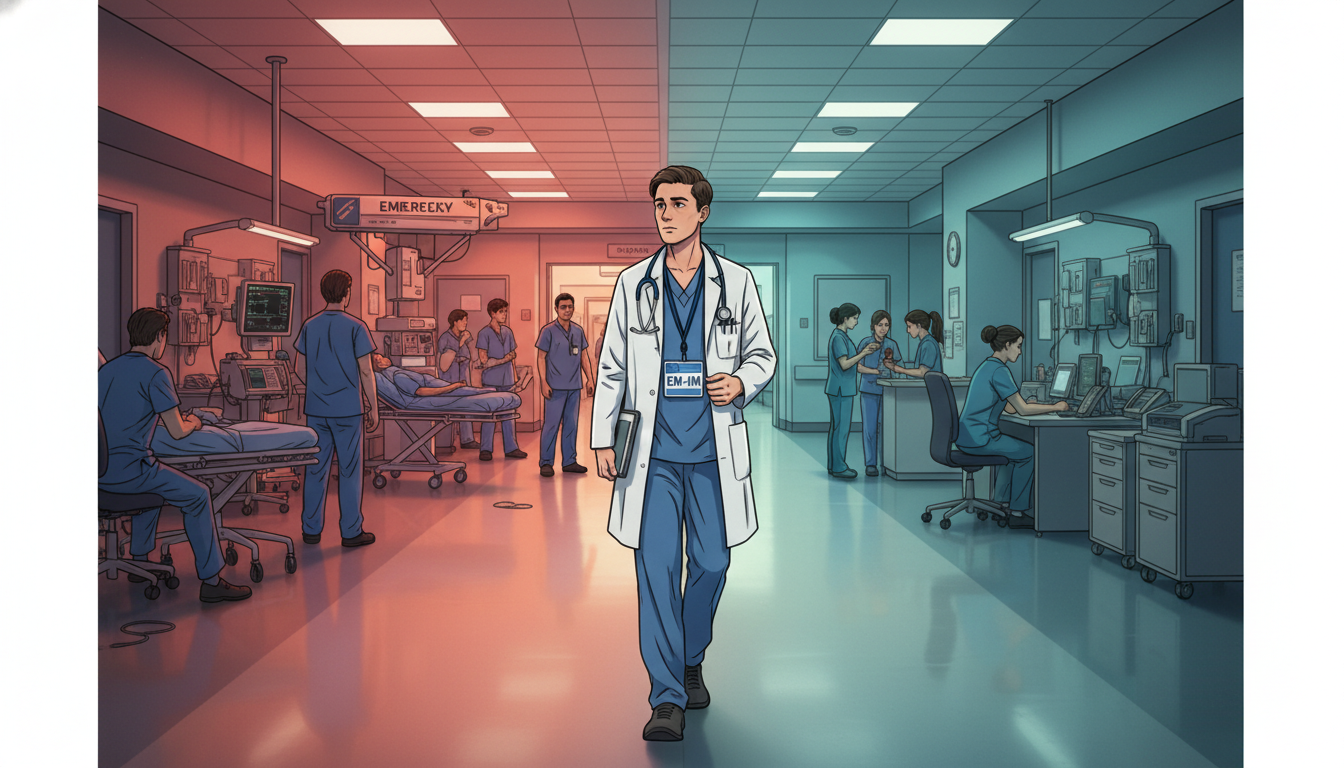
Emergency Medicine–Internal Medicine (EM IM combined) residency is one of the most demanding training pathways in medicine. You are effectively learning two specialties, navigating two cultures, and splitting your time between two high‑stakes clinical environments. That dual identity is a strength—but it also puts you at elevated risk for residency burnout.
Burnout is more than just “being tired.” It is a work‑related syndrome characterized by:
- Emotional exhaustion (feeling drained or “used up”)
- Depersonalization (cynicism, irritability, or detachment from patients)
- Reduced sense of personal accomplishment (feeling ineffective or “not good enough”)
In the context of an emergency medicine internal medicine combined program, the risk factors multiply:
- Workload intensity: EM shifts plus IM ward months, ICU blocks, nights, and cross‑cover.
- Role switching: Rapidly alternating between ED and inpatient mindsets, EM and IM expectations, different documentation and workflow norms.
- Schedule fragmentation: Irregular hours, circadian disruption, and frequent transitions.
- Identity strain: Being “the EM‑IM resident” may mean extra consults, expectations, or pressure to perform in both domains.
- Hidden curriculum: Subtle messages that self‑sacrifice is heroic and asking for help is weakness.
Understanding this context is the first step in medical burnout prevention. Burnout is not a personal failure; it is a predictable response to chronic, unmitigated stress in a high‑demand system. The goal of this guide is to give you a structured, practical approach to residency burnout prevention tailored to EM‑IM combined training.
Why EM–IM Residents Are Especially Vulnerable (and Especially Powerful)
The same things that put EM–IM residents at risk for burnout also position you to become leaders in physician burnout prevention.
Unique Stressors of EM–IM Combined Training
Cognitive and emotional switching costs
- In the ED you think in terms of rapid risk stratification, ruling out the worst first, and high‑throughput decision‑making.
- On the wards or in clinic you think more about diagnostic refinement, long‑term management, and nuanced goals of care.
Flipping between these modes multiple times per month (or even within the same week) is mentally taxing and can feel disorienting.
Double the responsibility, double the expectations
- Faculty may assume you’re “strong” or “self‑sufficient” because you chose a combined program.
- Co‑residents may lean on you for cross‑disciplinary questions (“You’re EM‑IM, what would you do if…?”).
- You might feel pressure to say “yes” to extra shifts, committees, or leadership roles because you’re “built for the grind.”
Schedules that push physiological limits
- EM shifts that rotate days–evenings–nights.
- IM ward months with 28‑hour calls or night float, plus ICU rotations.
- Inadequate recovery time between blocks or transitions from nights to days.
Fragmented social and support networks
- You belong to both the EM and IM departments—but may feel fully “at home” in neither.
- Conferences, retreats, and wellness events can conflict between departments.
- You may miss some of the continuity and camaraderie that single‑specialty residents develop.
Unique Strengths of EM–IM Residents
Despite these challenges, EM–IM residents bring skills that are protective against burnout when used intentionally:
- Systems thinking from IM plus rapid pattern recognition from EM.
- High tolerance for complexity and uncertainty.
- Strong communication skills with acute and chronic care teams.
- Experience advocating for patients across the continuum of care.
These are the same competencies needed to advocate for healthier residency systems and evidence‑based medical burnout prevention efforts. If you learn to protect your own well‑being, you can also influence the culture around you.
Recognizing Early Warning Signs of Burnout
Preventing residency burnout starts with early detection. Burnout rarely appears overnight; it often builds gradually. For EM–IM residents, these early signs can be masked by schedule chaos and chronic fatigue, so you need a deliberate self‑monitoring strategy.
Emotional and Cognitive Warning Signs
Irritability or cynicism
- Feeling annoyed by patients’ questions or colleagues’ pages.
- Eye‑rolling at new consults or “social admits.”
- Feeling numb during serious conversations (e.g., code situations, bad news).
Reduced empathy
- Seeing patients as tasks or “dispo problems” rather than people.
- Feeling indifferent to suffering you previously found meaningful to address.
Concentration difficulties
- Re‑reading the same note multiple times.
- Forgetting key details between patients or handoffs.
- Making small but frequent errors (e.g., wrong field in the EMR, delayed orders).
Detachment from purpose
- Thinking “None of this matters” or “I’m just a cog in the machine.”
- Losing excitement about EM or IM that you once felt strongly.
Physical and Behavioral Warning Signs
- Chronic exhaustion that doesn’t improve with a post‑call day.
- Sleep disruption: difficulty falling asleep after shifts, frequent early awakenings, non‑restorative sleep.
- Headaches, GI upset, or frequent minor illnesses.
- Increased reliance on substances: more caffeine, alcohol, or other sleep aids than before.
- Withdrawal from relationships: less time or energy for friends, family, or hobbies.
- Performance changes:
- Avoiding challenging cases or procedures.
- More “sick calls” for non‑specific reasons.
- Procrastinating on notes, scholarly projects, or applications.
A Simple Monthly Self‑Check
Once a month—ideally near your schedule change—ask yourself:
- Energy: Am I more exhausted than I was last month, even after days off?
- Connection: Do I feel connected to my patients, my colleagues, and my reasons for choosing EM–IM?
- Growth: Do I feel I am learning and progressing, or just surviving?
- Control: Do I feel I have any influence over my schedule, workload, or education?
- Joy: Did I have at least a few moments this month where I genuinely enjoyed my work?
If three or more answers consistently trend negative, that’s an early signal to intervene—before burnout becomes entrenched.
Evidence‑Based Strategies for Preventing Burnout in EM–IM Residency
Burnout prevention works best when approached on three levels:
- Individual strategies (what you can control day‑to‑day)
- Interpersonal strategies (how you engage with colleagues, mentors, and family)
- System‑level strategies (how your program and institution can help)
None of these alone is sufficient. You will need to blend them, especially in a demanding emergency medicine internal medicine combined program.
1. Individual Strategies: Protecting Your Core
Sleep: Treat It as a Clinical Priority
Sleep is foundational, particularly with alternating EM and IM schedules.
Anchor sleep windows on off days:
- Choose a 4‑5 hour “protected core sleep” window and keep it as consistent as possible.
- For example, even during nights, aim to sleep between 10:00–14:00 daily, then add naps around it.
Night shift tips for EM blocks
- Use light strategically: bright light at the start of your night shift; wear sunglasses on the way home.
- Keep your bedroom dark, cool, and quiet; consider blackout curtains, eye mask, white noise.
- Avoid large meals, caffeine, and screens close to sleep.
Transitioning between EM and IM
- Ask chiefs or schedulers (early!) to minimize abrupt flips (e.g., last EM night shift immediately followed by IM day wards).
- Plan a “buffer day” with intentional sleep, light exercise, and no major social obligations.
Energy Management (Not Just Time Management)
You can’t control every hour, but you can manage your energy cycles.
- Identify your high‑energy windows (for many, mid‑morning or early shift).
- Use these for high‑cognitive tasks: new consults, procedures, complex discharges, reading.
- Use lower‑energy times for administrative tasks:
- Finish brief notes, order sets, patient callbacks.
- Micro‑breaks during shift:
- 60–90 seconds of standing, stretching, or deep breathing between patients.
- A brief pause to drink water and look away from screens every hour.
Building a Sustainable Recovery Routine
Even on busy rotations, incorporate tiny, consistent recovery habits:
1–2 non‑negotiable micro‑rituals per day, such as:
- 3–5 minutes of guided breathing or mindfulness app in the call room.
- A 10‑minute walk outside before or after shift.
- Journaling 3 bullet points: “one win, one challenge, one gratitude” before bed.
On days off, protect at least one “no‑medicine block”:
- 4–6 hours with no charts, no email, no reading—only restorative activities.
- Communicate this boundary to your partner or close friends so they can support it.
Cognitive Tools to Reframe Stress
Cognitive reframing can reduce the emotional load of EM–IM work:
Replace self‑blame with systems awareness:
- Instead of: “I’m a bad resident; my list is always behind.”
- Try: “This census is unsafe; what can I safely prioritize and what needs escalation?”
Adopt the mindset: “Good enough, reliably, beats perfect, occasionally.”
- Aim for consistent, safe care rather than perfection in every note or decision.
Practice values‑based reflection:
- Once a week, ask: “What did I do this week that aligned with why I chose EM–IM?”
- Write down one specific example: a difficult dispo you navigated well, a chronic disease conversation you handled compassionately, a resuscitation you coordinated effectively.
2. Interpersonal Strategies: Connection as a Protective Factor
Residency burnout prevention is much harder in isolation. EM–IM residents in particular need deliberate connection to both departments.
Build Your EM–IM “Micro‑Community”
If possible, organize a small, recurring EM–IM meet‑up:
- Once every 4–6 weeks, even for 45 minutes.
- Agenda:
- Quick check‑ins: “High/low of the month from EM” and “High/low from IM.”
- Share one practical tip that helped you recently (sleep, sign‑out script, pre‑rounding strategy).
- Identify any shared concerns to bring to leadership.
This provides:
- Peer validation (“It’s not just me struggling with this schedule flip.”)
- Cross‑PGY learning (“Here’s how I handled this in PGY‑1; here’s what I do now in PGY‑3.”)
Invest in Mentorship on Both Sides
Aim for at least:
- One EM mentor
- One IM mentor
- One EM‑IM or dual‑trained mentor (if available)
Use mentorship meetings to:
- Discuss career goals (ED‑based vs hospitalist vs critical care vs administration).
- Strategize about rotation selection and elective planning to avoid overload.
- Problem‑solve around schedule conflicts and wellness challenges.
Bring specific questions:
- “I’m on my third month in a row with nights or ICU—how can I avoid this pattern next year?”
- “I’m struggling with shifting between rapid ED decisions and long IM notes; how did you manage this?”
Communicate Clearly with Family and Loved Ones
They are often your first line of support, but only if they understand your reality.
Before intense blocks (ICU or ED nights), have a brief expectations talk:
- “For the next four weeks, I’ll be more exhausted and less available. It’s not about you. Here are two small ways you could help: [e.g., handling groceries, brief check‑ins by text].”
Share your schedule visually:
- Use a shared calendar or whiteboard that marks:
- Call days
- Post‑call days
- Days off
- This helps others understand that a “day off” after four nights is not the same as a free weekend.
- Use a shared calendar or whiteboard that marks:

System‑Level and Program Strategies: What to Ask For and How to Advocate
While individual strategies are essential, physician burnout is fundamentally a systems problem. As an EM–IM resident, you may feel powerless, but you do have levers you can pull.
Knowing Your Rights and Program Standards
Become familiar with:
ACGME duty hour regulations
- 80‑hour work week (averaged over four weeks)
- Minimum time off between shifts
- Limitations on continuous duty (e.g., 24+4 hours)
Program wellness policies
- Required time for medical appointments.
- Access to mental health resources.
- Policies on schedule changes for family emergencies or illness.
If you are consistently:
- Exceeding duty hours,
- Skipping meals or breaks,
- Working off‑the‑clock to “finish notes,”
this is not just your problem; it is a program‑level issue. Document patterns and raise them respectfully but clearly to chief residents, program leadership, or your GME office.
Constructive Advocacy in Combined Programs
When advocating for changes, frame your feedback in terms of:
- Patient safety
- Educational value
- Program sustainability
Examples:
Instead of:
“This ED‑to‑ICU switch is brutal.”
Try:
“When we finish three consecutive ED night shifts and start ICU days with only a short turnaround, I notice slower cognition and more near‑misses. Could we explore schedule designs that allow an extra recovery day before ICU to support patient safety and resident performance?”Instead of:
“We’re drowning on wards.”
Try:
“Our average census on this IM service has increased by 40% over the last six months. Could we look at adding an advanced practice provider, redistributing admissions, or adjusting caps for EM–IM residents who are coming directly from EM nights?”
You can also participate in:
- Wellness committees
- Residency program councils
- GME safety and quality committees
These venues allow you to contribute EM‑IM perspectives to medical burnout prevention efforts.
Program‑Level Practices That Help Prevent Burnout
If your program is open to change, these are high‑yield targets:
Thoughtful block design for EM–IM residents
- Avoid sequential high‑intensity rotations (e.g., ED nights → MICU → cardiac ICU).
- Build in “buffer” rotations after especially taxing blocks.
Protected wellness half‑days
- Schedule predictable half‑days for medical and mental health appointments.
- Make it culturally acceptable to use them (not just “if you absolutely must”).
Debriefing after critical incidents
- Formal debriefs after codes, mass casualty incidents, or emotionally intense events.
- Include both EM and IM teams when cases cross settings.
Transparent workload and staffing management
- Monitor census, admission rates, and ED volumes.
- Adjust caps or staffing when metrics consistently exceed safe levels.
Creating a Personal Burnout Prevention Plan as an EM–IM Resident
To make all of this practical, translate concepts into a concrete, written plan. Treat this like a clinical care plan—but for yourself.
Step 1: Identify Your Top 3 Risk Factors
Examples for an EM–IM resident:
- Rapid alternation between EM nights and IM day wards.
- Tendency to overcommit to leadership roles.
- Difficulty saying “no” to extra shifts or research projects.
Write them down.
Step 2: Set 3 Specific, Measurable Wellness Goals
Use the SMART framework (Specific, Measurable, Achievable, Relevant, Time‑bound).
Examples:
Sleep goal
“For the next 8 weeks, I will maintain at least one 4‑hour core sleep window on every 24‑hour period, even on my ED night rotation.”Connection goal
“I will schedule one 30‑minute check‑in with my EM mentor and one with my IM mentor over the next two months.”Boundaries goal
“For the rest of this academic year, I will not add new leadership roles or research projects unless I drop or complete one existing commitment.”
Step 3: Build a Weekly Micro‑Routine
Pick 3–5 tiny actions you can integrate even during the busiest months:
- Before each shift:
- 60 seconds of deep breathing in your car or the stairwell.
- Mid‑shift:
- One intentional water break with a brief stretch.
- After each shift:
- A 2‑minute decompression ritual (e.g., jotting down a “mental handoff” of challenging cases and then closing the notebook).
- Once weekly:
- 10 minutes of reading something not related to medicine.
- Once monthly:
- A brief self‑check using the five questions from earlier (Energy, Connection, Growth, Control, Joy).
Step 4: Define Your Early Intervention Triggers
Decide now, while you feel relatively stable, when you will reach out for help. Examples:
If I have two weeks of persistent insomnia, I will:
- Email my PCP or student/resident health to schedule an appointment.
If I feel consistently numb or detached from patients for more than one month, I will:
- Contact the institution’s counseling or psychiatry service.
If I experience a near‑miss or actual safety event related to fatigue or burnout, I will:
- Debrief with my chief resident, program director, or a trusted faculty member within one week.
By pre‑defining these triggers, you reduce the cognitive barrier to taking action when you’re already depleted.
FAQs: Residency Burnout Prevention in EM–IM Combined Programs
1. Is burnout inevitable in an EM–IM residency?
No. High stress is expected; burnout is not inevitable. Many EM‑IM residents experience stress, fatigue, and occasional doubt without developing full‑blown burnout. The difference often lies in:
- Early recognition of warning signs,
- Access to supportive mentors and peers,
- Reasonable program design and workload,
- Active use of medical burnout prevention strategies.
You will have hard months. The goal is to prevent those months from cascading into persistent emotional exhaustion and loss of meaning.
2. How do I know when it’s time to seek professional help?
Consider professional support (counseling, therapy, or medical evaluation) when:
- Symptoms persist for more than a few weeks despite using your usual coping strategies.
- You notice significant impairment (work performance, relationships, sleep, or daily functioning).
- You experience thoughts of self‑harm, hopelessness, or feeling that others would be “better off without you.”
Seeking help is a sign of insight and professionalism, not weakness. Many institutions offer confidential resources specifically for residents.
3. What if my program culture discourages talking about burnout?
This is unfortunately common. In such environments:
- Start with trusted individuals: a particular faculty member, chief resident, or wellness officer who seems approachable.
- Frame your concerns around patient safety and learning rather than personal “complaints.”
- Connect with peers to validate your experience; collective feedback often carries more weight.
- Use institutional channels such as anonymous GME surveys or ombudspersons when needed.
If the culture remains toxic despite efforts to improve it, discuss your options with mentors—including, in extreme cases, transfer or change of setting.
4. Can focusing on wellness hurt my fellowship or job prospects?
Programs and employers increasingly recognize that burned‑out physicians are at higher risk for errors, attrition, and dissatisfaction. Demonstrating that you can:
- Set realistic boundaries,
- Manage your workload sustainably,
- Advocate constructively for safe working conditions,
often makes you a more attractive candidate. You don’t need to advertise personal struggles in applications, but you can certainly highlight your involvement in wellness initiatives or systems‑level physician burnout prevention work as evidence of leadership and maturity.
Residency in emergency medicine internal medicine combined training is demanding—but it does not have to consume you. With intentional strategies at the individual, interpersonal, and systems levels, you can build a career that is not only sustainable, but deeply meaningful. Use this guide as a starting framework, customize it to your reality, and revisit it regularly as you move through the phases of your EM–IM journey.