



Understanding the Psychiatry Fellowship Landscape
Psychiatry residency opens doors to a broad range of subspecialty fellowships. A strong, intentional strategy for your fellowship application can shape not only your psych match for fellowship, but also your long‑term career trajectory in clinical work, research, and leadership.
Common Psychiatry Fellowship Pathways
Most psychiatry fellowships in the U.S. are pursued after completing (or nearly completing) a general adult psychiatry residency (4 years in most programs). Major ACGME-accredited psychiatry fellowships include:
Child & Adolescent Psychiatry (CAP)
- 2 years (often entered via “fast track” after PGY‑3)
- Focus: developmental psychopathology, school consultation, family work, systems of care
Addiction Psychiatry
- 1 year
- Focus: substance use disorders, medication-assisted treatment, consultation in medical and psychiatric settings
Consultation-Liaison (C-L) Psychiatry
- 1 year
- Focus: interface of psychiatry and medicine/surgery, complex comorbidity, delirium, psycho-oncology
Geriatric Psychiatry
- 1 year
- Focus: late-life mood and psychotic disorders, neurocognitive disorders, polypharmacy, systems of care
Forensic Psychiatry
- 1 year
- Focus: mental health and the law, criminal and civil evaluations, correctional psychiatry
Sleep Medicine
- Typically 1 year, interdisciplinary
- Focus: sleep disorders, PSG interpretation, behavioral sleep medicine
Pain Medicine, Brain Injury Medicine, Palliative Care, and others
- Often interdisciplinary, some accessible from psychiatry
There are also non-ACGME fellowships (e.g., women’s mental health, psychiatric research, psycho-oncology, early psychosis, public psychiatry, global mental health) and research fellowships (T32 training grants, VA-funded programs).
Understanding the range of options early helps you align your residency experiences and craft a strategy that makes sense for your goals.
Why Strategy Matters for the Fellowship Match
The fellowship match in psychiatry is generally less cutthroat than the general psychiatry residency match, but top programs and certain subspecialties (e.g., Child & Adolescent at elite institutions, specific forensic programs, research-heavy fellowships) can be highly competitive. A strategic approach matters because:
- Strong applications are built over years, not months.
- Different fellowships value different types of experiences.
- Your choices now (electives, research, mentors) can unlock or limit options later.
- Some fellowships use ERAS fellowship and NRMP match, others use specialty-specific systems or direct offers.
Planning ahead allows you to present a coherent, compelling story instead of a last‑minute assortment of experiences.
Clarifying Your Goals and Timeline
Before you open ERAS or draft a personal statement, you need clarity on what you want and when you want it.
Step 1: Define Your Career Direction
Ask yourself:
Clinical interests
- What patient populations energize you? (e.g., adolescents, older adults, patients with SUD, medically complex patients, justice-involved individuals)
- Do you prefer longitudinal outpatient care, acute inpatient, consultative work, or procedural/technical skills (e.g., ECT, neuromodulation, sleep studies)?
Academic vs. community career
- Are you aiming for academic psychiatry (teaching, research, leadership) or primarily clinical/community practice?
- Academic programs often value research, teaching, and evidence of scholarly productivity more heavily.
Lifestyle and setting
- Geographic preferences (city vs. suburban vs. rural).
- Tolerance for call schedules, weekend coverage, and consult volume.
- Interest in policy/administration, advocacy, or leadership roles.
Board certification and recognition
- Some subspecialties offer formal subspecialty board certification (e.g., CAP, C-L, Addiction, Geriatric, Forensic).
- Others are niche but may not require fellowship (e.g., women’s mental health) depending on your long‑term goals.
Write out a one-paragraph “future self” description:
“In 5–10 years, I see myself as a _____ psychiatrist working in _____ setting, with a focus on ____ and ____.”
Use this to check alignment with potential fellowships.
Step 2: Know the Application Timelines
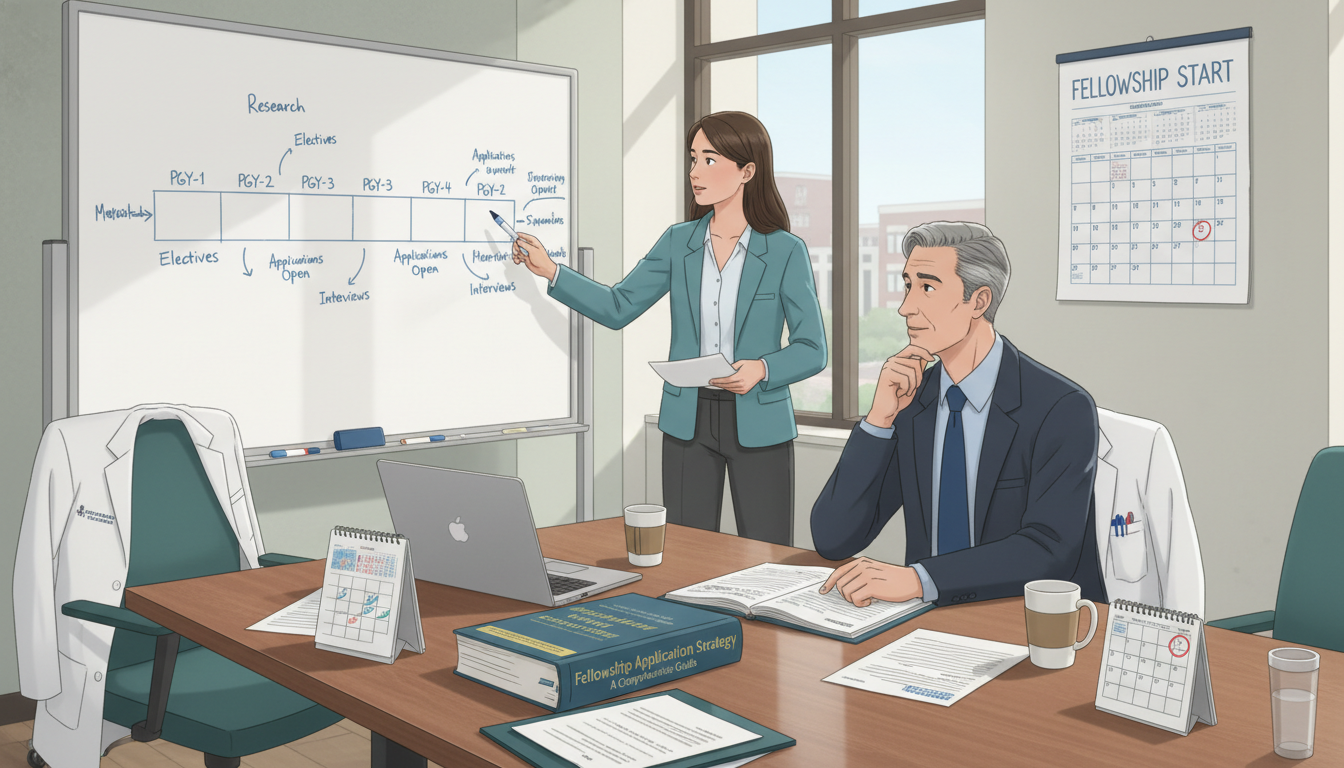
Timelines vary by subspecialty and year, but a general pattern for ACGME-accredited fellowships using ERAS fellowship and NRMP looks like:
PGY‑2 / early PGY‑3
- Explore subspecialty clinics and electives.
- Start or join relevant research or quality-improvement (QI) projects.
- Seek mentors in your area of interest.
Mid‑PGY‑3
- Clarify subspecialty interests.
- Identify letter writers.
- Polish your CV, consider presentations/publications.
- Investigate programs and application requirements.
Late PGY‑3 to early PGY‑4
- ERAS fellowship applications often open in late spring.
- Programs receive applications starting summer.
- Interviews typically occur late summer through fall.
- Fellowship match (NRMP or specialty match) takes place in late fall or winter.
PGY‑4
- Final interviews and match outcomes.
- Ranking programs and signing contracts (if outside the match).
Child & Adolescent Psychiatry (fast track)
CAP is unique because many apply during PGY‑3 to start fellowship instead of doing PGY‑4. This alters your timeline:
- You’ll need to explore CAP early (PGY‑2).
- Programs may expect clear commitment and potentially more mature letters earlier.
Check each subspecialty’s and program’s timelines through:
- ERAS and NRMP websites
- Specialty organizations (AACAP, AAPL, AAAP, AAGP, ACLP, etc.)
- Program websites and coordinators
Building a Competitive Fellowship Profile During Residency
Your eventual fellowship application is a snapshot of your entire residency. Competitive fellows often build a cohesive narrative that aligns clinical work, scholarly activity, and mentorship with their chosen subspecialty.
Foundational Elements for All Psychiatry Fellowships
Regardless of subspecialty, programs will look at:
Clinical Performance and Evaluations
- Strong In-Training Exam performance is helpful but not usually decisive.
- Rotation evaluations matter, especially in relevant settings (e.g., C-L rotations for C-L fellowship).
- Professionalism, reliability, and collaboration are heavily weighted through narrative comments.
Letters of Recommendation
- Typically 3–4 letters, including:
- Program Director (often required)
- At least one subspecialty-aligned faculty member
- Additional letter from a supervisor who knows your clinical strengths well
- Start cultivating meaningful clinical relationships by being engaged, proactive, and open to feedback.
- Typically 3–4 letters, including:
Scholarly Activity
- QI projects, poster presentations, case reports, and research all help, especially at national meetings.
- Even if you don’t pursue a research fellowship, scholarly activity signals curiosity and initiative.
Leadership and Teaching
- Chief residency, committee involvement, resident wellness initiatives, or curriculum development can stand out.
- Teaching medical students and junior residents is highly valued in academic settings.
Professional Reputation
- Psychiatry is a small world. Word-of-mouth from faculty, program directors, and conference contacts can subtly influence how your application is perceived.
Tailoring Experiences to Specific Subspecialties
Child & Adolescent Psychiatry
- Seek CAP electives early, including:
- Outpatient child clinic
- School-based services
- Inpatient child/adolescent units or PHP/IOP
- Join projects related to:
- ADHD, autism, mood/anxiety in youth, school interventions, trauma-informed care
- Attend AACAP or local child psychiatry meetings if possible.
- Develop competence and comfort working with families and systems (schools, child welfare, juvenile justice).
Addiction Psychiatry
- Prioritize:
- Rotations in addiction consult services, methadone/buprenorphine clinics, dual-diagnosis units.
- Waiver training (e.g., buprenorphine), naloxone training, and advocacy projects.
- Involvement in:
- AAAP conferences or similar societies.
- Research or QI related to overdose prevention, integrated addiction treatment, or harm reduction.
Consultation-Liaison Psychiatry
- Maximize:
- C-L rotations, transplant psychiatry, psycho-oncology, HIV psychiatry, ICU consults.
- Seek:
- Opportunities for medically complex case presentations.
- Scholarly work in delirium prevention, collaborative care, or capacity evaluations.
- Show comfort in medical comorbidity, interface with multiple specialties, and hospital systems.
Geriatric Psychiatry
- Focus on:
- Rotations in geriatric clinics, memory clinics, nursing home/long-term care, VA geriatric systems.
- Projects in:
- Dementia care, late-life depression, psychopharmacology in older adults, polypharmacy, caregiver burden.
- Demonstrate skills in collaborating with families, primary care, and neurology.
Forensic Psychiatry
- Gain exposure to:
- Forensic didactics, expert witness workshops, correctional psychiatry rotations.
- Court observations or structured evaluation experiences (e.g., competency, risk assessment).
- Join:
- AAPL events or local forensic interest groups.
- Consider:
- Research or writing in ethics, criminal responsibility, risk assessment, or civil commitment.
Sleep Medicine, Pain Medicine, Palliative Care, Other Interdisciplinary Fellowships
- Seek cross-disciplinary rotations (neurology, pulmonary, anesthesiology, oncology).
- Pursue projects in:
- Insomnia and CBT‑I (sleep)
- Interdisciplinary pain management, opioid stewardship (pain)
- Depression/anxiety in serious illness, existential distress (palliative)
- Show you can navigate and collaborate within multidisciplinary teams.
Mastering the Fellowship Application Process (ERAS & Beyond)
Once you’ve built a solid foundation, the emphasis shifts to presenting your profile effectively. This is where the fellowship application strategy becomes very concrete.
ERAS Fellowship Application Essentials
Many psychiatry fellowships now use the ERAS fellowship platform. Key components typically include:
Application Form and CV
- Ensure dates and roles are consistent.
- Emphasize:
- Psychiatry‑specific experiences relevant to the fellowship.
- Leadership, teaching, QI, and research.
- Avoid long lists of minor activities; highlight a few impactful roles.
Personal Statement
- Purpose:
- Tell a coherent story of why this subspecialty.
- Demonstrate readiness and insight into the field.
- Structure:
- Brief opening narrative (a clinical moment or trajectory, not a dramatic anecdote).
- Development of your interests (clinical + scholarly + personal influences).
- Concrete examples: key rotations, projects, mentors.
- Career goals: what you hope to do post-fellowship and how this fellowship bridges the gap.
- Tone:
- Professional, reflective, honest.
- Avoid overdramatization or overly generalized passion statements (“I just love helping people”).
- Purpose:
Letters of Recommendation
- Ask early (3–4 months before deadlines).
- Provide:
- Updated CV
- Draft of your personal statement
- Bullet points of cases or projects you did with them
- Politely request specific, detailed letters highlighting:
- Your clinical maturity
- Reliability and teamwork
- Skills relevant to that subspecialty
Program Signaling (if applicable)
- Some subspecialties are experimenting with signaling on ERAS.
- Use signals on programs you would be genuinely excited to match at, especially where you might otherwise blend in.
Supplemental Materials
- May include:
- Writing sample (for forensic)
- Case write‑ups or de-identified reports
- List of scholarly work with PDFs or abstracts
- May include:
Applying Outside ERAS: Specialty-Specific Processes
Not all psychiatry fellowships use ERAS or the NRMP fellowship match. Some:
- Use institution-specific portals
- Use the San Francisco Match (historically in some subspecialties)
- Or accept applications via email to the coordinator
Your strategy:
- Create a program spreadsheet listing:
- Application platform (ERAS, SF Match, institutional)
- Deadlines
- Required documents
- Contact info and notes
- Start earlier for non-ERAS programs since processes are less standardized.
Strategically Selecting Where to Apply
Factors to consider:
- Program reputation and training content
- Does the curriculum match your goals? (e.g., strong psychotherapy focus for CAP vs. strong systems/advocacy vs. research)
- Faculty interests and mentorship
- Do faculty share your subspecialty and research interests?
- Clinical volume and diversity
- Will you see enough complexity and variety to feel competent at graduation?
- Research infrastructure (if relevant)
- Access to mentors, protected time, and funding.
Be realistic and balanced:
- Include a mix of:
- “Reach” programs (highly prestigious, very competitive)
- “Target” programs (solid fit, typical applicant profile)
- “Safety” programs (likely matches where you could still be happy)
Most applicants to psychiatry fellowships do not need to submit dozens of applications; 10–20 is common, though this varies by subspecialty and competitiveness.

Excelling in Fellowship Interviews and the Match
Once interviews arrive, the focus shifts from documents to interpersonal fit, professionalism, and clarity of your goals.
Preparing for Fellowship Interviews
Know Your Application
- Be ready to discuss:
- Key cases from your rotations (maintaining confidentiality).
- Your research and what you actually did (methods, your role, limitations).
- Any gaps, leaves, or changes in your training path.
- Be ready to discuss:
Research Each Program
- Review:
- Program website (curriculum, call, rotation sites).
- Faculty bios aligned with your interests.
- Recent publications or projects in your area.
- Prepare specific questions that show you’ve done your homework.
- Review:
Common Interview Questions You can expect variations on:
- “Why this subspecialty?”
- “Why our program?”
- “Tell us about a challenging clinical case and how you handled it.”
- “Describe a time you received critical feedback and how you responded.”
- “What are your long-term career goals?”
- “What do you see as the biggest challenges in this field going forward?”
For forensic or C-L, ethical and boundary questions are more common. For CAP, questions about family dynamics, systems of care, and development may be emphasized.
Your Questions for Them Ask substantive questions about:
- Structure of supervision and teaching.
- Typical fellow responsibilities and autonomy.
- Exposure to specific patient populations.
- Opportunities in research, QI, leadership, or teaching.
- Support for board exam preparation and career placement.
Virtual vs. In-Person Interviews
Many psychiatry fellowships now conduct virtual interviews:
- Test your tech (camera, microphone, connection) beforehand.
- Choose a quiet, well-lit space with a neutral background.
- Professional attire still matters.
- Keep notes nearby but avoid reading verbatim; maintain eye contact.
If in-person:
- Clarify reimbursement policies for travel.
- Use any tours and informal meals to gauge program culture.
- Remember that residents and fellows you meet are often informally asked for feedback about applicants.
Post-Interview Strategy and Rank Lists
After each interview:
- Take notes that day:
- Pros/cons
- Program culture
- Mentorship and clinical opportunities
- Location and lifestyle considerations
- Reflect on:
- Where you felt most at ease.
- Where faculty seemed genuinely interested in your growth.
- How well the program aligns with your 5–10 year vision.
For programs using the fellowship match (NRMP):
- Rank programs in true order of preference, not just perceived competitiveness.
- Avoid over-fixating on name prestige at the expense of fit and day-to-day training quality.
For non-match programs:
- Some will extend offers with short response windows.
- Avoid accepting a position if you’re not sure—ask for a reasonable amount of time to decide.
- Communicate clearly and professionally with programs; don’t “ghost” or hold multiple offers.
Integrating Life, Well-Being, and Long-Term Planning
A good fellowship strategy also factors in your life outside medicine and trajectory beyond training.
Considering Personal and Family Factors
- Geography
- Proximity to partners, family, or support systems.
- Cost of living and housing markets.
- Life events
- Anticipated family changes (marriage, children, caregiving responsibilities).
- Visa and immigration issues
- For international medical graduates, confirm:
- Program’s history with J‑1 or H‑1B sponsorship.
- Any service commitments or waivers.
- Institution’s track record of helping fellows transition to post-fellowship roles.
- For international medical graduates, confirm:
Balanced decisions recognize that fellowship is an intense year (or two), and burnout during subspecialty training can be especially painful if the environment doesn’t align with your needs.
Planning Beyond Fellowship
As you plan your fellowship match, also think about:
- Post-fellowship job market
- Demand for your subspecialty in desired regions.
- Academic vs. community opportunities.
- Board certification
- Requirements for subspecialty boards (cases, practice logs, time limits).
- Scholarship and leadership
- If you see yourself in academic or leadership roles, choose programs with mentorship, protected time, and institutional support.
Building connections during fellowship can position you for:
- Faculty roles at your fellowship institution.
- Affiliated hospitals or partner institutions.
- Specialty clinics or systems (e.g., VA, public mental health systems).
The better you align fellowship training with your long‑term trajectory, the more strategic—and satisfying—your path will be.
FAQs: Psychiatry Fellowship Application Strategy
1. How competitive are psychiatry fellowships compared to general psychiatry residency?
Overall, most psychiatry fellowships are less competitive than the general psychiatry psych match. However, top‑tier programs and certain subspecialties (e.g., some CAP, forensic, or highly research-heavy fellowships) can be very competitive. A well-constructed application with solid clinical performance, aligned experiences, and strong letters usually suffices for most programs, but you’ll need a stronger portfolio for the most prestigious or research-focused positions.
2. Do I need research to match into a psychiatry fellowship?
Research is helpful but not mandatory for many clinically oriented fellowships (e.g., many CAP, addiction, geriatrics, and C-L programs). However, if you’re aiming for academic careers or research-heavy fellowships (T32 positions, top academic centers), having at least some scholarly productivity (posters, case reports, publications) is an advantage. Even a modest project aligned with your subspecialty interest can strengthen your narrative.
3. Should I apply broadly or focus on a small number of programs?
For most psychiatry fellowships, a targeted list of around 10–20 programs is reasonable, adjusted for your competitiveness and subspecialty. Apply broadly enough to ensure options but not so widely that you can’t seriously research or interview with each program. Focus on where there is true alignment between your career goals and the program’s strengths.
4. How important are letters of recommendation compared to other parts of the application?
Letters are very important, often as influential as your CV. A smaller number of strong, specific letters from people who know your work well is far better than multiple generic ones. For many program directors, letters confirming that you are reliable, collegial, clinically solid, and ready for subspecialty-level responsibility carry significant weight—sometimes more than test scores or the sheer number of research projects.
By approaching your psychiatry fellowship application with clear goals, intentional experiences, and a well-organized strategy—from early residency through the ERAS fellowship application and interview season—you place yourself in a strong position to match into a program that will shape your next decade of professional growth.




















