Preparing for psychiatry board exams can feel like a second residency on top of your actual training. Between clinical duties, call, research, and life outside of medicine, choosing the right board exam resources—and using them efficiently—is critical. This guide walks through the major resources for psychiatry residency board prep, how to combine them into a plan, and how your earlier USMLE experience (Anki USMLE decks, UWorld tips, etc.) can inform your strategy for the psych match and beyond.
Understanding the Psychiatry Board Exam Landscape
Before diving into specific board exam resources, it helps to understand which exams you’re actually preparing for and how they differ from prior tests.
Key Exams for Psychiatry Trainees
Most psychiatry residents will encounter, in approximate order:
USMLE/COMLEX (Step 2 CK / Level 2-3)
- Often completed before or early in psychiatry residency.
- Still influences your learning style and how you use tools like Anki and UWorld.
- Performance matters for the psych match and fellowship competitiveness.
PRITE (Psychiatry Resident-In-Training Examination)
- Annual, usually during PGY‑2–4.
- Not “board certification,” but a strong predictor of American Board of Psychiatry and Neurology (ABPN) performance.
- Used by programs for benchmarking, promotion decisions, and identifying weaknesses.
ABPN Psychiatry Board Certification Exam
- Your primary target in late residency or early attending life.
- Computer-based, multiple-choice exam.
- Focused on clinical psychiatry, evidence-based practice, and real-world decision-making.
Psychiatry Subspecialty Boards (if applicable)
- Child & Adolescent, Addiction, Geriatric, Forensic, Consultation-Liaison, etc.
- Build off core psych knowledge, but require targeted resources.
How Psychiatry Boards Differ from USMLE
Many residents approach psychiatry boards as “Step 3 but psych-heavy.” That’s only partly accurate:
- Less raw memorization, more clinical reasoning.
- Heavier emphasis on longitudinal care (e.g., titrating meds over time, managing side effects).
- Psychotherapy, systems, and ethics feature more prominently than on USMLE.
- Less obscure minutiae, more guideline-based practice.
That means you still benefit from board exam resources that resemble USMLE-style Qbanks and flashcards, but you must pivot toward psychiatry-specific clinical application.
Core Study Resources for Psychiatry Boards
This section covers the must-know categories: primary texts, question banks, and structured review tools. Your ideal mix depends on your learning style and time.
1. Question Banks: Your Primary Engine for Learning
For most psychiatry residents, question banks function the same way UWorld did for Step 2 CK—a core learning modality, not just an assessment tool.
What to Look For in a Psychiatry Qbank
- Exam-style stems: clinical vignettes with realistic length and complexity.
- Explanations that teach, not just justify the answer.
- High yield for both PRITE and ABPN boards.
- Good coverage of:
- Psychopharmacology
- Psychotherapy modalities
- Neurocognitive disorders
- Neurology/neuromodulation interfaces
- Cultural and forensic issues
- Ethics and systems of care
Commonly Used Psychiatry Qbanks
While specific brand names may change or new platforms emerge, many residents rely on:
- Large commercial Qbanks with dedicated psychiatry sections
- Often modeled after USMLE-style UWorld questions.
- Use them early in residency to prepare for PRITE.
- Later, reset or filter psychiatry-only questions for board-focused study.
- Board-specific psychiatry Qbanks
- Designed around ABPN content outlines.
- Often include more nuanced questions about practice guidelines and psychotherapy.
Practical Qbank Strategy (Borrowing UWorld Tips)
Use your USMLE UWorld tips and apply them specifically to psychiatry:
- Do timed, random blocks once you have a baseline foundation.
- Treat each question as a learning opportunity, not a test of memory.
- Annotate key concepts into a condensed digital or handwritten “psychiatry boards notebook.”
- Flag high-yield or frequently missed questions and re-do them 2–3 times.
- Leverage incorrects for pattern recognition:
- Do you repeatedly miss questions on bipolar maintenance, clozapine monitoring, or MAOI interactions?
- Those patterns should drive your targeted reading.
Aim for at least 2,000–3,000 psychiatry-relevant questions over the course of PGY‑2–4, combining PRITE prep and final board prep.
2. Standard Textbooks and Core References
Textbooks are not board exam resources you read cover-to-cover during residency; they’re references you sample strategically to deepen weak areas.
Essential References
APA Textbook of Psychiatry
- Comprehensive overview of major diagnoses, treatments, and systems issues.
- Best used for:
- Filling gaps in areas you consistently miss on questions.
- Skimming key chapters before PRITE or boards (e.g., psychopharm, mood disorders).
Kaplan & Sadock’s Concise Textbook of Clinical Psychiatry
- More manageable than the full Synopsis/Textbook.
- Good for:
- Quick reviews of specific diagnoses.
- Clarifying diagnostic criteria and epidemiology.
DSM‑5‑TR
- Not a narrative text, but your gold standard diagnostic reference.
- Review commonly tested areas:
- Criteria for major disorders (MDD, BPD, schizophrenia, PTSD, bipolar).
- Differences between closely related conditions (schizoaffective vs schizophrenia; PTSD vs acute stress disorder).
- Specifiers and time frames.
How to Use Textbooks Efficiently
- Let Qbank errors direct your reading: if you missed three questions on catatonia, read that section in APA Textbook and DSM‑5‑TR.
- For PRITE: identify 3–5 weak domains from prior scores and read those chapters in the months before the exam.
- For boards: focus on:
- Mood, psychotic, anxiety, personality disorders
- Substance use
- Child & adolescent
- Geriatric psychiatry
- Neurologic and neurocognitive disorders
- Somatic therapies (ECT, rTMS, neuromodulation)
You don’t need to be an expert in every chapter; you need to be solid in the top 70–80% of high-yield content.
3. Review Books and High-Yield Outlines
Review books are your bridge between dense textbooks and scattered Qbank explanations.
Typical Options
- Concise psychiatry board review manuals
- Bullet-pointed, organized by diagnosis or topic.
- Often include quick tables for:
- Side effect profiles
- Drug interactions
- Differential diagnoses
- High-yield outlines for PRITE/ABPN
- Condense guideline-level information.
- Useful in the final 6–8 weeks before boards.
How to Integrate Review Books
- During PGY‑2–3
- Skim relevant chapters before or after specific rotations (e.g., addiction, C/L, geriatrics).
- Use as a roadmap to ensure you’re not missing big topics.
- During final board prep (PGY‑4 / early attending)
- Read through the entire review book once.
- Mark areas that feel weak and build flashcards or summary sheets.
- Use it as a spine for your study calendar.
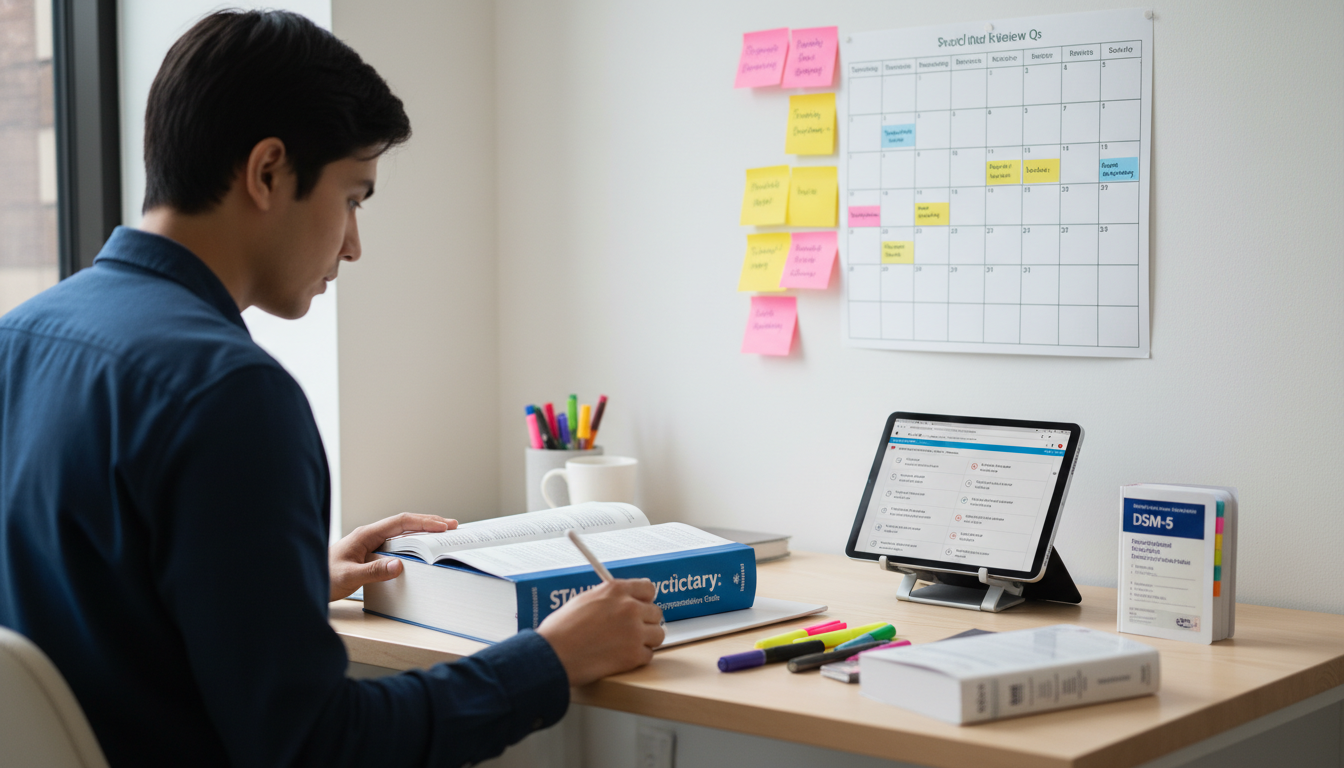
A practical approach is to pair a review book with a Qbank: read a chapter (e.g., schizophrenia) → complete 20–40 questions on that topic → correct and annotate.
4. Flashcards and Spaced Repetition (Anki for Psychiatry)
If you previously used Anki USMLE decks, you already know how powerful spaced repetition can be. The same principles apply in psychiatry, but the focus should shift slightly.
What Works Well in Anki for Psychiatry
- Medication details:
- Mechanisms, indications, contraindications.
- Side effect profiles, black box warnings.
- Monitoring requirements (e.g., lithium, clozapine, valproate).
- Diagnostic criteria and specifiers:
- Enough detail to differentiate disorders.
- Reinforce time frames and required symptoms.
- Psychotherapy modalities:
- Core principles of CBT, DBT, psychodynamic, IPT, supportive therapy.
- Indications and contraindications.
- Risk assessment and management:
- Suicide risk factors, documentation standards, legal issues.
- Involuntary commitment criteria (state-specific concepts may vary on exams).
Building or Choosing Anki Decks
- Some psychiatry-specific Anki decks exist (often built for PRITE or ABPN).
- Many residents create small, targeted decks instead of massive premade ones.
- Use a “less but consistent” approach: 20–50 new cards a day during heavy prep periods.
Using Anki Efficiently
- Convert Qbank explanations and your own mistakes into concise cards.
- Avoid overly long cards; focus on one fact or concept at a time.
- Even 15–20 minutes a day can maintain psychiatry knowledge during busy rotations.
Spaced repetition is especially valuable if your exam is 6–12 months away; it allows low-intensity, high-yield retention that doesn’t rely on cramming.
Digital Tools, Courses, and Structured Programs
Beyond self-directed textbooks and Qbanks, many psychiatry residents benefit from more structured, curated board exam resources.
1. Live and On-Demand Psychiatry Board Review Courses
These courses can be especially helpful if:
- You prefer lectures or audio over reading.
- You have gaps from extended leave, part-time training, or non-traditional paths.
- You’re several years out of residency and re-entering exam mode.
Typical features:
- Lecture series (live virtual or recorded).
- Integrated Qbanks or practice questions.
- Study schedules and faculty office hours.
- Mock exams or self-assessment scores.
How to decide if you need one:
- If your PRITE scores are consistently strong (e.g., >75th percentile) and you are disciplined with Qbanks, you may not need a full course.
- If your program strongly recommends one or funds it, it’s often worth attending.
2. Apps and Audiovisual Resources
- Podcasts and audio lectures
- Great for commutes or workouts.
- Use them for:
- Reviewing psychopharm classes.
- Reinforcing psychotherapy concepts.
- Staying current with guideline changes.
- Clinical guideline apps
- Useful to check dosing, interactions, or monitoring on the go.
- Reinforce best practices that overlap with exam content.
Use these tools as supplements, not replacements, for systematic studying.

Building a Study Plan Across Residency
Resources are only as good as the structure you put around them. Here’s a practical, phase-based approach you can adapt.
PGY‑1: Laying the Clinical and Cognitive Foundation
Focus:
- Clinical competence in general medicine, neurology, and basic psychiatry.
- Efficient habits you’ll later use for PRITE and boards.
Suggested approach:
- Light Qbank work:
- 10–20 psychiatry questions/week beginning in the latter half of PGY‑1.
- Emphasis on fundamentals: mood disorders, psychosis, delirium, substance withdrawal.
- Set up Anki or another spaced repetition system:
- Add key psych pharm facts encountered on call or during consults.
- Read strategically:
- Short sections of concise psychiatry texts tied to your rotations.
The goal is familiarity, not high-intensity board prep.
PGY‑2–3: Heavy Learning and PRITE as a Dress Rehearsal
Focus:
- Use PRITE scores as an early barometer for ABPN readiness.
- Build your board exam resource system (Qbank + review book + spaced repetition).
Suggested approach:
- Regular Qbank usage:
- 10–20 questions/day, 4–5 days/week.
- Switch between tutor mode (learning) and timed blocks (assessment).
- Targeted reading from core psychiatry texts:
- Let PRITE results and Qbank weaknesses guide you.
- Incremental flashcard building:
- Capture each new or corrected concept in Anki.
- Post-PRITE debrief:
- Identify 3–5 specific domains to reinforce over the next year.
By the end of PGY‑3, aim to have done ~60–70% of your planned psychiatry questions and established solid habits.
PGY‑4 and Beyond: Focused Board Prep
Focus:
- Solidifying knowledge.
- Practicing exam timing and endurance.
- Closing final gaps.
Suggested 3–6 month board prep plan:
Months 1–2: Content consolidation
- Read through your chosen psychiatry board review book.
- Complete remaining Qbank questions; reset missed or flagged ones.
- Review key Anki decks daily.
Months 3–4: Intensive Qbank and practice exams
- Shift to more full-length timed blocks simulating test conditions.
- If available, take a formal self-assessment exam and benchmark your performance.
- Fill in remaining gaps with DSM‑5‑TR and core text chapters.
Last 2–4 weeks: Polishing, not cramming
- Focus on:
- High-yield lists (side effects, contraindications, first-line vs second-line).
- Topics you still frequently miss (e.g., neurocognitive disorders, somatic treatments).
- Avoid learning brand new obscure material; refine what you already know.
- Focus on:
Integrating Board Prep with the Psych Match and Career Goals
Even though this article emphasizes board exam resources for the ABPN, your study behaviors begin to matter earlier—during medical school and the psych match process.
How Early Study Habits Impact the Psych Match
- Strong USMLE/COMLEX scores (built through resources such as Anki USMLE decks and UWorld tips) show programs you have test-taking stamina and discipline.
- A track record of solid PRITE performance during residency can support fellowship applications in competitive subspecialties.
- Program directors notice residents who:
- Bring insightful, evidence-based reasoning to case conferences.
- Can explain the “why” behind treatment decisions, not just the “what.”
Using board exam resources thoughtfully from early on helps you become that resident.
Aligning Resources with Future Subspecialty Plans
If you’re considering:
- Child & Adolescent Psychiatry:
- Make sure your board prep includes robust pediatric and developmental content.
- Addiction Psychiatry:
- Focus more deeply on substance use disorders and psychopharmacology relevant to addiction.
- Forensic Psychiatry:
- Pay extra attention to ethics, capacity, involuntary treatment, and legal frameworks.
Your core psychiatry board prep provides the base for all of these—don’t silo them too early.
Frequently Asked Questions (FAQ)
1. How many months do I need to seriously study for the psychiatry boards?
Most residents do well with 3–6 months of structured studying, assuming they engaged consistently with PRITE prep and clinical reading during residency. If you have significant gaps, extended leave, or test anxiety, lean toward the longer end and consider a structured board review course.
2. Can I rely only on Qbanks and skip textbooks for psychiatry boards?
You can pass using primarily Qbanks and a good review book, but textbooks and DSM‑5‑TR are valuable for filling conceptual gaps, especially in areas where you consistently miss questions. Think of textbooks as targeted reinforcements, not cover-to-cover requirements.
3. Do I really need Anki or flashcards if I’m already doing questions?
You don’t need Anki, but spaced repetition helps lock in details that Qbanks alone may not fully cement, especially:
- Medication side effects and interactions.
- Diagnostic criteria time frames.
- Risk and legal concepts.
A small, focused psychiatry deck used consistently is often more effective than trying to review dozens of pages of notes.
4. How different is PRITE preparation from ABPN board preparation?
They overlap substantially. PRITE is:
- More frequent and sometimes slightly more academic or detail-oriented.
- Used for in-training benchmarking.
ABPN boards are:
- More clinically oriented and high-stakes.
- Focused on guideline-informed practice and applied reasoning.
If you treat each PRITE as a mini-board exam—using board-style resources and reviewing results thoroughly—you’ll be in a strong position when the actual boards arrive.
By choosing a small set of high-quality board exam resources and using them deliberately—Qbanks, a concise review book, targeted reading from core texts, and optionally Anki—you can prepare effectively for psychiatry boards while still being present in residency and life. The key isn’t owning every resource; it’s mastering the ones you commit to.